Film Capacitors in Power Electronics
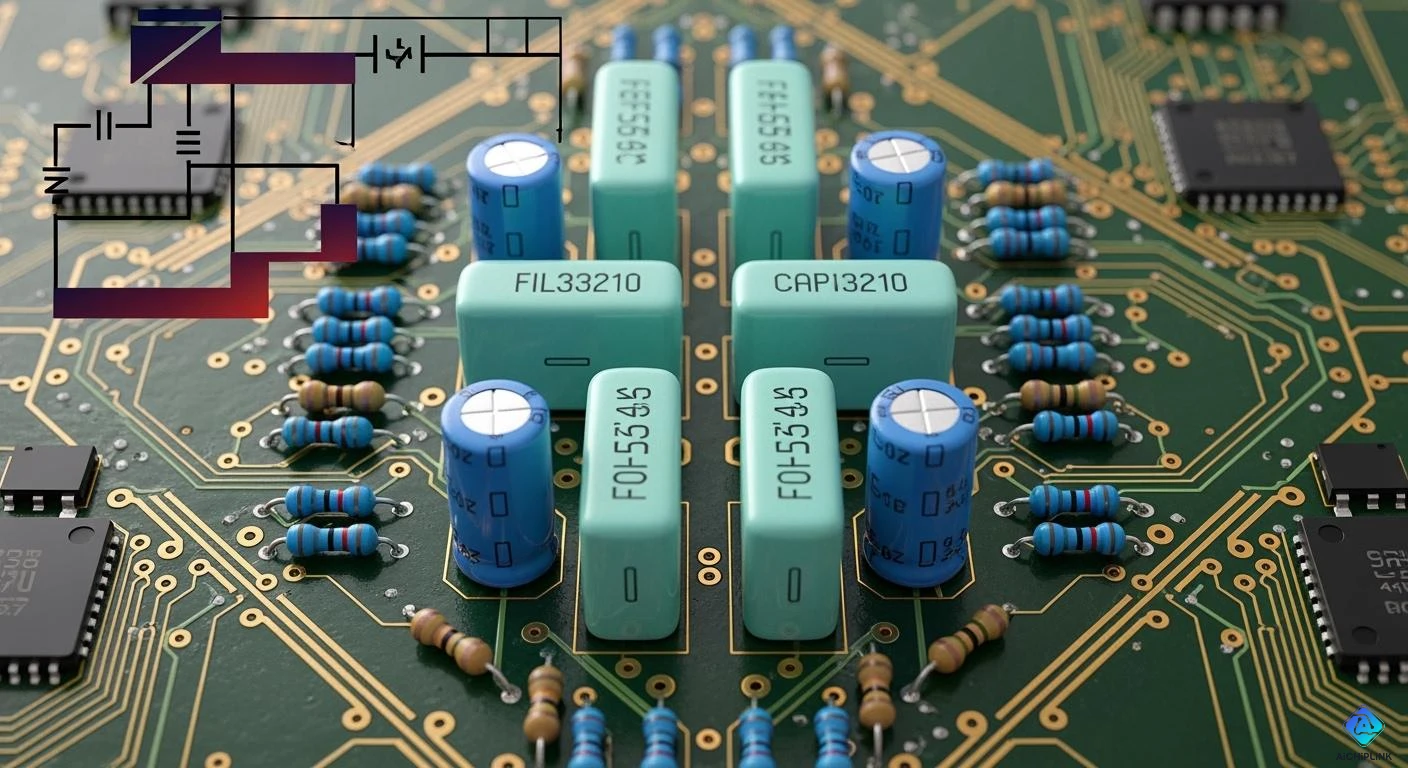
You see film capacitors in lots of power electronics systems. They keep their capacitance steady even when temperatures change. They can last more than ten years without needing any maintenance. These capacitors can handle high voltages. They also resist ripple current and can fix themselves if damaged. The global market for film capacitors grows every year. This happens because industries want reliable and energy-saving solutions.
Key Takeaways
-
Film capacitors are very reliable and can work for over 100,000 hours without needing repairs. This makes them a good choice for power electronics.
-
They can fix themselves if they get damaged. This makes them even more reliable and lowers the chance of problems in circuits.
-
Film capacitors can handle high voltages. They are good at blocking noise, so devices like electric cars and renewable energy systems work well.
Film Capacitors: Characteristics and Function
Construction and Materials
Film capacitors are used in many devices because of how they are made. Manufacturers use thin plastic films for the dielectric. They roll these films with metal electrodes. This design makes short paths for current. Short paths lower the equivalent series inductance (ESL). This means there are fewer losses and better circuit performance.
-
The electrode structure lets both ends touch the winding.
-
Short paths for current lower parasitic inductance.
-
The winding acts like many capacitors in parallel, so losses inside are less.
Different materials are used for the dielectric. Polypropylene and polyester are the most common ones. Each material changes how the capacitor works. Polypropylene is very stable and has low losses. Polyester costs less but has more losses.
| Material | Market Share (%) |
|---|---|
| Polypropylene | 50 |
| Polyester | 40 |
| Polyphenylene sulfide | 3 |
| Paper | 3 |
| Other dielectric | 4 |
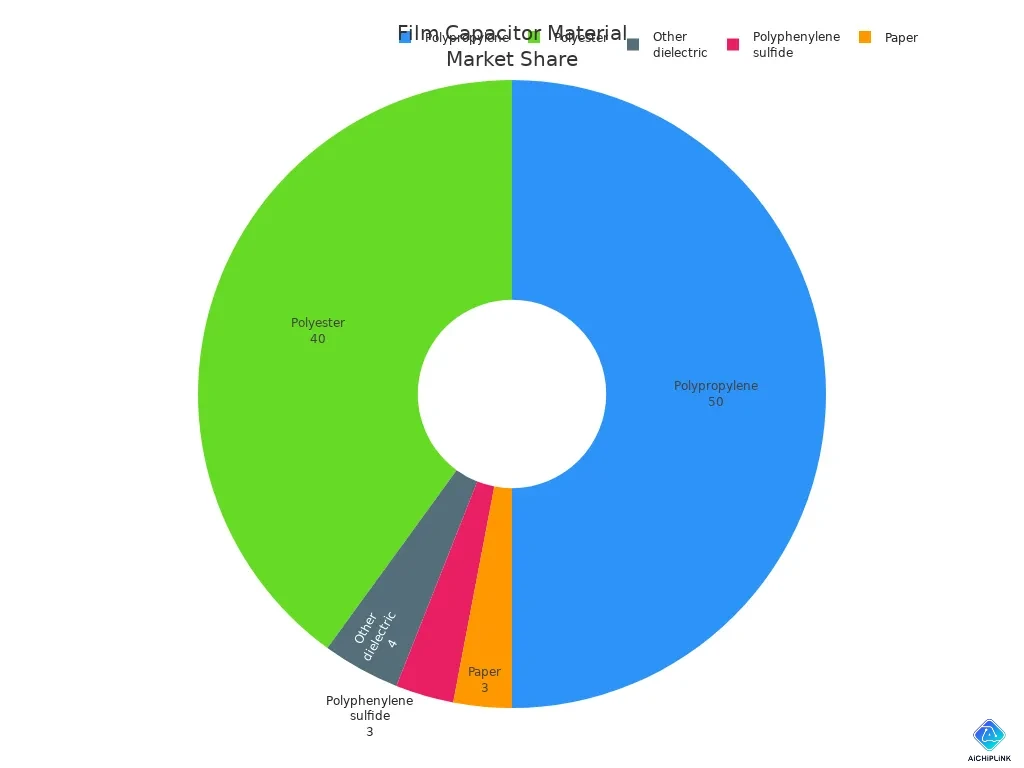
The electrical properties, temperature, and frequency behavior of film capacitors depend on the dielectric material. Polypropylene and polyester are important for how well the capacitor works. They affect capacitance, voltage rating, and stability.
Electrical Properties
Film capacitors are used because their electrical properties stay steady. Their capacitance does not change much when the temperature changes. The dielectric material decides how much the capacitance will shift.
| Stability Class | Temperature Coefficient (α) | Permissible Change of Capacitance |
|---|---|---|
| 1 | ±40 ppm/K | ±(0.5 % + 0.5 pF) |
| 2 | ±100 ppm/K | ±(1 % + 1 pF) |
| 3 | ±160 ppm/K | ±(2 % + 2 pF) |
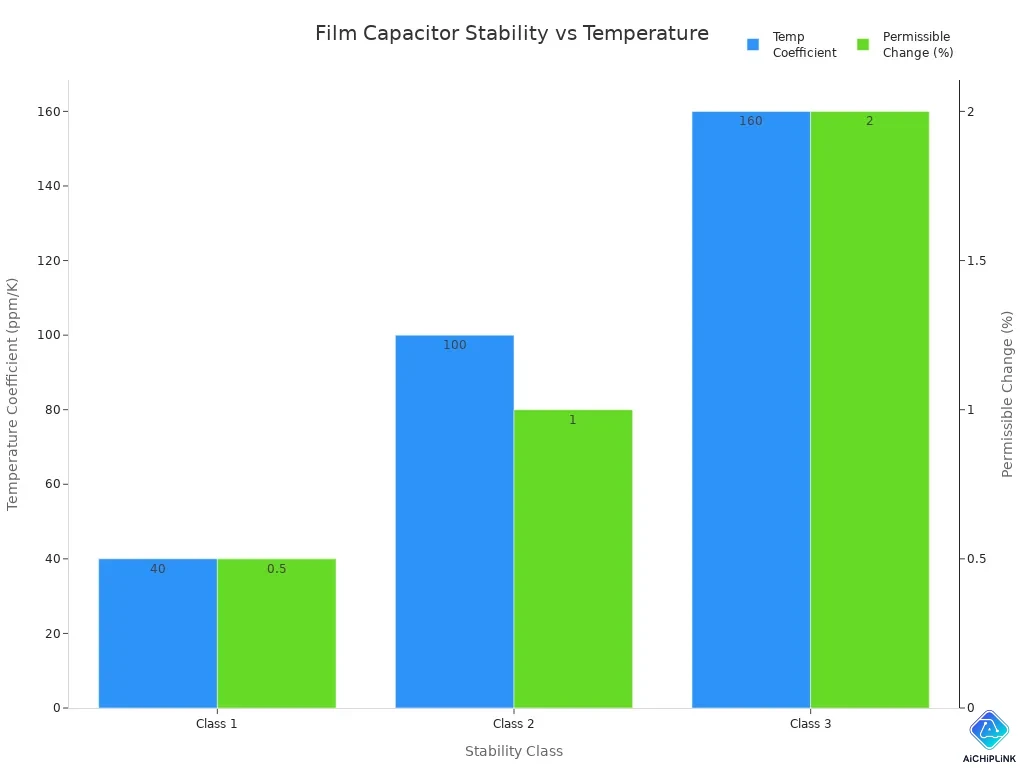
Polypropylene capacitors have a linear, negative temperature coefficient of capacitance of ±2.5% in their range. Polyester capacitors have a positive temperature coefficient. Film capacitors work well over a wide temperature range. They have higher insulation resistance than ceramic and aluminum electrolytic capacitors. This means there are fewer failures and they last longer.
Film capacitors also work well at high frequencies. Polypropylene capacitors have low dielectric losses and high breakdown strength. They are used for high-frequency AC applications. Polyester capacitors have higher dielectric losses, so they are not used in high-frequency circuits.
Self-Healing and Reliability
Film capacitors are trusted because they can self-heal. If a breakdown happens, energy vaporizes the thin metallization near the spot. This makes a metal-free area, turning a short circuit into an open circuit. The capacitor still works, but its capacitance is a little less.
-
The self-healing feature makes them more reliable than foil capacitors.
-
Film capacitors block off damaged spots and keep working.
-
They usually fail open, not short, so there is less risk of fire or too much current.
Film capacitors can last almost forever if used right — often rated at 100,000+ hours with no wear-out. They do not have liquid electrolyte that dries up like aluminum electrolytics (which last 2,000-12,000 hours).
Safety-rated capacitors (X1, X2, Y1, Y2) are mostly film types. They are safer and more reliable. You get fewer failures and longer life in power electronics.
Applications in Power Electronics
Filtering and Noise Suppression
Capacitors are used to block signals you do not want. Film capacitors help lower electromagnetic interference (EMI) and radio frequency interference (RFI). These problems can mess up sensitive circuits. Devices must meet safety and EMC rules, so you need parts that can handle noise for a long time.
EMI/RFI suppression capacitors connect right to the mains voltage. They must survive strong voltages and power surges. That is why international safety rules matter for these parts.
There are two main types of film capacitors for noise control:
-
X Capacitors: These stop noise between the Line and Neutral wires. They help with power factor correction and keep EMI low.
-
Y Capacitors: These stop noise between Line or Neutral and Earth. They give a safe path for high-frequency currents and protect people from electric shock.
Film capacitors are good as bypass and decoupling capacitors. They block high-frequency noise and help circuits work well. You see them in inverter power supplies, motor drives, and renewable energy systems. Their steady performance and high reliability make them a great pick for filtering.
Voltage Stabilization and Smoothing
You need steady voltage in power electronics to keep things safe and efficient. Film capacitors help smooth out voltage changes and block high-frequency noise. They have low ESR, so they can handle big ripple currents without getting hot. This makes them great for high-frequency switching power supplies.
-
You can use film capacitors in resonant circuits and filters.
-
They keep voltage steady, even if the load changes fast.
-
Their high ripple current ability helps stop voltage spikes.
Here is a table showing normal ripple current ratings for film capacitors used in voltage smoothing:
| Ripple Current Rating (Arms) | Capacitance (µF) |
|---|---|
| 10-50 | 100-2000 |
You see these capacitors in high-voltage circuits, like DC links in inverters and converters. Their strong anti-ripple current performance and long life make them reliable for industrial automation and electric vehicles. You can count on them to keep your system working with fewer problems.
Energy Storage
Energy storage lets you save extra energy for later use. Film capacitors store energy in high-voltage circuits, but their energy density is lower than aluminum electrolytic capacitors. For the same rating, an aluminum electrolytic capacitor can be up to ten times smaller than a polypropylene film capacitor.
-
Film capacitors have a lower dielectric constant, so they take up more space.
-
Aluminum electrolytic capacitors are better for small, high-energy storage.
Still, you find film capacitors in many energy storage systems. They work well in rectifiers, power supplies, voltage inverters, and motor drives. You also see them in pulse power uses, like pulsed lasers, where you need fast energy release. In snubber circuits, film capacitors protect semiconductor devices from voltage spikes.
The need for energy-saving solutions is growing. You see more film capacitors in high-frequency power conversion systems, electric vehicles, and renewable energy sources like solar and wind. Manufacturers keep making materials better to make these capacitors even more reliable.
Film capacitors help you handle changing power needs. They cut down energy losses during high-demand times, like speeding up or braking in electric vehicles. Their long life, high insulation resistance, and steady performance make them a smart choice for many power electronics uses.
Capacitors Comparison and Use Cases
Film vs. Electrolytic Capacitors
You pick between film capacitors and electrolytic capacitors. Each one has good and bad points. Film capacitors last a very long time. They stay reliable for many years. Electrolytic capacitors wear out faster. They can break when stressed. Look at the table to see the differences:
| Capacitor Type | Lifespan and Reliability | Temperature Stability |
|---|---|---|
| Film Capacitors | Very reliable and last a long time. Fail less often. | Work well in many temperatures. |
| Electrolytic Capacitors | Do not last as long. Fail more when stressed. | Do not handle temperature changes well. Performance drops in extreme heat or cold. |
Film capacitors can work for over 100,000 hours. They do not need much maintenance. Electrolytic capacitors last from 2,000 to 12,000 hours. You should also think about price. Film capacitors cost more at first. But you spend less money later on replacements and fixing problems. Here is a cost comparison for 20 years:
| Cost Factor | Electrolytic (20-year period) | Film (20-year period) |
|---|---|---|
| Initial capacitor cost | $300 | $1,200 |
| Replacement capacitors (3 changes) | $900 | $0 |
| Replacement labor (3 events) | $3,000 | $0 |
| Unplanned downtime (est. 1 event) | $5,000 | $0 |
| Total 20-year cost | $9,200 | $1,200 |
Limitations and Bulk Capacitance
Film capacitors have some limits. They usually have lower capacitance. This makes them less useful for jobs needing lots of capacitance. Film capacitors are bigger than other types. They take up more space in high-power systems. Engineers use special materials to help with size. These materials give more capacitance without making the device too big.
Real-World Use Cases
Capacitors are used in many power electronics systems. Film capacitors help solar power by keeping DC links steady and lowering voltage ripple. Wind power uses them for power factor correction and EMI filtering. Electric vehicles use film capacitors to smooth voltage and cut electrical noise. This protects important parts and helps the system last longer. Good capacitors with low ESR help manage heat and keep batteries healthy.
International standards like IEC/EN 61071 and IEC/EN 60831-1 help guide how to use capacitors in power electronics. These standards help you pick safe and reliable parts for your projects.
Film capacitors give you lots of good things in power electronics. They last a long time. They can fix themselves if damaged. They handle strong voltages well. But they are bigger and have less capacitance. Look at this table to help you pick the right one:
| Requirement | Recommended Dielectric | Reason |
|---|---|---|
| Best AC performance | Polypropylene (PP) | Lowest losses, best stability |
| Cost-effective | Polyester (PET) | High capacitance per volume |
| High temperature | PEN or PPS | Handles up to 200°C |
Always check the rated voltage. Pick a capacitor with extra safety for your project.

Written by Jack Elliott from AIChipLink.
AIChipLink, one of the fastest-growing global independent electronic components distributors in the world, offers millions of products from thousands of manufacturers, and many of our in-stock parts is available to ship same day.
We mainly source and distribute integrated circuit (IC) products of brands such as Broadcom, Microchip, Texas Instruments, Infineon, NXP, Analog Devices, Qualcomm, Intel, etc., which are widely used in communication & network, telecom, industrial control, new energy and automotive electronics.
Empowered by AI, Linked to the Future. Get started on AIChipLink and submit your RFQ online today!
Frequently Asked Questions
What makes film capacitors different from electrolytic capacitors?
Film capacitors last longer than electrolytic capacitors. They stay stable for many years. They do not dry out over time. You can use them in high-frequency circuits. They also work well in high-voltage circuits.
Can you use film capacitors for energy storage?
Film capacitors can store energy in power electronics. They hold less energy than electrolytic types. But they last longer and work at high voltages.
Why do film capacitors last so long?
Film capacitors do not have any liquid inside. This means there are no leaks or drying out. Their self-healing feature helps them last longer.