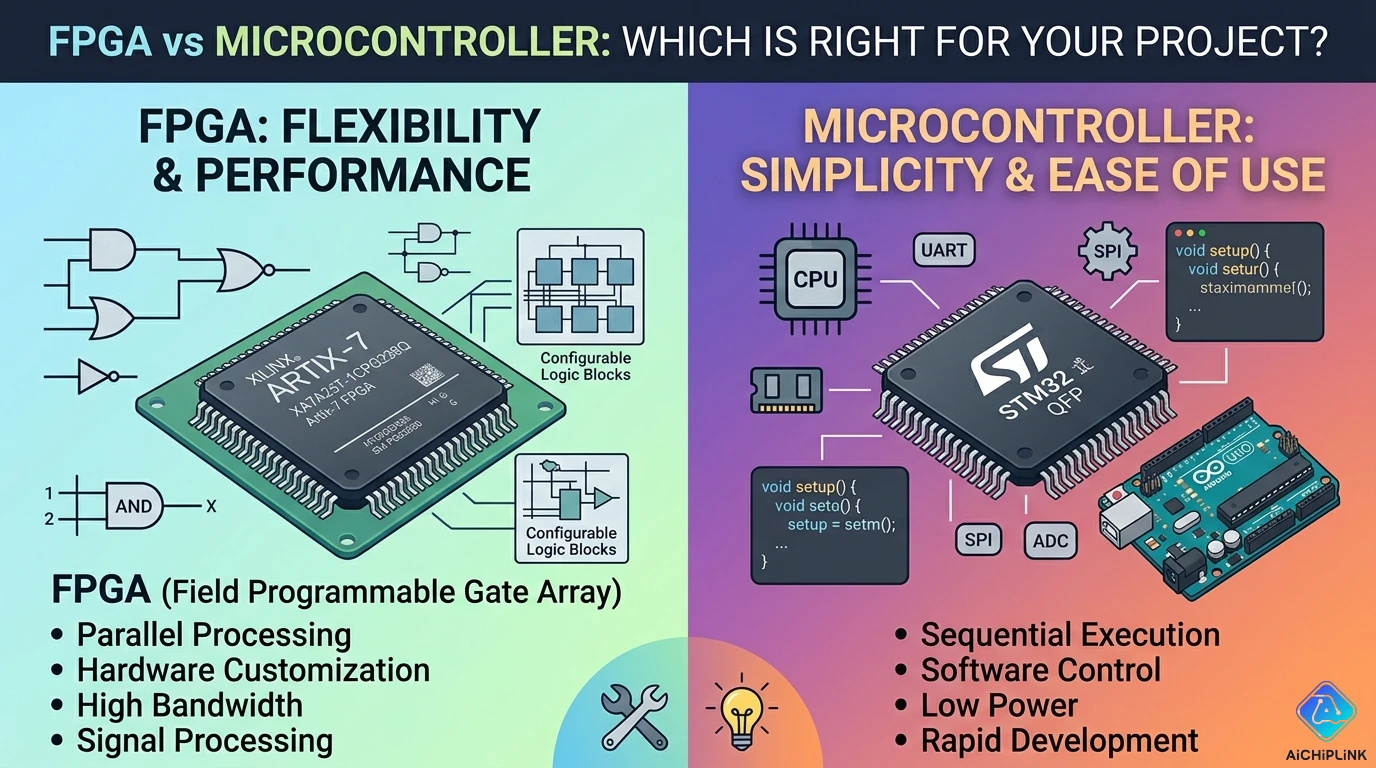
Quick Answer: FPGA vs Microcontroller
| Feature | FPGA | Microcontroller |
|---|---|---|
| Architecture | Programmable hardware | Fixed CPU + peripherals |
| Speed | Extremely fast (parallel) | Moderate (sequential) |
| Flexibility | Maximum (reconfigurable) | Limited (fixed architecture) |
| Power | High (5-50W typical) | Low (0.001-1W typical) |
| Cost | Expensive ($10-1000+) | Cheap ($0.50-20) |
| Learning Curve | Steep (VHDL/Verilog) | Gentle (C/C++) |
| Best For | High-speed processing, parallel tasks | General-purpose control, IoT |
Bottom Line:
- Choose FPGA → Need extreme speed, parallel processing, or custom hardware
- Choose MCU → General control, cost-sensitive, battery-powered
Understanding the Fundamentals
What is a Microcontroller?
Simple Definition: A microcontroller is a small computer on a single chip with CPU, memory, and peripherals.
Architecture:
Microcontroller (Fixed Hardware)
┌─────────────────────────┐
│  CPU (ARM Cortex-M4)    │ ← Fixed processor
│  ├─ 168 MHz clock       │
│  └─ Sequential execution│
│                         │
│  Memory                 │
│  ├─ 512KB Flash (code)  │
│  └─ 128KB RAM (data)    │
│                         │
│  Peripherals (built-in) │
│  ├─ GPIO pins           │
│  ├─ UART, SPI, I2C      │
│  ├─ ADC, DAC            │
│  └─ Timers, PWM         │
└─────────────────────────┘

Execution: Sequential (one instruction at a time)
Speed: MHz range (100-400 MHz typical)
Examples:
- Arduino (ATmega328P)
- ESP32 (Xtensa dual-core)
- STM32 (ARM Cortex-M series)
- PIC (Microchip 8/16/32-bit)
What is an FPGA?
Simple Definition: FPGA (Field-Programmable Gate Array) is a chip you can rewire electronically to create custom digital circuits.
Architecture:
FPGA (Reconfigurable Hardware)
┌─────────────────────────────────┐
│  Logic Blocks (100,000+)        │
│  ┌─┐ ┌─┐ ┌─┐ ┌─┐              │
│  │LB│─│LB│─│LB│─│LB│   ← Each can │
│  └─┘ └─┘ └─┘ └─┘      be any    │
│   │   │   │   │        logic gate│
│  ┌─┐ ┌─┐ ┌─┐ ┌─┐              │
│  │LB│─│LB│─│LB│─│LB│            │
│  └─┘ └─┘ └─┘ └─┘              │
│                                 │
│  Programmable Interconnects     │
│  (Routes signals between blocks)│
│                                 │
│  Block RAM (Memory)             │
│  DSP Blocks (Math units)        │
│  I/O Blocks (External pins)     │
└─────────────────────────────────┘

Execution: Parallel (everything happens simultaneously)
Speed: GHz range internally, 100+ MHz I/O
Examples:
- Xilinx (AMD): Artix, Kintex, Virtex
- Intel (Altera): Cyclone, Stratix, Arria
- Lattice: iCE40, ECP5
- Microchip: PolarFire
Key Differences Explained
Difference 1: Architecture (Sequential vs Parallel)
Microcontroller: Sequential Execution
Task: Read 8 sensors and calculate average

MCU Execution (Sequential):
Time 0ms:   Read Sensor 1 → 1ms
Time 1ms:   Read Sensor 2 → 1ms
Time 2ms:   Read Sensor 3 → 1ms
...
Time 7ms:   Read Sensor 8 → 1ms
Time 8ms:   Calculate average → 1ms
Total Time: 9ms

One operation at a time!
FPGA: Parallel Execution
Task: Read 8 sensors and calculate average

FPGA Execution (Parallel):
Time 0ms:   Read ALL 8 sensors simultaneously → 1ms
Time 1ms:   Calculate average → 0.1ms
Total Time: 1.1ms

Everything happens at once! (8× faster)
Winner: FPGA for parallel tasks, MCU for sequential control
Difference 2: Speed & Performance
Microcontroller:
Clock Speed: 16 MHz (Arduino) to 800 MHz (high-end)
Execution: 1 instruction per clock (ideal)
Performance: 16-800 MIPS (million instructions/sec)

Example (STM32F4 @ 168 MHz):
- 32-bit multiply: 1 cycle (6ns)
- Branch instruction: 2-3 cycles
- Interrupt latency: 12 cycles (71ns)
FPGA:
Internal Clock: Can run GHz internally
Parallelism: 1000+ operations simultaneously
Performance: Equivalent to 10,000+ MIPS

Example (Xilinx Artix-7):
- 1000× 32-bit multiply: 1 cycle TOTAL
- Custom pipeline: Any depth
- Latency: Sub-nanosecond (combinational logic)
Real-World Example:
Image Processing (1920×1080 pixels, 60 FPS)

Microcontroller (STM32H7 @ 480 MHz):
- Grayscale conversion: 50ms per frame
- Maximum FPS: 20 FPS ❌ Too slow

FPGA (Cyclone V):
- Grayscale conversion: 0.5ms per frame
- Maximum FPS: 2000+ FPS ✅ Real-time
Winner: FPGA for high-speed processing
Difference 3: Flexibility & Reconfigurability
Microcontroller:
Hardware: Fixed at manufacturing
CPU: Always ARM Cortex-M4 (example)
Peripherals: Built-in UART, SPI, ADC (fixed)

Change: Reprogram software only
Cannot: Add new hardware (e.g., extra UART)
FPGA:
Hardware: Reconfigurable anytime
Can Become:
- 10 UART controllers (if needed)
- Custom video encoder
- Specialized AI accelerator
- Even a CPU! (soft-core processor)

Change: Reprogram ENTIRE hardware architecture
Can: Create any digital circuit imaginable
Example - FPGA Creating Multiple MCU Peripherals:
Xilinx FPGA Configuration:
┌────────────────────────┐
│ Soft-core CPU (MicroBlaze) ← Acts like MCU CPU
│ + 8 UART ports          ← Normally only 1-2
│ + 4 SPI controllers     ← Normally only 1
│ + Custom crypto engine  ← Not in any MCU
│ + Video encoder         ← Not in any MCU
└────────────────────────┘

All running in parallel!
Winner: FPGA for ultimate flexibility
Difference 4: Power Consumption
Microcontroller:
Active Mode:
- Arduino: 15-30 mW
- ESP32: 160-260 mW
- STM32L4 (low-power): 50 mW

Sleep Mode:
- Deep sleep: 10-100 µW
- Standby: 1-10 µW

Battery Life:
CR2032 coin cell (220 mAh):
- Active 24/7: 1-2 months
- Sleep 99%: 1-2 years ✅
FPGA:
Active Mode:
- Small FPGA: 0.5-2W
- Medium FPGA: 2-10W
- Large FPGA: 10-50W

Sleep Mode:
- Minimal reduction (logic cells idle but powered)
- 50-80% of active power

Battery Life:
CR2032 coin cell:
- Active: Hours ❌
- Not practical for battery operation
Real Comparison:
Task: Sensor data logger (1 year battery life)

Microcontroller:
✅ STM32L4 + CR2032 = 1+ year
✅ Sleep between readings
✅ Perfect for battery operation

FPGA:
❌ Requires wall power or large battery
❌ Overkill for this application
Winner: MCU for low-power, battery applications
Difference 5: Cost
Microcontroller (2026 Pricing):
Entry Level:
- ATtiny85 (8-bit): $0.50
- STM32F0 (32-bit): $1.00

Mid-Range:
- ESP32 (WiFi+BT): $2-4
- STM32F4 (168 MHz): $3-6

High-End:
- STM32H7 (480 MHz): $8-15
- i.MX RT1170 (1 GHz): $10-20

Development:
- Arduino Uno: $25
- ESP32 DevKit: $10
FPGA (2026 Pricing):
Entry Level:
- Lattice iCE40 (1K gates): $5-10
- Xilinx Spartan-7 (12K gates): $15-30

Mid-Range:
- Cyclone V (85K gates): $50-150
- Artix-7 (100K gates): $100-300

High-End:
- Kintex-7 (400K gates): $500-2000
- Virtex UltraScale+: $3,000-20,000+

Development:
- Basys 3 board (Artix-7): $150
- DE10-Nano (Cyclone V): $130
Winner: MCU for cost-sensitive projects
Difference 6: Programming & Development
Microcontroller Programming:
Language: C/C++ (high-level, familiar)
Tools: Arduino IDE, Keil, IAR, GCC
Debugging: JTAG, printf(), LED blinking

Example Code (Blink LED):
void setup() {
  pinMode(LED_PIN, OUTPUT);
}

void loop() {
  digitalWrite(LED_PIN, HIGH);
  delay(1000);
  digitalWrite(LED_PIN, LOW);
  delay(1000);
}

Learning Curve: 1-2 weeks for basics
FPGA Programming:
Language: VHDL or Verilog (hardware description)
Tools: Vivado (Xilinx), Quartus (Intel)
Debugging: Logic analyzer, simulation waveforms

Example Code (Blink LED):
module blink (
  input clk,
  output reg led
);
  reg [24:0] counter;

  always @(posedge clk) begin
    counter <= counter + 1;
    if (counter == 25000000)  // 1 sec at 50MHz
      led <= ~led;
  end
endmodule

Learning Curve: 3-6 months for proficiency
Winner: MCU for ease of development
Head-to-Head Comparison
Comparison 1: Image Processing
Task: Apply blur filter to 1080p video (60 FPS)
Microcontroller (STM32H7 @ 480 MHz):
Performance:
- Single pixel blur: 100 CPU cycles
- Full frame: 207 million pixels
- Time per frame: 43 seconds ❌

Conclusion: Cannot handle real-time
Workaround: Reduce resolution to 320×240
FPGA (Cyclone V):
Performance:
- Parallel pipeline (10 pixels simultaneously)
- Full frame: 2 milliseconds ✅
- Framerate: 500 FPS capable

Conclusion: Easy real-time, headroom for more
Winner: FPGA (250× faster)
Comparison 2: Motor Control
Task: Control 4 motors with PID loops @ 10 kHz
Microcontroller (STM32F4 @ 168 MHz):
CPU Usage:
- PID calculation: 50 cycles per motor
- Total: 200 cycles per loop
- At 10 kHz: 2% CPU usage ✅

Conclusion: Easy, plenty of headroom
Cost: $5 MCU
FPGA (Artix-7):
Resources:
- 4 PID controllers in parallel
- 0.1% FPGA resources used
- Can do 1000 motors if needed

Conclusion: Overkill for this task
Cost: $100+ FPGA + $50 development
Winner: MCU (simpler, cheaper, sufficient)
Comparison 3: Neural Network Inference
Task: Run CNN for object detection (YOLOv3-tiny)
Microcontroller (STM32H7 + CMSIS-NN):
Performance:
- Inference time: 5-10 seconds ❌
- Power: 500 mW
- Throughput: 0.1-0.2 FPS

Conclusion: Too slow for real-time
FPGA (Kintex-7 with custom accelerator):
Performance:
- Inference time: 30-50 ms ✅
- Power: 5W
- Throughput: 20-30 FPS

Conclusion: Real-time capable
Custom IP: Optimized for specific network
Winner: FPGA (100-200× faster)
Note: Dedicated AI chips (Google TPU, NVIDIA) even better
Use Case Recommendations
Choose Microcontroller If:
✅ IoT Sensors & Actuators
- Temperature/humidity logger
- Smart home devices
- Wearable electronics
- Battery-powered sensors
✅ Simple Control Systems
- Motor controllers
- LED displays
- Robotics (hobbyist)
- Home automation
✅ Communication Devices
- WiFi/Bluetooth modules (ESP32)
- Serial interfaces
- Industrial PLCs
✅ Cost-Sensitive Products
- Consumer electronics
- Mass production (millions of units)
- Toys, appliances
Example Projects:
- Weather station ($10 ESP32)
- 3D printer controller ($5 STM32)
- Fitness tracker ($3 nRF52)
Choose FPGA If:
✅ High-Speed Signal Processing
- Software-defined radio (SDR)
- Video encoding/decoding
- High-speed data acquisition
- Oscilloscopes, logic analyzers
✅ Parallel Processing
- Cryptocurrency mining (historically)
- Neural network acceleration
- Financial trading (low latency)
- Scientific computing
✅ Custom Interfaces
- Proprietary protocols
- High-speed serial (10G Ethernet)
- PCIe endpoints
- Camera interfaces (MIPI CSI-2)
✅ Hardware Emulation
- Retro game consoles (MiSTer project)
- Old computer systems
- ASIC prototyping
Example Projects:
- 4K video mixer ($500 FPGA)
- Real-time object detection ($300 FPGA)
- Custom oscilloscope ($200 FPGA)
Performance Benchmarks
Benchmark 1: AES Encryption (128-bit)
| Device | Throughput | Latency | Power |
|---|---|---|---|
| AVR (Arduino) | 0.5 MB/s | 16 ms | 20 mW |
| STM32F4 | 15 MB/s | 0.5 ms | 200 mW |
| STM32H7 (HW crypto) | 120 MB/s | 0.06 ms | 300 mW |
| Artix-7 FPGA | 2,000 MB/s | 0.004 ms | 5W |
Winner: FPGA (16× faster than best MCU)
Benchmark 2: FFT (1024-point)
| Device | Time | Power | Efficiency |
|---|---|---|---|
| STM32F4 | 2.5 ms | 200 mW | 12.5 J/s |
| STM32H7 (DSP) | 0.5 ms | 300 mW | 6 J/s |
| Cyclone V FPGA | 0.01 ms | 3W | 0.3 J/s ✅ |
Winner: FPGA (50× faster, 20× more efficient)
Benchmark 3: GPIO Toggle Speed
| Device | Max Frequency | Note |
|---|---|---|
| Arduino Uno | 100 kHz | Software toggle |
| STM32F4 | 42 MHz | Direct register |
| Artix-7 FPGA | 450 MHz | Hardware logic |
Winner: FPGA (10× faster I/O)
Hybrid Solutions
FPGA + ARM Processor (SoC)
Best of Both Worlds:
Xilinx Zynq (ARM + FPGA):
┌─────────────────────────┐
│ ARM Cortex-A9 (Dual)    │ ← Software (C/C++)
│ 866 MHz CPU             │
│ + Linux OS              │
├─────────────────────────┤
│ Artix-7 FPGA Fabric     │ ← Hardware (VHDL)
│ 85,000 logic cells      │
│ + Custom accelerators   │
└─────────────────────────┘

Use ARM for: Control, OS, networking
Use FPGA for: Signal processing, acceleration
Intel Cyclone V SoC:
ARM Cortex-A9 + Cyclone V FPGA
Examples:
- Industrial vision systems
- Medical imaging
- Automotive ADAS
Decision Matrix
When FPGA is Worth the Complexity:
Score each factor (1-5):

[ ] Speed critical (>100 MHz processing): ___
[ ] Parallel tasks (10+ simultaneous): ___
[ ] Custom protocol/interface: ___
[ ] Budget >$500 for hardware: ___
[ ] Team has FPGA expertise: ___
[ ] Production volume <10,000 units: ___

Total Score: ___

0-10: Use Microcontroller ✅
11-20: Consider FPGA if budget allows
21-30: FPGA strongly recommended ⭐
When Microcontroller is the Right Choice:
Check all that apply:

[✓] Battery-powered required
[✓] Cost per unit <$10
[✓] Simple control tasks
[✓] Production volume >100,000
[✓] Team familiar with C/C++
[✓] Quick time-to-market (<6 months)

If 4+ checked: Microcontroller is best ✅
Real-World Examples
Example 1: Smart Doorbell (IoT Device)
Requirements:
- Camera interface
- WiFi connectivity
- Motion detection
- Battery-powered
Solution: Microcontroller (ESP32-CAM)
- Cost: $10
- Power: 200 mW active, 10 µW sleep
- Camera: Built-in interface
- WiFi: Integrated
- Development: Arduino IDE (easy)
Why not FPGA?
- Overkill for simple image capture
- Power consumption too high for battery
- Cost 10× higher
Example 2: 4K Video Switcher
Requirements:
- 4 HDMI inputs, 1 output
- Real-time switching (<1 frame delay)
- Picture-in-picture mode
- Professional quality
Solution: FPGA (Cyclone V)
- Cost: $300 for board
- Power: 8W
- Latency: <10 ms (0.5 frame @ 60 FPS)
- Custom: HDMI encoder/decoder in FPGA
Why not MCU?
- Cannot process 4K @ 60 FPS (12 Gbps data rate)
- No HDMI 2.0 interfaces
- Insufficient processing power
Example 3: Crypto Trading Bot
Requirements:
- Ultra-low latency (<1 µs)
- Market data parsing
- Decision algorithm
- Order execution
Solution: FPGA (Arria 10)
- Latency: 200-500 ns ✅
- Parallel: Process all market feeds simultaneously
- Advantage: Microseconds matter in HFT
Why not MCU?
- Latency: 10-100 µs (100× slower)
- Lost opportunities in high-frequency trading
Learning Resources
For Microcontroller:
Beginner:
- Arduino tutorials (arduino.cc)
- STM32 CubeMX HAL
- ESP32 examples
Intermediate:
- Embedded C programming
- Real-time operating systems (FreeRTOS)
- Hardware debugging (JTAG)
Time to Productivity: 2-4 weeks
For FPGA:
Beginner:
- "Digital Design" by M. Morris Mano
- FPGA tutorials (nandland.com)
- Vivado/Quartus getting started
Intermediate:
- "FPGA Prototyping by Verilog Examples"
- Timing closure
- High-speed design
Time to Productivity: 3-6 months
Common Misconceptions
Myth 1: "FPGA is always faster" ❌
Reality: Only for parallel tasks. Sequential code runs slower on FPGA than optimized CPU.
Example:
Bubble sort algorithm (single-threaded):
MCU @ 480 MHz: 0.5 ms
FPGA soft-core @ 100 MHz: 2.4 ms

MCU is 5× faster for this specific task!
Myth 2: "FPGAs replace microcontrollers" ❌
Reality: Different tools for different jobs. MCUs dominate IoT, embedded control (99% of market).
Sales Volume (2026):
- Microcontrollers: 30 billion units/year
- FPGAs: 500 million units/year (60× less)
Myth 3: "You need FPGA for AI" ❌
Reality: Dedicated AI chips (TPU, NPU) better. FPGAs = niche (custom models, edge deployment).
Inference Performance:
Task: ResNet-50 (image classification)

MCU (STM32H7): 10 sec/image
FPGA (Kintex-7): 50 ms/image ✅
Google Coral TPU: 3 ms/image ✅✅ (Best)
Future Trends
2026-2030 Predictions:
Microcontrollers:
- AI acceleration (NPU blocks)
- Wireless integration (WiFi 6E, BLE 5.4)
- Sub-$1 with advanced features
- Energy harvesting support
FPGAs:
- AI-optimized architectures
- Lower power (eFPGA cores)
- Easier tools (high-level synthesis from C++)
- Hybrid SoCs more common
Summary & Recommendations
Quick Decision Guide:
Choose Microcontroller (80% of projects):
- General control, sensing, communication
- Cost <$10 per unit
- Battery-powered
- Team familiar with C/C++
Choose FPGA (specialized applications):
- High-speed data processing (>100 Mbps)
- Parallel algorithms
- Custom interfaces
- Budget allows ($100-500+ per unit)
Consider Hybrid SoC:
- Need both flexible software AND hardware acceleration
- Budget $50-200
- Examples: Xilinx Zynq, Intel Cyclone V SoC
Conclusion
Microcontrollers and FPGAs serve different purposes in the embedded systems ecosystem. Microcontrollers excel at general-purpose control, low-power operation, and cost-effectiveness - making them ideal for IoT, consumer electronics, and most embedded applications.
FPGAs shine in specialized high-performance scenarios requiring parallel processing, custom hardware interfaces, or extreme speed - such as video processing, signal analysis, and hardware acceleration.
For 95% of projects, a microcontroller is the right choice. Only when you encounter specific speed, parallelism, or flexibility requirements should you consider the added complexity and cost of an FPGA.
For more embedded systems guides, FPGA tutorials, and microcontroller resources, visit AiChipLink.com.

Written by Jack Elliott from AIChipLink.
AIChipLink, one of the fastest-growing global independent electronic components distributors in the world, offers millions of products from thousands of manufacturers, and many of our in-stock parts is available to ship same day.
We mainly source and distribute integrated circuit (IC) products of brands such as Broadcom, Microchip, Texas Instruments, Infineon, NXP, Analog Devices, Qualcomm, Intel, etc., which are widely used in communication & network, telecom, industrial control, new energy and automotive electronics.
Empowered by AI, Linked to the Future. Get started on AIChipLink and submit your RFQ online today!
Frequently Asked Questions
What is the main difference between FPGA and a microcontroller?
An FPGA is reconfigurable hardware that enables true parallel processing for high-speed tasks, while a microcontroller (MCU) is a fixed-architecture chip that executes instructions sequentially, making it ideal for general-purpose control applications.
Is FPGA always faster than an MCU?
No. FPGAs excel in parallel workloads like signal processing or AI acceleration, but for simple sequential tasks, MCUs are often more efficient, easier to implement, and cost-effective.
Why are microcontrollers better for IoT and low-power devices?
MCUs are designed for ultra-low power consumption and support sleep modes, making them ideal for battery-powered devices like sensors and wearables, whereas FPGAs typically consume much more power.
Why is FPGA development more difficult?
FPGA development requires hardware description languages (HDLs) like Verilog or VHDL to design circuits at the hardware level, which is more complex and has a steeper learning curve compared to MCU programming in C/C++.
Can FPGA and MCU be used together?
Yes. Many modern systems use hybrid SoCs that combine an MCU/CPU for control and communication with an FPGA for high-speed processing, achieving both flexibility and performance.