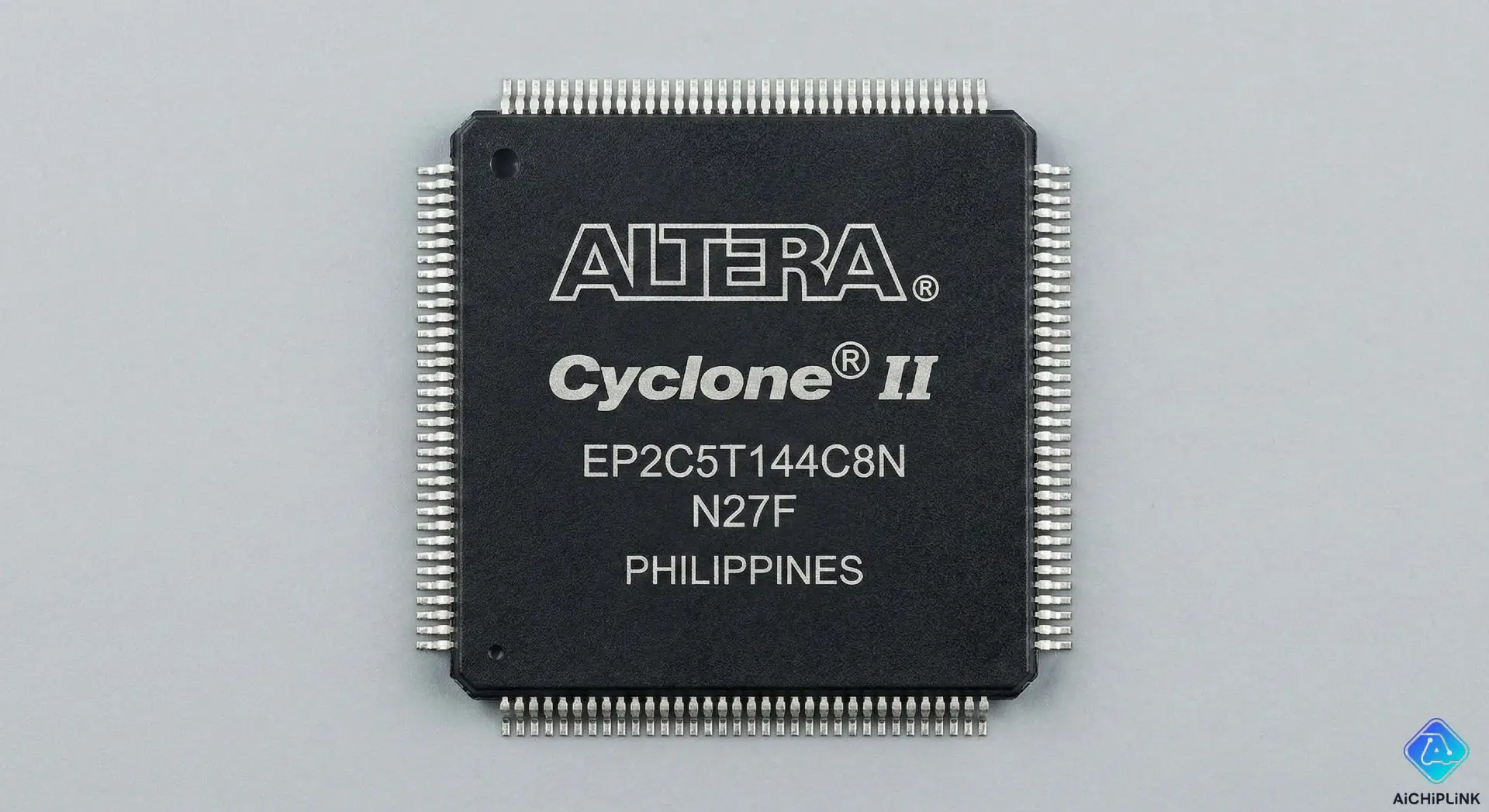
If you have ever bought a low-cost FPGA development board online, chances are it featured the Altera (Intel) EP2C5T144C8N. Despite being a legacy component from the Cyclone® II family, this chip remains the absolute king of the FPGA educational and hobbyist market.
Its popularity stems from a perfect storm of factors: it has enough Logic Elements (LEs) for basic projects (like blinking LEDs, VGA controllers, or simple CPUs), a hand-solderable TQFP144 package, and an incredibly low price point. However, getting started with it in 2024 requires navigating some software hurdles. This guide covers everything you need to know.
EP2C5T144C8N Datasheet & Key Specifications
The EP2C5T144C8N is the smallest member of the Cyclone II family in a 144-pin package.
- EP2C5: Device Type (4,608 Logic Elements).
- T144: Package (Thin Quad Flat Pack, 144 pins).
- C8: Speed Grade (8 is the slowest/standard grade) and Commercial Temp.
- N: Lead-Free (RoHS).
Key Specifications Table
| Feature | Specification |
|---|---|
| Logic Elements (LEs) | 4,608 |
| M4K RAM Blocks | 26 (Total 119,808 bits) |
| Multipliers (18x18) | 13 (Great for simple DSP) |
| PLLs | 2 |
| User I/O | 89 |
| Core Voltage ($V_{CCINT}$) | 1.2V |
| I/O Voltage ($V_{CCIO}$) | 3.3V (LVTTL/LVCMOS) |
Why Cyclone II is Still Popular
While modern FPGAs (like Cyclone 10) are more powerful, they often come in BGA packages that are impossible for hobbyists to solder. The TQFP144 package of the EP2C5 allows for easy probing and PCB design. Furthermore, 4K LEs is the "Goldilocks" size for learning Verilog/VHDL—enough to build a soft-core processor (like NIOS II e-core) but not so complex that compile times are long.
Price Analysis & Availability
Due to its legacy status, finding brand-new stock can be tricky, but it is widely available in the secondary market and on pre-made dev boards.
Note: Sourcing reliable legacy FPGAs is critical to avoid "pulls" or fakes. [Check Stock for EP2C5T144C8N at Aichiplink] to view inventory from verified distributors.
TQFP144 Pinout & Hardware Design
The 144 pins are arranged with 36 pins per side.
Power Supply Requirements
The Cyclone II requires two main voltage rails:
- 1.2V for the Core Logic ($V_{CCINT}$).
- 3.3V for the I/O Banks ($V_{CCIO}$) and PLLs. Design Tip: Most minimal system boards use a simple LDO (like the AMS1117-3.3 and AMS1117-1.2) to generate these voltages from a 5V USB input.
Configuration Circuit (AS vs. JTAG)
The FPGA is SRAM-based, meaning it loses its configuration when power is lost.
- JTAG: Used for debugging and temporary programming. Connects to pins like TCK, TMS, TDI, TDO.
- AS (Active Serial): Used for permanent storage. Requires an external serial flash chip, typically the EPCS4 (4Mbit). When the board powers up, the FPGA automatically reads the configuration from the EPCS4.
Programming Guide: Surviving Legacy Software
This is the most common stumbling block for new users.
The "Quartus 13.0sp1" Rule
Crucial Warning: Modern versions of Intel Quartus Prime (v14.0, v20.0, etc.) DO NOT support the Cyclone II family. To program the EP2C5T144, you must download and install Quartus II Web Edition 13.0sp1.
- This was the last version to include support for Cyclone II.
- It is available for free on the Intel website (requires registration).
USB-Blaster Driver Fixes
Using the official Altera USB-Blaster (or clones) on Windows 10/11 often triggers driver signature enforcement errors.
- Solution: You may need to disable "Driver Signature Enforcement" in Windows Advanced Boot Options to install the legacy drivers located in the
Quartus/driversfolder.
Conclusion
The EP2C5T144C8N is a legend in the FPGA world. While it may not run AI workloads, it remains the best platform for learning the fundamentals of digital logic design, glue logic, and hardware description languages.
Ready to start learning FPGA? Don't let component sourcing hold back your education or prototyping. Visit Aichiplink.com to search for EP2C5T144C8N chips and development resources.

Written by Jack Elliott from AIChipLink.
AIChipLink, one of the fastest-growing global independent electronic components distributors in the world, offers millions of products from thousands of manufacturers, and many of our in-stock parts is available to ship same day.
We mainly source and distribute integrated circuit (IC) products of brands such as Broadcom, Microchip, Texas Instruments, Infineon, NXP, Analog Devices, Qualcomm, Intel, etc., which are widely used in communication & network, telecom, industrial control, new energy and automotive electronics.
Empowered by AI, Linked to the Future. Get started on AIChipLink.com and submit your RFQ online today!
Frequently Asked Questions
Is the EP2C5T144C8N 5V tolerant?
**No.** The maximum absolute rating for input pins is \~4.6V, but recommended operation is 3.3V. Connecting 5V logic (like an Arduino Uno) directly to the FPGA will likely damage the I/O bank. Use a level shifter or a simple voltage divider.
Can I use Verilog and VHDL?
Yes, Quartus II 13.0sp1 supports both Verilog (up to 2001 standard fully, some 2005 features) and VHDL.
How many pins are available for my project?
Out of 144 pins, about **89** are usable I/Os. The rest are dedicated to Power (VCC/GND), JTAG, and Configuration (AS).
What is the clock speed?
FPGAs do not have a fixed CPU speed. The EP2C5 has internal PLLs. A typical "Minimum System Board" comes with a **50 MHz** external crystal oscillator connected to PIN\_17 (CLK0).
Why does my design fail to download?
Check if you are using the correct "Device" in Quartus. Ensure you selected **EP2C5T144C8**. Also, verify if you are programming the FPGA (JTAG) or the Flash (AS).