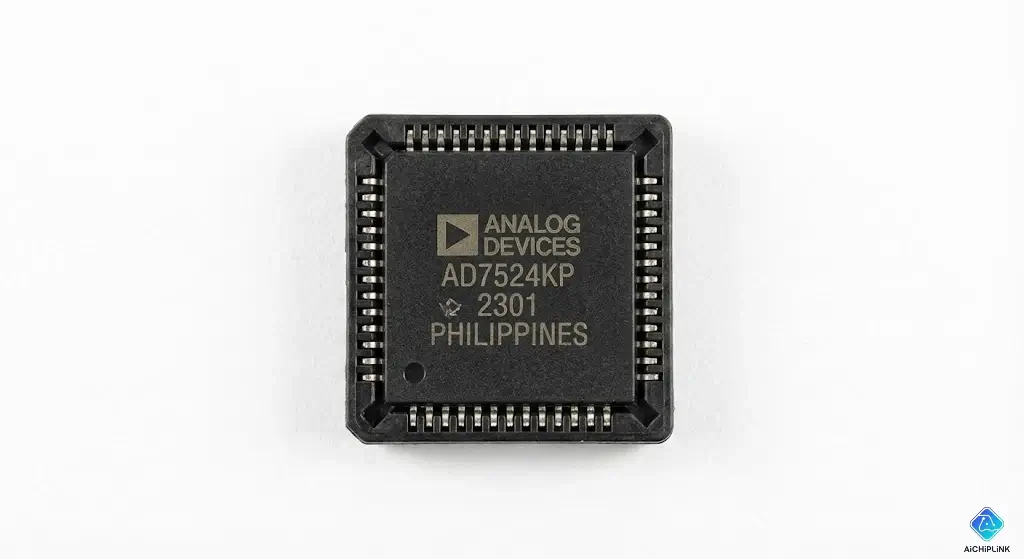
In the world of Digital-to-Analog Converters (DACs), the AD7524 is a legend. First introduced by Analog Devices decades ago, it remains a favorite for engineers who need a low-cost, reliable interface between the digital world of microprocessors and the analog world of voltage.
The AD7524KP specifically is the PLCC (Plastic Leaded Chip Carrier) version of this chip. It is widely used in legacy industrial controllers and audio equipment.
But what makes this chip special isn't just that it converts bits to volts—it's that it is a Multiplying DAC. This guide explains what that means and how to use it.
Table of Contents
- 1. Decoding the Part Number: KP vs. JN
- 2. What is a "Multiplying" DAC?
- 3. Technical Specifications
- 4. Hardware Guide: The PLCC-20 Pinout
- 5. Key Applications
- 6. Conclusion
1. Decoding the Part Number: KP vs. JN
When sourcing the AD7524, the suffix is critical. Analog Devices uses specific codes for package and temperature.
The Breakdown Matrix
| Code | Meaning | Detail |
|---|---|---|
| AD7524 | Base Model | 8-Bit Buffered Multiplying DAC. |
| K | Grade | Better Precision. (K grade has tighter linearity error than J grade). |
| P | Package | PLCC-20 (Plastic Leaded Chip Carrier). Square shape. |
Common Confusion: Engineers often confuse the AD7524KP (Square PLCC) with the AD7524KN (Rectangular DIP).
- N = DIP (Through-hole).
- P = PLCC (Surface Mount / Socket).
- Make sure your PCB footprint matches the letter!
2. What is a "Multiplying" DAC?
Most standard DACs have a fixed internal voltage reference (e.g., 2.5V). If you send it code 255, it outputs 2.5V.
The AD7524 is a Multiplying DAC (MDAC). It does not have a fixed reference. Instead, you provide the reference voltage ($V_{REF}$), and the DAC acts like a digital potentiometer.
$$V_{OUT} = - \left( \frac{\text{Digital Code}}{256} \right) \times V_{REF}$$
The Magic: Because it is a "Multiplying" DAC, $V_{REF}$ doesn't have to be a steady DC voltage. It can be a varying signal—like Audio.
- If you feed an audio signal into $V_{REF}$ and change the Digital Code, you are effectively controlling the volume of the audio signal digitally. This is why the AD7524 is famous in Digital Audio Gain Control.
3. Technical Specifications
- Resolution: 8-Bit (256 discrete levels).
- Linearity Error: $\pm \frac{1}{2}$ LSB (K Grade).
- Interface: Parallel Data Bus (DB0-DB7) with $\overline{CS}$ and $\overline{WR}$ latches.
- Benefit: This allows the AD7524 to sit directly on a microprocessor's data bus, looking just like a memory address (Memory Mapped I/O).
- Power Supply: Single +5V to +15V operation.
- Technology: CMOS (Low power consumption).
4. Hardware Guide: The PLCC-20 Pinout
The AD7524KP comes in a 20-lead PLCC package. This is distinct from the 16-pin DIP version.
- Pin Mapping: Since the PLCC has 20 pins and the chip only needs ~16 connections, there are several NC (No Connect) pins in the corners.
- Key Pins:
- RFB (Feedback Resistor): Connects to the op-amp output for voltage conversion.
- OUT1 / OUT2: Current outputs. Must be connected to an external Op-Amp (like an AD741 or OP07) to convert the current to voltage.
- DB0-DB7: Digital Inputs.
Design Tip: PLCC chips are often placed in sockets (Through-hole sockets). If you are repairing a board, use a PLCC Extractor Tool to remove the old chip without cracking the socket.
5. Key Applications
1. Programmable Power Supply
By using a stable DC voltage as $V_{REF}$, a microcontroller can adjust the output voltage of a power supply unit with 8-bit precision.
2. Audio Volume Control
Feed music into $V_{REF}$. The microcontroller sends codes 0-255 to attenuate the signal. Unlike a mechanical potentiometer, this never wears out or gets "scratchy."
3. Waveform Generation
By cycling through a lookup table of values (Sine, Triangle), a microcontroller can generate complex waveforms for testing equipment.
6. Conclusion
The Analog Devices AD7524KP is a versatile component that bridges the gap between digital logic and analog reality. Its ability to "multiply" input signals makes it far more powerful than a standard fixed-reference DAC. Whether you are maintaining 1990s industrial gear or building a digitally controlled synthesizer, the AD7524KP is a reliable choice.
Sourcing Legacy Analog Components Need to repair a controller or build a prototype? Visit Aichiplink.com to search for stock of the AD7524KP and compatible Op-Amps.

Written by Jack Elliott from AIChipLink.
AIChipLink, one of the fastest-growing global independent electronic components distributors in the world, offers millions of products from thousands of manufacturers, and many of our in-stock parts is available to ship same day.
We mainly source and distribute integrated circuit (IC) products of brands such as Broadcom, Microchip, Texas Instruments, Infineon, NXP, Analog Devices, Qualcomm, Intel, etc., which are widely used in communication & network, telecom, industrial control, new energy and automotive electronics.
Empowered by AI, Linked to the Future. Get started on AIChipLink.com and submit your RFQ online today!
Frequently Asked Questions
1. What is the AD7524KP used for?
The AD7524KP is used for digital gain control, programmable voltage outputs, and waveform generation in industrial and audio systems.
2. What does “multiplying DAC” mean in AD7524KP?
It means the output is a scaled version of the external reference voltage, allowing the DAC to act like a digital potentiometer.
3. What package does AD7524KP use?
AD7524KP comes in a PLCC-20 (Plastic Leaded Chip Carrier) package, commonly used with sockets in legacy boards.
4. What is the difference between AD7524KP and AD7524KN?
The difference is the package: KP = PLCC (surface-mount/socket) KN = DIP (through-hole) The electrical function is the same.
5. Does AD7524KP require an external op-amp?
Yes. It outputs current, so an external op-amp is required to convert the signal into voltage.