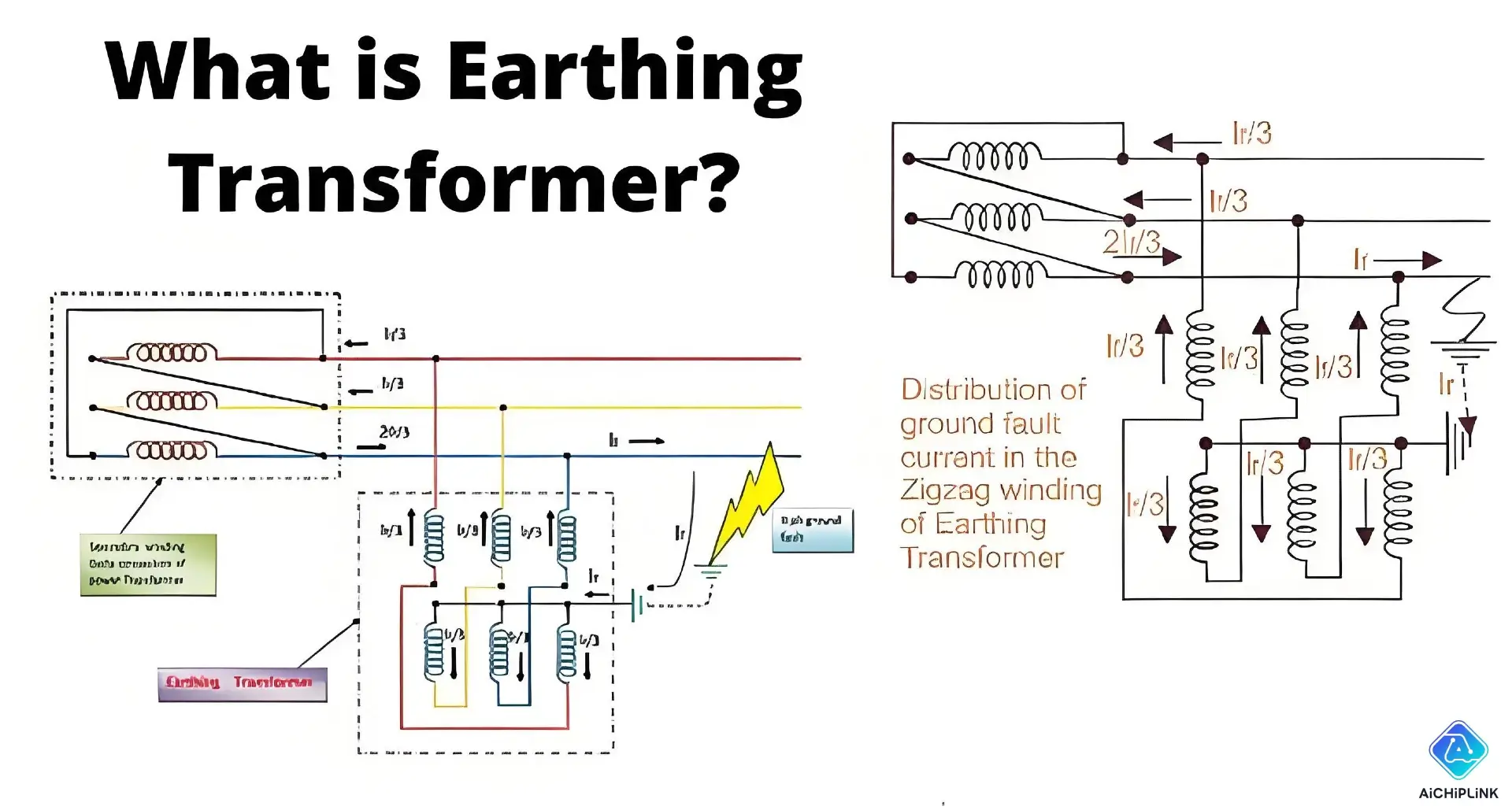
In power distribution, safety relies on a stable path to ground. But what happens when your power system—like a 3-phase Delta connection—doesn't have a neutral wire?
If a tree branch touches a line on an ungrounded system, the system might keep running, but the voltages on the other lines will spike dangerously. Worse, your protection relays might not even know a fault occurred.
The solution is a specialized piece of equipment called an Earthing Transformer (or Grounding Transformer).
This device creates a "Virtual Neutral" for ungrounded systems, ensuring safety and enabling fault protection. Here is a deep dive into how they work, with a focus on the popular Zigzag configuration.
1. The Problem: Ungrounded Delta Systems
Most high-voltage transmission lines and industrial distribution systems use a Delta ($\Delta$) winding configuration.
- The Benefit: It carries high power with only 3 wires (no neutral wire needed), saving cost.
- The Flaw: It has no physical connection to the ground.
Without a ground reference (Neutral), the system is "Floating."
- Arcing Grounds: Intermittent faults can cause voltage buildup (up to 6x normal voltage), destroying insulation.
- Blind Protection: Standard earth fault relays cannot detect a fault because no current flows back to the source.
2. The Solution: Creating a Virtual Neutral
An Earthing Transformer is a device connected to the 3-phase bus solely to provide a Neutral Point.
It does not typically carry power to loads (unless equipped with an auxiliary winding). Its primary job is to stand by and wait for a fault.
- Normal Condition: It sits quietly, drawing almost zero current.
- Fault Condition: It provides a low-impedance path for the fault current to flow from the ground back to the system, allowing the circuit breaker to trip.
3. Types of Earthing Transformers
There are two main ways to build these, but one is the clear industry favorite.
Type 1: The Zigzag Transformer (Interconnected Star)
This is the most common type. It is a single-winding transformer (autotransformer) with a special winding arrangement.
- Configuration: Each phase winding is split into two halves. The top half of Phase A is wound on the same core leg as the bottom half of Phase C, and so on.
- Why it wins: It is 30% smaller and cheaper than a 2-winding transformer for the same rating.
Type 2: The Wye-Delta (Star-Delta) Transformer
This is a standard isolation transformer.
- Primary: Connected in Star (Wye) with the neutral grounded.
- Secondary: Connected in a closed Delta loop.
- Function: The closed Delta secondary allows "Zero Sequence" currents (caused by faults) to circulate, balancing the magnetic flux.
4. How a Zigzag Transformer Works
The magic of the Zigzag design lies in Vector Cancellation.
Normal Operation (Balanced Load)
When 3-phase voltage is applied, the current flows through the windings in such a way that the magnetic flux generated by one half of the winding opposes the flux from the other half.
- Result: The transformer presents a very High Impedance (Magnetizing Reactance). It acts like an open circuit and draws almost no power.
Earth Fault Condition
When a single line-to-ground fault occurs, Zero Sequence Current ($I_0$) flows from the fault, through the earth, up the neutral of the Zigzag transformer, and splits equally into the three phases.
- Result: The currents in the winding halves flow in the same direction magnetically. The fluxes no longer cancel; they add up. However, the path offers Low Impedance to this fault current, allowing enough current to flow to trip the relay.
5. Earthing Transformer vs. NGR
You will often see an Earthing Transformer paired with a large resistor box.
- The Earthing Transformer: Creates the Neutral Point.
- The NGR (Neutral Grounding Resistor): Connects between that Neutral Point and the Earth.
Why combine them? If you ground the neutral directly (Solid Grounding), the fault current might be huge (thousands of Amps), damaging the transformer. The NGR limits this current to a safe value (e.g., 400A or 100A) to prevent equipment damage while still allowing detection.
6. Sizing & Specifications
Since Earthing Transformers are essentially "Short-Circuit Devices," they are rated differently than power transformers.
- Rated Voltage: Must match the system line-to-line voltage.
- Rated Fault Current: The maximum current it must handle during a fault (e.g., 400A).
- Time Rating: How long can it handle that fault? Typical ratings are 10 seconds, 30 seconds, or 60 seconds. It does not need to handle this continuously because the breaker should trip quickly.
- Continuous Rating (kVA): If the unit has an Auxiliary Winding (to provide 240V/400V power to the substation lights), it will also have a continuous kVA rating.
7. Conclusion
The Earthing Transformer is the unsung hero of industrial and utility substations. By creating a stable neutral on Delta systems, it prevents dangerous overvoltages and ensures that protection relays can do their job. Whether utilizing a compact Zigzag design or a robust Wye-Delta unit, proper sizing is critical for system safety.
Sourcing Power Transformers? Need reliable Earthing Transformers or NGRs for your substation project? Visit Aichiplink.com to search for transformers and protective relay equipment.

Written by Jack Elliott from AIChipLink.
AIChipLink, one of the fastest-growing global independent electronic components distributors in the world, offers millions of products from thousands of manufacturers, and many of our in-stock parts is available to ship same day.
We mainly source and distribute integrated circuit (IC) products of brands such as Broadcom, Microchip, Texas Instruments, Infineon, NXP, Analog Devices, Qualcomm, Intel, etc., which are widely used in communication & network, telecom, industrial control, new energy and automotive electronics.
Empowered by AI, Linked to the Future. Get started on AIChipLink.com and submit your RFQ online today!
Frequently Asked Questions
What is an earthing transformer?
It is a transformer that creates a neutral grounding point for ungrounded or delta-connected power systems.
Why is an earthing transformer needed in delta systems?
Delta systems have no neutral, making earth faults hard to detect and causing dangerous overvoltages.
What is a zigzag earthing transformer?
A zigzag transformer uses interconnected windings to provide a neutral path while carrying almost no current during normal operation.
Does an earthing transformer supply load power?
No. It normally carries only fault current, unless it has an auxiliary secondary winding.
Why is a neutral grounding resistor (NGR) used with it?
The NGR limits earth fault current to protect equipment while still allowing fault detection.