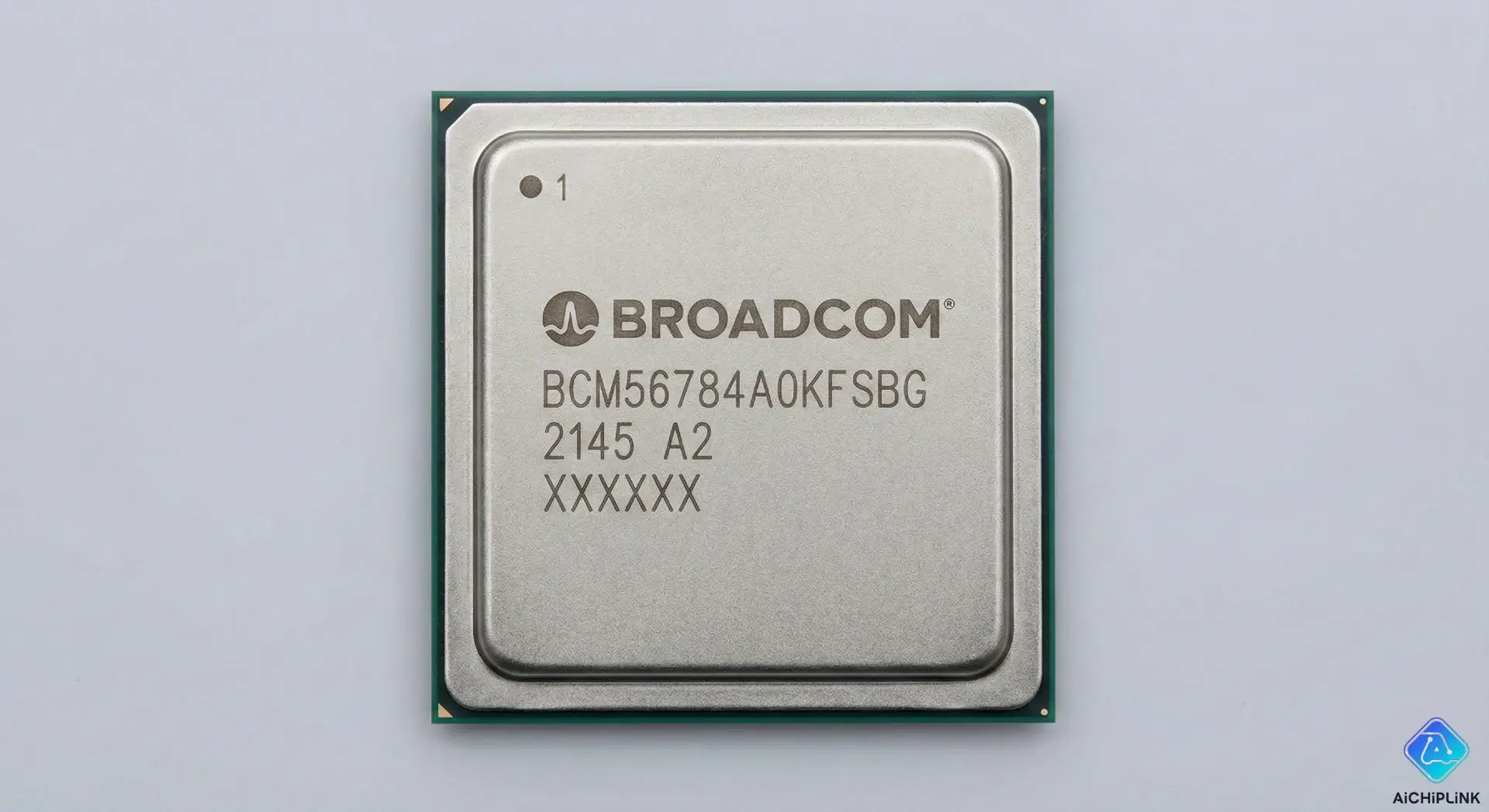
In the hierarchy of network silicon, if the Tomahawk series is the "Muscle Car" built for pure speed, the Broadcom StrataXGS® Trident 4 series is the "Super Computer on Wheels."
The BCM56784A0KFSBG is a premier member of this family. Built on a 7nm process, it delivers a massive 12.8 Terabits per second (Tbps) of bandwidth. But unlike standard switches, its true power lies in its fully programmable pipeline. For enterprise cores, service provider edges, and campus aggregation layers requiring complex policy enforcement and real-time telemetry, the BCM56784 is the definitive solution.
This guide explores the technical architecture of the BCM56784, the benefits of its NPL programmability, and how it compares to its siblings in the Broadcom portfolio.
BCM56784A0KFSBG Datasheet & Key Specs
The BCM56784 is the 12.8T flagship of the Trident 4 (TD4) line.
- BCM56: Broadcom Switch Series.
- 784: Specific SKU (12.8T capacity, typically X9 variant).
- B0: Silicon Revision (Stepping).
- KFLGG: Package type (RoHS compliant).
Key Specifications Matrix
| Feature | Specification | Impact |
|---|---|---|
| Switching Capacity | 12.8 Tbps | Supports 32x 400GbE or 128x 100GbE ports. |
| Architecture | Programmable Pipeline | Field-upgradable protocol support via NPL. |
| SerDes | 50G PAM4 | High-density, power-efficient connectivity. |
| Packet Buffer | High-performance shared buffer | Absorbs bursts in enterprise traffic. |
| Process Node | 7nm | Industry-leading power efficiency per Gbit. |
| Telemetry | In-Band Flow Analyzer (IFA) | Granular visibility into every packet. |
The Power of Programmability (NPL)
The BCM56784 is defined by its support for NPL (Network Programming Language).
- Flexibility: Unlike fixed-function ASICs, the forwarding behavior of the Trident 4 can be changed by loading a new NPL image.
- Future-Proofing: If a new protocol (e.g., a new variant of VXLAN or SRv6) emerges, engineers can implement it in software without replacing the hardware. For more on the concept of programmable networks, see the Wikipedia article on P4 and Programmable Switches (NPL is Broadcom's open parallel to P4).
Price Analysis & Stock Availability
The BCM56784 is a high-value enterprise component.
Note: Sourcing programmable 7nm silicon requires a robust supply chain. [Check Stock for BCM56784A0KFSBG at Aichiplink] to view inventory from verified global distributors.
Architecture: Trident 4 vs. Tomahawk 4
Engineers often confuse the two 12.8T/25.6T product lines. Here is the distinction:
| Feature | Trident 4 (BCM56784) | Tomahawk 4 (BCM56990) |
|---|---|---|
| Primary Focus | Features & Flexibility | Throughput & Density |
| Pipeline | Fully Programmable | Fixed / Configurable |
| Table Size | Massive (Routes, ACLs, Counters) | Optimized for Cloud Scale |
| Target Market | Enterprise Core, Campus, SP Edge | Hyperscale Data Center Spine |
| Features | NAT, MPLS, SRv6, rich ACLs | Basic L2/L3, leaner features |
Why Enterprise Core Needs Trident 4: In an enterprise core, you aren't just moving packets; you are enforcing security policies, performing Network Address Translation (NAT), and routing complex overlays. The Trident 4's massive table sizes allow it to hold the enormous routing tables and Access Control Lists (ACLs) required for these tasks.
Applications: Modernizing the Enterprise Core
Advanced Telemetry with IFA 2.0
The BCM56784 supports In-band Flow Analyzer (IFA) 2.0.
- Visibility: It enables the switch to add metadata to packets as they traverse the network.
- Insight: Operators can see exactly which switch added latency, which queue was congested, and which path a specific packet took—all in real-time at line rate.
Securing the Edge
With its programmable pipeline, the BCM56784 is ideal for Security Appliances and Firewalls. It can offload complex flow tracking and DDoS mitigation tasks from the main CPU, acting as a hardware-accelerated firewall front-end.
Software Ecosystem & Development
SDKLT and SONiC Integration
Broadcom provides the SDKLT (SDK Logical Table) for the Trident 4.
- Modern API: SDKLT treats switch resources as a database, making automation and API integration easier than legacy register access.
- SONiC Support: The chip is fully compatible with SONiC, enabling open-source network management that decouples hardware from software. This allows enterprises to deploy the same OS across different hardware vendors.
50G PAM4 SerDes Design Challenges
Integrating the BCM56784 requires mastering 50G PAM4 signal integrity.
- PCB Layout: Requires ultra-low-loss materials (like Megtron 7) and careful routing to minimize crosstalk and insertion loss.
- Thermal: The 7nm chip is dense. Proper thermal design (heatsinks, airflow) is critical. For thermal management techniques, refer to EEPower's Thermal Guide.
Conclusion
The Broadcom BCM56784A0KFSBG (Trident 4) represents the pinnacle of intelligent switching. It proves that you don't have to sacrifice speed for intelligence. By offering 12.8 Tbps of fully programmable bandwidth, it empowers network architects to build smarter, more secure, and highly observable networks.
Sourcing High-End Programmable Silicon The demand for intelligent networking chips is at an all-time high. Visit Aichiplink.com to search for BCM56784A0KFSBG and other cutting-edge Broadcom solutions.

Written by Jack Elliott from AIChipLink.
AIChipLink, one of the fastest-growing global independent electronic components distributors in the world, offers millions of products from thousands of manufacturers, and many of our in-stock parts is available to ship same day.
We mainly source and distribute integrated circuit (IC) products of brands such as Broadcom, Microchip, Texas Instruments, Infineon, NXP, Analog Devices, Qualcomm, Intel, etc., which are widely used in communication & network, telecom, industrial control, new energy and automotive electronics.
Empowered by AI, Linked to the Future. Get started on AIChipLink.com and submit your RFQ online today!
Frequently Asked Questions
Does BCM56784 support 800GbE?
Typically, the Trident 4 generation is optimized for **400GbE** (8x50G lanes). 800GbE support is a primary feature of the newer Trident 5 and Tomahawk 5 generations (using 100G lanes).
Can I use NPL to add my own protocols?
Yes, that is the primary value proposition. Using the NPL compiler and development environment, you can define custom headers and parsing logic to support proprietary or emerging protocols.
What is the power consumption?
While 7nm is efficient, a 12.8T switch chip still consumes significant power (often hundreds of Watts TDP). Exact figures require an NDA datasheet, but system design must account for substantial cooling.
Is this chip backward compatible with 10G/25G?
Yes, the SerDes lanes are highly flexible and can be configured to support legacy speeds like 10GbE and 25GbE, making it suitable for aggregating older racks.
Why choose Trident 4 over Tomahawk 4 for a Campus Core?
The Campus Core requires rich features: deep buffers for bursty traffic, large routing tables for segmented networks, and complex ACLs for security. Trident 4 excels in these areas where Tomahawk 4 is streamlined for raw speed.