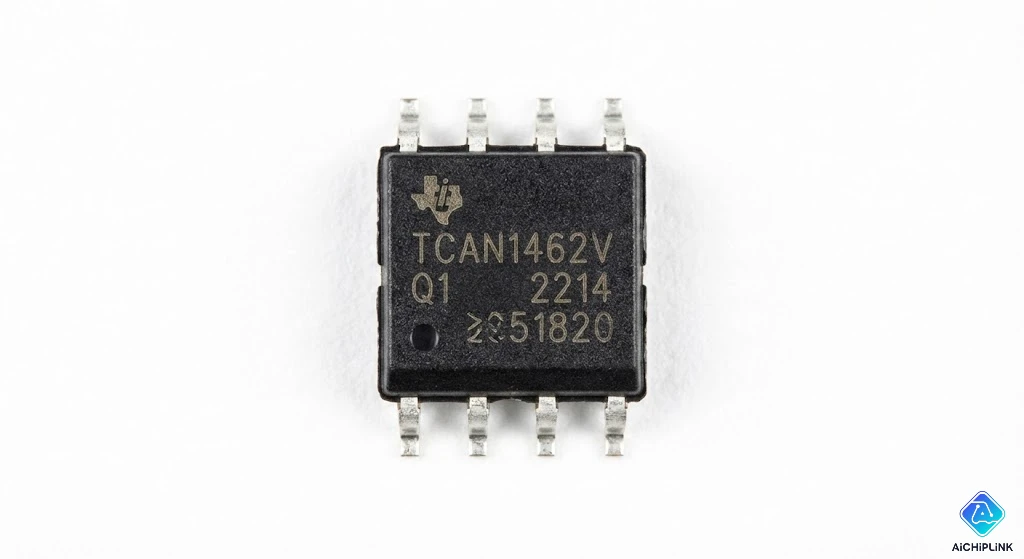
In the race to build Software-Defined Vehicles (SDVs), data bandwidth is everything. While Automotive Ethernet gets the headlines, the humble CAN bus is still the backbone of the car. But standard CAN FD hit a wall: Signal Ringing.
When you try to push CAN FD past 2 Mbps in a complex wiring harness (with star topologies and long stubs), reflections cause "ringing" that corrupts the data.
Enter the Texas Instruments TCAN1462VDRQ1.
This isn't just another transceiver. It features Signal Improvement Capability (SIC), a game-changing technology that actively cleans up the signal, allowing you to run CAN FD at 5 Mbps or even 8 Mbps on networks that previously failed at 2 Mbps.
This guide explains how SIC works, why you need it, and how the TCAN1462 fits into your next ECU design.
Table of Contents
- Decoding the Part Number
- The Core Problem: Why CAN FD Rings
- The Solution: How SIC Works
- Technical Specs: TCAN1462VDRQ1
- Competitor Comparison: TI vs. NXP
- Conclusion
1. Decoding the Part Number
TI part numbers are descriptive. Here is the breakdown for TCAN1462VDRQ1:
| Segment | Code | Meaning |
|---|---|---|
| TCAN | Transceiver CAN | Product Family. |
| 1462 | Series | 146x Series = CAN FD with SIC + Standby Mode. |
| V | VIO Pin | Includes Level Shifter pin for directly interfacing with 1.8V, 3.3V, or 5V MCUs. |
| D | Package | SOIC-8 (Standard 8-pin body). |
| R | Reel | Tape & Reel Packaging (3000 pcs typically). |
| Q1 | Automotive | AEC-Q100 Grade 1 Qualified (-40°C to +125°C). |
Pro Tip: If you see TCAN1462 (no V), the digital I/O is referenced to $V_{CC}$ (5V), which may damage 3.3V MCUs without external level shifters. Always check for the "V".
2. The Core Problem: Why CAN FD Rings
In a perfect world, a CAN bus is a straight line with 120Ω termination at both ends. In a real car, the bus is a mess. It has "stubs" (branches) going to door modules, seats, and sensors.
- The Physics: At high speeds (CAN FD data phase), these stubs act like open transmission lines.
- The Result: When the signal switches from Dominant (0) to Recessive (1), the energy bounces back from the stub, creating Ringing (oscillations).
- The Failure: If the ringing doesn't settle before the sample point, the receiver reads the wrong bit. This limits most complex CAN FD networks to ~2 Mbps.
3. The Solution: How SIC Works
Signal Improvement Capability (SIC), defined in the CiA 601-4 specification, fixes this at the hardware level.
Unlike a standard transceiver that just "lets go" of the bus to let it float back to recessive, the TCAN1462VDRQ1 actively drives the bus impedance to match the line characteristic impedance for a brief moment during the transition.
- Result: It eats the reflection. The ringing is suppressed almost instantly.
- Benefit: You can run at 5 Mbps or 8 Mbps even with complex star topologies and unterminated stubs. It gives you the "Topology Freedom" of low-speed CAN with the bandwidth of CAN FD.
4. Technical Specs: TCAN1462VDRQ1
- Max Data Rate: 8 Mbps (FD Mode).
- VIO Supply: 1.7V to 5.5V (Seamless 1.8V MCU support).
- Bus Fault Protection: $\pm 58V$ (Protects against short-to-battery on 12V/24V systems).
- Modes:
- Normal Mode: Full communication.
- Standby Mode: Ultra-low power (<30 µA), wakes up via CAN pattern (WUP).
- Package: 8-Pin SOIC (D) is pin-compatible with standard CAN transceivers (like TCAN1042).
5. Competitor Comparison: TI vs. NXP
The main rival in the SIC space is NXP's TJA146x series.
| Feature | TI TCAN1462V-Q1 | NXP TJA1462 |
|---|---|---|
| Technology | CAN SIC (CiA 601-4) | CAN SIC (CiA 601-4) |
| Max Speed | 8 Mbps | 8 Mbps |
| VIO Range | 1.7V - 5.5V | 2.95V - 5.5V (some variants) |
| Standby Current | Typical 12 µA | Typical 10-15 µA |
| Pinout | Standard SOIC-8 | Standard SOIC-8 |
Why Choose TI? The TCAN1462 often offers wider availability and a slightly broader $V_{IO}$ range on the low end (1.7V), making it safer for next-gen 1.8V automotive SoCs.
6. Conclusion
If your CAN FD network is suffering from error frames or you are limited to 2 Mbps because of your wiring harness topology, you don't need to redesign the harness. You just need to swap the transceiver.
The TCAN1462VDRQ1 is a drop-in upgrade that brings Signal Improvement Capability to your design, effectively "cleaning" the wire physics to unlock the full 5-8 Mbps potential of CAN FD.
Sourcing Automotive Chips? Need to secure stock for your next ECU build? Visit Aichiplink.com to check inventory for TCAN1462VDRQ1 and other AEC-Q100 components.

Written by Jack Elliott from AIChipLink.
AIChipLink, one of the fastest-growing global independent electronic components distributors in the world, offers millions of products from thousands of manufacturers, and many of our in-stock parts is available to ship same day.
We mainly source and distribute integrated circuit (IC) products of brands such as Broadcom, Microchip, Texas Instruments, Infineon, NXP, Analog Devices, Qualcomm, Intel, etc., which are widely used in communication & network, telecom, industrial control, new energy and automotive electronics.
Empowered by AI, Linked to the Future. Get started on AIChipLink.com and submit your RFQ online today!
Frequently Asked Questions
What makes TCAN1462VDRQ1 different from standard CAN FD transceivers?
It supports Signal Improvement Capability (SIC), which suppresses signal ringing and enables higher CAN FD speeds.
How fast can TCAN1462VDRQ1 run CAN FD?
It supports CAN FD data rates up to 8 Mbps, even on complex wiring topologies.
What problem does SIC solve in CAN FD networks?
SIC reduces reflections and ringing caused by stubs and star topologies, improving signal integrity.
Is TCAN1462VDRQ1 compatible with 1.8V or 3.3V MCUs?
Yes. The VIO pin supports 1.7V to 5.5V, allowing direct connection to low-voltage MCUs.
Is TCAN1462VDRQ1 qualified for automotive use?
Yes. It is AEC-Q100 Grade 1 qualified for operation from -40°C to +125°C.