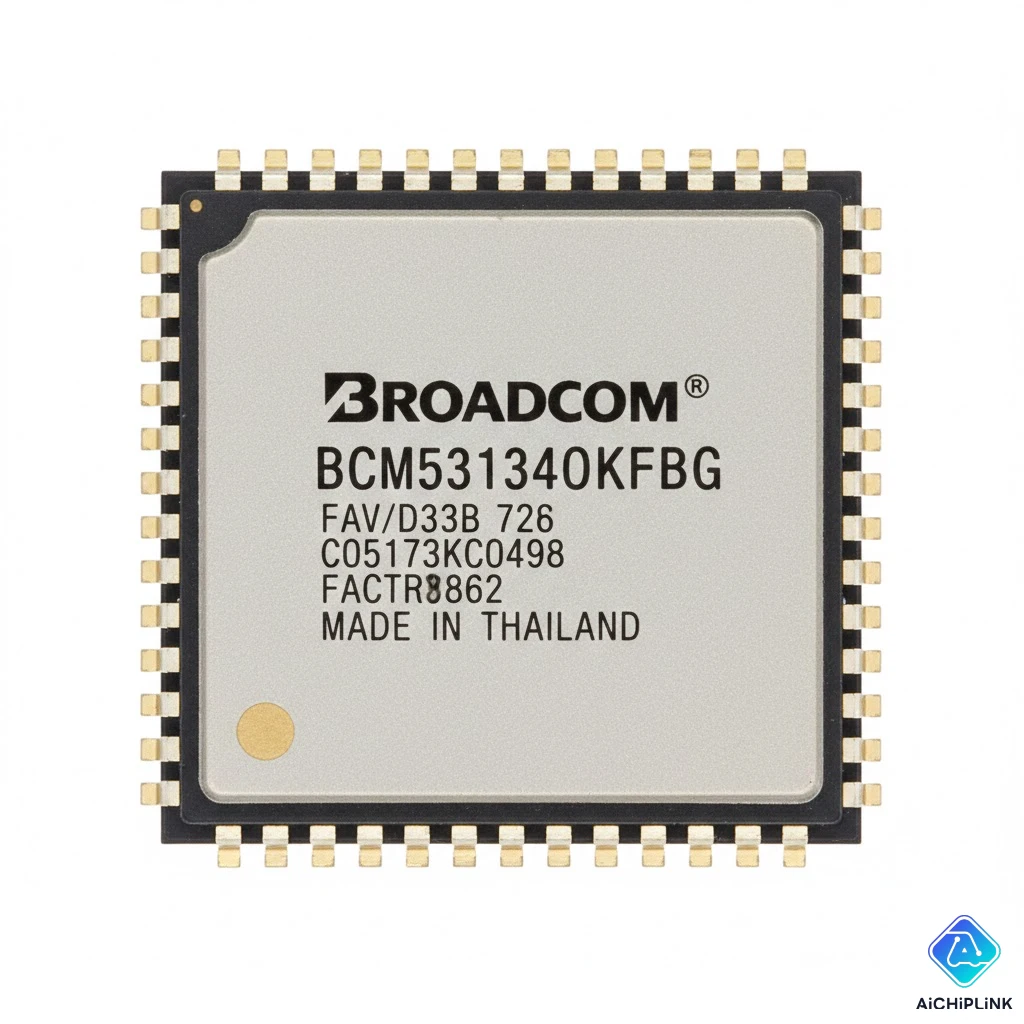
Introduction
Are you designing managed switches for small-to-medium businesses, implementing enterprise access layer networking, or building cost-effective Gigabit Ethernet infrastructure? The BCM53134OKFBG represents Broadcom's proven solution for SMB and enterprise-class managed switches, delivering reliable Layer 2+ switching with comprehensive management features at competitive economics.
The BCM53134OKFBG is a Gigabit Ethernet switch-on-a-chip (SoC) manufactured by Broadcom Inc., the world's leading provider of Ethernet switching silicon. This integrated device combines a non-blocking switch fabric, port PHYs, management processor, and advanced features in a single package, enabling switch manufacturers to build full-featured managed switches with minimal external components. Designed for 8-port and 16-port managed switch products, it delivers wire-speed performance across all Gigabit ports with Layer 2/Layer 3 capabilities, comprehensive QoS, and enterprise-class security features.
According to Crehan Research's 2024 Ethernet switch report, SMB managed switches continue to represent significant market opportunity with businesses migrating from unmanaged to managed infrastructure for improved network visibility, security, and performance. The BCM53134OKFBG addresses this demand by providing enterprise-grade features at SMB price points, enabling network administrators to deploy professional-quality switches in distributed enterprise environments, small business offices, and branch locations.
In this comprehensive technical guide, you'll discover the BCM53134OKFBG's architecture, complete specifications, feature set, enterprise applications, implementation guidance, and competitive positioning to support informed switch silicon selection for managed network equipment designs.
BCM53134OKFBG Technical Overview
The BCM53134OKFBG is a fully-integrated Ethernet switch solution that combines switching fabric, port controllers, and management capabilities in a single-chip design optimized for cost-effective managed switches.
Core Specifications Summary
| Parameter | Specification | Significance |
|---|---|---|
| Switch Fabric | 32 Gbps non-blocking | Wire-speed for all ports |
| Gigabit Ports | 8× internal GbE PHY | Integrated 1000BASE-T PHYs |
| Uplink Ports | 2× 2.5G SGMII | Flexible uplink options |
| Management | Embedded MIPS CPU | On-chip management processor |
| Memory | Integrated SRAM | Packet buffering |
| Layer 2 Features | VLAN, STP, LACP | Enterprise-grade L2 |
| Layer 3 Features | Static routing | Basic L3 capability |
| QoS | 8 queues/port | Traffic prioritization |
| Security | ACL, port security | Access control |
| Package | BGA | Surface-mount integration |
Product Positioning
The BCM53134OKFBG occupies the SMB/Enterprise Access segment:
Market Position:
- Above: Unmanaged switches (lower cost, no management)
- Target: SMB managed switches, enterprise access layer
- Below: Core/aggregation switches (higher port count/speed)
Competitive Advantages:
- Fully-integrated solution (minimal BOM)
- Enterprise features at SMB pricing
- Proven Broadcom quality and ecosystem
- Low power consumption
Part Number Decoder
Understanding Broadcom nomenclature:
BCM53134OKFBG breakdown:
- BCM = Broadcom Corporation
- 531 = Switch product family
- 34 = Specific model/feature set
- O = Package type
- KFBG = Speed grade and qualifications
Target Markets
The BCM53134OKFBG is optimized for:
SMB Managed Switches:
- 8-port and 16-port desktop switches
- Wall-mounted switches for small offices
- Retail and hospitality networking
- Small business infrastructure
Enterprise Access Layer:
- Office floor switches (access tier)
- Conference room connectivity
- Branch office switches
- Departmental networking
Specific Verticals:
- Education (classroom switches)
- Healthcare (clinic/ward networking)
- Retail (store infrastructure)
- Manufacturing (office areas)
Key Differentiators
Integrated Design:
- Switch fabric + PHYs + CPU in one chip
- Reduces external component count
- Simplifies PCB design
- Lower total system cost
Enterprise Features:
- VLAN support (4K VLANs)
- Spanning Tree Protocol (STP/RSTP/MSTP)
- Link Aggregation (LACP)
- QoS with 8 priority queues
- Comprehensive security (ACLs, port security)
Management Capabilities:
- Web GUI, CLI, SNMP
- Remote configuration and monitoring
- Firmware upgrades
- Syslog and event logging
Ethernet Switch Architecture
Understanding the BCM53134OKFBG architecture reveals how it achieves wire-speed performance and enterprise features in an integrated design.
Functional Block Diagram
┌────────────────────────────────────────────────────┐
│          BCM53134OKFBG Architecture                │
├────────────────────────────────────────────────────┤
│                                                     │
│  ┌──────────────────────────────────────────────┐ │
│  │   8× Gigabit Ethernet PHY (1000BASE-T)       │ │
│  │   - Auto-negotiation                         │ │
│  │   - MDI/MDIX auto-crossover                  │ │
│  │   - Energy Efficient Ethernet (802.3az)      │ │
│  └────────────┬─────────────────────────────────┘ │
│               │                                     │
│  ┌────────────▼─────────────────────────────────┐ │
│  │     32 Gbps Non-Blocking Switch Fabric       │ │
│  │     - Shared memory architecture             │ │
│  │     - 256KB packet buffer                    │ │
│  │     - Cut-through switching                  │ │
│  └────────────┬─────────────────────────────────┘ │
│               │                                     │
│  ┌────────────▼─────────────────────────────────┐ │
│  │         Packet Processing Engine             │ │
│  │  - VLAN tagging/filtering                    │ │
│  │  - L2 forwarding (32K MAC table)             │ │
│  │  - L3 routing (static routes)                │ │
│  │  - ACL processing                            │ │
│  │  - QoS classification/scheduling             │ │
│  └────────────┬─────────────────────────────────┘ │
│               │                                     │
│  ┌────────────▼─────────────────────────────────┐ │
│  │       Management Processor (MIPS)            │ │
│  │  - Web server                                │ │
│  │  - SNMP agent                                │ │
│  │  - CLI interface                             │ │
│  │  - Configuration management                  │ │
│  └──────────────────────────────────────────────┘ │
│               │                                     │
│  ┌────────────▼─────────────────────────────────┐ │
│  │         External Interfaces                  │ │
│  │  - 2× SGMII (uplinks)                        │ │
│  │  - UART (console)                            │ │
│  │  - JTAG (debug)                              │ │
│  │  - GPIO                                      │ │
│  └──────────────────────────────────────────────┘ │
│                                                     │
└────────────────────────────────────────────────────┘
Switch Fabric Architecture
The BCM53134OKFBG implements a shared memory architecture:
Design Principles:
- Shared packet buffer: 256KB SRAM
- Virtual output queuing: Eliminates head-of-line blocking
- Cut-through forwarding: Minimal latency
- Store-and-forward: Optional for error checking
Benefits:
- Efficient buffer utilization
- Flexible bandwidth allocation
- Low latency (<5μs typical)
- Non-blocking performance
Integrated Gigabit PHYs
Each of the 8 internal ports includes complete 1000BASE-T PHY:
PHY Capabilities:
- Auto-negotiation: Automatically detects 10/100/1000 Mbps
- Auto-MDI/MDIX: Automatic crossover detection
- EEE (802.3az): Energy Efficient Ethernet for power savings
- Cable diagnostics: Length and fault detection
Advantages of Integration:
- No external PHY chips required
- Reduced PCB area and cost
- Simplified design and routing
- Lower power consumption
Management Processor
The embedded MIPS CPU handles control plane functions:
Responsibilities:
- Protocol processing: STP, IGMP, LLDP
- Management interfaces: Web, CLI, SNMP
- Configuration: VLAN, QoS, security policies
- Monitoring: Statistics, logs, alerts
External Connectivity:
- UART for console access (CLI)
- External flash for firmware storage
- Optional external RAM for larger tables
Uplink Architecture
The BCM53134OKFBG provides 2× SGMII interfaces for flexible uplinks:
SGMII (Serial Gigabit Media Independent Interface):
- 2.5 Gbps signaling (supports 1G Ethernet)
- Connects to external PHYs or SFP cages
- Enables fiber or long-reach copper uplinks
Typical Uplink Configurations:
- 2× SFP cages for fiber uplinks
- External PHY for 10GBASE-T uplink
- Cascade to aggregation switches
Complete Technical Specifications
Let's examine the detailed specifications defining the BCM53134OKFBG's capabilities and operational parameters.
Switching Performance
| Parameter | Specification | Details |
|---|---|---|
| Switch Fabric | 32 Gbps | 16 Gbps full-duplex |
| Forwarding Rate | 23.8 Mpps | Million packets per second |
| Latency | <5μs | Cut-through mode |
| Packet Buffer | 256 KB | Shared memory |
| Jumbo Frames | Up to 9KB | Optional support |
Throughput Calculation:
Per-Port Throughput:
- 1000 Mbps × 8 ports = 8 Gbps total
- Full-duplex: 16 Gbps aggregate
- Wire-speed: Non-blocking for all ports

Packet Forwarding:
- 64-byte packets @ 1 Gbps = 1.488 Mpps per port
- 8 ports × 1.488 Mpps = 11.9 Mpps ingress + 11.9 Mpps egress
- Total: 23.8 Mpps
Port Configuration
Integrated Gigabit Ports:
- Count: 8 ports
- Type: 10/100/1000BASE-T
- PHY: Integrated (no external required)
- Connector: RJ-45 (on switch product)
Uplink Ports:
- Count: 2 ports
- Interface: SGMII (2.5G)
- Options: SFP, external PHY, or cascade
Layer 2 Features
VLAN Support:
- 4K VLANs (802.1Q standard)
- Port-based VLANs
- Protocol-based VLANs
- Private VLANs (PVLAN)
Spanning Tree:
- STP (802.1D)
- RSTP (802.1w) - faster convergence
- MSTP (802.1s) - multiple spanning trees
Link Aggregation:
- LACP (802.1ax/802.3ad)
- Static link aggregation
- Up to 8 groups
Multicast:
- IGMP snooping v1/v2/v3
- MLD snooping (IPv6)
- Multicast forwarding optimization
Layer 3 Capabilities
Routing:
- Static routing
- Up to 256 static routes
- Inter-VLAN routing
Note: BCM53134OKFBG is primarily Layer 2 with basic Layer 3 features. Not a full L3 router.
Quality of Service (QoS)
Traffic Classification:
- 802.1p (CoS) - Layer 2 priority
- DSCP (DiffServ) - Layer 3 priority
- Port-based priority
- ACL-based classification
Queue Management:
- 8 priority queues per port
- Strict priority scheduling
- Weighted Round Robin (WRR)
- Weighted Deficit Round Robin (WDRR)
Traffic Shaping:
- Per-port rate limiting (ingress/egress)
- Per-queue shaping
- Storm control (broadcast/multicast/unknown unicast)
Security Features
Access Control:
- Port-based ACLs (ingress/egress)
- MAC-based ACLs
- IP-based ACLs (IPv4/IPv6)
- Up to 512 ACL rules
Port Security:
- MAC address learning limit
- Static MAC binding
- Dynamic MAC learning control
- Sticky MAC addresses
Additional Security:
- 802.1X port-based authentication
- RADIUS/TACACS+ integration
- DHCP snooping
- ARP inspection
- IP Source Guard
Management Specifications
Management Interfaces:
- Web GUI: HTTP/HTTPS
- CLI: Telnet/SSH/Console
- SNMP: v1/v2c/v3
- RMON: Network monitoring
Configuration:
- Flash storage for config
- TFTP firmware updates
- Configuration backup/restore
- Factory reset capability
Power Specifications
Power Consumption:
- Typical operation: 8-12W (all ports active)
- Idle power: 5-7W
- Per-port: ~1W per Gigabit port
- Energy Efficient Ethernet: Reduces power when idle
Voltage:
- Core: 1.0V/1.2V (internal regulation)
- I/O: 3.3V
- Input: Typically 12V DC (on switch product)
Physical Specifications
Package:
- Type: BGA (Ball Grid Array)
- Dimensions: ~23mm × 23mm (estimated)
- Operating Temperature: 0°C to 70°C (commercial)
- Storage Temperature: -40°C to 125°C
Performance and Features
What performance and capabilities does the BCM53134OKFBG deliver for real-world managed switch deployments? Let's examine key features.
Wire-Speed Performance
Non-Blocking Architecture:
- All 8 ports can transmit/receive at full 1 Gbps simultaneously
- 32 Gbps total switching capacity
- Zero packet loss under full load
- Deterministic performance
Latency:
- Cut-through: <5μs port-to-port
- Store-and-forward: <10μs (with error checking)
- Benefit: Suitable for latency-sensitive applications (VoIP, video)
VLAN Capabilities
Flexible VLAN Configuration:
| VLAN Type | Description | Use Case |
|---|---|---|
| Port-based | Assign ports to VLANs | Departmental segmentation |
| 802.1Q tagging | VLAN ID in frame | Multi-switch VLANs |
| Voice VLAN | Auto-detect VoIP traffic | Separate voice network |
| Private VLAN | Port isolation within VLAN | Guest network isolation |
Example Deployment:
- VLAN 10: Management (port 1)
- VLAN 20: Data network (ports 2-5)
- VLAN 30: VoIP phones (ports 2-5, tagged)
- VLAN 40: Guest WiFi (ports 6-7)
- Uplinks (port 9-10): Trunk all VLANs
Advanced QoS
Priority Queue Operation:
Priority Queue Architecture (per port):

Queue 7 (Highest) ─────► [Strict Priority]
Queue 6           ─────► [Strict Priority]
Queue 5           ─────► [WRR 30%]
Queue 4           ─────► [WRR 25%]
Queue 3           ─────► [WRR 20%]
Queue 2           ─────► [WRR 15%]
Queue 1           ─────► [WRR 8%]
Queue 0 (Lowest)  ─────► [WRR 2%]
                         │
                         ▼
                   Physical Port
Traffic Prioritization Example:
- Queue 7: Network control (STP, LLDP)
- Queue 6: VoIP (voice calls)
- Queue 5: Video conferencing
- Queue 4: Business-critical apps
- Queue 3: Standard user traffic
- Queue 2: Bulk data transfers
- Queue 1: Guest network
- Queue 0: Best-effort
Spanning Tree Features
Loop Prevention:
STP (802.1D):
- Basic loop prevention
- Convergence: 30-50 seconds
RSTP (802.1w):
- Rapid convergence: <2 seconds
- Backward compatible with STP
- Recommended for modern networks
MSTP (802.1s):
- Multiple spanning tree instances
- Per-VLAN load balancing
- Enterprise-grade redundancy
Link Aggregation
LACP Benefits:
- Increased bandwidth (2-8× links aggregated)
- Redundancy (link failure tolerance)
- Load balancing across member links
Configuration:
- Static LAG (manual configuration)
- Dynamic LACP (automatic negotiation)
- Up to 8 ports per group
Example:
- Aggregate ports 9-10 (uplinks) into 2 Gbps trunk
- Provides redundancy and increased bandwidth
Energy Efficiency
Energy Efficient Ethernet (802.3az):
- Automatically reduces power when ports idle
- Power savings: 30-50% on lightly loaded networks
- Transparent to connected devices
- No performance impact
Additional Power Features:
- Port-level power down (unused ports)
- Link-down power saving
- Short-reach optimization
Enterprise and SMB Applications
Where does the BCM53134OKFBG excel in business networking? Let's examine specific deployment scenarios.
1. Small Office/Branch Office (SOBO)
Application:
- 5-20 employee office
- Desktop and wireless access
- Server and printer connectivity
- Internet/WAN connectivity
Typical Configuration:
- 8-port managed switch powered by BCM53134OKFBG
- Ports 1-6: User workstations and wireless APs
- Port 7: Network printer
- Port 8: Uplink to router/firewall
Features Used:
- VLANs for network segmentation (data, voice, guest)
- QoS for VoIP prioritization
- Port mirroring for troubleshooting
- SNMP monitoring from central office
Benefits:
- Professional network management in small office
- Remote configuration and monitoring
- Cost-effective enterprise features
2. Retail Store Networks
Application:
- Point-of-sale terminals
- Inventory management systems
- Wireless for customers and staff
- Security cameras
Network Requirements:
- Reliability: 24/7 operation
- Security: PCI-DSS compliance for POS
- Segmentation: Separate POS, employee, guest networks
- Remote management: Multi-site management
BCM53134OKFBG Configuration:
- VLAN 10: POS terminals (secure, isolated)
- VLAN 20: Employee WiFi
- VLAN 30: Guest WiFi (internet-only)
- VLAN 40: IP cameras
- ACLs: Restrict POS communication to payment server only
3. Education (Classroom Switches)
Application:
- Classroom desks and teacher workstation
- Interactive displays and projectors
- Student tablets/laptops
- Wireless access points
Requirements:
- Density: Multiple devices per student
- Ease of use: Simple for IT staff
- Cost: Budget constraints
- Management: Centralized across campus
Deployment:
- One BCM53134OKFBG-based switch per classroom
- 6 ports: Desk connections
- 2 ports: Wireless APs
- 2 uplinks: Redundant building switches
Features:
- VLAN segmentation (students, staff, admin)
- QoS for video streaming (educational content)
- Port security to prevent rogue devices
- Remote monitoring from IT office
4. Healthcare (Clinic/Ward Networking)
Application:
- Electronic Health Records (EHR) workstations
- Medical devices (monitors, infusion pumps)
- VoIP phones
- Nurse call systems
Critical Requirements:
- Reliability: Patient safety depends on network
- Security: HIPAA compliance
- Segmentation: Medical devices on separate VLAN
- QoS: Prioritize critical traffic
BCM53134OKFBG Features:
- Medical device VLAN (isolated, monitored)
- Voice VLAN for VoIP phones
- ACLs to restrict device communication
- Port security for known MAC addresses only
- SNMP alerts for link failures
5. Enterprise Access Layer
Application:
- Office floor desktop switches
- Conference room connectivity
- Printer and copier connection
- Connection to aggregation switches
Typical Deployment:
- Multiple BCM53134OKFBG switches per floor
- LACP trunks to aggregation layer
- Centralized management via SNMP/Web
- Standardized VLAN configuration
Enterprise Features:
- 802.1X authentication (RADIUS)
- Dynamic VLAN assignment
- Link aggregation for uplinks
- MSTP for redundancy
Deployment Density
| Deployment Type | Switches per Site | Total Ports | Management |
|---|---|---|---|
| Small Office | 1-2 | 8-16 | Standalone |
| Retail Store | 2-4 | 16-32 | Remote |
| School (building) | 10-30 | 80-240 | Centralized |
| Enterprise Floor | 5-15 | 40-120 | Centralized |
Implementation and Integration
How do you implement the BCM53134OKFBG in managed switch hardware designs? Let's examine integration requirements and best practices.
System Architecture
Minimal BOM Design:
BCM53134OKFBG-Based Switch Architecture:

┌──────────────────────────────────────────┐
│  BCM53134OKFBG (Main Switch Chip)        │
│  - 8× GbE PHY (integrated)               │
│  - Switch fabric                         │
│  - Management CPU                        │
│  - 2× SGMII uplinks                      │
└────┬──────────────┬──────────────┬───────┘
     │              │              │
     ▼              ▼              ▼
┌─────────┐   ┌──────────┐   ┌─────────┐
│ 8× RJ-45│   │  SPI     │   │  2× SFP │
│Magnetics│   │  Flash   │   │  Cages  │
│         │   │ (Firmware)│   │(Uplinks)│
└─────────┘   └──────────┘   └─────────┘
     │              │              │
     ▼              ▼              ▼
  Ports 1-8      Config       Uplinks 9-10
Required External Components:
- RJ-45 connectors with integrated magnetics (8× for ports)
- SPI flash (4-16MB for firmware storage)
- SFP cages (2× for fiber uplinks, optional)
- Voltage regulators (3.3V, 1.2V/1.0V)
- Crystal oscillator (25MHz reference clock)
- RS-232 transceiver (for console port)
- LEDs (port status indicators)
PCB Design Guidelines
Layer Stackup:
- 6-layer PCB recommended
- Layer 1: Signal (top, components)
- Layer 2: Ground plane
- Layer 3: Signal (inner)
- Layer 4: Power plane (3.3V)
- Layer 5: Signal (inner)
- Layer 6: Signal (bottom)
Design Considerations:
- Gigabit Ethernet: Maintain 100Ω differential impedance
- Trace length matching: ±5 mils for differential pairs
- Ground planes: Solid return paths for high-speed signals
- Power delivery: Low-noise regulation, extensive decoupling
Thermal Management:
- BCM53134OKFBG: ~10W typical power dissipation
- Heatsink or thermal pad to PCB
- Adequate airflow (convection or fan)
- Junction temperature: Keep <85°C
Software and Firmware
Bootloader:
- U-Boot or vendor-specific bootloader
- Loads from SPI flash
- Network boot (TFTP) optional
Network Operating System:
- Vendor-specific firmware
- Linux-based common (embedded Linux)
- Real-time OS alternative
Management Software:
- Web server (HTTP/HTTPS)
- CLI via Telnet/SSH/console
- SNMP agent
- Configuration database
Development:
- Broadcom SDK available under NDA
- Reference designs from Broadcom
- Third-party firmware vendors (ODM support)
Configuration Examples
Basic VLAN Configuration:
# Create VLANs
vlan 10
  name Management
vlan 20
  name Data
vlan 30
  name Voice

# Assign ports
interface port 1-6
  switchport mode access
  switchport access vlan 20
  switchport voice vlan 30

interface port 7-8
  switchport mode trunk
  switchport trunk allowed vlan 10,20,30
QoS Configuration:
# Enable QoS globally
qos enable

# Trust DSCP from IP phones
interface port 1-6
  qos trust dscp
  qos cos-to-queue 0 1 2 3 4 5 6 7 to 0 1 2 3 4 5 6 7

# Rate limit guest VLAN
interface port 8
  rate-limit ingress 10000  # 10 Mbps
Testing and Validation
Functional Testing:
- Port connectivity (all ports at 10/100/1000)
- VLAN isolation verification
- Spanning tree convergence testing
- QoS traffic prioritization
- Management access (Web/CLI/SNMP)
Performance Testing:
- Throughput: Wire-speed on all ports
- Latency: <10μs typical
- Packet loss: 0% at full load
- Buffer performance: Sustained burst handling
Compliance Testing:
- IEEE 802.3 Ethernet standards
- IEEE 802.1Q VLAN tagging
- FCC/CE EMI compliance
- Safety certifications (UL, CE)
Comparison with Alternative Solutions
How does the BCM53134OKFBG compare to alternative managed switch silicon? Let's examine competitive options.
Broadcom Product Family
| Product | Ports | Features | Target Market |
|---|---|---|---|
| BCM53101 | 5-port | Unmanaged | SOHO unmanaged |
| BCM53125 | 8-port | Basic managed | Entry SMB |
| BCM53134OKFBG | 8-port | Full managed | SMB/Enterprise |
| BCM53158 | 16-port | Full managed | Larger SMB |
| BCM53242 | 24-port | Advanced managed | Enterprise |
BCM53134OKFBG Positioning:
- Sweet spot for 8-port managed switches
- Balanced features vs. cost
- Suitable for distributed enterprise deployments
Competitive Silicon
| Vendor | Part Number | Ports | Features | Notes |
|---|---|---|---|---|
| Broadcom | BCM53134OKFBG | 8 GbE | Full managed | Industry standard |
| Marvell | 88E6321 | 8 GbE | Full managed | Strong competitor |
| Microchip | VSC7428 | 8 GbE | Full managed | Good alternative |
| Realtek | RTL8380M | 8 GbE | Managed | Cost-focused |
Broadcom (BCM53134OKFBG) Advantages:
- Market leader reputation
- Mature ecosystem and software
- Broad customer base and proven designs
- Comprehensive technical support
Alternative Considerations:
- Marvell: Competitive features, strong in automotive
- Microchip: Good industrial temperature options
- Realtek: Lower cost, growing market share
Feature Comparison
| Feature | BCM53134OKFBG | Typical Competitor |
|---|---|---|
| Switching Capacity | 32 Gbps | 32 Gbps (similar) |
| Latency | <5μs | <10μs (varies) |
| VLANs | 4K | 256-4K (varies) |
| ACL Rules | 512 | 256-1K (varies) |
| QoS Queues | 8 per port | 4-8 per port |
| Management CPU | Integrated | Varies |
| Power | 8-12W | 8-15W (varies) |
Key Differentiators:
- Broadcom's integrated management CPU
- Comprehensive security features
- Lower power consumption
- Proven reliability
Cost Considerations
Silicon Cost:
- BCM53134OKFBG: Moderate (industry standard pricing)
- Marvell equivalent: Similar
- Realtek: 10-20% lower cost
- Microchip: Competitive
Total System Cost:
- Integrated PHYs reduce external component cost
- Fewer external chips = simpler PCB = lower assembly cost
- Net result: Similar total cost across tier-1 vendors
TCO (Total Cost of Ownership):
- Lower power → reduced electricity cost
- Reliability → reduced RMA/support costs
- BCM53134OKFBG: Competitive TCO in enterprise deployments
Conclusion
The BCM53134OKFBG represents Broadcom's proven solution for SMB and enterprise managed switching, delivering professional-grade features in a cost-effective, integrated package. With 32 Gbps non-blocking performance, comprehensive Layer 2+ capabilities, enterprise security, and flexible management options, this switch-on-a-chip enables network equipment manufacturers to build reliable managed switches serving small businesses, distributed enterprises, and specialized vertical markets.
Key Advantages:
✅ Integrated Design: Switch fabric + 8 GbE PHYs + CPU in single chip
✅ Enterprise Features: VLANs, QoS, security, spanning tree, link aggregation
✅ Wire-Speed Performance: Non-blocking 32 Gbps, <5μs latency
✅ Comprehensive Management: Web/CLI/SNMP with embedded processor
✅ Power Efficient: 8-12W typical with Energy Efficient Ethernet
✅ Proven Ecosystem: Broadcom market leadership and mature support
For network equipment designers building SMB managed switches, enterprise architects planning distributed access infrastructure, or vertical market specialists requiring professional switching at competitive economics, the BCM53134OKFBG delivers the integration, performance, and features that enable reliable, manageable business networks.
Planning managed switch designs with BCM53134OKFBG? Visit AiChipLink.com for technical resources, reference designs, and expert consultation on Ethernet switch silicon selection and network architecture.
Build professional managed switches with proven technology—the BCM53134OKFBG powers reliable SMB and enterprise networking infrastructure.

Written by Jack Elliott from AIChipLink.
AIChipLink, one of the fastest-growing global independent electronic components distributors in the world, offers millions of products from thousands of manufacturers, and many of our in-stock parts is available to ship same day.
We mainly source and distribute integrated circuit (IC) products of brands such as Broadcom, Microchip, Texas Instruments, Infineon, NXP, Analog Devices, Qualcomm, Intel, etc., which are widely used in communication & network, telecom, industrial control, new energy and automotive electronics.
Empowered by AI, Linked to the Future. Get started on AIChipLink.com and submit your RFQ online today!
Frequently Asked Questions
What is BCM53134OKFBG?
BCM53134OKFBG is a fully integrated Gigabit Ethernet switch SoC from Broadcom, designed for managed 8-port Ethernet switches.
What are the main features of BCM53134OKFBG?
It provides 8 integrated Gigabit PHYs, Layer-2 switching, basic Layer-3 functions, VLAN, QoS, ACL, and an embedded management CPU.
What applications use BCM53134OKFBG?
BCM53134OKFBG is widely used in SMB switches, enterprise access switches, retail and office networks, and branch networking equipment.
Does BCM53134OKFBG support PoE?
BCM53134OKFBG does not include built-in PoE, but it can support PoE through external PoE controller chips.
How is BCM53134OKFBG managed?
BCM53134OKFBG supports management through Web GUI, CLI, and SNMP in typical managed switch designs.