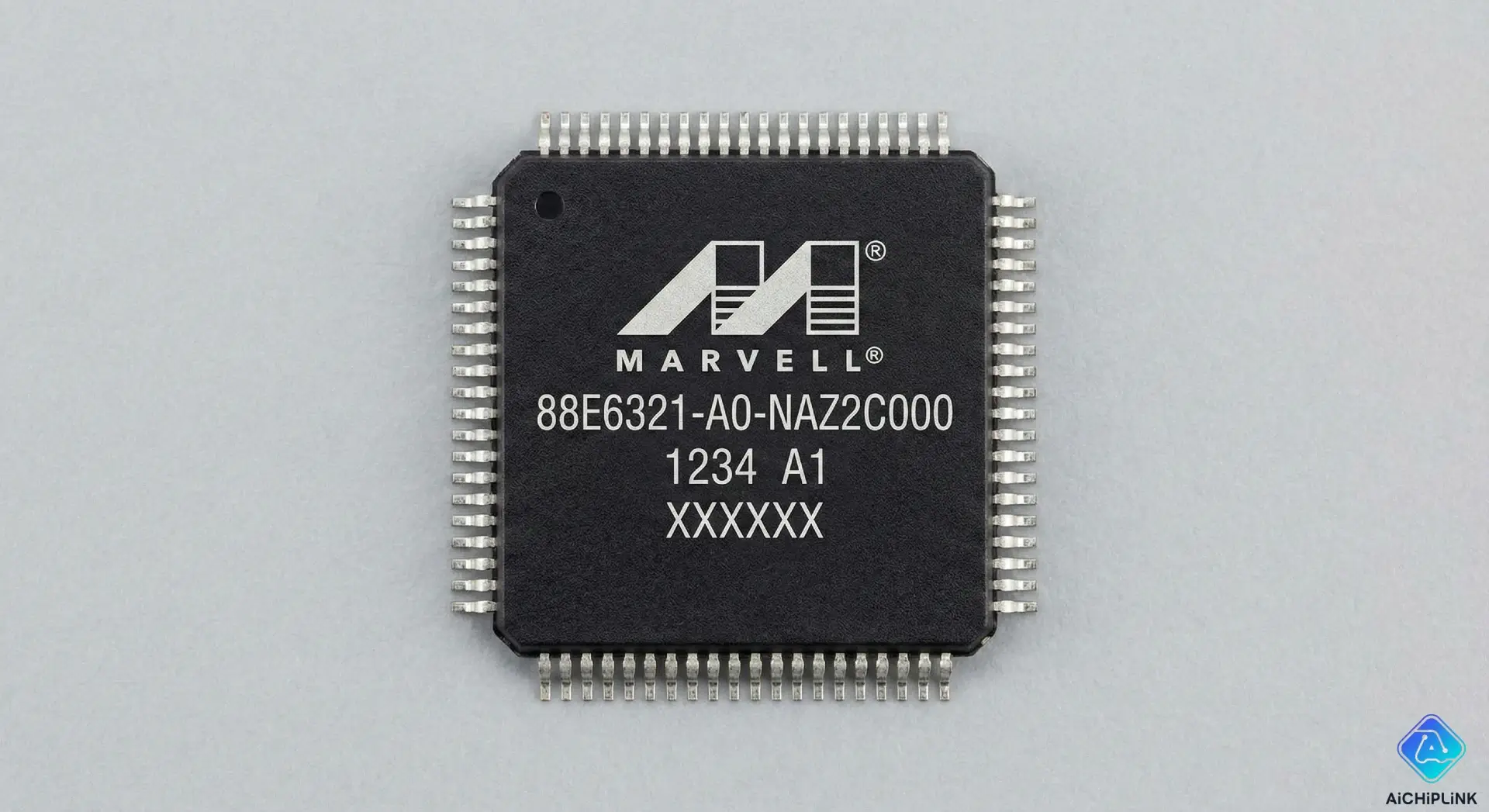
In the landscape of embedded networking, finding a switch chip that balances port density, interface flexibility, and advanced feature sets like Audio Video Bridging (AVB) is rare. The Marvell (Link Street®) 88E6321-A0-NAZ2C000 is precisely that solution.
Widely used in industrial gateways, automotive infotainment, and high-end SOHO routers, the 88E6321 offers a unique 7-port architecture that mixes copper PHYs with fiber-ready SerDes. Furthermore, its robust support within the Linux DSA (Distributed Switch Architecture) ecosystem makes it a favorite among firmware engineers.
Table of Contents
- 88E6321-A0-NAZ2C000 Datasheet & Key Specs
- Interface Configuration: RGMII, SerDes, and PHYs
- Software Integration: Linux DSA Driver
- Hardware Design & Package
- Conclusion
88E6321-A0-NAZ2C000 Datasheet & Key Specs
The 88E6321-A0-NAZ2C000 is a highly integrated Layer 2 switch. The breakdown of the part number is:
- 88E6321: Part Series (7-Port Gigabit AVB Switch).
- A0: Silicon Revision.
- NAZ2: Package Code (likely Green/RoHS compliant).
- C000: Commercial Temperature Grade.
Port Configuration Matrix
Unlike standard 5-port switches, the 88E6321 offers a "Mix-and-Match" interface approach, making it highly versatile:
| Port Type | Quantity | Features |
|---|---|---|
| Integrated PHYs | 2 | 10/100/1000BASE-T (Copper) |
| SerDes / SGMII | 2 | 100BASE-FX, 1000BASE-X (Fiber), or SGMII |
| Digital Interfaces | 3 | RGMII, MII, RMII, or GMII (MAC-to-MAC/CPU) |
| Total Ports | 7 |
Audio Video Bridging (AVB) & PTP Support
The chip is IEEE 802.1BA (AVB) compliant. It supports IEEE 802.1AS (PTP) for precise time synchronization and IEEE 802.1Qav for traffic shaping.
- Use Case: This is critical in automotive and industrial audio applications where data streams must be synchronized across the network with deterministic latency. For more details on these protocols, you can refer to the Wikipedia article on Audio Video Bridging.
Price Analysis & Stock Availability
The 88E6321 is a legacy but active component. Sourcing it can be challenging due to high demand in the automotive sector.
Note: Ensure you are buying genuine Marvell silicon. [Check Stock for 88E6321-A0-NAZ2C000 at Aichiplink] to view real-time inventory from authorized distributors.
Interface Configuration: RGMII, SerDes, and PHYs
The flexibility of the 88E6321 allows it to sit at the center of complex board designs.
Handling SGMII and Fiber Connections
The two SerDes ports are particularly powerful.
- SGMII Mode: Can be used to connect to an external PHY (copper or fiber) or a CPU MAC that supports SGMII, saving board traces compared to RGMII.
- 1000BASE-X: Allows direct connection to SFP optical modules for fiber uplinks without an external PHY.
Digital Interfaces (RGMII)
The three digital ports (often Ports 2, 5, 6 in the register map) can be configured as RGMII to connect to the host processor (SoC) or to cascade another switch. Correctly setting the RGMII delay (internal vs. PCB trace) is crucial for stable gigabit transfer.
Software Integration: Linux DSA Driver
For Linux developers, the 88E6321 is a "Gold Standard" device. It utilizes the Distributed Switch Architecture (DSA) subsystem.
Device Tree Integration
Instead of a proprietary SDK, you configure the switch in the Linux Device Tree (DTS). This abstracts the hardware complexity, allowing standard Linux network tools to manage the switch.
- Advantage: Each switch port appears as a separate network interface (e.g.,
lan1,lan2) in Linux, allowing you to use standard tools likeip,bridge, andtc(Traffic Control) to manage VLANs and routing.
MDIO/MDC Management Interface
The chip is managed via the standard SMI (MDC/MDIO) interface. It supports both the Single-Chip Addressing Mode and Multi-Chip Addressing Mode, allowing access to internal PHY registers and global switch registers.
Hardware Design & Package
- Package: The NAZ2 code typically refers to a space-saving QFN or similar leadless package.
- Power Rails: Requires multiple rails, typically 1.0V or 1.2V for core logic and 3.3V / 2.5V for I/O.
- Thermal: Although efficient (with Energy Efficient Ethernet support), the integrated PHYs generate heat. A ground pad connection to the PCB ground plane is essential for thermal dissipation. For more on thermal resistance in surface-mount devices, see EEPower's Thermal Guide.
Conclusion
The Marvell 88E6321-A0-NAZ2C000 is more than just a switch chip; it is a gateway to advanced networking features such as AVB and SGMII integration. Its seamless compatibility with the Linux kernel makes it a preferred choice for developers building robust, intelligent edge devices.
Need Marvell Switch ICs?
Don't let legacy component sourcing slow you down. Visit Aichiplink.com to search for 88E6321-A0-NAZ2C000 and other high-performance networking silicon.
Frequently Asked Questions
What is the difference between 88E6321 and 88E6320?
The **88E6320** is a 2-port version (often used as a simple media converter or extender), whereas the **88E6321** is a full 7-port switch. They share similar register maps and architecture.
Can Port 0 and Port 1 be used for Fiber?
No, typically Ports 0 and 1 are the **Integrated Copper PHYs**. The SerDes interfaces (capable of Fiber/SFP) are usually assigned to specific logic ports (e.g., Port 3 and 4), but verify the specific pinout in the datasheet.
Does it support VLANs?
Yes, it supports full IEEE 802.1Q VLANs (up to 4096 IDs) and Port-based VLANs, manageable easily through the Linux `bridge vlan` command set.
Is the 88E6321 suitable for automotive?
Yes, Marvell markets this family for automotive applications (infotainment, gateway). However, ensure you select the correct temperature grade (Industrial or Automotive) if your application requires AEC-Q100 compliance.
What is the maximum throughput?
It is a non-blocking gigabit switch, meaning it supports full wire-speed forwarding for all ports simultaneously, assuming the backplane bandwidth is not exceeded.