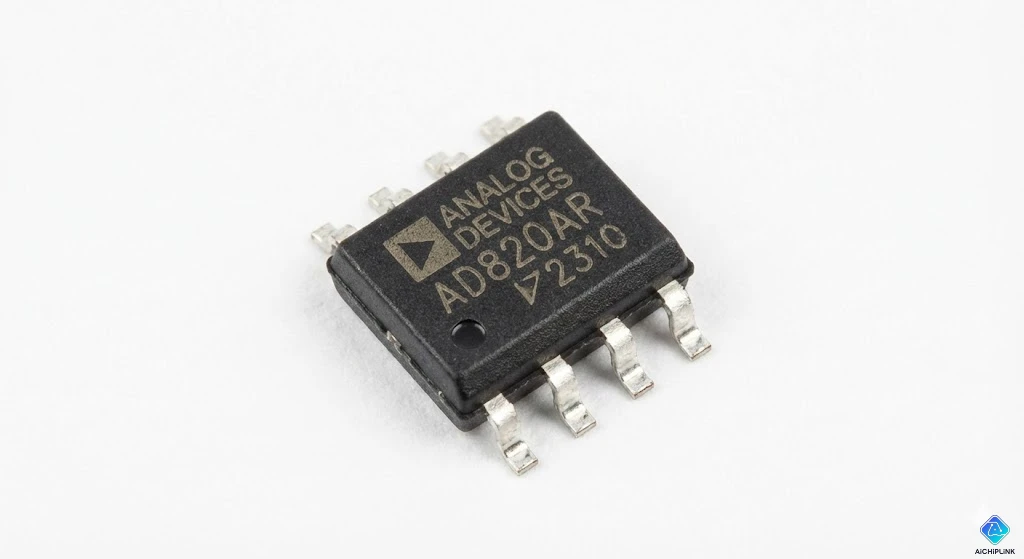
In the world of precision analog electronics, measuring tiny currents is a massive challenge. Standard Bipolar op-amps (like the LM741) draw too much current at their inputs, effectively "eating" the signal you are trying to measure.
Enter the Analog Devices AD820AR.
This is a JFET Input operational amplifier. It combines the ultra-high input impedance of FETs with the modern convenience of Single-Supply and Rail-to-Rail operation. Whether you are designing a medical pulse oximeter or a high-precision photometer, the AD820AR is likely the chip powering your front end.
This guide decodes its specs, explains the package variations, and highlights its best use cases.
Table of Contents
- 1. Decoding the Part Number: AR vs. AN
- 2. Technical Specifications: Why JFET Matters
- 3. Hardware Guide: The SOIC-8 Package
- 4. Key Application: Photodiode Transimpedance Amp
- 5. Conclusion
1. Decoding the Part Number: AR vs. AN
When sourcing the AD820, paying attention to the suffix is critical to ensure it fits your PCB.
The Breakdown Matrix
| Segment | Code | Meaning |
|---|---|---|
| AD820 | Base Model | Precision Low Power FET Input Op-Amp. |
| A | Grade | Standard Grade. (B grade offers tighter offset voltage, but A is common). |
| R | Package | SOIC-8 (Small Outline Integrated Circuit). Surface Mount. |
| N | Alternative | DIP-8 (Plastic Dual In-Line). Through-Hole. |
| Z | Suffix | Often seen as "ARZ", indicating RoHS Compliant / Lead-Free. |
The Takeaway: If your board is designed for surface mount assembly, you must order the AD820AR (or ARZ). The "AN" version will not fit.
2. Technical Specifications: Why JFET Matters
The AD820 is built on JFET (Junction Field Effect Transistor) technology.
- Input Impedance: $10^{13} \Omega$. This is astronomically high. It means the op-amp puts virtually zero load on the sensor.
- Input Bias Current: Low pA range. Ideal for sensors that output tiny currents (like photodiodes or pH probes).
- Rail-to-Rail Output: The output voltage can swing to within 10 mV of the supply rails.
- Benefit: If you are running on a single +5V battery, a standard op-amp might only output 1.5V to 3.5V. The AD820 gives you almost the full 0V to 5V range, maximizing your signal resolution.
- Supply Voltage: Single Supply (5V to 36V) or Dual Supply ($\pm 2.5V$ to $\pm 18V$).
3. Hardware Guide: The SOIC-8 Package
The AD820AR uses the industry-standard SOIC-8 pinout.
- Pin 1: NC (No Connect)
- Pin 2: Inverting Input (-)
- Pin 3: Non-Inverting Input (+)
- Pin 4: V- (Ground in single supply)
- Pin 6: Output
- Pin 7: V+ (Supply)
- Pin 8: NC (No Connect)
Layout Tip: Because the input current is so low (pico-amps), leakage current on the PCB surface can cause errors. For extreme precision, use a Guard Ring trace around the input pins connected to the same potential as the inputs.
4. Key Application: Photodiode Transimpedance Amp
The most famous use for the AD820 is as a Transimpedance Amplifier (TIA).
- The Problem: Photodiodes generate current, not voltage.
- The Circuit: The AD820 converts this current into a usable voltage.
- Why AD820? Ideally, zero current should flow into the op-amp; all photodiode current should flow through the feedback resistor. Bipolar op-amps leak current, corrupting the measurement. The AD820's JFET inputs ensure near-perfect conversion accuracy.
5. Conclusion
The Analog Devices AD820AR is a "Super-Op-Amp" for precision measurement. It replaces legacy parts like the TL071 in modern designs by offering single-supply capability and rail-to-rail outputs without sacrificing the high impedance benefits of JFETs. If you are sensing light, pH, or tiny charges, this is the chip you need.
Sourcing Precision Op-Amps Building a precision instrument? Visit Aichiplink.com to search for stock of the AD820AR and other high-performance analog ICs.

Written by Jack Elliott from AIChipLink.
AIChipLink, one of the fastest-growing global independent electronic components distributors in the world, offers millions of products from thousands of manufacturers, and many of our in-stock parts is available to ship same day.
We mainly source and distribute integrated circuit (IC) products of brands such as Broadcom, Microchip, Texas Instruments, Infineon, NXP, Analog Devices, Qualcomm, Intel, etc., which are widely used in communication & network, telecom, industrial control, new energy and automotive electronics.
Empowered by AI, Linked to the Future. Get started on AIChipLink.com and submit your RFQ online today!
Frequently Asked Questions
1. What is the AD820AR mainly used for?
It is used for precision signal amplification, especially photodiodes, sensors, and low-current measurements.
2. Why does the AD820AR use JFET inputs?
JFET inputs provide extremely high input impedance and very low bias current, preventing signal loss.
3. Does AD820AR support single-supply operation?
Yes. It works with single supply (5V–36V) or dual supply (±2.5V to ±18V).
4. What is the difference between AD820AR and AD820AN?
The difference is the package: AR = SOIC-8 (surface mount) AN = DIP-8 (through-hole)
5. Is AD820AR suitable for photodiode amplifiers?
Yes. It is a classic choice for transimpedance amplifiers (TIA) due to its ultra-low input bias current.