VFD vs Soft Starter: Which One to Choose?
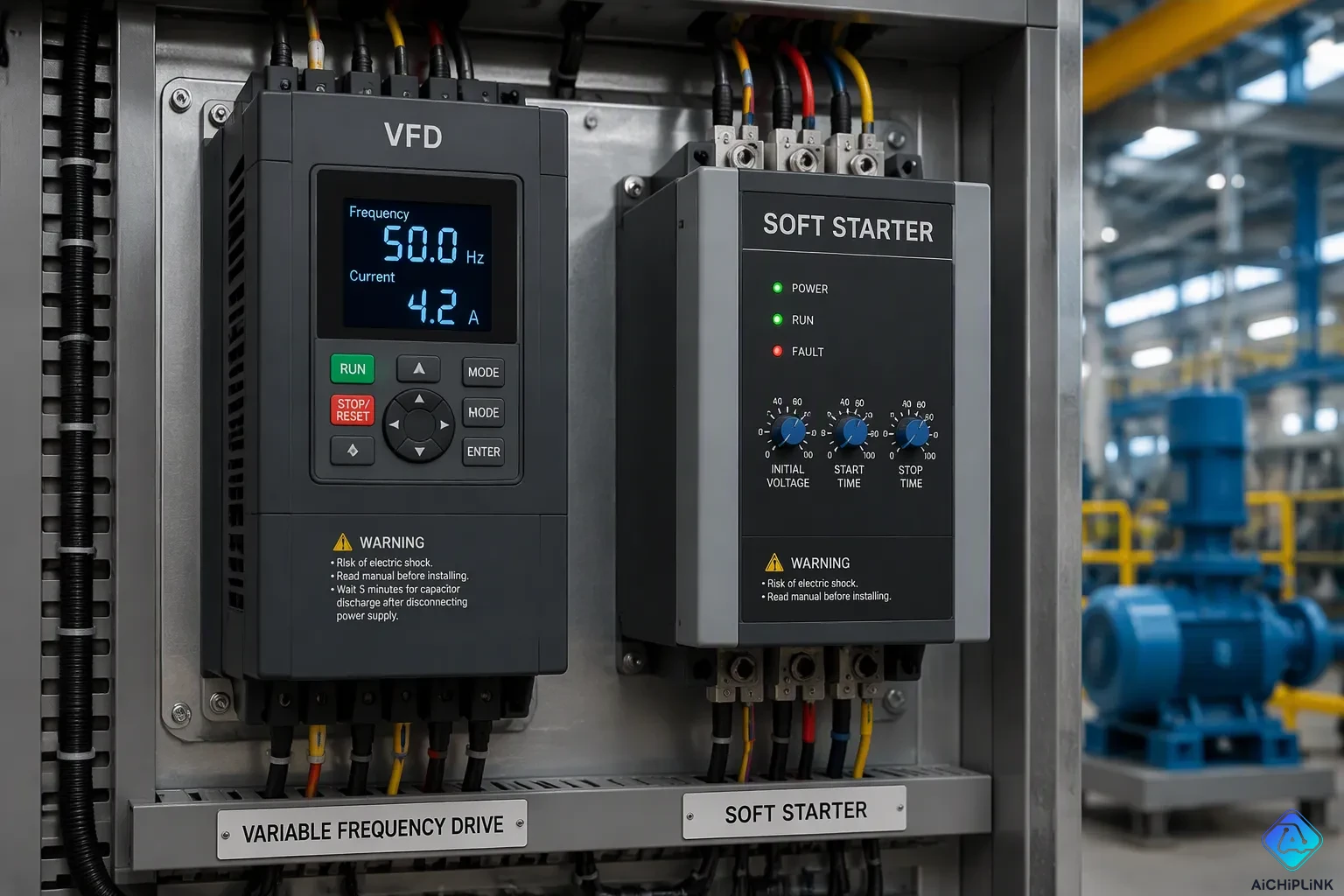
The choice between a soft starter vs VFD depends on three real factors. A variable frequency drive works well for applications that need steady speed control, energy savings, and exact process control. A soft starter works for lower-cost, fixed-speed starting that lowers mechanical stress on the motor.
Engineers should think about three key factors before picking motor control equipment. First, does the process need motor speed changes over time? Second, what load type does the application have? Third, what budget limits are there? These questions help readers figure out their situation right away.
A soft starter vs VFD decision becomes clear once speed control needs, load type, and budget are known. This guide helps readers determine Which to Choose for their own application.
Key Takeaways
-
Choose a soft starter for fixed-speed motors. It cuts startup shock and costs less than a VFD.
-
Choose a VFD for variable-speed pumps and fans. It matches motor speed to demand and saves energy.
-
Match the device to your load type. Constant torque loads like conveyors fit soft starters. Variable torque loads fit VFDs.
-
Let budget guide your final pick. Soft starters cost less upfront. VFDs pay back in 12 to 24 months.
What Is a Soft Starter?
Working Principle
A soft starter uses silicon controlled rectifiers, or SCRs, to control motor voltage when the motor starts. These SCRs are connected in anti-parallel pairs on each motor phase. The controller changes their firing angle to set how much of each AC voltage half-cycle gets to the motor. When a start command comes in, the SCRs cut the motor voltage by 30–50%. This cut stops the inrush current from getting too high. Then the control circuit slowly raises the voltage on a set ramp-up path. The ramp time can be adjusted, often from 2 to 30 seconds, so the soft starter can match the startup ramp to the load inertia. While the motor starts, the device checks current draw nonstop. If current goes past a preset limit, the voltage is adjusted to keep current in safe range. When the motor hits operating speed, the starter sends full rated voltage and normal current levels.
A soft starter limits inrush current and cuts mechanical stress when the motor starts up. The current drops in the same proportion as the voltage drop. For example, a 50% drop in voltage gives a 50% drop in current, while torque falls by 75% since torque is proportional to the square of the voltage. The table below compares starting methods:
| Starting Method | Inrush Current (% of motor rated current) |
|---|---|
| Across-the-line (DOL/ATL) | Over 600% |
| Soft starter | Roughly 300–400% (about half of DOL) |
Typical Applications
Soft starters are smaller, cheaper, and easier to install than VFDs, especially in larger horsepower applications. They fit fixed-speed loads that only need startup stress and starting current reduction. After startup, the motor runs right at full speed.
Common uses include water pumps at constant flow, fire pump systems, and industrial circulation pumps. Smooth acceleration cuts water hammer and protects shafts, seals, and couplings. Centrifugal fans with fixed airflow, factory exhaust fans, and warehouse ventilation fans also gain from this. Lower starting shock cuts belt slippage and lowers bearing stress. Aggregate conveyors, cement plant conveyors, and warehouse transport systems use soft starters too. Reduced startup shock lowers chain and belt tension and cuts gearbox wear.
What Is a Variable Frequency Drive?
Working Principle
A variable frequency drive turns incoming AC power into output with adjustable frequency and voltage. This happens in three steps. First, a rectifier changes incoming alternating current into direct current. Standard drives use diodes for one-way conversion. Regenerative drives use thyristors to allow two-way power flow and energy recovery during braking. Second, a DC bus steady and stores energy. Capacitors soak up voltage ups and downs, and inductors reduce electrical noise. Third, an inverter turns the steady DC power back into AC with controlled frequency and voltage.
The inverter uses insulated-gate bipolar transistors (IGBTs) to switch the DC bus on and off very fast. By controlling the switching order, the inverter builds an output waveform with adjustable frequency and voltage. Sinusoidal pulse-width modulation (SPWM) is the most common method. A modulating sinusoidal signal crosses a saw-toothed carrier signal to make pulses of varying width. These pulses build the AC waveform. In Volts-per-Hertz control, the drive adjusts output voltage in step with frequency. For example, a 460 V, 60 Hz motor keeps a ratio of about 7.67 V/Hz. This link holds magnetic flux steady across the speed range.
A VFD gives precise speed and torque control that soft starters cannot match. It adjusts motor speed and torque to match load demand in real time. This ability supports variable speed operation and large energy efficiency gains. Replacing a soft starter with a VFD requires an inverter-duty motor. Standard motors may fail under the harmonic stresses a VFD produces. If the existing motor is not inverter-rated, it should be replaced as well.
Typical Applications
VFDs do best in variable torque loads where flow or pressure changes over time. Centrifugal pumps, fans, blowers, and compressors gain the most. The affinity laws govern these loads: power use drops with the cube of speed reduction. Cutting speed by 20% lowers power draw by about 50%. Halving speed uses roughly one-eighth of the energy. Facilities often achieve 20–50% energy reductions on pumps and fans.
| VFD Application | Reported Energy Savings |
|---|---|
| VFDs as motor speed controllers in suitable industrial applications | 20% to 50% electricity reduction |
| Variable-torque centrifugal pumps and fans in the Affinity Laws sweet spot | 30% to 50% energy reduction |
| Variable torque loads including centrifugal pumps, fans, blowers, and compressors | Up to 50% energy savings |
Cooling tower fans, air handler supply and return fans, and wastewater pumps are strong choices. These loads run at reduced speed most of the year. Variable-loaded air compressors also gain when valve or damper control wastes energy. A VFD adjusts motor speed instead, giving adjustable speed control across the operating range.
Difference Between a Soft Starter and a VFD
Functionality and Torque Control
When a motor starts, a soft starter lowers the inrush current by limiting the voltage it sends. Back-to-back thyristors fire at a set angle, so each AC half-cycle only passes part of its voltage. This slow voltage ramp makes starting torque smooth and stops mechanical jolt. The device cannot change frequency, so it cannot adjust speed while running. Once the motor reaches full speed, the starter drops out.
A VFD controls voltage and frequency at the same time. Its rectifier changes AC to DC. An inverter switches the power back to AC at the frequency you want. Induction motor speed follows supply frequency, so the drive can vary speed from zero to full speed and hold high torque at low speed. That continuous control is the real difference between soft starter and vfd in torque management.
The soft starter vs vfd comparison below shows the most important torque differences.
| Aspect | Soft Starter | Variable Frequency Drive |
|---|---|---|
| Torque during start | Smooth controlled starting torque | High torque at low speed |
| Continuous torque | No control after startup | Full control from 0 to 100% speed |
| Control mechanism | Voltage only | Voltage and frequency |
Another difference between soft starter and vfd shows up at low-speed torque. A soft starter cannot give full torque at low speed because it does not change frequency. A VFD and soft starter differ a lot here. The VFD gives full torque from a standstill, while a soft starter only smooths line torque. In high-load applications that need controlled acceleration, the drive beats the starter.
Stopping Capabilities and Motor Protection
The difference between soft starter and vfd also covers stopping. Soft starters offer a soft stop by slowly reducing voltage. The operator cannot set an exact stopping time. The motor coasts to rest with no active braking. Many fixed-speed processes accept this, but processes that must stop quickly need more.
VFDs offer several stopping modes. A timed ramp-down brings the motor to a stop over a preset duration. Acceleration and deceleration use separate time settings. Dynamic or regenerative braking gives precise halts.
| Device | Stopping capability | Motor braking |
|---|---|---|
| Soft starter | Soft stop by gradual voltage reduction; limited control | No active braking; coast-to-stop |
| VFD | Ramp-down, coast, dynamic or regenerative braking | Dynamic or regenerative braking for precise halts |
Motor protection also sets the devices apart. Both a soft starter and vfd protect the motor. Built-in protection covers overvoltage, undervoltage, and short-circuit faults. The inverter limits short-circuit current electronically. A soft starter drops out at full speed. The motor then connects straight to the supply and adds full short-circuit current, just like a direct-on-line motor. Fault studies must include that full contribution, which affects arc flash levels and breaker sizing.
Choosing between a soft starter and vfd for motor control depends on the process. Fixed-speed pumps and fans usually favor the economical soft starter. Variable-torque loads that need speed regulation favor the drive. The selection also requires attention to motor specifications, application type, environmental conditions, control features, and harmonic filters.
Difference Between a VFD and a Soft Starter: Energy and Cost
Energy Efficiency and Load Profiles
A soft starter does not save energy while the motor runs. It only limits starting current and then lets the motor run at full speed. A VFD cuts energy use by matching motor speed to demand. This is the core difference between a VFD and a soft starter in energy terms.
For centrifugal pumps and fans, power follows the cube of speed. A pump at 80% speed needs about 0.512 of full-load power, so a VFD saves roughly 50% of motor power at that speed. A soft starter leaves the motor at full speed and provides no partial-load saving.
The affinity laws for pumps and fans relate power to the cube of speed. If a pump runs at 80% speed, required power is about 0.512 of full-load power (0.8³ ≈ 0.512), so a VFD can save roughly 50% of motor power at 80% speed. A soft starter, by contrast, only controls starting torque and leaves the motor at full speed once running, so it does not provide this partial-load saving.
Variable torque loads like fans and pumps gain the most. A 30% speed reduction cuts power requirement by nearly 65%. Constant torque loads like conveyors and mixers need the same torque at low speed, so they gain less. Traditional damper or throttle control wastes energy because the motor still runs at full speed. A VFD avoids this waste by reducing motor speed directly.
Upfront Cost, Space, and Maintenance
A soft starter costs less upfront. The VFD capital premium over a soft starter is typically 2 to 3 times.
| Aspect | Soft Starter | VFD |
|---|---|---|
| Upfront cost | Lower | 2–3× higher |
| Enclosure size | Compact | Larger, needs cooling space |
| Maintenance | Startup stress only | Full-operation motor protection |
A soft starter and a VFD differ in space needs. A soft starter has a smaller footprint because it mainly starts and stops the motor. A VFD is larger and needs extra cooling space. A VFD also introduces harmonics and power quality concerns that a soft starter does not. These factors affect the difference between soft starter and VFD in total cost of ownership.
VFD vs Soft Starter: Which to Choose for Your Application?
Picking the right motor control begins with three questions: does speed need to change, what kind of load is it, and how much money is available? Those answers help you decide which one to choose.
When a Soft Starter Fits Best
A soft starter works well for fixed-speed jobs where starting current and mechanical shock are the main worries. These loads run at full speed after they start, so a variable frequency drive would add speed control that nobody needs.
Load type is important. Constant torque loads like conveyors, elevators, shredders, and extruders need the same torque at slow and fast speeds. Variable torque loads like pumps and fans use less. If the process never changes speed, a starter handles start and stop smoothly while limiting inrush current, reducing water hammer, and lowering belt shock. It fits constant air volume HVAC, fixed-speed conveyors, refrigeration compressors, and mixers.
At full voltage, inrush can go over 600% of motor rated current. A soft starter cuts this to about 300-400%, which reduces voltage dips. The ramp helps conveyors with frequent starts. Soft starter running savings stay small, so projects with tight budgets favor this vfd vs soft starters decision.
When a VFD Fits Best
A VFD earns its price when motor speed needs to change during operation. Centrifugal pumps and fans follow the affinity law, so drives can save 20% to 50% on variable-load applications. No starter can match that because it only controls startup. This drives the vfd vs soft starter choice in HVAC and water treatment.
These drives also improve process control. Operators can adjust speed and torque in real time and set exact ramps. A variable motor speed application like an air handler cuts energy use compared with damper control. Energy efficiency becomes a deciding factor when load changes every day.
Motor compatibility matters. Soft starters run at line frequency and impose no special insulation requirements. A drive makes voltage spikes that can stress standard insulation. New installations should specify inverter-duty motors. Retrofits with short cable runs often work; longer runs may need motor replacement or dV/dt filtering. Drives may also need line reactors or harmonic filters.
This vfd and soft starter comparison shows different roles. Soft starters serve fixed-speed pumps, fans, and conveyors. Drives serve compressors, mixers, and variable-load systems. Engineers weighing soft starter and vfd options should match the device to load type and budget. A limited budget favors the starter. When choosing between a soft starter and vfd, total ownership cost matters more than upfront price. A soft starter and a vfd differ mainly in speed capability. Budget often decides which to choose. If the process requires variable speed operation, pick a drive; if the motor runs at one speed, a starter usually gives the best return. That is the answer to which to choose. The goal is motor control for performance and efficiency, not brand preference.
The final choice depends on three key things: speed control, load type, and budget. A soft starter suits fixed-speed loads, occasional starts, and smaller budgets. A VFD suits variable-speed loads, frequent starts, and energy-saving goals. Do not pick based on popularity.
| Decision Factor | Soft Starter | VFD |
|---|---|---|
| Speed control need | Fixed-speed setups | Variable speeds required |
| Load type | Constant torque loads | Variable torque loads |
| Budget | Lower upfront cost | Higher cost, payback on pump and fan applications |
A simple rule applies: if the motor runs at one speed, pick a soft starter; if speed must change, pick a VFD. That is the answer to which to choose. Match the device to the job, not the trend, for the right motor control.

Written by Jack Elliott from AIChipLink.
AIChipLink, one of the fastest-growing global independent electronic components distributors in the world, offers millions of products from thousands of manufacturers, and many of our in-stock parts is available to ship same day.
We mainly source and distribute integrated circuit (IC) products of brands such as Broadcom, Microchip, Texas Instruments, Infineon, NXP, Analog Devices, Qualcomm, Intel, etc., which are widely used in communication & network, telecom, industrial control, new energy and automotive electronics.
Empowered by AI, Linked to the Future. Get started on AIChipLink and submit your RFQ online today!
Frequently Asked Questions
Which device saves energy during normal operation?
A soft starter does not save energy while the motor runs. It only limits startup current, then the motor operates at full speed. A VFD matches motor speed to load demand. Centrifugal pumps and fans commonly achieve 20% to 50% savings.
Do drives require special motors?
Yes for most retrofits. A VFD creates voltage spikes. These spikes can stress standard insulation. New installations should use inverter-duty motors. Long cable retrofits may require motor replacement or dV/dt filtering.
Which device offers better stopping control?
The starter gradually reduces voltage for a soft stop, but the motor coasts without active braking. A VFD provides timed ramp-down, dynamic braking, or regenerative braking. These options allow quick, precise stops.
How do the upfront costs compare?
The upfront cost of a soft starter runs roughly 30% to 60% of a comparable drive. At 50 horsepower, the starter typically costs $1,500 to $2,500, while a similar drive runs $3,000 to $5,000.