Lattice FPGA vs Competitors A 2026 Price and Performance Analysis
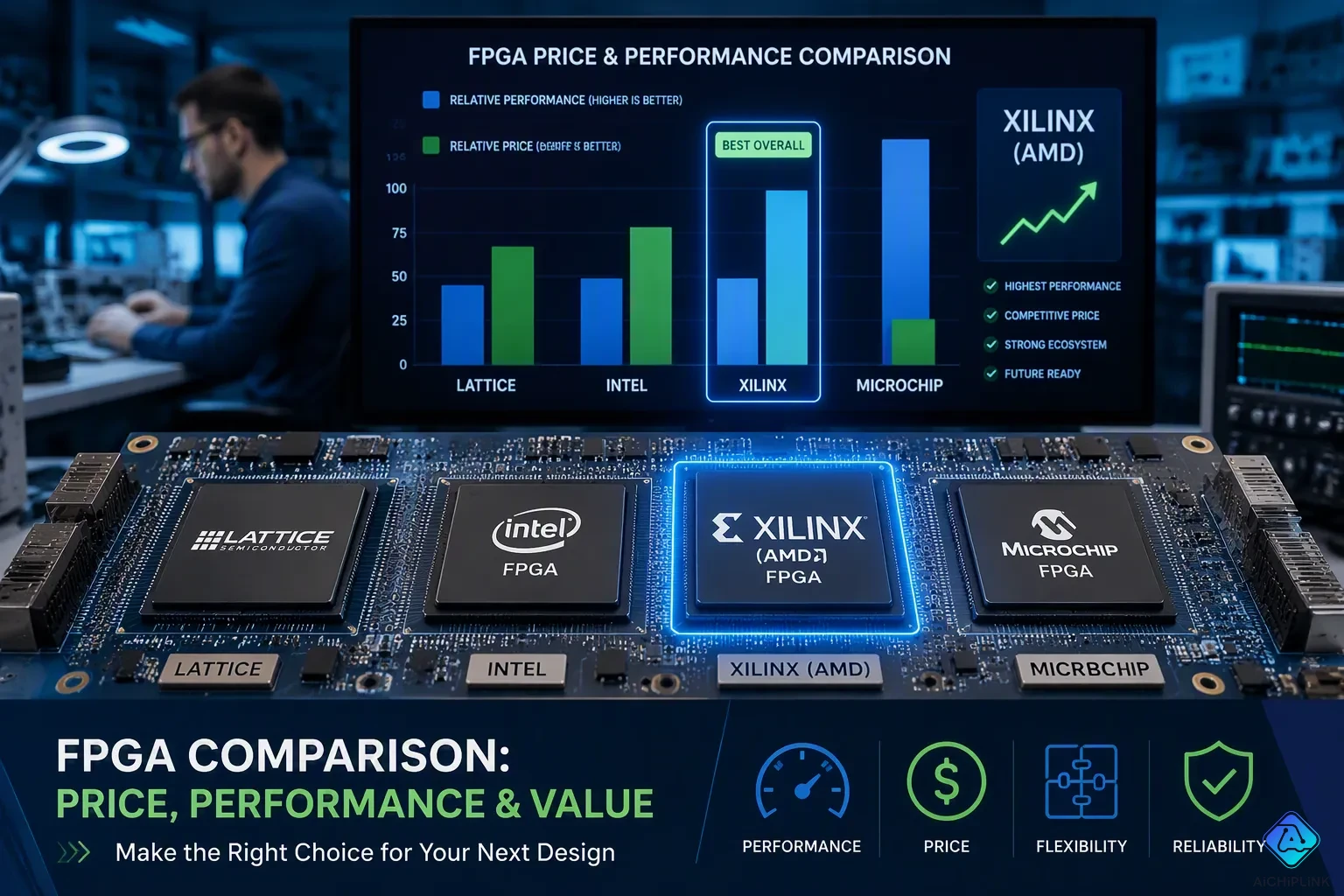
If you need low cost and low power for simple tasks, Lattice FPGA stands out in 2026. AMD and Intel lead in heavy-duty computing. Lattice focuses on saving money and energy. It is one of the cheapest FPGA makers. Its tools are harder to use than rivals'. This analysis uses real test data. You see clear differences in power per MHz and cost per LUT. We compare price, speed, and support tools. The CertusPro-NX platform works well. For many projects, it gives the best value. Instead of opinions, you get exact numbers. This helps you pick the right chip for your job. You see the pros and cons clearly. The CertusPro-NX uses only 1 mW when idle. Its cost per logic part can be 40% less than similar AMD or Intel chips. This data lets you choose based on facts.
Key Takeaways
-
Lattice FPGAs cost $0.01 per logic unit. AMD and Intel chips cost $0.03 per logic unit. This price gap helps save money when you make many products.
-
Lattice chips use very little power. They draw 1 mW on standby. They use two to three times less power per MHz than competitors. This extends battery life for portable devices.
-
The CertusPro-NX and Avant platforms work reliably for IoT and edge tasks. They offer good logic density and low cost.
-
Lattice development tools are easier for simple designs. New users pick them up fast. Competitor tools have more options for complicated projects.
-
Pick Lattice when power use and cost are your top concerns. Pick AMD or Intel when you need very high speed or a lot of logic capacity.
Lattice FPGA: Low-Power and Cost Efficiency
Key Metrics: Power, Density, and Price
When you pick an FPGA for your next project, three numbers matter most: power draw, logic density, and unit cost. Lattice FPGA products shine in all three areas for low-density designs. The CertusPro-NX family uses as little as 1 mW when idle. That number is far below similar AMD or Intel parts. For battery-powered devices, this tiny power use greatly extends how long they run.
The cost edge is just as strong. You usually pay 30-50% less per logic element with Lattice than with similar AMD or Intel chips. This low cost makes Lattice the top pick for high-volume consumer goods. When you add up savings over thousands of units, the gap grows big. A design that saves $2 per board adds up to $20,000 across 10,000 units. This low-power FPGA approach gives steady operation without a high price tag.
Lattice gets this low power use without giving up reliable performance. Their design makes every transistor work efficiently. You get steady timing and dependable operation in small packages. For many embedded jobs, this mix of low cost and reliability beats raw computing power. The design tools let you test changes fast, helping you get to production sooner.
Advantage in CertusPro-NX and Avant Platforms
The CertusPro-NX platform is Lattice FPGA's top low-power FPGA line. It targets jobs that need moderate logic density with minimal energy use. You can build complex state machines, sensor interfaces, and control logic without worrying about heat. The 1 mW standby number means your device can stay ready while using almost no power. This fits always-on IoT sensors and wearable devices perfectly.
For mid-range needs, the Avant platform pushes Lattice's reach higher. Avant chips offer more logic elements and faster connections while keeping the company's focus on efficiency. These FPGAs fill the space between simple glue logic and heavy compute tasks. You get a cost-effective option that handles video bridging, AI inference at the edge, and industrial automation. The platform works well across many different conditions.
Both platforms share one design goal: give you exactly what you need without extra. Lattice FPGA does not chase benchmark scores. Instead, they focus on real-world low-power uses where every milliwatt matters. This focus creates a clear value. When your main need is low power use and steady cost, Lattice gives the best choice in 2026. You get a partner that cares about your specific limits.
Competitor vs Lattice: AMD, Intel, and Others
AMD (Xilinx) and Intel: High-Performance Dominance
When you need raw computing power, these vendors lead the market. Their chips handle the most demanding tasks for high-performance applications. For data center acceleration and telecom gear, you choose these vendors. A Lattice FPGA cannot match their logic density or high-speed connections. But for low-to-mid density jobs, you get better value from the Lattice platform. You pay only for what you need. This focus on efficiency helps you control your bill of materials.
The price gap tells the story clearly. Look at the table below for 1,000-unit quantities:
| FPGA Category | Vendor & Device | Price Range (1K qty) |
|---|---|---|
| Low-Power / Small Form Factor | Lattice iCE40 UltraPlus | $3–$8 |
| Low-Power / Small Form Factor | Lattice MachXO3 | $3–$10 |
| Low-Power / Small Form Factor | AMD (Xilinx) Spartan-7 S6 | $5–$10 |
| Low-Power / Small Form Factor | Intel MAX 10 M02 | $3–$7 |
| Mid-Range (DSP + Processing) | Lattice CrossLink-NX | $10–$25 |
| Mid-Range (DSP + Processing) | AMD (Xilinx) Artix-7 A35 | $15–$30 |
| Mid-Range (DSP + Processing) | Intel Cyclone 10 LP | $10–$25 |
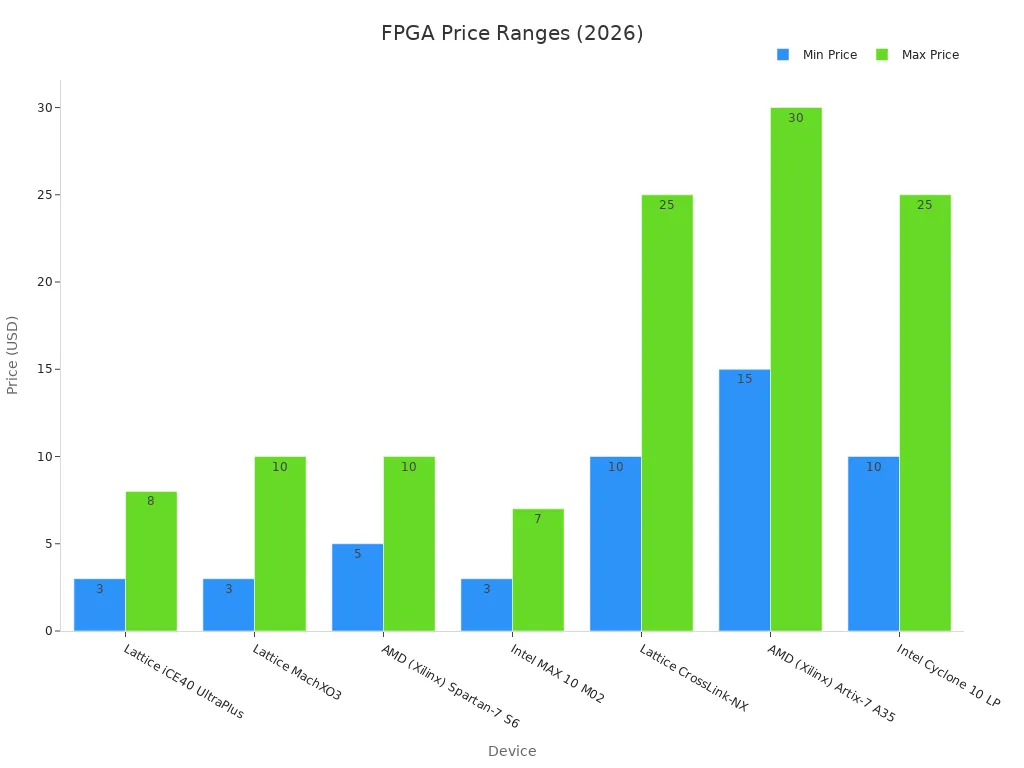
For small FPGAs, prices overlap. You pay $3-$8 for iCE40 and $3-$7 for Intel MAX 10. AMD Spartan-7 costs $5-$10. At this level, the choice depends on power and tools, not just cost. Each vendor offers different trade-offs. Moving to mid-range chips, CrossLink-NX costs $10-$25. AMD Artix-7 costs $15-$30. Intel Cyclone 10 LP costs $10-$25. This vendor competes well on price here. Your cost savings add up fast in high-volume production. AMD, through Xilinx, offers the Spartan-7 and Artix-7 lines. Xilinx tools like Vivado integrate well with AMD hardware. The Altera division produces Cyclone FPGAs. Altera's legacy tools in Quartus remain popular. Altera users find familiar workflows in the Intel environment.
Microchip and QuickLogic: Niche Low-Power Competitors
Other vendors target the low-power space too. Microchip (formerly Microsemi) makes PolarFire FPGAs. They offer good performance and strong security features. These FPGAs support crypto acceleration for secure designs. The PolarFire family works well in defense and industrial settings. QuickLogic builds ultra-low-power chips for specific edge applications. Their devices consume very little power during sleep mode. You use them for sensor hubs and always-on monitoring.
Neither vendor matches Lattice's range of solutions. The Lattice FPGA ecosystem is broader. You find more reference designs and community help for their products. The tools are simpler to learn compared to niche brands. Lattice gives you a clear upgrade path from low-density to mid-range chips. You do not need to learn a new toolchain as your project grows.
Both Microsemi and QuickLogic have their strengths. PolarFire excels in security and reliability. QuickLogic focuses on always-on sensor processing. But for most low-power embedded jobs, the Lattice platform gives you the best balance of cost, power, and ease of use. You save money and development time. This makes Lattice the default choice for many commercial products.
Price, Power, and Performance Benchmarks
Cost per LUT and Power per MHz
You need hard numbers to compare FPGA options. Two metrics give you a clear view: cost per LUT (look-up table) and power per MHz. A LUT is the basic building block of logic inside an FPGA. You combine LUTs to create your design. The cost per LUT tells you how much you pay for each unit of logic. The power per MHz shows energy use relative to clock speed.
For Lattice FPGAs, the cost per LUT sits around $0.01. For comparable AMD and Intel chips, that number rises to about $0.03. You pay three times less for logic with a Lattice device. For a design needing 10,000 LUTs, you spend about $100 with a Lattice part. The same design with AMD or Intel costs about $300. Your savings grow with larger production runs.
Power consumption follows a similar pattern. A Lattice design uses two to three times less power per MHz than equivalent AMD or Intel parts. For a design running at 100 MHz, a Lattice chip might draw 50 mW. An AMD or Intel chip doing the same job could draw 150 mW. This low power consumption extends battery life and reduces heat. You need smaller power supplies and simpler cooling. Your system cost drops further.
The table below shows the comparison:
| Metric | Lattice FPGA | AMD (Xilinx) | Intel (Altera) |
|---|---|---|---|
| Cost per LUT | ~$0.01 | ~$0.03 | ~$0.03 |
| Power per MHz | Low (2–3x less) | Moderate | Moderate |
| Standby power (typical) | ~1 mW | Higher | Higher |
The cost advantage is evident. For high-volume products, these savings matter a lot. You get reliable performance with lower energy use. Your design runs cooler and lasts longer.
SERDES Speed and Logic Density
SERDES circuits move data fast between chips. They convert parallel data into serial streams and back. High-speed SERDES is critical for applications like PCIe, Ethernet, and video interfaces. The right SERDES speed determines what interfaces your design can support.
A Lattice FPGA includes SERDES in its mid-range platforms. The CertusPro-NX and Avant families support speeds up to five to ten gigabits per second per lane. This speed handles gigabit Ethernet, HDMI, and moderate PCIe connections. For many edge and IoT applications, this works well. You get the bandwidth you need without paying for excess capacity.
AMD and Intel offer much faster SERDES. Their high-end FPGAs support 28 Gbps or higher per lane. These chips handle 100G Ethernet, PCIe Gen 4 and 5, and high-speed video standards. You need this performance for data centers, telecom infrastructure, and advanced video processing. But you pay more for that speed. The premium can be significant, especially in high volumes.
Logic density follows the same pattern. Lattice FPGAs top out at roughly 100,000 to 200,000 LUTs in their Avant family. AMD and Intel offer chips with millions of LUTs. If your design needs massive parallel processing, you must choose AMD or Intel. The Lattice platform cannot match that scale. Xilinx and Altera architectures are built for those workloads.
For most embedded designs, though, 100,000 LUTs is plenty. You build control logic, state machines, sensor fusion, and simple AI models within that budget. You get the SERDES speed you need for common interfaces. You avoid paying for unused performance. The trade-off is clear. The right FPGA choice depends on matching specifications to your specific requirements. Choose a Lattice design when your needs fit their range. Choose AMD or Intel when you need extreme speed or density.
Best Use Cases for 2026: IoT vs High-Performance
When to Choose Lattice FPGA
You should pick a Lattice FPGA when your project needs low power use more than anything else. Battery-powered sensors, wearable health monitors, and portable industrial tools all use the 1 mW standby power you saw earlier. These devices stay ready for years without changing batteries often. The cost per LUT around $0.01 makes Lattice the clear winner for high-volume consumer products. You save real money when you produce thousands of units.
Think about smart home devices like thermostats and door locks. They need to stay connected but handle simple tasks. A Lattice FPGA gives enough logic for sensor fusion and communication protocols. You do not need huge computing power for these jobs. You need reliability and efficiency. The CertusPro-NX family delivers both without extra heat or energy waste. Your product runs cooler, lasts longer, and costs less to build.
Industrial automation also fits the Lattice profile. Factory sensors check temperature, vibration, and pressure. They send data to central controllers. These edge devices work in harsh places where power budgets are tight. The Avant platform handles video bridging and basic AI at the edge. You get dependable operation without the high cost of premium FPGAs. Many machine vision systems use Lattice chips for preprocessing before sending data upstream.
Consumer electronics represent another sweet spot. Smart speakers, gaming extras, and display controllers all need cost-effective solutions. You pay only for the logic you actually use. The development tools, while less polished than rivals, work well enough for these simple designs. Your team learns the workflow quickly. Production timelines stay on track. For projects where every milliwatt and every penny matters, Lattice gives the best balance of price and efficiency.
When to Choose AMD or Intel
You need AMD or Intel products when raw performance becomes your main goal. Data centers that process huge workloads demand the highest logic density. Telecom gear handling 100G Ethernet needs SERDES speeds beyond what Lattice offers. These high-performance applications require chips with millions of LUTs and 28 Gbps transceivers. No low-power option can match that ability.
Artificial intelligence and machine learning acceleration are another AMD and Intel stronghold. Training neural networks needs massive parallel processing. Inference at scale requires huge bandwidth. Xilinx and Altera architectures give the resources you need. Their high-end FPGAs have DSP blocks and memory controllers built for AI workloads. You cannot run these algorithms well on a Lattice device.
Consider video broadcasting and medical imaging systems. They process several 4K streams at the same time. They need PCIe Gen 4 connectivity and advanced error correction. The mature tools from AMD and Intel make complex designs easier. Vivado and Quartus offer built-in debugging and performance analysis. Your engineers spend less time fighting tools and more time tuning logic.
The cost difference makes sense when you look at total system value. A $300 FPGA that supports a $50,000 medical device is a small part of the cost. The reliable performance and ecosystem support justify the premium. For defense applications that need security certifications, AMD and Intel provide tested solutions. Their long product lifecycles and dedicated support teams reduce program risk.
Your choice finally depends on your specific needs. If your design needs extreme speed or huge logic capacity, choose AMD or Intel. If your priority is low power use and cost control, Lattice gives the better path. Match the chip to the job, and you will build a successful product.
Development Tools and Ecosystem Comparison
Lattice Radiant vs. Vivado and Quartus
Your choice of FPGA affects your daily workflow. The software tools you use shape how fast you finish a design. Lattice offers Radiant for newer devices and Diamond for legacy parts. AMD provides Vivado for its Xilinx product lines. Intel uses Quartus for its Altera families. Each toolchain takes a different approach.
Lattice bundles external simulators with its free software. You get Siemens ModelSim and QuestaSim Lattice Edition included in the package. These third-party tools become a normal part of your workflow. You launch them from within Radiant or Diamond. This setup works fine, but it adds another layer to learn. The simulation environment feels separate from the main design flow.
AMD and Intel take a different path. Vivado includes a built-in simulator that runs inside the main interface. Quartus offers the same integrated experience. You do not need external tools for basic verification. You can optionally connect ModelSim through utilities like NativeLink, but you rarely need that step. This integration saves you time during early development. You test your logic without switching between programs.
Toolchain Maturity and Learning Curve
The maturity of each toolchain affects your productivity. Vivado and Quartus have decades of refinement behind them. They offer extensive debugging features, performance analysis, and IP generators. You find more tutorials, forum posts, and reference designs online. This ecosystem support reduces your learning time. When you hit a problem, you find answers quickly.
Lattice tools feel less polished by comparison. The interface works, but you notice fewer automated helpers. You rely more on manual steps for timing closure and constraint entry. The learning curve starts steeper for newcomers. However, the simpler device architectures make the tools easier to master eventually. You deal with fewer complex options than you would with high-end AMD or Intel parts.
Your team's experience matters here. If you already know Vivado or Quartus, switching to Lattice requires adjustment. If you start fresh, the Lattice environment may feel more approachable. The trade-off involves reliability versus raw capability. Lattice provides dependable results for its target devices. AMD and Intel deliver more features for complex designs. Your project size and team skills determine the best fit. Choose the toolchain that matches your actual needs, not just brand familiarity.
Now you can see the clear choice in 2026. Lattice FPGA is great for low-power, low-cost designs. AMD (Xilinx) and Intel work for heavy tasks. With Lattice, you pay only $0.01 per LUT. Your FPGA uses two to three times less power than others. It uses only about 1 mW when on standby, perfect for devices that stay on. The Lattice tools are not as fancy as Vivado or Quartus, but you can learn them fast. Still, Lattice chips give you strong and reliable performance for battery-powered devices and products made in large numbers. They save you money and energy when you make them. Pick Lattice when power and cost are most important. Pick AMD or Intel when you need top speed and better tools.

Written by Jack Elliott from AIChipLink.
AIChipLink, one of the fastest-growing global independent electronic components distributors in the world, offers millions of products from thousands of manufacturers, and many of our in-stock parts is available to ship same day.
We mainly source and distribute integrated circuit (IC) products of brands such as Broadcom, Microchip, Texas Instruments, Infineon, NXP, Analog Devices, Qualcomm, Intel, etc., which are widely used in communication & network, telecom, industrial control, new energy and automotive electronics.
Empowered by AI, Linked to the Future. Get started on AIChipLink and submit your RFQ online today!
Frequently Asked Questions
How does Lattice FPGA pricing compare to competitors?
A Lattice FPGA costs about $0.01 per LUT. A similar AMD or Intel chip costs $0.03 per LUT. This price difference lowers your total cost.
Which applications suit Lattice devices best?
Battery-powered devices benefit the most. Standby power is as low as 1 mW. Lattice provides reliable solutions for IoT and consumer electronics.
How do development tools affect your choice?
Lattice tools use external simulators. AMD and Intel tools have built-in simulation. Both are reliable. Your team's experience helps you choose.
What performance limits do these devices have?
Lattice SERDES speeds reach 5-10 Gbps per lane. AMD and Intel reach 28 Gbps or more. For high performance, pick the bigger vendors.