How does a Resettable Fuse Work?
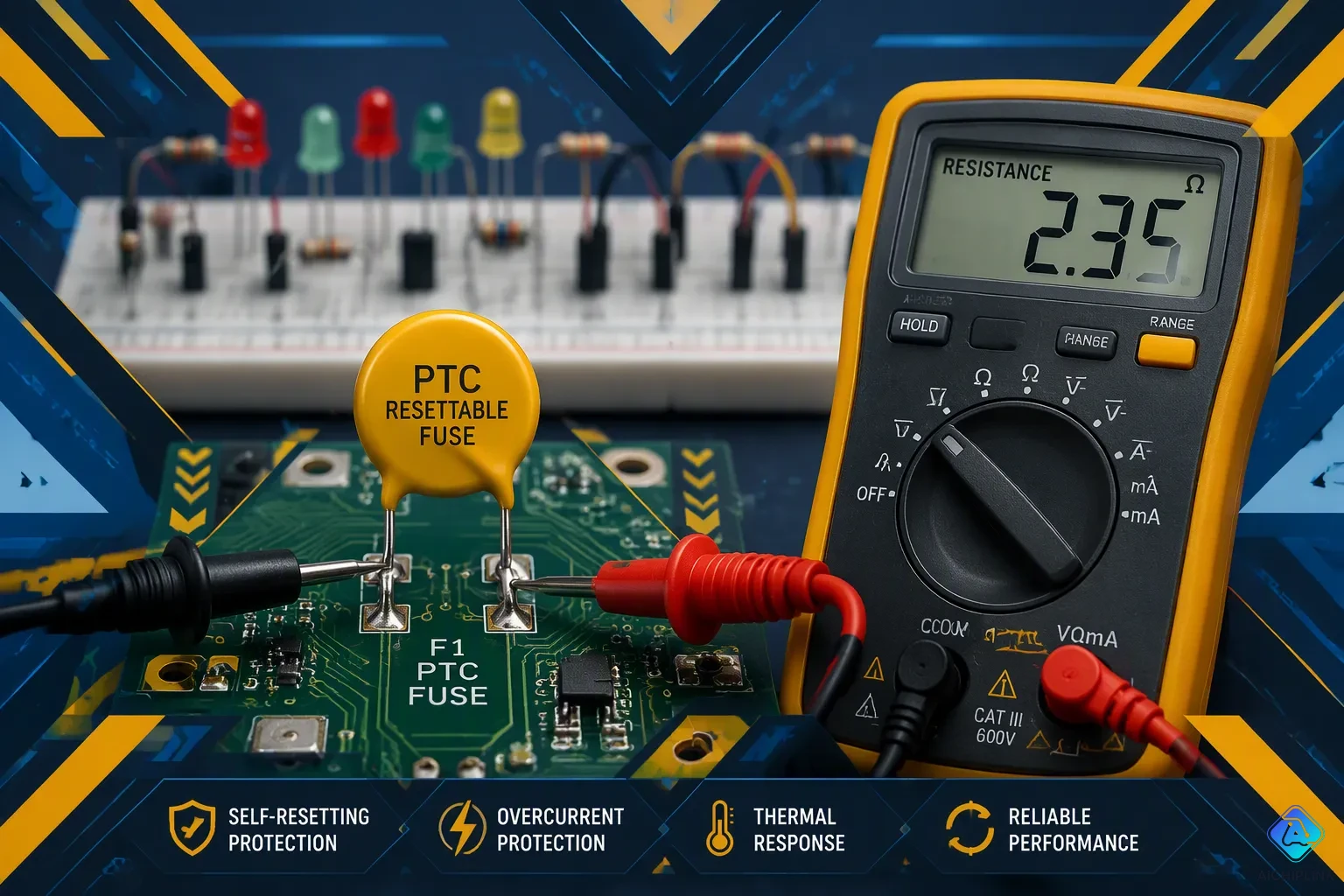
A ptc resettable fuse uses a special polymer inside. This polymer heats up when too much current flows. Its resistance rises sharply. This stops the electricity flow. This simple mechanism answers how does a resettable fuse work?. This part is not like a standard fuse. It is a passive, self-healing device. You can remove the power. You can clear the fault. The material cools down. The ptc circuit returns to its low-resistance state without manual intervention. Think of a self-closing door. It shuts firmly under pressure. It reopens when the pressure is gone. This ptc technology is very common. Around 45% of modern consumer electronics use it for reliable overcurrent protection. The reusable ptc fuse makes modern gadgets safer and more convenient.
Key Takeaways
-
A resettable fuse uses a special polymer that expands when heated, which breaks the circuit to stop too much current.
-
Once the problem is fixed and the power is turned off, the polymer cools down and shrinks. This closes the circuit again on its own.
-
Regular fuses have to be replaced after they blow, but resettable fuses can be used again and again without anyone swapping them out.
-
Resettable fuses are common in everyday electronics like USB ports, battery packs, and laptops to give steady protection.
-
Temperature changes how the fuse works, so you must pick the right specifications for your environment.
The Core Mechanism of a PTC Resettable Fuse
How Heat Raises Resistance
A positive temperature coefficient describes a material whose resistance climbs as its temperature climbs. That single property drives everything inside a ptc resettable fuse. The heart of the device is a conductive polymer composite. A polymer matrix holds dispersed conductive particles, such as carbon black or graphite. At normal temperature, these particles sit close together. They form continuous conductive chains. Current passes through with ease, and the device shows low resistance.
Now picture what happens during an overcurrent event. Excess current creates resistive heating, known as I²R heating. The polymer matrix warms up. As it warms, it expands thermally. The spacing between conductive particles grows. The conductive chains stretch and break apart. The conductive network collapses. Resistance jumps sharply, often by 10³ to 10⁶ times, within milliseconds. The ptc device now blocks the flow of electricity.
Positive temperature coefficient (PTC) thermistors are important electronic components used as over-current protectors, self-regulating heaters, and resettable fuses in electric circuits. Their electrical resistance sharply increases with rising temperature, showing a typical PTC phenomenon resulting from the abrupt breakdown of the conductive network at elevated temperatures.
You can follow the full sequence in order:
-
Normal state: conductive particles form a low-resistance network.
-
Heating: an overcurrent, short circuit, or motor stall raises the device temperature.
-
Expansion: the polymer matrix expands thermally.
-
Network breakdown: expanded spacing separates the particles and disrupts the conductive paths.
-
Resistance rise: resistance increases sharply within milliseconds, limiting current to a safe leakage level of typically tens of milliamps.
-
Reset: when the fault clears and the device cools, the polymer contracts, the chains reform, and low resistance returns.
The Trip Point Explained
The trip point is the current level at which heating outpaces cooling. Every ptc resettable fuse carries a current rating. Below that rating, the heat generated inside the device escapes into the surroundings at the same rate it builds. The temperature stays stable. The fuse stays conductive.
Cross the rating, and the balance tips. Heat builds faster than the device can shed it. The polymer climbs past its transition temperature. At that point, its crystalline structure changes phase. This phase change produces a sudden volume expansion. The expansion makes tripping quick and predictable once you cross the threshold. The sharp, non-linear resistance jump limits the current to a small, safe leakage level.
Two details matter here. First, response time ranges from microseconds to seconds, depending on how far the overcurrent exceeds the rating. Second, trip characteristics vary with ambient temperature. A hot environment pushes the device toward its trip point sooner. A cool one delays it. This behavior explains how does a resettable fuse work? under real conditions. The device reacts to heat, not to a fixed current alone. After you remove power and clear the fault, the ptc cools and returns to its initial state without manual operation.
How Does a Resettable Fuse Work vs. a Traditional Fuse?
One-Time vs. Self-Healing
A traditional fuse has a thin piece of metal inside. That metal melts when too much current passes through. This breaks the circuit for good. You have to put in a new fuse before the device can work again. A ptc resettable fuse works in a different way. It uses a reusable polymer instead of a metal strip that gets thrown away. The polymer changes its resistance and then recovers on its own. You do not need to replace it.
This difference changes how you use the device. A traditional fuse only works once. After it trips, the circuit stays open until you put in a new one. A resettable fuse resets by itself when you turn off the power and fix the problem. The device cools down, shrinks, and goes back to its low‑resistance state. You avoid the work and lost time of swapping parts.
When Each Type Makes Sense
Your choice depends on what you are using it for. A resettable fuse works best in consumer electronics, telephones, and battery protection systems. These places often have parts that are hard to reach and many small overloads. The higher upfront cost pays off because you need fewer service calls and less manual replacement over the product’s life.
A traditional fuse is still better in some cases. Look at these conditions:
| Condition | Preferred Protection |
|---|---|
| Sensitive electronics | Traditional fuse |
| High fault current applications | Traditional fuse |
| Overcurrent events are rare | Traditional fuse |
| Replacement is acceptable | Traditional fuse |
Traditional fuses are still best when you need a clear, one‑time break in the circuit for safety rules. Resettable fuses are chosen when the ease of automatic recovery is more important than a hard, permanent stop.
Many designs use both types together. A traditional fuse acts as a backup for very bad faults behind a resettable device. The resettable part handles normal, fixable overloads. The traditional fuse handles the rare, dangerous surges. This mix gives you both convenience and strong safety in one circuit.
Inside the PTC Device: Construction and Reset
Layers and Materials
You can think of the ptc device as a sandwich. A polymer core sits between two metal electrodes. The outer electrode is a copper foil layer. The inner electrode is a silver paste layer. This double-sided electrode setup gives you steady contact on both sides.
The polymer core mixes semi-crystalline EVA and amorphous PVAc. Manufacturers add cheap graphite as the conductive filler. They also add cellulose nanofiber, or CNF, as a hybrid filler. One example mix is PVAc0.4/EVA0.6/GP-3wt.% CNF. This blend has a Curie temperature of 29.4 °C. That number marks where the material's behavior changes.
Manufacturers build the conductive particle network in a few ways. High-shear mixing blends the filler above the polymer melt point. Extrusion and injection molding shape thermoplastic matrices filled with copper. Screen printing puts conductive pastes onto substrates. Each method aims for the same goal: an even particle spread inside the polymer.
The Reset Cycle Step by Step
The reset cycle follows a clear order. First, you cut the power from the circuit. Second, you clear the fault that caused the overcurrent event. Third, you turn the power back on. The ptc device now cools and goes back to its low-resistance state.
The trip event does not permanently harm the device. The polymer expands during the trip. It shrinks again during cooling. The conductive chains break apart and then form again. This reversible process is the whole point of a ptc resettable fuse. You get protection without swapping a part.
A traditional fuse gives up its metal element. A ptc device keeps its polymer core whole. That difference saves you time and money. You just fix the fault and restore power. The ptc fuse takes care of the rest on its own.
Key Specs and Practical Applications
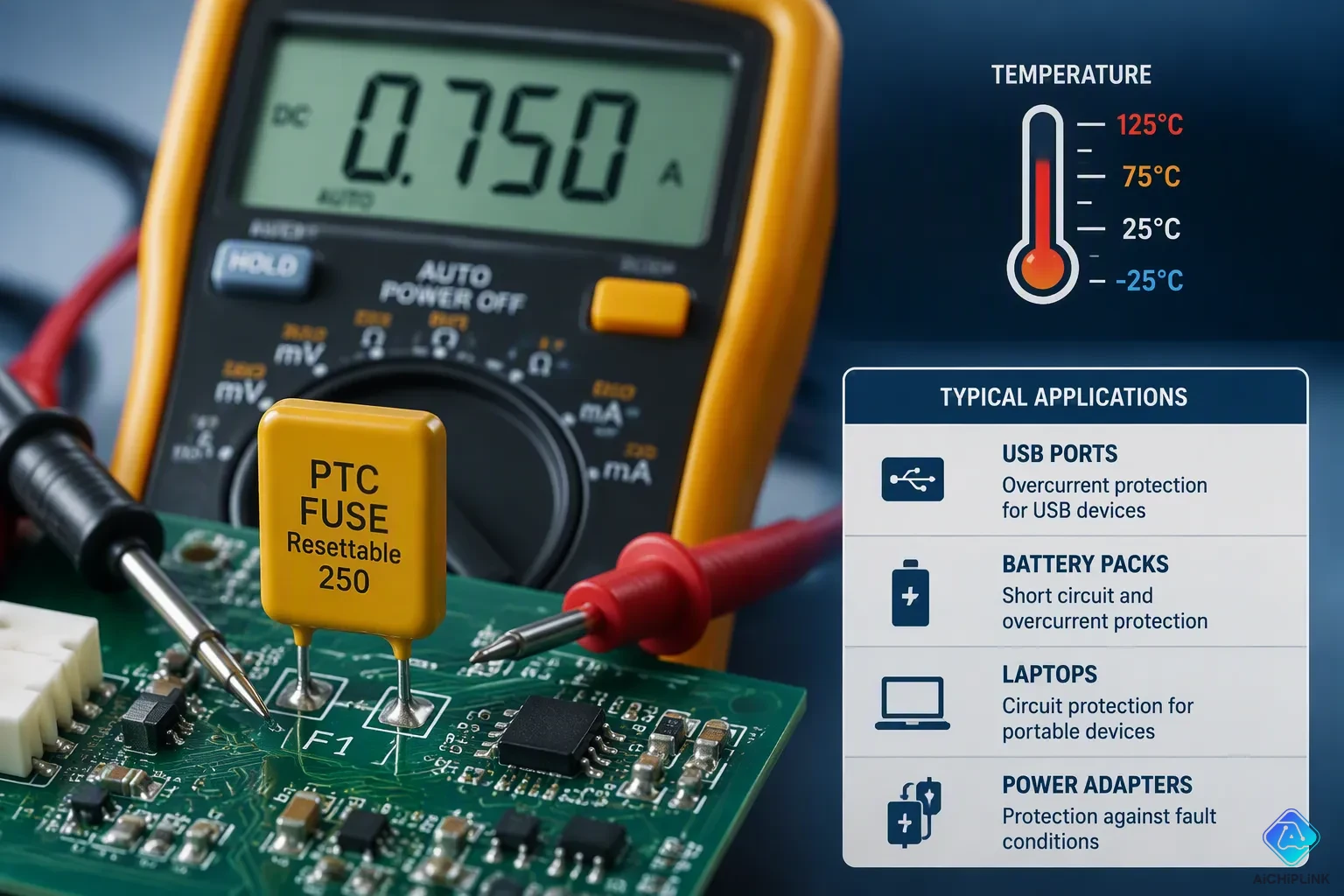
Hold Current and Trip Current
Two numbers show how a ptc resettable fuse acts in your circuit. The hold current (Ihold) is the most current the device can carry forever without tripping. The trip current (Itrip) is the level that pushes the fuse into its high-resistance state. Think of hold current as the floor of normal operation and trip current as the ceiling that triggers protection.
Temperature changes both values. A device rated at 1.0 A hold current at +20 °C drops to 0.5 A at +80 °C. At -20 °C, that same part holds 1.3 A. Heating above 20 °C cuts hold and trip current by a factor of 0.5. Cooling below 20 °C raises them by a factor of 1.3. You must derate the part for hot enclosures.
Other specs matter too. Voltage rating sets the most circuit voltage the device can block safely. Time-to-trip tells you how fast the ptc reacts. At twice the hold current, a typical part trips in about 2 seconds. At four times the hold current, that time drops to roughly 0.3 seconds. When you learn how to choose the right ptc resettable fuse, you match these specs to your load.
Common Uses in Electronics
You will find this overcurrent protection device in many places. USB ports and chargers rely on it to guard phones and tablets. Battery packs for lithium-ion cells use it to stop runaway discharge. Laptops, power banks, and gaming devices all carry ptc parts on their boards.
| Device Category | Specific Examples |
|---|---|
| USB Ports and Chargers | Phones, tablets, other electronics |
| Battery Packs | Lithium-ion rechargeable batteries |
| Consumer Electronics | Laptops, power banks, gaming devices |
| Circuit Boards (PCB) | Sensitive components on PCBs |
| Telecommunication Devices | Modems, routers, networking equipment |
| Automotive Electronics | Sensors, infotainment systems, control modules |
| Portable Devices | Wearables, handheld electronics |
Each application faces overcurrent events that come and go. A stalled motor or a shorted cable triggers the ptc. Once you clear the fault, the fuse resets itself. That self-healing behavior saves you from replacing parts by hand.
A ptc resettable fuse protects your circuit without breaking. Heat makes its polymer expand. This expansion stops the flow of electricity. Cooling brings the flow back. You turn off power, fix the problem, and turn power back on. The fuse returns to normal. This works great for electric problems that come and go. Replacing a part by hand is too hard in those cases.
Recent advances push this technology further. New designs handle higher current and voltage with better resistance stability. Ultra-low-profile SMD versions serve car electronics with longer cycling life. Halogen-free, RoHS-compliant series meet green rules. These improvements keep modern electronics safer and more convenient.

Written by Jack Elliott from AIChipLink.
AIChipLink, one of the fastest-growing global independent electronic components distributors in the world, offers millions of products from thousands of manufacturers, and many of our in-stock parts is available to ship same day.
We mainly source and distribute integrated circuit (IC) products of brands such as Broadcom, Microchip, Texas Instruments, Infineon, NXP, Analog Devices, Qualcomm, Intel, etc., which are widely used in communication & network, telecom, industrial control, new energy and automotive electronics.
Empowered by AI, Linked to the Future. Get started on AIChipLink and submit your RFQ online today!
Frequently Asked Questions
What happens when the fuse trips?
When an overcurrent heats a ptc element, its resistance jumps. The ptc resettable fuse changes from a conductor to a blocker. Current drops to a tiny level. You do not need to replace the fuse. It waits for the next cycle.
What is the difference between hold current and trip current?
Hold current is the maximum current the device can carry without tripping. Trip current forces the ptc into its high-resistance state. Your circuit runs normally below hold current.
Does ambient temperature affect a ptc resettable fuse?
Yes. Warm air lowers the hold current. The ptc trip point comes sooner. Cool air delays it. You should derate the ptc for the temperature inside your enclosure.
What is the core idea in one sentence?
When someone asks how does a resettable fuse work?, you can answer with one loop: heat expands the polymer, expansion breaks the conductive path, cooling rebuilds it. The fuse then returns to low resistance.