In the late 1990s, Xilinx changed the world with the Virtex® architecture. It was the first FPGA platform robust enough to challenge ASICs in terms of capacity and performance.
Decades later, the XCV400-5BG560I remains a critical component in the maintenance supply chain. Why? Because industrial systems, MRI machines, and aerospace controllers built 20 years ago are still running today—and they depend on this specific chip.
This guide is for the engineers and procurement specialists tasked with keeping these legacy systems alive. We decode the part number, verify the voltage specs, and navigate the legacy software landscape.
Table of Contents
- 1. Decoding the Part Number: The Original Virtex
- 2. Technical Specifications: A Look Back
- 3. Software Compatibility: The ISE Challenge
- 4. Hardware Considerations: The BG560 Package
- 5. Sourcing Strategy: Avoiding Counterfeits
- 6. Conclusion
1. Decoding the Part Number: The Original Virtex
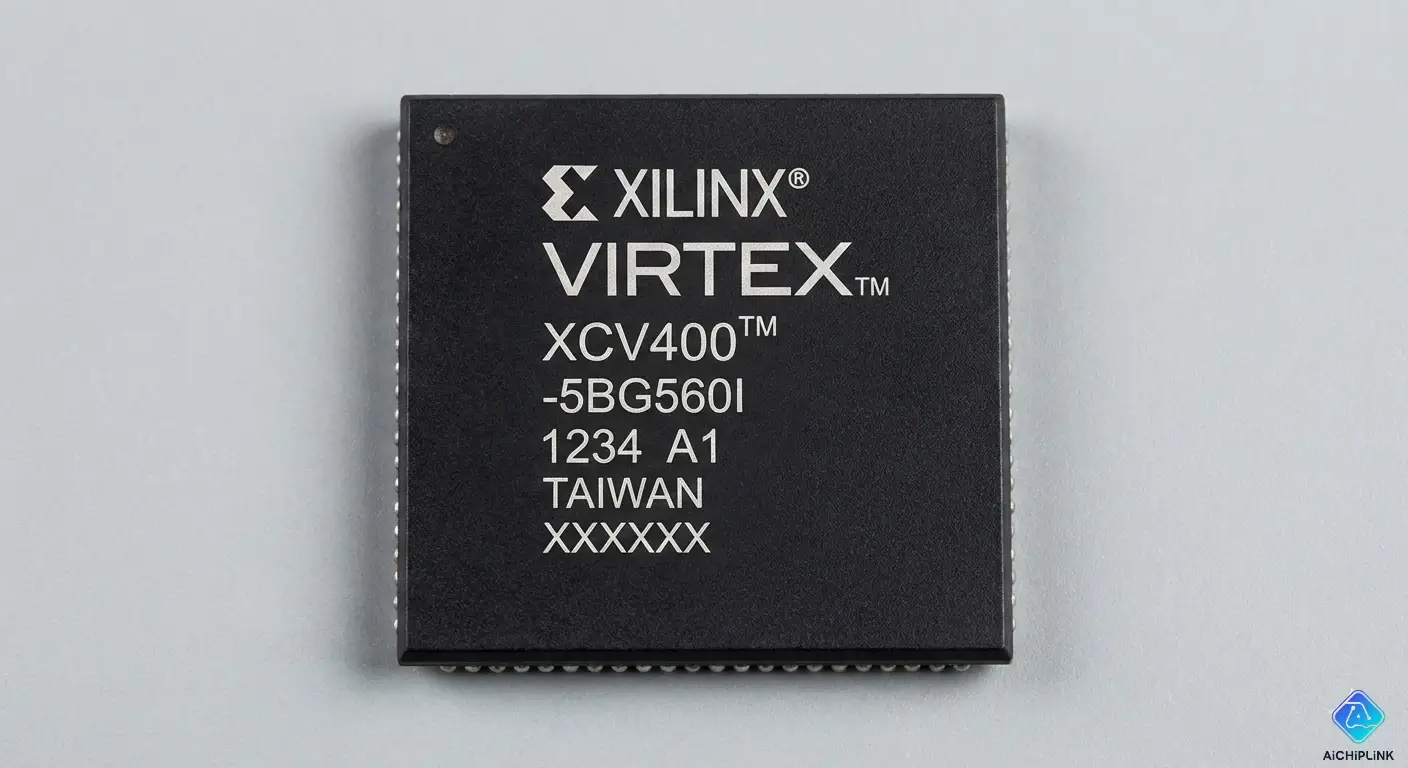
Xilinx nomenclature is precise. Here is the breakdown for XCV400-5BG560I:
The Breakdown Matrix
| Segment | Code | Meaning |
|---|---|---|
| XCV | Virtex Family | This denotes the Original Virtex (2.5V). Note: XCV-E would be Virtex-E (1.8V). |
| 400 | Density | 400,000 System Gates. |
| -5 | Speed Grade | Standard speed. (-6 is faster, -4 is slower). |
| BG | Package | Ball Grid Array (Standard 1.27mm pitch). |
| 560 | Pin Count | 560 Balls. |
| I | Temperature | Industrial (-40°C to +100°C). |
Why the "I" Matters
The "I" (Industrial) suffix is the most valuable part of this code.
- Commercial parts ("C") are rated for 0°C to 85°C.
- Industrial parts ("I") are tested to survive freezing cold and extreme heat.
- Repair Warning: You generally cannot replace an "I" part with a "C" part in medical or aerospace equipment, as it may fail qualification tests or reliability standards during temperature cycling.
2. Technical Specifications: A Look Back
The XCV400 was a beast in its era. It offered a balance of logic and memory that defined the early FPGA market.
- Logic Cells: 10,800
- System Gates: 468,252
- CLB Array: 40 x 60
- Block RAM: 81,920 bits (40 blocks)
- Max User I/O: 404 (in the BG560 package)
- Core Voltage ($V_{CCINT}$): 2.5 V
- Process: 0.22-micron 5-layer metal CMOS.
The 2.5V Criticality
Modern FPGAs run on 1.0V or 0.8V. The XCV400 requires a dedicated 2.5V regulator for its core.
Critical Note: Do not confuse this with the Virtex-E (1.8V) or Virtex-II (1.5V). Supplying 1.8V to an XCV400 will result in a non-functional chip (brownout).
3. Software Compatibility: The ISE Challenge
You cannot use the modern Vivado Design Suite for this chip. Vivado only supports 7-Series (Artix-7, Kintex-7) and newer.
The Tool: Xilinx ISE Design Suite.
- Version: The most stable final version is ISE 14.7.
- The Catch: ISE 14.7 does not run natively on Windows 10/11 well.
- The Fix: Xilinx provides a Windows 10 VM version of ISE 14.7 (which runs inside a VirtualBox Linux container). Alternatively, many engineers keep an "air-gapped" Windows XP or Windows 7 laptop specifically for maintaining these legacy Virtex designs.
Programming Cable: You need a Platform Cable USB II (Model DLC10) or a compatible clone. The older Parallel Port IV cables are essentially obsolete unless you have a legacy PC with a physical LPT port.
4. Hardware Considerations: The BG560 Package
The BG560 is a standard Ball Grid Array.
- Pitch: 1.27 mm. This is a "forgiving" pitch compared to modern 0.8mm BGAs, making rework stations slightly easier to align.
- Moisture Sensitivity (MSL): These chips are likely New Old Stock (NOS) manufactured years ago. They have likely absorbed moisture.
- Action: You MUST bake these chips before reflow soldering (typically 125°C for 24 hours) to prevent "popcorning" (cracking due to steam expansion inside the package).
- Reflow Profile: Since these are older leaded or early lead-free packages, check the specific ball composition. Older XCV parts often used Sn63/Pb37 (Leaded) balls, which have a lower melting point than modern SAC305 lead-free solder.
5. Sourcing Strategy: Avoiding Counterfeits
Since the XCV400 is EOL (End of Life), the market is flooded with "pulls" (used chips removed from e-waste) and re-marked parts.
- Check the Bottom: Look for scratches or flux residue on the BGA balls. "Re-balled" parts often look cleaner than the original factory balls (which oxidize over 20 years).
- Check the Top: Perform an acetone swipe test. If the text wipes off or the black coating smears, it is a fake (blacktopped).
- Date Codes: Be realistic. You are unlikely to find a date code from 2024. These chips were mostly made in the early 2000s.
Procurement Tip: [Check Stock for XCV400-5BG560I at Aichiplink] to find verified legacy inventory from trusted distributors.
6. Conclusion
The Xilinx XCV400-5BG560I is a piece of computing history that refuses to retire. Its robust 2.5V architecture and industrial ruggedness keep it relevant in critical infrastructure globally. While maintaining it requires navigating old software (ISE) and careful soldering practices, it remains the only drop-in solution for its designated socket.
Sourcing Legacy Xilinx FPGAs Need to repair a critical legacy system? Visit Aichiplink.com to search for Virtex XCV400 and other obsolete FPGA components.

Written by Jack Elliott from AIChipLink.
AIChipLink, one of the fastest-growing global independent electronic components distributors in the world, offers millions of products from thousands of manufacturers, and many of our in-stock parts is available to ship same day.
We mainly source and distribute integrated circuit (IC) products of brands such as Broadcom, Microchip, Texas Instruments, Infineon, NXP, Analog Devices, Qualcomm, Intel, etc., which are widely used in communication & network, telecom, industrial control, new energy and automotive electronics.
Empowered by AI, Linked to the Future. Get started on AIChipLink.com and submit your RFQ online today!
Frequently Asked Questions
Is the XCV400-5BG560I still manufactured by Xilinx?
No. The XCV400 series is officially end-of-life (EOL) and only available through legacy or broker channels.
What core voltage does the XCV400 require?
The XCV400 requires a 2.5V core voltage ($V_{CCINT}$). Supplying lower voltages will cause malfunction.
What does the “I” suffix mean in XCV400-5BG560I?
The “I” indicates Industrial temperature range (-40°C to +100°C), suitable for harsh environments.
Which software supports the XCV400 FPGA?
The XCV400 is supported by Xilinx ISE Design Suite, with ISE 14.7 being the final recommended version.
Can a commercial-grade XCV400 replace an industrial one?
No. Commercial (“C”) parts are not rated for extreme temperatures and may fail reliability requirements in industrial or medical systems.

.png&w=256&q=75)