Sensor Level Measurement vs Traditional Methods: A Comprehensive Comparison
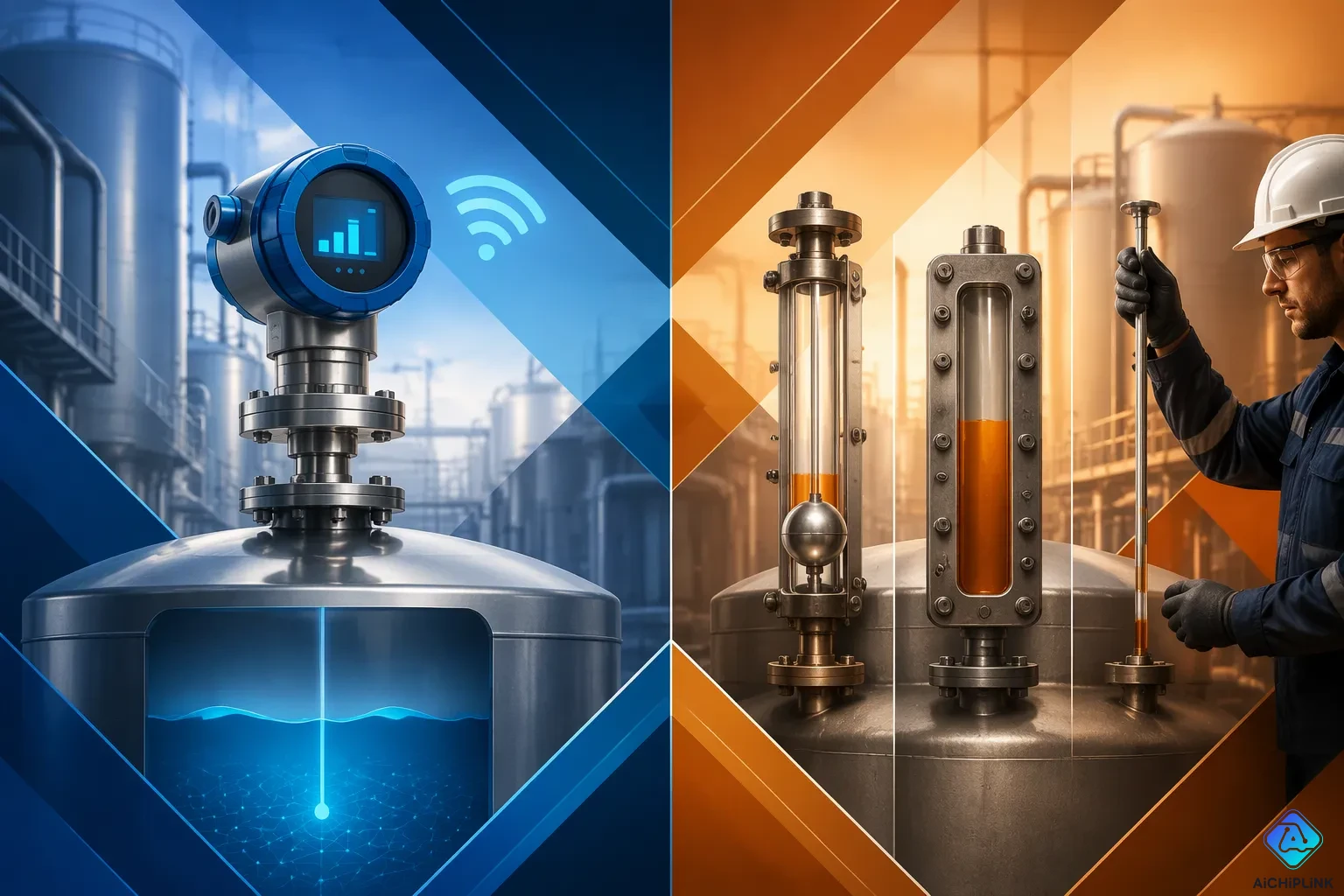
Which approach fits the process: sensor-based level measurement or a traditional method? No single technology wins every case. The right answer depends on the material, the application requirements, and the environmental conditions at the tank or channel. A clean, open vessel and a foaming, pressurized one need different solutions. Material type matters too, since some liquids and slurries work well with non-contact sensing while others do better with direct contact designs. This sensor level vs traditional measurement comparison looks at working principles, performance, installation and maintenance demands, and cost. It then offers guidance for specific applications, so readers can match a method to their own process conditions instead of choosing by habit.
Key Takeaways
-
Sensor methods such as radar and ultrasonic measure from above without touching the liquid. Traditional methods like float and pressure sensors touch the liquid directly.
-
Radar works well in tough conditions like foam, steam, and high pressure. But ultrasonic is good for clean, calm liquids and costs less.
-
Traditional methods often cost less at the start, but sensor methods may save money over time. They need less upkeep and give better accuracy.
-
Pick a method based on your process conditions, accuracy needs, installation limits, and budget—not on habit or the newest technology.
Sensor Level Measurement Explained
Sensor methods are often in the non-contact group. The contact versus non-contact grouping is important here. Contact devices touch the material directly. Non-contact measurement technologies send a signal from above and read the return. This section focuses on the non-contact side, where the instrument never touches the liquid level. That gap keeps the device safe from corrosion and buildup.
Radar Level Measurement Basics
Radar level measurement uses microwave technology. The instrument sends a microwave pulse downward and measures the time until the echo comes back. Radar level transmitters then turn that travel time into a distance reading. A usual setup includes an antenna, a signal processor, and an output module. These radar level transmitters mount at the top of the tank.
Level radar sensors work well with steam, dust, and pressure because microwaves travel through them. Many radar level measurement systems also handle foam better than sound-based designs. A level transmitter radar unit often needs no moving parts, so wear stays low. Non-contact radar sensors suit closed vessels and harsh chemical service. Engineers choose level radar when the process runs hot or pressurized. Level radar handles vacuum service too. Radar level measurement remains a strong fit for continuous readings in demanding plants. Radar level measurement also reports liquid level with high repeatability, and radar level transmitters need little upkeep.
Ultrasonic Liquid Level Sensors
Ultrasonic liquid level sensors rely on high-frequency sound waves. The device sends a sound pulse and times the echo. Ultrasonic level measurement depends on that echo timing to compute distance. Ultrasonic level sensors include a transducer, a timing circuit, and a controller. These ultrasonic level sensors mount above the surface and never touch the product.
Ultrasonic level sensing struggles with foam, heavy dust, and strong turbulence, which scatter the sound. A non-contact measurement solution based on sound also shifts with temperature, so many units include compensation. Ultrasonic liquid level sensors fit open channels and simple tanks. A non-contact measurement approach with sound often costs less than radar. Ultrasonic level sensors serve water and wastewater duties well. Plant teams pick ultrasonic level sensors for clean, calm liquids.
Traditional Water Level Measurement Methods
Traditional water level measurement methods usually depend on contact. The sensing part touches the liquid or sits inside the tank. That direct contact affects how each design works, what it measures well, and where it has problems. Three main principles cover most of this: float, pressure, and capacitance.
Float, Pressure, and Capacitance Principles
A float device uses buoyancy. The float moves up and down with the liquid surface, and a linkage or magnet turns that motion into a reading. Sino-Insts describes the float-type sensor as simple in structure and easy to debug. The same source notes that viscosity, impurities, and magnetic substances can affect it, and that its detection accuracy is low. Float designs are still common in sumps, tanks, and simple water management systems where a rough reading is enough.
A pressure sensor measures hydrostatic head. The pressure from a liquid column is proportional to its height, so a submerged probe reads higher pressure as the level rises. Sino-Insts gives the relation as P = ρ × g × H + Po, where P is the pressure at the transmitter, ρ is the liquid density, g is local gravitational acceleration, Po is atmospheric pressure at the surface, and H is the immersion depth. The instrument turns that pressure into an electrical signal and reports depth. Submersible level gauges use exactly this approach.
Capacitance sensing treats the probe and a second electrode as the two plates of a capacitor. ABB explains that process fluids generally have dielectric constants far from that of air, which is very close to 1.0. Oils range from 1.8 to 5, pure glycol is 37, and aqueous solutions fall between 50 and 80. As liquid rises and fills more of the gap, the overall capacitance rises proportionately. Pokcenser Tech expresses the relationship as C = ε × A / d, where A is plate area, d is the distance between plates, and ε is the dielectric constant of the material between them. A capacitance bridge circuit measures the change and gives a continuous reading.
| Principle | What it senses | Contact with liquid | Typical fit |
|---|---|---|---|
| Float | Buoyancy motion of the surface | Yes | Simple tanks, sumps, on/off control |
| Pressure | Hydrostatic head at a submerged point | Yes | Deep wells, sealed vessels, continuous depth |
| Capacitance | Change in dielectric between electrodes | Yes | Clean liquids, continuous level in tanks |
Key Components and Configurations
These traditional level measurement technologies split into two jobs: point detection and continuous tracking. A point level switch reports one condition, such as high, low, or alarm. A float switch belongs here. It trips when the surface reaches the float, and it suits pump protection and overflow alarms. A continuous level sensor reports the level across the full span. Pressure transmitters and capacitance probes serve this role.
The hardware follows the job. A float switch needs a float, a stem or cable, and a switching mechanism. A submersible pressure transmitter pairs a diaphragm sensor with a cable and a signal conditioner. A capacitance system uses an insulated or uninsulated rod, a reference electrode or the vessel wall, and a bridge circuit. Each setup has its own installation rules. Traditional measurement methods reward careful mounting, because the sensor must sit where the liquid actually reaches it.
Sensor Level vs Traditional Measurement
The two families differ first in how they touch the process. Sensor methods like level radar and ultrasonic level sensors read the surface from above, so no part goes into the liquid. Traditional level measurement uses contact instead. A float rides the surface, a pressure probe sits underwater, and a capacitance rod gets its plates wet. Traditional measurement designs all share that direct-contact trait, and it leads to corrosion, buildup, and wear. Each choice then brings different results for upkeep and for the quality of data a control system gets.
Principle and Environmental Resistance
Foam, dust, turbulence, temperature, and pressure test each design in different ways. Icon Process Controls notes that radar finds liquid level reliably even with foam present, because microwaves pass through the layer and bounce off the denser liquid below. Ultrasonic level sensors depend on sound bouncing off a clean surface. Foam can make them read the foam layer itself or lose the echo in false returns. Dense vapor blocks sound in much the same way. Radar level measurement holds up in vapor-heavy, dusty, hot, and high-pressure service. Mechanical floats often corrode or stick in harsh conditions. Floats can handle some turbulence, yet they wear out fast in corrosive service and offer limited resolution. Submersible probes suit applications with little vapor and foam, yet they need direct contact with the fluid. Radar suits extreme temperatures and high-pressure applications, while ultrasonic units struggle in high-temperature tanks. Dust rarely troubles a radar beam, and extreme temperature or pressure leaves the reading intact. A plant that needs non-contact measurement should weigh these limits before picking a device, and the sensor level vs traditional measurement question often turns on exactly this point.
Accuracy, Range, and Installation
Accuracy separates the options in practical terms. Float and dye markers usually deliver plus or minus 1% to plus or minus 5%, according to C&D Sentec. Mechanical gages do better at plus or minus 0.5% to plus or minus 1%. Sensor-based instruments generally tighten measurement accuracy further, though the final figure depends on the technology, the mounting, and the process. This accuracy and reliability comparison matters most where billing, dosing, or safety depends on the reading, and it sits at the heart of any sensor level vs traditional measurement review.
| Method | Typical accuracy |
|---|---|
| Float and dye markers | ±1–5% |
| Mechanical gages | ±0.5% to ±1% |
Range and installation demands also differ. Radar level transmitters mount at the top of a tank and need a clear path to the surface. Sound-based units follow the same rule but need a cleaner acoustic environment. Submersible probes drop into the vessel and need a cable path and a sealed entry. Float switches sit where the trip point falls. Tall or deep vessels favor non-contact designs, because a long probe becomes awkward to install and service. A wide measuring span also favors radar, which reads a tall vessel from a single top-mounted point. Calibration needs vary too, and each routine protects measurement accuracy over time. A float switch often needs only a position check, while a capacitance probe needs a baseline reading in air and in liquid. Radar units usually arrive factory-calibrated and need little field adjustment. Traditional measurement devices often reward periodic inspection, since buildup and wear shift their readings over time.
Maintenance and Cost Comparison
Installation, Calibration, and Upkeep
Setting up the two families takes very different amounts of work. A float switch drops into a sump with little trouble. A guided-wave radar needs careful spacing, and Sino-Insts lists the rules: keep the probe at least 300 mm from the tank wall, leave 30 mm between the probe tip and the tank bottom, and hold 200 mm of clearance from internal obstructions. A rod probe reaches 6 meters, and longer spans call for a 4 mm cable probe. Technicians must also keep the probe out of the fill stream and fit a sun shade outdoors.
Calibration works the same way. A guided-wave unit needs no filled tank; the technician enters empty and full points, selects the medium and probe type, and checks one manual dip, per Sino-Insts. Radar level transmitters often come factory-calibrated, so field work stays light. Ultrasonic level sensors need a clean sound path and temperature compensation to keep measurement accuracy. Icon Process Controls stresses a stable power supply, shielded cables, and routing away from high-power equipment, since electrical noise can cause bad readings or sensor failure. The same source advises regular checks for drift and buildup, plus a comparison with a manual dip every 6 to 12 months for guided-wave units.
Upfront Cost vs Total Cost of Ownership
The purchase price tells only part of the story. Kyueinstruments publishes a comparison that tracks purchase, installation, and ten-year maintenance together. A float switch costs about $50 to buy and roughly $300 over ten years. Level radar runs about $2,000 upfront and near $3,800 across a decade. Ultrasonic sits between them at roughly $1,900 total.
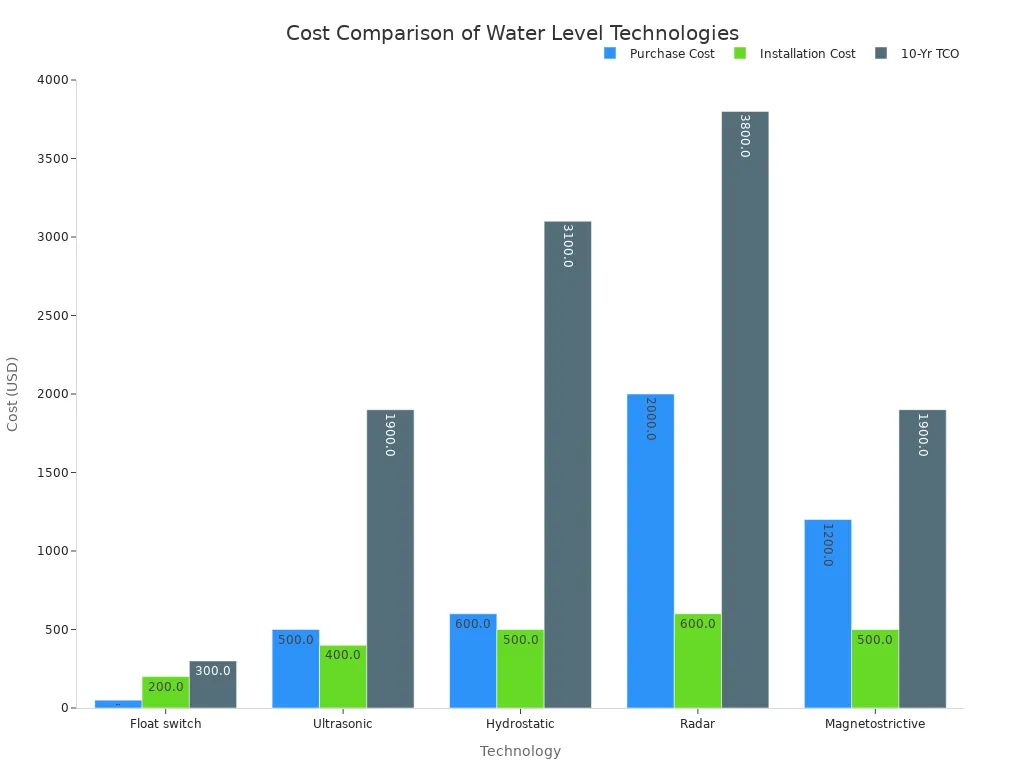
Yearly upkeep changes the math even more. Kyueinstruments puts ultrasonic and radar cleaning at $50 to $200 per year, while hydrostatic sensors need $100 to $300 yearly for calibration. Float switches need only occasional cleaning. Installation labor adds $200 to $800 per sensor, and a stilling well adds $150 to $500. Buyers should weigh the full decade, not the invoice.
Choosing the Right Water Level Measurement
Process Conditions and Industry Fit
The process itself should guide the choice. Actsensors matches sensor types to conditions and industries. Ultrasonic level sensors work well in hazardous or corrosive places, river and reservoir monitoring for flood control, petrochemical storage, manufacturing vats, water treatment, and oil and gas. They win there because they never touch the liquid, cover a wide distance range, and lower maintenance and contamination risk. Optical sensors fit sterile rooms, pharmaceutical bioreactors, food and beverage bottling, and semiconductor chemical lines. Radar handles extreme temperature, pressure, vapor, and gas, so it serves petroleum storage, wastewater treatment, and reactive chemical service. Capacitance units fit chemical processing, bulk solids, slurries, and corrosive fluids.
| Industry or Condition | Fitting Method | Reason |
|---|---|---|
| Corrosive or hazardous fluids | Non-contact radar and ultrasonic | No contact with the liquid |
| Dust, vapor, heat, pressure | Level radar | Reliable in harsh service |
| Clean water, general industry | Ultrasonic level sensors | Low cost, easy install |
| Sterile or clean rooms | Optical | No contamination risk |
| Slurries and bulk solids | Capacitance | Handles varied dielectrics |
Point versus continuous needs settle the rest. A high-level alarm or pump trip calls for a float switch. A full-span reading calls for a continuous device. This sensor level vs traditional measurement choice shapes operational efficiency and measurement accuracy alike. A plant that needs water level monitoring across a deep well should favor a continuous design. A simple sump needs only a switch.
Compliance and Budget Considerations
Rules narrow the field. Mirelay notes that food, beverage, dairy, and pharmaceutical work needs wetted materials that meet FDA regulations, and many of those cases also call for 3-A Sanitary Standards on surface finish and cleanability. An IP rating defines dust and water resistance, and IP67 or IP68 suits wet or wash-down areas. Hazardous locations require ATEX or NEC Zone certification. Pokcenser Tech adds that ATEX certification is mandatory where explosive atmospheres exist, and that CE marking, ISO certifications, and RoHS compliance affect safety and legal operation.
Budget then sets the final frame. Actsensors lists float sensors at $50 to $300, capacitive units at $100 to $500, ultrasonic level sensors at $200 to $1,000, and radar level transmitters at $500 to $2,000 or more. Industrial Monitor Direct advises a standard tank above 2 m diameter to use ultrasonic for the best cost-to-performance ratio. Tanks with foam or vapor favor 80 GHz level radar despite the higher price. Budget-constrained sites with maintenance access can pick hydrostatic pressure sensors for the lowest installed cost. Icon Process Controls sums up the trade-off well: affordable sensors fit less critical duties, and premium units fit critical processes that demand high accuracy and durability. A sound water level measurement technology plan weighs the decade, not the invoice. That approach keeps any level measurement solution honest about total value.
A good choice begins with the process, not the product. Teams should first list the material type, temperature, pressure, foam, and turbulence at the measuring point. They then weigh accuracy and range needs, installation limits, maintenance capacity, rules, and budget. This order keeps the sensor level vs traditional measurement question based on real conditions.
Each family does well somewhere. Radar and ultrasonic level sensors are great in non-contact, harsh, or clean service. Floats, pressure probes, and capacitance units stay reliable, low-cost choices for simple tanks and point alarms. The best fit wins, not the newest or the cheapest option. Readers should take this comparison criteria to their own vessel, score each candidate, and confirm the pick with a site trial.

Written by Jack Elliott from AIChipLink.
AIChipLink, one of the fastest-growing global independent electronic components distributors in the world, offers millions of products from thousands of manufacturers, and many of our in-stock parts is available to ship same day.
We mainly source and distribute integrated circuit (IC) products of brands such as Broadcom, Microchip, Texas Instruments, Infineon, NXP, Analog Devices, Qualcomm, Intel, etc., which are widely used in communication & network, telecom, industrial control, new energy and automotive electronics.
Empowered by AI, Linked to the Future. Get started on AIChipLink and submit your RFQ online today!
Frequently Asked Questions
Does foam really rule out ultrasonic sensors?
Foam scatters sound waves, so an ultrasonic unit may read the foam layer instead of the liquid. Radar handles foam better because microwaves pass through the layer and bounce off the denser liquid below. A foaming vessel therefore favors radar, while calm liquids suit ultrasonic sensors.
Can a float switch replace a continuous level sensor?
No. A float switch reports one condition, such as a high alarm or a pump trip. A continuous device reports the level across the full span. A sump needs only a switch, but a deep well needs a continuous design.
How often should a plant check level readings against a manual dip?
The article cites a comparison with a manual dip every 6 to 12 months for guided-wave units. Buildup and wear shift traditional readings over time, so periodic inspection protects accuracy. Radar units usually arrive factory-calibrated and need little field adjustment.
Which method costs less over ten years?
A float switch runs about $50 to buy and roughly $300 across a decade. Level radar costs about $2,000 upfront and near $3,800 over ten years. Ultrasonic sits between them at roughly $1,900 total. Yearly cleaning and calibration fees widen the gap further.
What certifications should a buyer confirm before ordering?
Food, beverage, dairy, and pharmaceutical work needs wetted materials that meet FDA regulations, and many of those cases also call for 3-A Sanitary Standards. Wet or wash-down areas need IP67 or IP68. Explosive atmospheres require ATEX or NEC Zone certification.