DIP Switch Types Functions and Applications
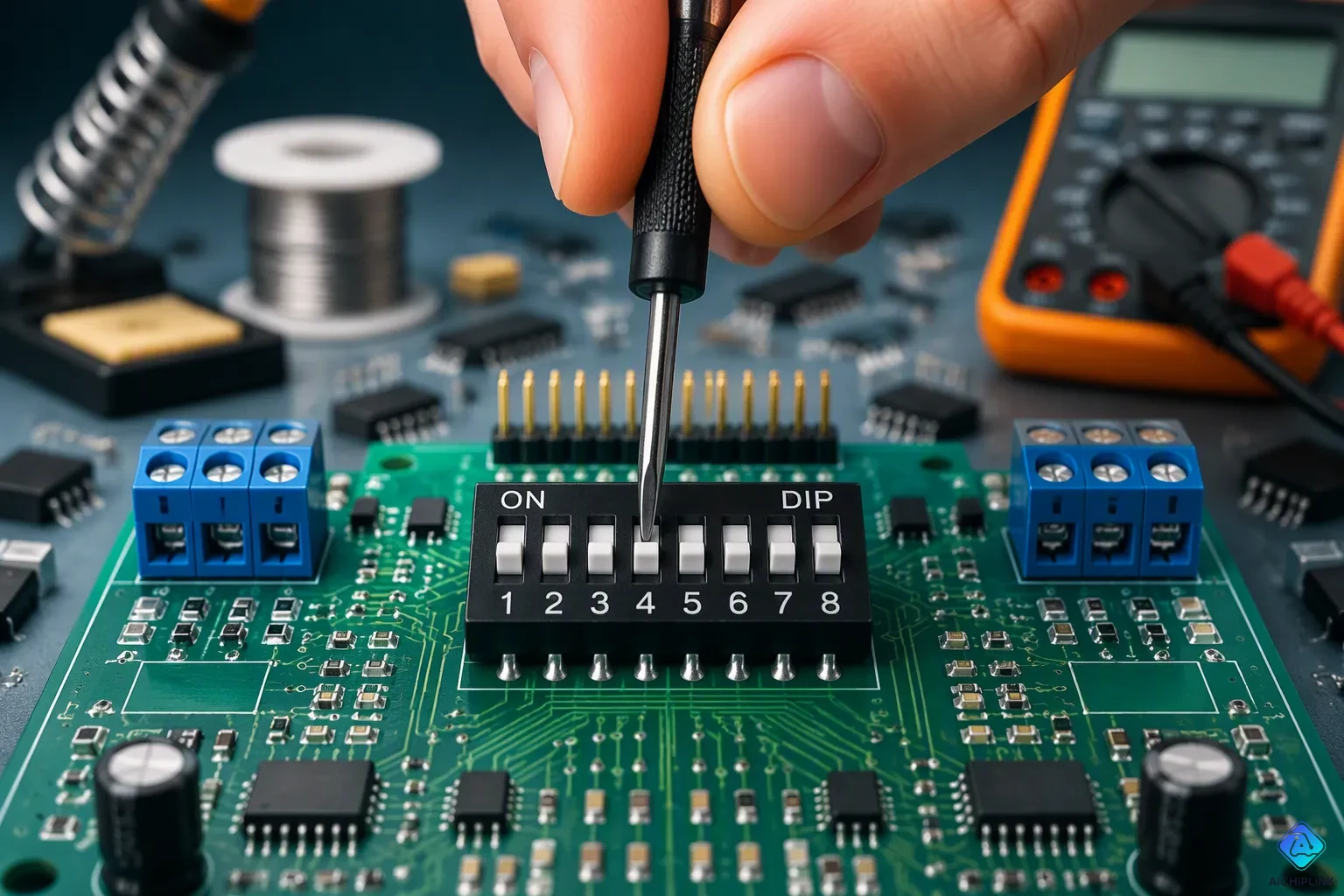
A DIP switch is a small module you operate by hand to set up hardware. Its name comes from dual in-line package switch, which describes how it is laid out. Each package holds a set of tiny switches. You set binary states for device addressing, baud rates, or operating modes. The three main ways to operate them are sliding, piano, and rotary. Common kinds include rocker, IC, SMD, and BCD types. These dip switches come in several electrical ratings, such as SPST, SPDT, and DPDT. You will learn how each type works and where to use them.
Key Takeaways
-
DIP switches set hardware states by hand. They keep settings without software.
-
Common types include slide, rocker, piano, rotary, and SMD. Each type fits different needs.
-
Use DIP switches for device addresses, baud rates, and operating modes. They give reliable fixed settings.
-
Pick the right switch by looking at its positions, actuator style, and environment. Stay away from wrong positions and dust problems.
DIP Switch Basics
Definition and Construction
A dual in-line package switch is named for how it looks. Its pins are in two rows that run side by side, like a typical integrated circuit. This layout allows you to put the part right onto a circuit board. Inside, several pieces work together to make or break electrical connections.
| Component | Function |
|---|---|
| Cover | Connects to base to protect internal mechanisms |
| Strikers | Set to ON/OFF with fine-tip implement; applies contact force to wiper for stable contact |
| Wiper | V-shaped moving contact; moves with striker to open/close connection between two contacts |
| Contact Terminal | Built into base; two types: PCB insert-hole and surface-mount |
| Base | Molded with contact terminal as single unit; protects inside with cover |
You move each DIP switch position by hand. A small lever or toggle makes or breaks the internal connections. When the contacts touch, electricity flows. When they separate, the circuit stops. The outer case keeps these parts safe and stops short circuits. The pins often have tin or gold plating over bronze to avoid rust. Some types, like the CTS 219G, use gold terminals for surface-mount boards.
Package Sizes and Pin Configurations
DIP switches come with 1 to 12 positions. Common sizes are 4 and 8 pins, and 8-pin is the most popular. The usual pin distance is 2.54mm (0.100"). Through-hole types have a standard row width of 7.62mm (0.300"), which fits narrow DIP chip bodies.
You can mount them in two ways. Through-hole parts go into drilled holes and work well for testing or socket setups. Surface-mount parts solder right onto the board and take up less room on crowded boards. How long they last depends on the type. Rotary Gray-coded switches last at least 100,000 uses. Slide switches usually last between 20,000 and 50,000 uses. Pick a type that fits how often you plan to change settings.
Common DIP Switch Types
Slide, Rocker, and Piano Types
Slide dip switches, rocker types, and piano dip switches are all part of the traditional toggle family. You work them by moving a small actuator with your hand. Slide dip switches use a flat blade that moves side to side. Rocker and piano dip switches have raised keys that rock up and down like tiny piano keys. This design gives a satisfying flipping action. It also makes them easier to use for people with larger fingers. That comfort edge matters in recessed enclosure areas.
| Aspect | Slide DIP Switch | Piano (Rocker) DIP Switch |
|---|---|---|
| Actuator type | Flat blade that slides side to side | Raised keys that rock up and down |
| Market position | Industry default; leads the market | Less common variant |
| Cost & size | Small and low in cost | Similar contact life |
| Configurations | 2- to 12-position; 2.54 mm pitch (through-hole), 1.27 mm pitch (SMD) | Not specified |
| Accidental actuation | Most likely to flip by accident during PCB handling | Raised keys lower the risk of accidental actuation |
| Tactile feel | Standard flat-blade feel | More tactile; easier to use with a fingertip or small tool |
| Contact life | 1,000–2,000 operating cycles | 1,000–2,000 operating cycles |
These types come in normally open (NO) and normally closed (NC) variants. Three-stage versions give you three selectable positions, often On/Off/On, with the middle position as default. You can also pick multiple pole/throw configurations. SPST is the simplest, with a single connect/disconnect. SPDT lets you choose between two terminals that are never connected together. DPDT uses two SPDT switches driven by a single actuator to control two circuits together. Module sizes range from 1–2 switches up to 16 or more, with common setups like 2, 3, 4, 8, and 10 position variants. Even though software control panels and programmable chips have made these dip switches less common in some modern uses, they still work well for industrial settings and circuit testing workflows.
Rotary, IC, and SMD Variants
Rotary dip switches work in a different way. You turn a small screwdriver slot to pick a position. Rotary BCD switches make a binary-coded decimal output that matches rotary positions 0–9. The truth table defines which output pins are active for each position. This design lets a microcontroller read the BCD value from the lower 4 bits. Rotary dip switches offer outputs in BCD or hexadecimal formats. BCD gives a coded decimal output from 0 to 9. Rotary Gray-coded switches last at least 100,000 uses, making them great for settings you change often.
IC and SMD variants are made for high-density boards. SMD dip switches bring several advantages to crowded PCB designs.
| Advantage | Detail |
|---|---|
| Ultra-miniature footprint | 1.27 mm half-pitch allows higher component density |
| SMT assembly support | Works with standard SMT flows and automated pick-and-place |
| Contact reliability | Gold-plated bifurcated contacts give low, stable contact resistance |
| Reflow/cleaning compatibility | Top-tape sealed housing allows reflow soldering and aqueous cleaning |
| Electrical suitability | Contact ratings up to 50 V DC, 100 mA for configuration and low-power logic |
| Service life | Mechanical and electrical life of 1,000 cycles |
| Design flexibility | Available in 2, 4, 6, 8, and 10 position variants |
| Production scalability | Tube and tape-and-reel packaging options |
SMD types cut PCB space by up to 46% compared to traditional 2.54 mm pitch solutions. They stand only 2.2 mm tall. Their half-pitch 1.27 mm design supports high-density layouts. Gullwing and J-bend terminations improve automated SMT assembly. This lowers manufacturing complexity and cost. The operating range spans -40 °C to +85 °C. Initial contact resistance stays at or below 100 mΩ. These dip switch types suit address and low-power logic switching. IC types pack multiple positions into a single in-line package for even tighter integration.
DIP Switch Function and Operation
Electrical Configurations (SPST, SPDT, DPDT)
An SPST switch closes a circuit with one simple action. Two terminals sit inside the dip switch, and the actuator either connects them or pulls them apart. When the contacts touch, current flows. When they separate, the circuit opens. This on/off behavior makes the SPST the most common dip switch function for power control, reset buttons, and basic electronic equipment.
SPDT and DPDT configurations handle more complex routing. An SPDT switch has three terminals and lets you pick between two signal paths or operating modes. A DPDT switch controls two separate circuits at once with six terminals, which works well for motor reversal or stereo audio routing. The table below compares these three types.
| Switch Type | Poles × Throws | Terminals | Typical States | Applications |
|---|---|---|---|---|
| SPST | 1 × 1 | Two (C and NO/NC) | ON/OFF | Power switches, simple lights, battery control |
| SPDT | 1 × 2 | Three (C, NO, NC) | Two positions | Change-over circuits, power source selection |
| DPDT | 2 × 2 | Six (2 × C, 2 × NO, 2 × NC) | Two positions | Motor reversal, redundant signaling |
Picking the right switch means balancing what it can do with keeping things simple. The best designs use the simplest component that gets the job done.
Mechanical Operation and Ratings
Contact material drives long-term reliability. Gold resists the oxide and sulfide films that disrupt low-energy circuits, so it suits microcontroller inputs and instrumentation signals. Silver carries higher current with low initial resistance, but sulfur compounds in the air can raise contact resistance over time. Match the material to your load type.
Current and voltage ratings vary widely across dip switch models. Some parts handle 5A at 250VAC, while others rate only 0.1A at 24VDC. A 25 mA rating at 24 VDC applies when the switch state changes often, and 100 mA at 50 VDC applies to a constant state. These ratings are not interchangeable. Actuator force also matters, since stiff levers resist accidental flips but tire your fingers during frequent adjustments.
Common DIP Switch Applications
You find dip switches in many devices. They set hardware setups without using software. You slide a lever or turn a knob. This section covers common dip switch uses in networking and consumer electronics.
Device Addressing and Mode Selection
Networking equipment uses these parts to set device addresses. You set up an I2C or CAN bus node by changing a few positions. Each device needs its own address. You set that address with the dip switch. You also set the baud rate the same way. A three-position dip on an RS-485 module gives you eight settings. The table below shows one common setup.
| S1-1 | S1-2 | S1-3 | Baud Rate |
|---|---|---|---|
| OFF | OFF | OFF | User defined |
| OFF | OFF | ON | 76800 |
| OFF | ON | OFF | 4800 |
| OFF | ON | ON | 9600 |
| ON | OFF | OFF | 19200 |
| ON | OFF | ON | 38400 |
| ON | ON | OFF | 57600 |
| ON | ON | ON | 115200 |
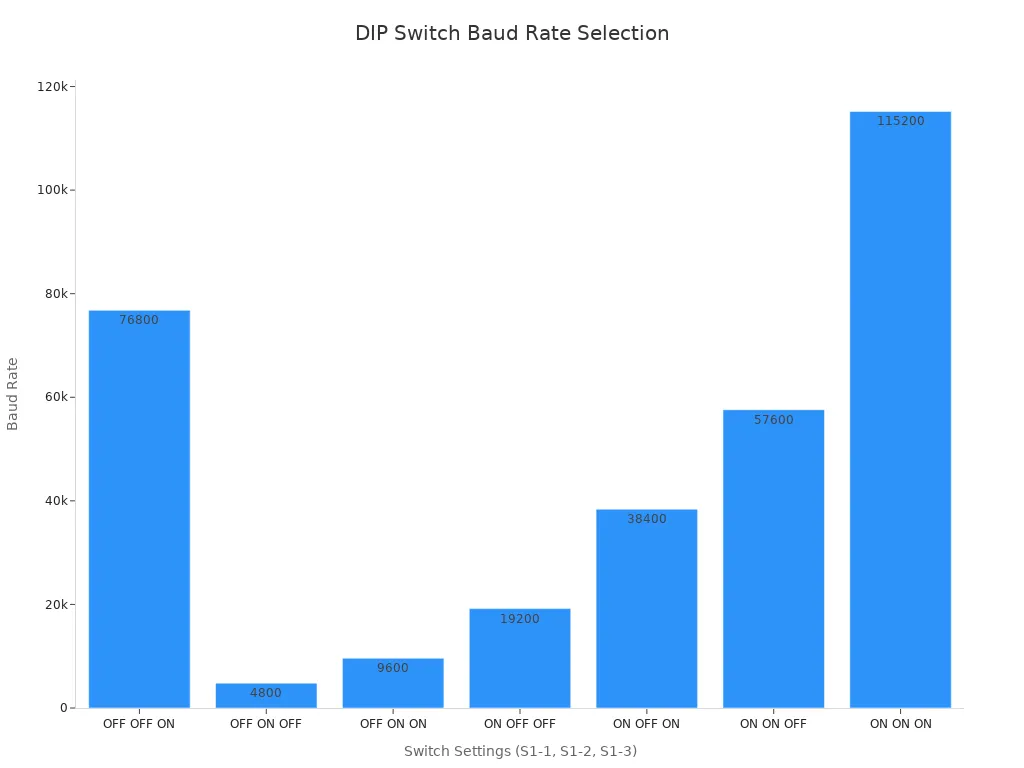
You must set the positions while the device is off. The new rate starts working after you turn the power on. Some modules use six dip positions for both address and baud rate. For example, setting SW1 and SW2 to ON and SW3 through SW5 to OFF gives station number 3. Setting SW6 to ON and SW7 to OFF sets the rate to 38,400 bps. This dual-purpose use is a common use for these devices in industrial networks.
Industrial and Consumer Electronics Use
PLCs depend on the dip for setup. An 8-position dip on a PLC controller sets input ranges, output modes, and communication settings. You change the positions to match your system needs. You write no code. This ease makes the dip a key part in factory automation.
Garage door openers also use this method. You match the remote positions to the ceiling motor positions. The table below shows common brands.
| Brand | Count | Frequencies Used | Logic |
|---|---|---|---|
| Sears Craftsman | 9 | 390 MHz (pre-2005) | Trinary (+, 0, -) |
| Chamberlain / LiftMaster | 9 or 12 | 390 MHz / 315 MHz | Trinary (+, 0, -) |
| Genie (Blue Max) | 9 or 12 | 390 MHz | Binary (ON/OFF) |
| Linear / Multi-Code | 10 | 300 MHz | Binary (ON/OFF) |
| Linear Delta-3 | 8 | 310 MHz | Binary (ON/OFF) |
Example sequence for a 9-position unit: +, -, 0, +, 0, -, -, +, 0. You slide the remote keys to match this sequence.
Consumer electronics such as remote controls also use these parts. You set modes or pairing codes with a few slides. This use covers many home devices you use daily.
DIP switches are being changed for smart devices, improving connectivity and automation.
New trends such as automation and IoT integration drive demand for more flexible dip designs. Miniaturization packs more positions into smaller packages. The shift toward green electronics pushes material innovation. As connectivity grows, dip switches find roles in smart devices and modular systems. These are common uses for the component in modern electronics.
Selecting a DIP Switch
Key Specifications to Evaluate
First, figure out how many addresses you need. An 8-position DIP gives you 256 addresses. Then check that the pitch and footprint match your PCB design rules. The table below shows common options.
| Parameter | 1.27 mm pitch SMD | 2.54 mm pitch SMD | Rotary SMD |
|---|---|---|---|
| Rated current | 25 mA | 25–100 mA | 25 mA |
| Rated voltage | 24 VDC | 24 VDC | 24 VDC |
| Contact resistance | ≤ 100 mΩ | ≤ 100 mΩ | ≤ 150 mΩ |
| Operating temperature | -40°C to +85°C | -40°C to +85°C | -20°C to +70°C |
| Typical lifespan | 1,000–3,000 cycles | 1,000–5,000 cycles | 2,000–5,000 cycles |
Check these items before you choose a part:
-
Find how many poles you need from your address range.
-
Make sure the pitch and footprint work with your PCB rules.
-
Pick the actuation type: slide, rotary, or piano.
-
Check the working temperature range.
-
Look at RoHS, MSL, and ESD class.
-
Check how long the supplier takes to deliver.
You also need to think about the number of positions, actuator style, current rating, mounting style, pitch, and IP rating. A sealed dip switch costs more and takes up more space, but it keeps out dust and moisture.
Pitfalls and Troubleshooting Tips
Normal small DIP switches have no IP rating. They are open-frame parts, so they fail in dusty or damp places without conformal coating. Sealed types reach IP40 or IP67, but they cost more and are bigger. The KSM-series SMD units work from −40 °C to +85 °C.
Address conflicts from one wrong position cause many first-time setup failures in multi-node industrial bus systems. Position 7 is the most important single-bit error because its decimal weight is 64. When a DIP switch acts up, make sure you fully turned power off and on after the last change. Read position 7 under bright light. Use a continuity tester to check the electrical state. Recalculate the address from scratch. Scan the bus for duplicate node IDs. Look for rust or dirt. Measure resistance across a closed switch; if it reads above 10 ohms, replace it.
Wear a grounded ESD wrist strap before touching any board. Do not adjust switches while the device is on unless the maker allows hot-swap setup. SMD actuators are only 1.2–2.0 mm wide, so use a precision ESD-safe stylus, not a toothpick.
DIP switches are compact, manual configuration tools. You set hardware states by hand, and those settings stay fixed until you change them. Unlike software settings that can reset during power cycles, a dip switch holds its state. This makes the dip switch reliable and cost-effective.
Different dip types serve different needs. Slide, rocker, and piano switches offer easy access. Rotary, IC, and SMD types save space on dense boards. A rotary dip switch often outputs BCD codes.
Before you commit, evaluate positions, actuator style, mounting method, and electrical ratings. Check environmental factors like dust and vibration. Consult datasheets and prototype your circuit. Test a dip switch on a breadboard to solidify your understanding.

Written by Jack Elliott from AIChipLink.
AIChipLink, one of the fastest-growing global independent electronic components distributors in the world, offers millions of products from thousands of manufacturers, and many of our in-stock parts is available to ship same day.
We mainly source and distribute integrated circuit (IC) products of brands such as Broadcom, Microchip, Texas Instruments, Infineon, NXP, Analog Devices, Qualcomm, Intel, etc., which are widely used in communication & network, telecom, industrial control, new energy and automotive electronics.
Empowered by AI, Linked to the Future. Get started on AIChipLink and submit your RFQ online today!
Frequently Asked Questions
What is a DIP switch used for?
You use it to set hardware options by hand. Common jobs include device addresses, baud rates, and operating modes. The setting stays fixed until you change it. This makes the dip switch reliable for networking gear, PLCs, and garage door openers.
How many positions do I need?
Count the addresses your system requires. An 8-position dip gives you 256 addresses. Smaller jobs often need only 2, 4, or 6 positions. Match the count to your address range, then confirm the footprint fits your board.
Which actuation style should I pick?
Slide types are the industry default and cost the least. Piano and rocker styles give a better tactile feel for fingers. Rotary types suit settings you change often, since Gray-coded versions last at least 100,000 cycles. Slide models typically last 20,000 to 50,000 cycles.
Do DIP switches work in dusty or wet places?
Standard open-frame types have no IP rating, so dust and moisture cause failures. Sealed versions reach IP40 or IP67, but they cost more and take up more space. Add conformal coating when you cannot use a sealed part.
Why does my address setting fail?
One wrong position causes most first-time setup failures on multi-node buses. Position 7 matters most because its decimal weight is 64. Power the device off and on after any change. Check the contacts with a continuity tester, then scan the bus for duplicate node IDs.