RS232 vs RS485 vs RS422 and What Is the Difference
You need the right serial communication standard for your hardware project. The physical layer separates these standards using voltage mechanics. RS-232 uses single-ended voltage signaling. This signal links to a shared ground. But RS-422 and RS-485 use differential signaling. They use two wires to cancel noise. Comparing rs232 vs rs485 vs rs422 helps you choose wisely. You get the best protocol for reliable communication.
| Standard Specification | RS232 | RS422 | RS485 |
|---|---|---|---|
| Maximum Data Rate | 20 kb/s | 10 Mb/s to 100 kb/s | 10 Mb/s to 100 kb/s |
| Max Driver Output Voltage | +/-25V | -0.25V to +6V | -7V to +12V |
| Driver Signal Level (Loaded Min) | +/-5V to +/-15V | +/-2.0V | +/-1.5V |
| Driver Signal Level (Unloaded Max) | +/-25V | +/-6V | +/-6V |
| Receiver Input Voltage Range | +/-15V | -10V to +10V | -7V to +12V |
| Receiver Input Sensitivity | +/-3V | +/-200mV | +/-200mV |
Key Takeaways
-
RS232 links two simple tools over short distances.
-
RS422 and RS485 block loud factory signal noise.
-
RS422 and RS485 stretch wires up to 4000 feet.
-
RS485 networks link 256 tools on one wire.
-
Active converters link old RS232 computer ports fast.
Key Differences: RS232 vs RS485 vs RS422
You can check serial standards by hardware numbers. These specs help you build solid tools.
Technical Comparison Chart
This chart sums up physical numbers for each setup.
| Parameter | RS-232 | RS-422 | RS-485 |
|---|---|---|---|
| Signaling Method | Single-Ended | Differential | Differential |
| Duplex Mode | Full | Full | Half / Full |
| Maximum Transmission Distance | Up to 50 feet (15 m) | Up to 4000 feet (1200 m) | Up to 4000 feet (1200 m) |
| Maximum Data Rate | 460 kb/s | 10 Mb/s | 30 Mb/s |
| Line Topology | Point-to-Point | Multi-drop | Multi-point |
| Wire Count | 3 (TX, RX, GND) | 4 (TX+, TX-, RX+, RX-) | 2 (A, B) |
| Max Driver / Receiver Nodes | 1 Driver, 1 Receiver | 1 Driver, 10 Receivers | 32 Drivers, 32 Receivers |
| Output Voltage Threshold (Loaded) | ±5V to ±15V | ±2.0V | ±1.5V |
| Driver Load Resistance | 3k to 7k Ω | 100 Ω | 54 Ω |
| Receiver Sensitivity | ±3V | ±200mV | ±200mV |
Core Protocol Specifications
Pick the right wire method for steady data flow. Old rs232 links use single ground lines. Outer noise causes bad ground voltage drops. Heavy noise ruins open rs232 protocol lines.
Single-Ended (RS232):  [ Signal Line ]  ---> Voltage measured against Ground
                       [ Ground Line ]  ---> Vulnerable to noise spikes

Differential (RS485):  [ Line A (+)  ]  ---> Voltage measured between A and B
                       [ Line B (-)  ]  ---> Noise affects both wires equally
The rs422 protocol and rs485 protocol fix noise. They use two balanced wires. These wires carry opposing power currents together. Magnetic fields cancel out completely. Special parts read line gaps instead of grounds.
Key Takeaway: Big factory machines make loud noise. Dual receivers block equal line spikes. This clever trick keeps long data speeds fast.
rs232 vs rs485 shows big length gains. Big drops keep basic rs232 lines short. But rs422 vs rs485 runs stay strong far. You can run multi-drop nets with rs422. Or run two-way paths with smart rs485 gear.
Deep Dive into RS-232 Standards
Old computer COM ports use the rs-232 interface. These systems link two units using serial paths.
Single-Ended Signaling
Unbalanced wires carry raw rs-232 interface signals. Logic signals use a single shared ground wire.
| Signal State / Logic Level | Associated Control State | Defined Voltage Range |
|---|---|---|
| Logic 0 (Space) | Asserted | +3 V to +15 V |
| Logic 1 (Mark) | Deasserted | -15 V to -3 V |
Drivers send levels from ±5 V to ±15 V. Old setups capped top signals at 12 Vpp. Open drivers held a 25 V limit.
Single wires cause three distinct hardware problems:
-
Shared Ground Reference: Weak ground lines corrupt sensitive data.
-
Electromagnetic Noise Susceptibility: Nearby magnets add bad signal noise.
-
Ground Potential Differentials: Extra wall plugs form bad loops.
Point-to-Point Architecture
One sender connects to one main hardware target. The rs232 protocol requires direct single-line links.
Extra drivers cause heavy line conflicts instantly. Pushing drivers creates damaged raw signal bytes. Thus, a basic rs232 connection links two units.
Distance and Baud Rate Limits
Line capacitance reduces overall total wire length. Official rules set a 2,500 pF limit. A 19,200 bps signal spans 50 feet.
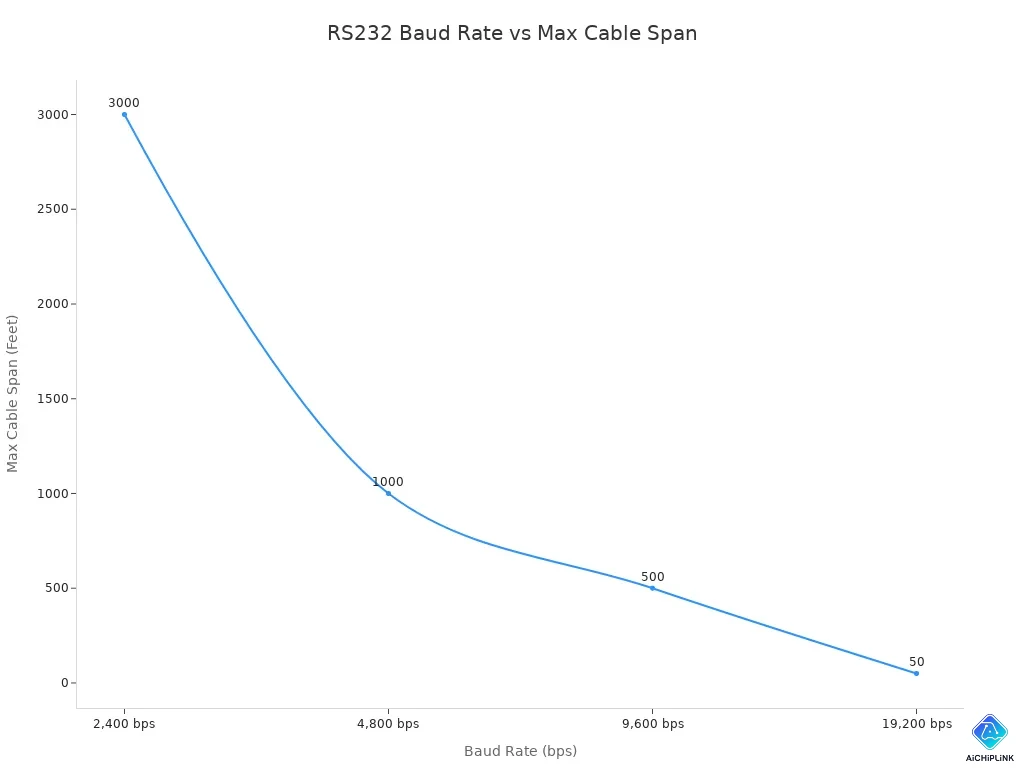
| Speed (Baud Rate) | Max Cable Span (Feet) |
|---|---|
| 19,200 bps | 50 |
| 9,600 bps | 500 |
| 4,800 bps | 1,000 |
| 2,400 bps | 3,000 |
Slower speeds let rs232 connection wires stretch farther. CAT-5 cables stretch an rs232 link 147 feet. Lower rates protect any rs232 setup well. The rs232 protocol stays reliable under balanced settings. Serial projects still rely on the rs-232 interface.
Differential Performance of RS-422
The rs-422 standard sends data fast over long distances.
This rs-422 interface handles factory communication links reliably.
Differential Noise Immunity
Engineers built the rs422 protocol for harsh industrial sites.
Heavy machinery quickly breaks normal serial lines.
The rs-422 interface sends split signals over dual wires.
One wire delivers the standard signal.
The second line sends an inverted signal.
Line A (+): Signal Voltage
Line B (-): Inverted Signal Voltage
Differential Result: (Voltage A) - (Voltage B)
Outer electrical noise impacts both wires the same way.
The receiver finds the voltage difference between wires.
This calculation deletes external line noise fully.
Your setups gain high noise resistance over long spans.
Multi-Drop Topology
The rs-422 connection powers a multi-drop network design.
A single main driver sends one-way commands to receivers.
Key Rule: A single rs-422 driver can broadcast commands to as many as 10 receiving nodes at the same time.
This smart multi-drop design cuts out extra cable runs.
One main transmitter line monitors up to 10 receivers.
However, slave units cannot reply on one-way lines.
You must plan signal paths to stop device errors.
Full-Duplex Four-Wire Cabling
You can send bi-directional data using rs422 hardware.
Full system runs require 5 physical line leads.
-
5 Conductors: Use 4 lines as 2 twisted pairs plus ground.
-
Crosshair Wiring: Link main Transmit pins directly to target Receive pins.
-
Line Labels: Parts makers print A and B on differential lines.
-
Termination Resistors: Put 120-ohm resistors across end RX lines to prevent reflections.
This rs422 wiring allows two-way serial data transfers.
Your setups send serial bytes without long pauses.
Thus, rs422 differential transmission keeps critical serial systems reliable.
Multi-Point Networking with RS-485
The rs-485 standard expands network options past simple links.
Factory systems use it for busy multi-point setups.
Multi-Point Shared Bus Architecture
Devices share a single serial network line easily.
The rs-485 interface connects many senders and receivers.
Nodes talk through one main bus line smoothly.
Extra wiring paths are not needed for messages.
Engineers choose the rs485 protocol for smart factories.
Older designs lack these flexible path options.
An rs-485 network sends data both ways easily.
Active drivers send data to all listening nodes.
This rs-485 architecture keeps every rs-485 node stable.
Half-Duplex Two-Wire Operation
Two wires run a basic rs485 line fast.
Units take turns to send data across lines.
Smart tri-state drivers manage data traffic well:
-
Enable Terminal Control: Dedicated terminals switch state modes in an rs-485 system.
-
Tri-State Output (Blocking State): High impedance disconnects the driver from basic logic levels.
-
Bus Sharing & Conflict Avoidance: Fast driver shuts stop node signal crashes quickly.
-
Bidirectional Listening: Silent drivers let receivers catch incoming node messages.
Two-wire rs485 networks save space over 4-wire layouts.
This smart rs485 design keeps messages clear everywhere.
Unit Loads and Bus Termination
Basic rs485 hardware limits setups to 32 nodes.
Fractional transceivers drop power usage by huge amounts.
Modern rs-485 components boost internal receiver sensitivity.
Now, an rs-485 bus supports up to 256 devices.
Proper rs485 termination stops long cable signal errors.
Unmatched lines bounce voltage signals back down wires.
These bounces cause bad data corruption issues fast.
120-ohm end resistors match native wire impedance levels.
This step absorbs extra power for accurate signal delivery.
Technical Trade-Offs and Selection
Picking the right network needs clear ideas.
Match your data speed with your site.
Distance, Speed, and Noise Trade-Offs
Your job site guides all tool picks.
Factory motor noise ruins normal rs232 signals.
So, pick the rs-485 standard for noisy rooms.
-
Signal Generation Method: The rs-485 interface uses two balanced wires. Old single-ended rs-232 interface options do not. This shape blocks strong electrical noise well.
-
Electromagnetic Compatibility: An rs485 network resists strong magnetic fields easily.
-
Communication Reliability: The rs485 physical layer sends steady data everywhere.
Long wire paths cap your system layout.
Basic rs232 connection paths reach 50 feet.
Fast rs422 hardware reaches 4000 feet easily.
The rs-422 interface powers fast lines for 10 units.
An rs-485 setup links 32 nodes on two-way lines.
| Feature | RS232 | RS422 | RS485 |
|---|---|---|---|
| Primary Topology | Point-to-Point | Multi-Drop | Multi-Point |
| Node Count | 2 Nodes | 11 Nodes | 32+ Nodes |
| Duplex Style | Full Duplex | Full Duplex | Half Duplex |
Comparing rs232 vs rs485 vs rs422 builds good networks.
RS232 Conversion and Integration
You can join new gear to older computers easily.
Old PCs use a standard rs-232 port.
Plug an rs232 to rs485 converter into your PC.
Tip: Active adapters use smart insulation chips. They stop power spikes from hurting your rs-232 interface.
An rs232 to rs485 converter changes single signals to differential lines.
An rs422 to rs232 converter links 4-wire rs422 hardware back to PCs.
These tiny adapters grow long rs422 differential transmission networks fast.
Pick your standard using this fast technical guide:
| Protocol Standard | Recommended Application & Distance | Max Node Capacity | Communication Duplex | Noise Immunity |
|---|---|---|---|---|
| rs-232 | Short point-to-point links (≤15 meters) | 1 Driver to 1 Receiver | Full-Duplex | Low |
| rs-422 | Fast single-master links (≤1200 m) | 1 Driver to 10 Receivers | Full-Duplex | High |
| rs-485 | Multi-device industrial trunks (≤1200 m) | 32+ Nodes | Half or Full-Duplex | High |
Use rs-232 for local equipment ports.
Pick rs-422 for fast data lines.
Use rs-485 for shared factory networks.
Follow these steps for stable data setup:
-
Single-Point Grounding: Attach shield wire to one earth ground spot.
-
Continuous Shielding: Keep shield wire connected without touching middle nodes.
-
Isolation Across Boundaries: Use optical isolators between separate building sites.
Match end wire resistance to protect your data.

Written by Jack Elliott from AIChipLink.
AIChipLink, one of the fastest-growing global independent electronic components distributors in the world, offers millions of products from thousands of manufacturers, and many of our in-stock parts is available to ship same day.
We mainly source and distribute integrated circuit (IC) products of brands such as Broadcom, Microchip, Texas Instruments, Infineon, NXP, Analog Devices, Qualcomm, Intel, etc., which are widely used in communication & network, telecom, industrial control, new energy and automotive electronics.
Empowered by AI, Linked to the Future. Get started on AIChipLink and submit your RFQ online today!
Frequently Asked Questions
Can you connect rs232 directly to rs485 hardware?
No. Direct hookups will not work here. The rs-232 interface uses single-ended signals. An rs485 network needs differential signals instead. Grab an active converter for safe conversion.
What is the main difference in rs232 vs rs485 vs rs422 distance limits?
| Standard | Maximum Transmission Distance | | : | : | | rs232 | 50 feet (15 meters) | | rs-422 | 4000 feet (1200 meters) | | rs-485 | 4000 feet (1200 meters) |
Why do engineers choose rs-422 for industrial sites?
Big factory tools make bad electrical noise. The rs422 protocol uses twin lines. These lines wipe out sudden noise spikes. This setup guards long wires better. It beats the older rs232 protocol easily.
How many devices can run on an rs-485 bus?
An rs-485 bus handles 32 parts. New high-impedance setups fit 256 nodes. They all share one central line.
When should you choose rs-232 over rs422 or rs485?
Pick rs-232 for basic short links. It joins two close items together. Desk tools and setup ports use rs-232 lines. Switch to rs422 or rs485 later. Do this for extra units or long wires.