How to Choose the Best Automotive DC-DC Converter IC for Your Vehicle Project
You need to pick the best automotive dc-dc converter ic by making sure it fits your project’s voltage, current, and safety needs. Good designs use less energy and follow tough emission rules. The best choices now use GaN or SiC materials. These help make the converter work better and smaller. Many converters have smart features like changing voltage and finding faults early. Always see if the IC follows automotive standards. Looking at technical details and testing it yourself helps your vehicle work well.
Key Takeaways
-
Find out what voltage and current your project needs before picking a DC-DC converter IC.
-
Pick converters that work well to make less heat and help the battery last longer.
-
Make sure the IC follows car safety rules to keep your vehicle's electronics safe.
-
Think about load regulation and stability to keep power steady.
-
Try out your converter in real situations to check how it works and if it is safe.
Define Automotive DC-DC Converter IC Requirements
Before picking an automotive dc-dc converter ic, you need to know what your project needs. Every vehicle project is different and has its own needs. You have to match the power and the environment for your project. First, make a list of everything your project needs. Think about how the dc-dc converter will work in a battery powered system. You should think about how much energy it saves, how safe it is, and if it works well all the time.
Input and Output Voltage Range
You need to check the input voltage and output voltage for your dc-dc converter. Most battery powered vehicles use 12 V to 48 V. Some models, like the LT8228, can go up to 100 V for both input and output. This makes it easier to use the converter in many projects. Always make sure your dc-dc converter can handle the voltage your project needs. If you need both buck and boost modes, pick a converter that does both. Write down the input voltage and output voltage your system needs.
Tip: Make a table to keep track of voltage needs for each part of your project.
| Application | Input Voltage | Output Voltage |
|---|---|---|
| Battery Powered ECU | 12 V | 5 V |
| Lighting System | 24 V | 12 V |
| Powertrain Control | 48 V | 24 V |
Output Current and Power
You need to know the output current and power your project needs. Each part of your project uses a different amount of power. Battery powered systems may need a lot of current for motors or just a little for sensors. The LT8228 lets you set and watch the current, so your system stays safe. Write down the highest output current and power for each part of your project. This helps your dc-dc converter save energy and not get overloaded.
-
List the output current for each part of your project.
-
Make sure your dc-dc converter can give enough power.
Load Regulation and Stability
You need your dc-dc converter to give steady power even when loads change. Good load regulation keeps the output voltage steady when the current goes up or down. Stability is important for car electronics that are sensitive. Bad regulation can cause mistakes or break things. Always check what your project needs for load regulation and stability. Pick a dc-dc converter that meets these needs and saves energy.
Note: Stable dc-dc converters help keep battery powered vehicles safe and reliable.
When you know these needs, you can pick the right automotive dc-dc converter ic for your project. This also helps you save energy and keep your car’s electronics safe.
Key Parameters for DC-DC Converter Selection
When you pick an automotive dc-dc converter ic, you must look at some important things. These things help you make a safe and good power system for your car.
Efficiency and Thermal Management
Efficiency is very important when picking a dc-dc converter. High efficiency means less energy turns into heat. This keeps your power system cool and working well. Most automotive rules, like 80 PLUS and Energy Star, want efficiency over 90% at normal use. You should check if high efficiency stays from 20% to 100% load. Good thermal management keeps your dc-dc converter safe. If the PCB gets to 80°C at high loads, you might need extra cooling, like a cold plate. Too much heat can cause shutdowns or damage.
| Observation | Result |
|---|---|
| PCB temperature at 1.5 kW load | Reached 80°C |
| Testing interruption due to heat | Needed extra cold plate for heat dissipation |
| System shutdown cause | Liquid leakage during setup rebuild |
Switching Frequency and Passive Components
Switching frequency changes the size and how well your dc-dc converter works. Most automotive dc-dc converter ICs use frequencies above 2 MHz or below 400 kHz. These ranges help stop problems with AM radio bands. Higher switching frequencies let you use smaller inductors and capacitors. This saves space in your project. When you pick passive parts, look at their rated currents, core materials, and ripple current ratios. These things change efficiency, voltage ripple, and electromagnetic compatibility.
| Factor | Influence on Performance |
|---|---|
| Rated and saturation currents | Changes efficiency, voltage ripple, and thermal management |
| Core material choices | Changes saturation, max frequency, and part size |
| Ripple current ratios | Changes inductor size, efficiency, capacitor ripple, and EMC behavior |
EMI and EMC Considerations
You must control electromagnetic interference (EMI) and electromagnetic compatibility (EMC) in every car project. Good dc-dc converter design helps your power system meet strict rules. Some important rules are IEC 61000-4 for immunity testing, CISPR 16 for high-frequency checks, EN 55022/32 for emissions, and FCC Part 15 for North America. Meeting these rules keeps your car electronics safe from bad noise.
| Standard | Description |
|---|---|
| IEC 61000-4 | Tests and measures immunity |
| CISPR 16 | Checks high-frequency EMC problems |
| EN 55022/32 | Limits for emissions in IT and multimedia equipment |
| FCC Part 15 | North American limits for emissions, like EN 55022/32 |
Protection Features and Safety
You need strong protection features in your dc-dc converter to keep your power system safe. Look for ESD protection up to 4 kV, wide temperature ranges from -40 °C to +150 °C, and diagnostic abilities. These protection features find overcurrent, overtemperature, undervoltage, and overvoltage. Good protection features help you stop failures and keep your project working well.
| Protection Feature | Specification |
|---|---|
| ESD Protection | Up to 4 kV |
| Operating Temperature | -40 °C to +150 °C |
| Diagnostic Capabilities | Finds overcurrent, overtemperature, undervoltage, and overvoltage |
Tip: Always check the datasheet for all protection features before you pick a dc-dc converter for your project.
Step-by-Step DC-DC Converter Selection Process
Picking the right automotive dc-dc converter ic needs a plan. You should follow steps to make a good choice. This helps you check and test each option. Here is a simple way to help you pick the best one.
Shortlist and Compare ICs
First, make a list of dc-dc converter ICs that fit your main needs. Look at input voltage, output voltage, current, and safety. Use a table to compare important things from datasheets. This helps you see which ICs work best for your project.
| Parameter | ROHM (BD9V100MUF-C) | A | B | C |
|---|---|---|---|---|
| Min. on-time | 9ns | 30ns | 80ns | 80ns |
| Min. duty cycle (at fsw=2 MHz) | 0.018 (1.8%) | 0.06 (6%) | 0.16 (16%) | 0.16 (16%) |
| Lowest possible step-down output voltage (at Vin=60 V) | 1.08V | 3.6V | 9.6V | 9.6V |
| Max. input voltage (at Vout=3.3 V) | 60V (Max. operation voltage) | 55V | 20.6V | 20.6V |
You can also use charts to see how ICs are different. This makes it easier to spot what is better or worse.
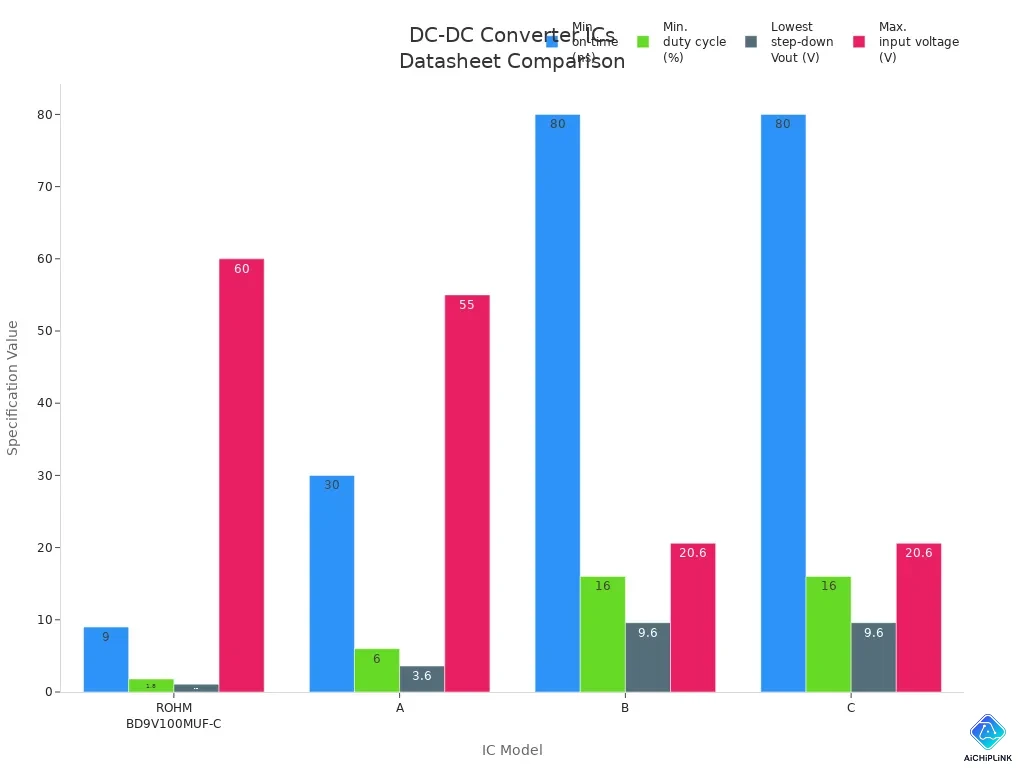
Tip: Pick ICs that match your voltage, current, and efficiency needs. Take out any ICs that do not meet safety or car rules.
Review Datasheets and Application Notes
After you have your list, read the datasheets for each dc-dc converter. Focus on the most important facts for your project. Use a table to keep track of what you find.
| Key Information | Description |
|---|---|
| Efficiency | High efficiency helps batteries last longer. |
| Topology Selection | Half-bridge and full-bridge converters work well for many uses. |
| Output Voltage Regulation | Good regulation is needed, with other ways besides optocouplers. |
| Input Voltage Range | LLC converters may not work well with wide input voltage ranges. |
Application notes show you how to use each dc-dc converter in real projects. They give tips, explain needs, and talk about problems. You learn about input voltage, output voltage, efficiency, and noise. Application notes often give you ideas for your power system.
-
Application notes help you match ICs to your needs.
-
They show how to fix power problems.
-
You get tips on efficiency, noise, and voltage control.
-
They help you not make mistakes in car projects.
Note: Always read both datasheets and application notes before you choose.
PCB Layout and Thermal Design
A good PCB layout is very important for your dc-dc converter. It changes how well your power system works. Follow these tips to get the best results:
| PCB Layout Guidelines | Description |
|---|---|
| Multilayer PCB Structure | Use multilayer PCBs to lower heat and noise. |
| Minimize High Current Loops | Keep high current loops small for less EMI. |
| Effective Grounding | Use solid ground planes to stop noise. |
| Power Stage Layout | Put parts close to keep “hot” loops small. |
| Solid Copper Planes | Use copper planes for better heat and power. |
The way you lay out your PCB also controls EMI. Short, straight lines stop antenna effects. Stitching vias connect ground layers and help return paths. Put decoupling capacitors close to IC power pins. Do not use right-angle bends in traces. Use 45-degree or curved bends for less EMI. Good grounding, like star grounding, stops ground loops and noise. Keep fast signals away from slow or analog signals to stop problems.
Tip: A good PCB layout helps your dc-dc converter pass car EMI and EMC rules.
Prototype and Functional Testing
Build a prototype of your dc-dc converter circuit. Test it in real situations. This step is very important. You need to see if the converter meets all your needs for voltage, current, efficiency, and safety. Test your power system at different loads and temperatures. Watch for problems with heat or EMI.
-
Measure efficiency at different loads.
-
Check voltage control and stability.
-
Test safety features like overcurrent and overtemperature.
-
Watch heat during long tests.
-
Make sure the converter passes all car rules.
Remember: Building and testing early helps you find problems fast. This saves time and money for your car project.
If you follow these steps, you can pick the best automotive dc-dc converter ic for your vehicle. You will meet all your needs for power, efficiency, and safety.
Special Considerations: DC-DC Buck Converter and Isolation
When to Use a DC-DC Buck Converter
A dc-dc buck converter is used in many vehicle projects. It takes a high voltage and makes it lower. You use it when your battery has more voltage than your devices need. For example, your battery might be 12 V or 48 V. Your sensors or microcontrollers may need only 5 V or 3.3 V. The buck converter gives the lower voltage safely and saves energy.
Pick a dc-dc buck converter if:
-
Your input voltage is always higher than your output voltage.
-
You want to use less energy and make less heat.
-
Your devices need a steady, lower voltage.
Buck converters are found in many car systems. They are used in lighting, infotainment, and control units. Another name for a buck converter is step-down converter. Buck converters power ECUs, sensors, and displays. They are simple and reliable. They are easy to use. There are many types for different needs. Some have extra features like fault detection and adjustable output. Always check what voltage, current, and safety your project needs before picking a buck converter. Buck converters help you meet these needs in a small space.
Tip: Use a buck converter when you need to lower voltage with high efficiency and low heat.
Isolation Needs in Automotive Applications
You must know when to use isolation in your automotive dc-dc converter ic. Isolation keeps parts of your system safe from each other. It stops current from moving between high-voltage and low-voltage sections. This makes your car safer and more reliable.
You need isolation in these cases:
-
High-voltage systems, like electric vehicles, where safety is critical.
-
When you want to protect low-power circuits from noise or faults.
-
If you need to prevent ground loops and reduce EMI.
Isolation in a dc-dc converter gives you:
-
Protection for sensitive circuits from high-risk sides.
-
Safe voltage-level translation between high and low voltages.
-
No risk of high-voltage breakdown or leakage to low-voltage parts.
Key isolation requirements include:
-
Partial discharge ratings to avoid insulation breakdown.
-
Common-mode transient immunity (CMTI) to handle voltage spikes.
-
High continuous isolation stress ratings for long-term use.
Isolation devices keep the vehicle and the operator safe. Isolation helps your system pass tough automotive requirements. It makes your system more reliable. High-voltage parts do not affect control systems. Galvanic isolation lets you send signals safely without letting current flow. Always check what isolation your project needs. The right isolation keeps your dc-dc converter safe and your car running well.
You can pick the right automotive DC-DC converter IC by using easy steps. First, make sure the voltage and power fit your project. Try to get high efficiency so your system stays cool and the battery lasts longer. Use this checklist to help you choose:
-
Make sure input and output voltage are correct.
-
Check what power and current you need.
-
See which one is most efficient.
-
Look at load regulation and how heat is handled.
-
Find strong protection features.
-
Think about if you need isolation.
-
Check for EMI and noise problems.
Always test your choice in real life. Look at the manufacturer’s guides for more help. High efficiency and good testing make your vehicle project work well.

Written by Jack Elliott from AIChipLink.
AIChipLink, one of the fastest-growing global independent electronic components distributors in the world, offers millions of products from thousands of manufacturers, and many of our in-stock parts is available to ship same day.
We mainly source and distribute integrated circuit (IC) products of brands such as Broadcom, Microchip, Texas Instruments, Infineon, NXP, Analog Devices, Qualcomm, Intel, etc., which are widely used in communication & network, telecom, industrial control, new energy and automotive electronics.
Empowered by AI, Linked to the Future. Get started on AIChipLink and submit your RFQ online today!
Frequently Asked Questions
What is the main job of a DC-DC converter IC in a car?
A DC-DC converter IC changes voltage levels. It helps power devices that need different voltages. Your car battery gives one voltage. Some parts need more or less voltage.
How do you know if a DC-DC converter IC is safe for cars?
You check if the IC follows car standards like AEC-Q100. Look for safety features like overcurrent and overtemperature protection. ESD protection is important too.
Why does efficiency matter in automotive DC-DC converters?
High efficiency makes less heat. It helps your battery last longer. You save energy and keep electronics safe.
Can you use a regular DC-DC converter IC in a vehicle project?
Tip: Always pick automotive-grade ICs. Regular ICs may not work with car heat, shaking, or electrical noise.