What Is a Power Management Integrated Circuit and Why It Matters
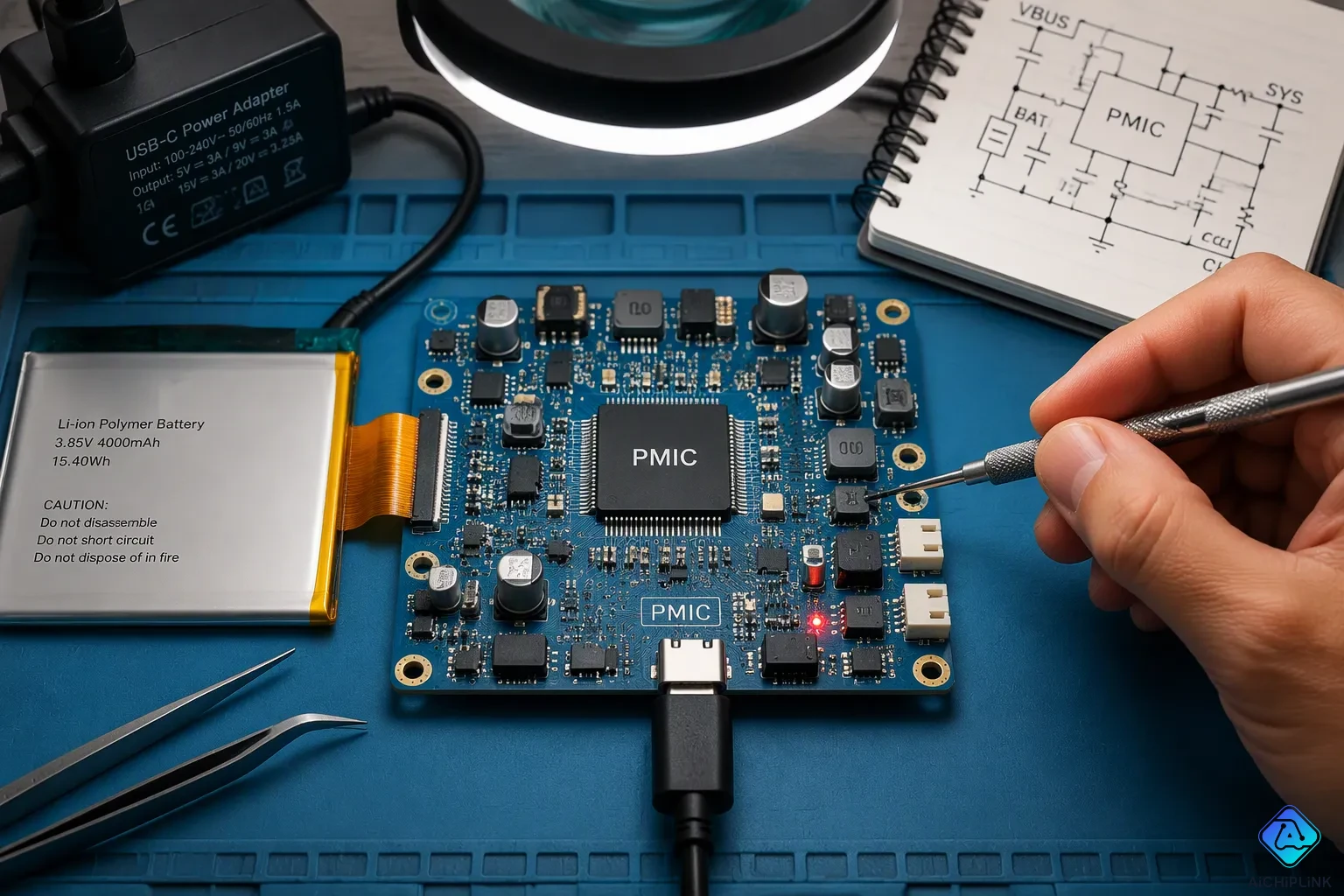
A power management integrated circuit (PMIC) is a single chip that controls how electrical power moves inside a device. It changes voltage, keeps output steady, and protects circuits from faults. This matters because you need compactness, efficiency, and reliability in modern electronics. PMICs put many regulators into one package, so your design stays small and runs cool. A PMIC also extends battery life by cutting down wasted energy. These chips are the power management core inside almost every smartphone, laptop, or car. Without PMICs, devices would be bigger, hotter, and less reliable. Whether you design hardware or pick components, understanding these chips helps you build better products.
Key Takeaways
-
A PMIC is one chip that controls power in devices. It helps devices be smaller, run cooler, and work more reliably.
-
PMICs manage voltage, keep circuits safe, and make batteries last longer. They are very important for smartphones, laptops, and cars.
-
Pick a PMIC for your needs. Think about input voltage, output current, efficiency, and package size.
-
PMICs have problems like heat and noise. You can use thermal vias, copper pours, and spread-spectrum methods to fix them.
-
PMICs are the future of power management. They allow fast charging, energy harvesting, and very low-power operation.
What Is a PMIC and Why It Matters
Defining the Power Management Integrated Circuit
A power management integrated circuit is a single chip that handles the delivery, change, control, protection, and sharing of electrical power. Semiconductor industry sources say a power management IC takes care of a host system's power needs. It shares, controls, changes, and watches electrical power for processors, memory units, and peripherals. The definition also says these chips put multiple voltage regulators and control circuits onto one chip. This integration gives complete power supply solutions, especially in systems that need multiple power rails and power domains.
You can think of a PMIC as a chip that does many jobs and manages the flow of electrical power inside an electronic device. It combines DC-DC conversion, LDO regulation, power sequencing, voltage programmability, monitoring, and control on one piece of silicon. By putting multiple power functions onto a single chip, PMICs improve performance and battery life. They also make design simpler and lower costs across applications from smartwatches to electric vehicles.
Why PMICs Are Essential
PMICs matter for five main reasons: compactness, efficiency, reliability, device longevity, and higher performance. First, integration lowers component count and printed circuit board area. This directly supports smaller device form factors. Compact packages such as the 1.9x1.9mm WLCSP nPM2100 and the 4x4mm QFN28 NEH71x0 show real miniaturization benefits. Second, high-efficiency conversion, including buck and boost converters exceeding 95% efficiency, cuts power loss and thermal stress. This lets compact devices keep higher performance without larger batteries or cooling solutions.
Third, reliability gets better through built-in protection. PMICs include overcurrent protection, overvoltage protection, undervoltage lockout, and thermal shutdown. These features keep the chip and system safe under abnormal conditions. Fourth, battery longevity gains from charge balancing, temperature regulation, and battery protection. Smart voltage regulation and adaptive power delivery extend battery usage and lower idle energy draw. Fifth, performance rises because multi-rail power sequencing and dynamic voltage scaling help systems start up correctly and adjust power in real time. This boosts performance and reliability in complex processors and systems on chip.
Power efficiency is not the only goal. A PMIC also coordinates multiple power rails with precise timing for proper system startup and shutdown. Dedicated standby mode controllers in high-performance computing and automotive systems depend on this sequencing. Advanced charging algorithms, LDO regulators, and smart sleep modes further improve battery life. For example, Nordic devices support 315mA charging with optimized power sequencing. Dynamic voltage and frequency scaling adjusts voltage and frequency based on system demand. Infineon TRAVEO T2G supports 2.7V–5.5V domains as one example. These capabilities explain why PMICs are essential building blocks in modern electronics.
Core Functions of Power Management Integrated Circuits
Voltage Regulation and Conversion
Voltage regulation and conversion are the main job of power management ICs. A PMIC takes an input voltage and turns it into the steady, exact levels your processors, memory, and sensors need. The main types are buck, boost, and buck-boost converters, plus low-dropout regulators. A buck converter brings voltage down, while a boost converter brings it up. A buck-boost handles inputs that go both above and below the target output. This two-way, programmable design does the work of two separate switching regulators, saving size, cost, and complexity.
| Topology | Voltage Relationship | Description |
|---|---|---|
| Buck (step-down) | Output lower than input | Converts DC input to PWM switching to control a power MOSFET, with external rectifier, inductor, and output capacitor producing regulated DC output. |
| Boost (step-up) | Output higher than input | Steps up output without a transformer; simple and low cost, but limited power range and relatively high output ripple. |
| Buck-boost | Input can be above or below output | Bidirectional, programmable topology that replaces two separate switching regulators, saving size, cost, and complexity. |
LDO regulators are different from switching regulators because they avoid switching noise, need less space since they do not use large inductors or transformers, and are simpler to design. Their main downside is that they must release extra power as heat. For a small change like 5 V to 3.3 V at 100 mA, an LDO releases only about 0.17 W, so it works well for low-current, small-voltage-difference uses. For a big change like 12 V to 3.3 V at 3 A, an LDO would release about 26.1 W, causing too much heat. A buck converter at 90% efficiency in the same case would release only about 1 W. Many systems use both: switchers for higher-current rails and local LDOs for low-noise, tightly regulated IC supplies.
Power sequencing and control turn on multiple high-current loads in separate steps instead of all at once. This avoids the large startup current spike that can trip breakers and damage components. Brownout protection constantly checks input voltage. If it drops below a safe level, downstream circuits switch off in a planned order and restart in sequence once supply is stable. Power-path management sends extra energy to charge a backup battery while powering the load. Under low input, the converter and backup battery take turns feeding the load without gaps in supply. A LoRa node using 2 mA at idle and surging to 66.5 mA in 1 ms did not disrupt the managed DC output, showing that active power-path management handles sudden load changes.
Battery Management and Protection
Battery management covers charging, fuel gauging, cell balancing, and safety monitoring. Battery charger ICs provide charge currents from about 200 mA up to 1.2 A for rechargeable lithium-ion batteries. Fuel gauge ICs measure voltage, current, and temperature with high accuracy and low power use to estimate state of charge and help increase runtime and lifespan. Multicell monitoring and balancing ICs provide high-accuracy measurement and include cell balancing to improve runtime, lifespan, and safety. These chips also check cell temperatures during use and charging and cut energy if temperature limits are reached.
Protection features keep the system safe under abnormal conditions. Overcurrent protection limits load current during sudden changes, with adjustable thresholds from 0.5A to 6.5A through an external resistor and a 200ms hiccup mode after 0.5ms blanking. Overvoltage protection turns off the MOSFET when input voltage goes above a threshold, adjustable through an external resistor network with a default of 3.8V typical. Undervoltage lockout turns off the internal MOSFET and disconnects the load when input voltage drops below a threshold, adjustable with a default of 2.6V typical. Thermal shutdown turns off the device and asserts a fault flag when junction temperature goes above 150°C, entering hiccup mode until a 30°C cooldown. These mechanisms deliver power monitoring and diagnostics that stop faults before they damage your design.
Types of Power Management ICs and Selection Criteria
Common PMIC Types
A power management integrated circuit controls how power flows. You can sort power management integrated circuits into six groups. Linear regulators help with low-noise analog supplies. A dc-dc converter raises or lowers voltage with high power conversion. Modern pmics mix several regulators, chargers, and switches. Battery charger ICs take care of charging and fuel gauging. Power sequencers control the order things start up. An automotive pmic protects ADAS, infotainment, and ECU systems.
| PMIC Type | Supported Packages | Applications |
|---|---|---|
| Linear regulator | SOT-23, TO-252, DFN | Low-noise analog supplies, sensor biasing |
| DC-DC converter | QFN, LGA, BGA, WLCSP | Power supply units, embedded boards, LED drivers |
| Integrated PMIC | QFN, BGA, CSP, WLCSP | Mobile SoCs, tablets, laptops, wearables |
| Battery charger IC | QFN, DFN, SOP, WLCSP | Portable electronics, power banks, wearables |
| Power sequencer | QFN, SOIC | Embedded systems, servers, telecom |
| Automotive PMIC | BGA, CBGA | ADAS, infotainment, ECU systems |
These integrated pmic solutions take up less board space. Some pmics mix chargers, LDOs, load switches, and buck-boost regulators. Advanced pmics add dynamic voltage scaling and power gating. That builds an integrated power management solution.
How to Choose a Power Management IC
Choosing a power management ic starts with input voltage range, output current capability, efficiency, thermal performance, package size, and programmability. For battery-powered IoT nodes, the top parameters are:
-
Quiescent current sets how long the battery lasts in sleep mode.
-
Dropout voltage matters as battery voltage goes down.
-
PSRR shields sensitive sensors and RF circuits from noise.
-
Transient response deals with load jumps when the device wakes up.
-
Efficiency across a wide load range matters because dynamic range can reach about 10,000:1.
-
Package size decides whether it fits in wearables.
Look for battery management features like voltage and current monitoring. A pmic with adaptive voltage scaling and dynamic power management gives out power based on demand. Power sequencing keeps multi-rail startups steady.
These types of power management ics come from analog and mixed-signal research on CMOS and BCD processes. Many pmics have programmable output rails. High-performance pmics give complete power supply solutions. They mix voltage regulation, voltage conversion, and protection. That raises power efficiency and improves overall power management. The right pmic makes your design smaller, cooler, and more reliable.
PMIC Applications and Design Challenges
Where Power Management ICs Are Used
You can find power management ICs in almost every electronics market. Consumer electronics use PMICs in smartphones, laptops, tablets, and wearables. These chips handle voltage regulation, battery management, and power sequencing in a very small space. Cars use PMICs for ADAS, infotainment, and ECU units. Industrial and IoT devices need PMICs for sensor nodes, gateways, and remote monitors. Telecom and network gear uses PMICs for routers, switches, and base stations. Each market wants different things. A wearable needs very low quiescent current. A car needs wide input voltage range and high reliability.
The design problems change with each use. Heat grows as power conversion goes up. EMI and noise matter more in shared frequency bands. You face trade-offs between size, cost, and heat when you want better efficiency. You must solve these problems early in your design.
Overcoming Heat, EMI, and Efficiency Trade-offs
Heat is the first problem. You can lower junction temperature with a few proven methods:
-
Thermal vias: pack plated holes under the IC pad to move heat up to inner or bottom copper layers.
-
Copper placement: add copper near active parts to boost the substrate's effective conductivity.
-
Heat sinks: match fin shape, material, and mounting to the heat load and airflow.
-
PCB layout: use wider traces and copper pours under high-power parts to spread heat sideways.
Use thermal interface materials with conductivity above 1 W/mK and thickness below 0.2 mm to cut contact resistance. Follow IPC-2221, IPC-2152, and JEDEC JESD51 rules to check thermal paths. Stop solder from filling vias by using holes below 0.3 mm or covering vias with solder mask.
EMI is the second problem. Most noise comes from the power switch MOS turning on and off and its drive pulses. You can use these methods to reduce it:
| Technique | Mechanism | Effect on Noise |
|---|---|---|
| Spread spectrum and frequency hopping | Spread signal energy over a wider frequency band | Makes it harder for narrowband interference to affect it |
| PCB layout and circuit design optimization | Careful trace routing, ground plane design, component placement | Cuts crosstalk and electromagnetic coupling |
Spread-spectrum methods change the clock pulse frequency that drives the power switch. This spreads out the strong line spectrum and lowers peak spectral levels. This helps you meet EMI standards like CISPR22 and need fewer bulky filters. Shrink the high di/dt current loops by making the loop that carries full switched AC current smaller. Put low-impedance decoupling capacitors close to switching nodes. Split the hot loop into two nearby loops with opposite polarity so their magnetic fields cancel. Use flipped-die packaging and copper pillars instead of bond wires to make conductors shorter.
A PMIC beats discrete power solutions on integration. Discrete designs need many parts, more board space, and careful layout. A PMIC puts monitoring and control, voltage conversion, and protection in one package. This integration boosts power efficiency, extends battery life, and makes your design simpler. The right PMIC makes your product smaller, cooler, and more reliable.
Power management integrated circuits are important in every industry. They make designs smaller, lower heat, and help batteries last longer. You should see a pmic as a smart design decision, not just one more part. Future trends will change the field. Wide-bandgap semiconductors like GaN and SiC lower switching losses. AI-optimized control loops adjust voltage and current in real time. Ultra-low-power operation cuts idle use for wearables. These advances will push power efficiency higher. PMICs will keep growing. Fast charging depends on PMICs. PMICs support energy harvesting. Workload changes demand PMICs. Your next design will likely rely on PMICs. The future looks bright for these tiny chips.

Written by Jack Elliott from AIChipLink.
AIChipLink, one of the fastest-growing global independent electronic components distributors in the world, offers millions of products from thousands of manufacturers, and many of our in-stock parts is available to ship same day.
We mainly source and distribute integrated circuit (IC) products of brands such as Broadcom, Microchip, Texas Instruments, Infineon, NXP, Analog Devices, Qualcomm, Intel, etc., which are widely used in communication & network, telecom, industrial control, new energy and automotive electronics.
Empowered by AI, Linked to the Future. Get started on AIChipLink and submit your RFQ online today!
Frequently Asked Questions
How is a PMIC different from using separate power parts?
One chip handles all voltage conversion, regulation, sequencing, and protection tasks. Separate power parts spread these jobs across many components, using more board space and adding layout work. Integrated pmics use fewer parts, simplify your design, and improve reliability. You end up with a smaller, cooler, more dependable product.
Why do battery-powered devices depend on pmics?
As batteries drain, they give a changing voltage. Your processors and sensors need steady, exact power levels. pmics change and steady that power while wasting less energy. They also handle charging, check cell health, and protect against faults. This makes runtime longer and keeps your device safe.
What should you check first when picking a PMIC for a wearable?
Start with quiescent current; it sets sleep-mode battery life. Then check dropout voltage, package size, and efficiency across a wide load range. Also look for battery management features like voltage and current monitoring. These pmics fit tight spaces and keep power draw low.
Can pmics handle heat and noise on their own?
Partly, because pmics include thermal shutdown and protection, but good PCB layout still matters. To spread heat and cut EMI, use thermal vias, copper pours, and short high-current loops. Spread-spectrum methods also lower peak noise, and careful design keeps pmics cool and quiet.