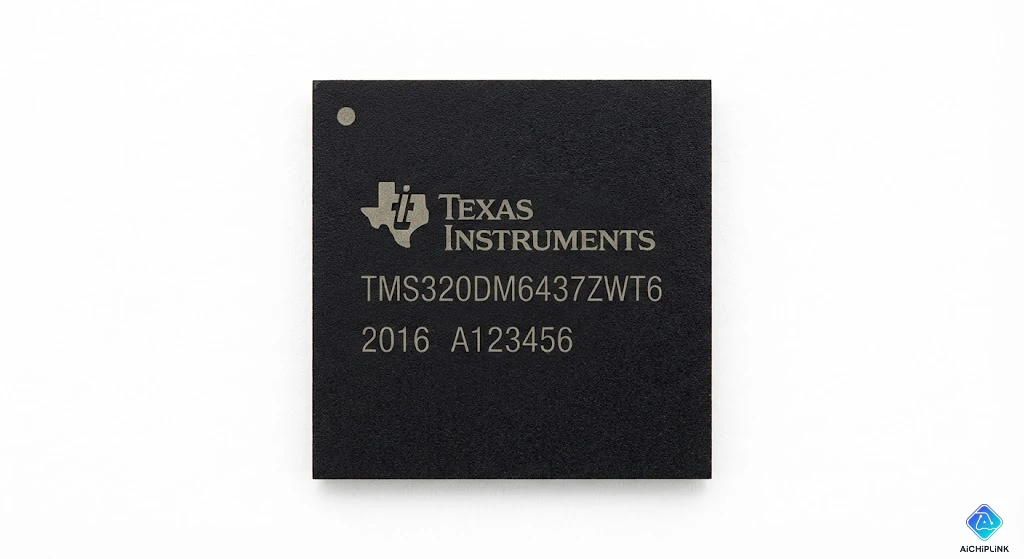
In the evolution of embedded video, one name stands out: DaVinci™.
Texas Instruments created the DaVinci family to solve a specific problem: generic processors were too slow for video, and FPGAs were too hard to program. The solution was the TMS320DM6437ZWT6.
This chip is a Digital Media Processor powered by the high-performance C64x+ DSP core. While modern SoCs now include AI accelerators, the DM6437 remains a staple in legacy automotive vision systems, industrial inspection cameras, and medical imaging devices due to its precise, deterministic control over video data.
This guide breaks down the architecture and specs of this video processing legend.
Table of Contents
- 1. Decoding the Part Number
- 2. Architecture: C64x+ Core & VPSS
- 3. Hardware Considerations: The ZWT Package
- 4. Key Applications
- 5. Conclusion
1. Decoding the Part Number
TI part numbers are descriptive. Here is what TMS320DM6437ZWT6 tells us:
| Segment | Code | Meaning |
|---|---|---|
| TMS320 | Family | TI DSP. The overarching family of Digital Signal Processors. |
| DM | Series | Digital Media. Optimized for video/imaging (DaVinci Platform). |
| 6437 | Device | Fixed-Point DSP. Contains the C64x+ core + Network peripherals. |
| ZWT | Package | NFBGA-361. (Plastic Ball Grid Array, 361 balls). Lead-free. |
| 6 | Speed | 600 MHz. (Can perform 4800 MIPS - Million Instructions Per Second). |
Note: You might also see "ZDU" or "ZWT" packages. ZWT is the standard commercial/industrial green package.
2. Architecture: C64x+ Core & VPSS
The DM6437 is not just a DSP; it is a System-on-Chip (SoC) designed for video.
The Brain: C64x+ DSP Core
- Clock: 600 MHz.
- Performance: It uses a VLIW (Very Long Instruction Word) architecture, capable of executing 8 instructions per cycle. This makes it incredibly fast for math-heavy tasks like FFTs (Fast Fourier Transforms) and matrix multiplication used in image compression.
The Muscle: VPSS (Video Processing Subsystem)
This is the "Secret Sauce." Instead of using the DSP core to read every pixel (which would choke the CPU), the VPSS handles the heavy lifting:
- Video Front End (VPFE): Directly connects to CCD/CMOS image sensors. It handles black level compensation, gain control, and raw-to-YUV conversion.
- Video Back End (VPBE): Handles On-Screen Display (OSD) layers and outputs analog (DAC) or digital video to screens.
- Hardware Resizer: Can scale video frames up or down in real-time without using CPU cycles.
3. Hardware Considerations: The ZWT Package
Designing a PCB for the TMS320DM6437ZWT6 is an advanced task.
- Package Type: NFBGA-361 (361-pin Ball Grid Array).
- Pitch: 0.8 mm.
- Routing: Because the balls are in a grid, you cannot route all signals on a single layer.
- Minimum Layers: Typically requires a 6-layer PCB (Signal-Ground-Power-Signal-Ground-Signal) to fan out the signals from the inner rows of balls.
- Power Rails: It requires multiple voltages:
- 1.2V for the Core ($CV_{DD}$).
- 1.8V / 3.3V for I/O ($DV_{DD}$).
- Power Sequencing: The Core voltage usually needs to stabilize before I/O voltage to prevent latch-up.
4. Key Applications
Automotive Vision (ADAS)
The DM6437 was a pioneer in early Advanced Driver Assistance Systems (ADAS).
- Lane Departure Warning: The DSP analyzes video frames to detect white lines on the road.
- Rear View Cameras: The VPSS handles the fisheye correction (dewarping) of the wide-angle lens.
Machine Vision
- Industrial Inspection: Checking bottles on a conveyor belt at high speed. The direct interface to CCD sensors and the determinism of the DSP (no OS jitter) make it perfect for real-time sorting.
IP Security Cameras
- Encoding raw video into H.264 streams for network transmission via the onboard Ethernet MAC (EMAC).
5. Conclusion
The Texas Instruments TMS320DM6437ZWT6 is a classic example of specialized silicon. By combining a powerful math engine (C64x+) with a dedicated video engine (VPSS), it allows engineers to build complex vision systems that would bring a standard microcontroller to its knees.
Sourcing TI DaVinci Processors Maintenance of legacy vision systems often requires specific DSPs. Visit Aichiplink.com to search for verified stock of TMS320DM6437ZWT6 and related power management ICs.

Written by Jack Elliott from AIChipLink.
AIChipLink, one of the fastest-growing global independent electronic components distributors in the world, offers millions of products from thousands of manufacturers, and many of our in-stock parts is available to ship same day.
We mainly source and distribute integrated circuit (IC) products of brands such as Broadcom, Microchip, Texas Instruments, Infineon, NXP, Analog Devices, Qualcomm, Intel, etc., which are widely used in communication & network, telecom, industrial control, new energy and automotive electronics.
Empowered by AI, Linked to the Future. Get started on AIChipLink.com and submit your RFQ online today!
Frequently Asked Questions
1: Is the TMS320DM6437 still in production?
No. The TMS320DM6437 is a legacy DaVinci DSP and is no longer in active production. It is mainly available through surplus or legacy component suppliers.
2: What makes the DM6437 suitable for video processing?
It combines a high-performance C64x+ DSP core with a dedicated Video Processing Subsystem (VPSS), allowing real-time video capture, scaling, and display without overloading the CPU.
3: Does the TMS320DM6437 support Linux?
Yes. TI provides legacy Linux and DSP/BIOS support packages specifically designed for DaVinci processors like the DM6437.
4: What PCB difficulty level is required for this chip?
High. The 361-ball NFBGA package typically requires at least a 6-layer PCB, controlled impedance routing, and careful power sequencing.
5: What are common replacement options for new designs?
For modern designs, developers typically migrate to ARM-based SoCs with integrated video accelerators or FPGA-based vision platforms, as direct pin-compatible replacements do not exist.


