NiMH vs Lithium-Ion Batteries: A Comprehensive Comparison
Which is better, NiMH or lithium-ion? Neither wins everywhere. The right choice depends on your use case. Lithium-ion leads on energy density and weight. NiMH leads on cost, safety, and reliability. That trade-off decides most purchases. A drone needs light, powerful cells. A wall clock needs cheap, safe ones. The nimh vs lithium-ion debate has no single answer. This guide helps you match the right chemistry to your device. Check what your device demands first. Then pick the battery that fits those demands.
Key Takeaways
-
NiMH batteries cost less and work well in devices that use little power, like clocks and remotes.
-
Lithium-ion batteries are lighter and more powerful for power-hungry devices like drones and laptops.
-
Lithium-ion batteries need a protection circuit to stay safe, but NiMH batteries are usually safer.
-
Never mix NiMH and lithium-ion chargers or batteries, because their voltages are not the same.
-
Pick the right battery for your device: NiMH for low cost and safety, lithium-ion for high performance and easy to carry.
NiMH vs Lithium-Ion: The Basics
Chemistry and Voltage
The two battery types are different in one key way: their normal cell voltage. A nickel-metal hydride cell gives 1.25 V. A lithium-ion cell runs from 2.4 V to 3.8 V, based on its charge level. This gap affects everything else, like pack design and charger choice.
The electrode materials are different too. A nickel metal hydride battery uses nickel hydroxide for the positive electrode. It uses a hydrogen-absorbing alloy for the negative electrode. Lithium-ion batteries use a lithium oxide positive electrode and a graphite negative electrode. These material choices explain why nimh vs. li-ion packs act so differently under load.
| Battery Chemistry | Nominal Cell Voltage | Positive Electrode | Negative Electrode |
|---|---|---|---|
| Nickel-Metal Hydride (NiMH) | 1.25 V | Nickel hydroxide | Hydrogen-absorbing alloy |
| Lithium-Ion (Li-ion) | 2.4–3.8 V | Lithium oxide | Graphite |
Cell Construction and Formats
Physical format sets these two battery types apart just as much as voltage does. NiMH batteries often come in AA (14.5 × 50 mm) and AAA (10.5 × 44.5 mm) round sizes. Lithium-ion batteries made their own round standards, such as the 18650 (18 × 65 mm) and the newer 21700 (21 × 70 mm). A 14500 li-ion cell is the same size as an AA. But its voltage is very different from a nimh battery of the same size.
Round cells are used for both nickel metal hydride battery cells and lithium-ion designs. The 18650 is still a common format for laptops, power tools, and e-bikes. The 21700 holds more space, about 24 cm³ versus the 18650's 16 cm³. Its capacity can reach about 6000 mAh. Prismatic formats like the 564656P also exist for tight designs. For the same physical size, nimh battery packs often show higher mAh ratings. But lithium-ion packs are lighter and smaller for equal capacity.
NiMH vs Lithium Ion Batteries: At-a-Glance Table
Key Specs Compared
Looking at the two side by side makes the nimh vs lithium ion batteries choice much easier. The table below shows how the two chemistries compare on the specs buyers care about most.
| Spec | NiMH | Lithium-Ion |
|---|---|---|
| Energy density | Lower | Higher |
| Nominal voltage | 1.25 V per cell | 2.4–3.8 V per cell |
| Self-discharge | Higher | Very low |
| Cycle life | ~500 cycles | >1,000 cycles |
| Memory effect | Rare in modern cells | Not applicable |
| Safety | Generally safer | Needs protection circuits |
| Upfront cost | Lower | Higher |
| Weight | Heavier | Lighter |
| Temperature tolerance | More robust | Degrades in extreme cold |
The energy density gap is the first thing you notice. Lithium-ion packs hold more power in less space and weight. That one advantage explains why li-ion batteries are used in most phones, laptops, and drones.
How to Read the Numbers
Cycle life is worth reading closely. A nimh battery lasts about 500 cycles before its capacity drops. Lithium-ion cells often go past 1,000 cycles. Over a few years, that gap changes what you really pay to own them.
Charge time shows a similar pattern. Lithium-ion batteries fill up in 2–5 hours. NiMH cells take longer to charge, since their charging profile is more complex.
Two technical terms show up often in spec sheets. C-rate tells you how fast a battery can discharge compared to its capacity. A 1C rate empties the pack in one hour, a 2C rate in 30 minutes, and a 0.5C rate in two hours. High-drain lithium-ion cells handle 1C to 30C or higher. Standard consumer nimh batteries run from 0.5C to 5C. A BMS, or battery management system, is the circuit that checks voltage, current, and temperature. Lithium-ion packs need one to run safely.
Self-discharge numbers matter too. Nimh batteries lose charge faster when sitting idle. Lithium-ion keeps its charge much longer, which works well for devices stored for weeks.
Read every spec together, not on its own. A high mAh rating means little if the cell cannot give your device the current it needs. Match voltage, C-rate, and cycle life to the job at hand. The nimh battery vs lithium-ion specs above give you the full picture before you buy.
Cost, Size, and Weight
Upfront Price vs Cost per Cycle
A nimh battery usually costs less at the register. That low sticker price appeals to buyers who need many cells at once. A pack of four AA nimh batteries often sells for a few dollars. A single lithium-ion cell of similar capacity can cost more. For a wall clock or a remote, that upfront savings adds up fast.
The longer view tells a different story. Lithium-ion batteries often deliver more than 1,000 cycles. NiMH cells typically manage around 500. Divide the purchase price by the number of cycles, and the gap narrows or flips. A cheaper cell that dies twice as soon may cost more per year of service. Buyers who charge daily should weigh this carefully. Buyers who swap cells once a year may never notice.
Energy Density and Form Factor
Energy density decides how much power fits in a given space and weight. The numbers favor lithium-ion by a wide margin. The table below shows the gap in watt-hours per kilogram and watt-hours per liter.
| Chemistry | Gravimetric (Wh/kg) | Volumetric (Wh/L) |
|---|---|---|
| Lithium-ion | 150–250 | 250–730 |
| NiMH | 60–120 | 140–300 |
That advantage makes lithium-ion batteries the default for portable electronics. A drone, phone, or laptop needs every gram and every millimeter. Lithium ion batteries pack more charge into that limited room. The lighter pack also means longer flight times and easier carrying.
NiMH batteries still hold a practical edge in one case. For the same physical size, a nimh battery often shows a higher mAh rating. A AA nimh battery may list 2,000 mAh or more. A li-ion batteries cell of equal size may list less. That capacity suits devices where space is not the main concern. A flashlight, a toy, or a garden sensor can accept the extra weight. The choice comes down to what the device values most: light weight or raw capacity in a familiar size.
Safety and Enclosure Design
Thermal Runaway Risk
The biggest safety worry with lithium-ion batteries is thermal runaway. It starts when a cell gets too hot. The heat triggers a chemical reaction. That reaction makes more heat. This loop can end in fire or explosion. A protective case and special circuits help stop this. A battery management system checks voltage, current, and temperature. It turns the pack off when things become unsafe.
In real use, failure rates stay low. Good lithium-ion cells fail less than once in a million cases. Some good cells do even better: less than once in 10 million. The table below lists the reported failure rates for different uses.
| Battery Type | Application | Reported Failure/Fire Rate per Million Cells |
|---|---|---|
| Lithium-ion | General (fires) | ~1–10 incidents per million cells |
| Lithium-ion | Consumer electronics | ~1 in 10 million cells |
| Lithium-ion | Electric vehicles | ~1 in 1–2 million cells |
| Lithium-ion (quality cells) | General failure | <1 in 1 million cells; better than 1 in 10 million cells |
Lithium-ion batteries fail less than once in a million cells. A quality Li-ion cell fails less than once in 10 million.
Why NiMH Is Safer
Nickel-metal hydride cells are safer than lithium-ion designs. Research places them at a medium risk level. They are less likely than lithium-ion cells to overheat and reach thermal runaway. Their fires are also less severe. Overheating can still happen if the cells are abused. But the overall danger is smaller. This matters for devices used near people or in homes.
NiMH batteries also have a smaller environmental impact. They do not use the reactive materials found in lithium-ion batteries. That makes disposal and recycling simpler. One downside is the memory effect. Older NiMH cells lost capacity if they were recharged before being fully drained. Modern NiMH cells handle this problem much better. Taking care of NiMH packs keeps them in good shape. Users should follow the charger instructions and avoid fully draining the cells. These habits make any NiMH battery last longer. The safety gap between NiMH and lithium-ion remains clear. One battery type needs strong protection. The other works fine with simple design choices.
Battery Management Systems
What a BMS Does
A battery management system, or BMS, is the electronic circuit that guards a battery pack. It checks voltage, current, and temperature for each cell or cell group. This circuit is the main shield against overcurrent, overvoltage, undervoltage, and extreme temperatures. An analog-to-digital converter or comparator with a sense resistor measures current flow in and out of the pack. Voltage is measured the same way, which protects cells from over-discharge, overcharge, or imbalance with other cells in series. Temperature comes from an NTC thermistor, which stops charging or discharging at dangerous temperatures.
Cell balancing keeps all series-connected cells at the same level. Passive balancing drains energy from the highest cells through resistors. Active balancing moves charge from higher cells to lower ones with almost no energy loss. Standards shape what a BMS must do. UL 2054 requires overcharge protection, short-circuit protection, abnormal charging protection, crush protection, impact protection, and thermal abuse protection. A BMS tested to UL 1973 and IEC 62619 includes overvoltage, undervoltage, overcurrent on both charge and discharge paths, short circuit, and over-temperature protection, with a short-circuit response time under 200 microseconds.
NiMH's Simpler Needs
Nickel metal hydride battery packs have higher internal resistance and simpler charging needs. They often need less complex management than lithium battery packs. A nickel-metal hydride battery has no float-charge voltage, so its charger depends on termination signals instead. Recommended full-charge detection methods include negative delta V, voltage plateau, delta temperature, temperature threshold, and time-out timers. These methods work as or-gates, meaning the charger stops on whichever signal comes first. The negative delta V signal for NiMH is weak, especially below 0.5C, so a charger should detect a drop of about 5 mV per cell or less. Delta temperature is often more reliable. Nimh batteries handle less overcharge than older chemistries, so trickle charge is usually set to about 0.05C. Lithium-ion batteries can control overcharge with a simple maximum charge voltage. That difference explains why li-ion batteries need a full BMS while nimh battery packs often manage with simpler circuits.
Charging, Cycle Life, and C-Rate
Charge Times and Cycle Counts
How long a battery takes to charge depends on the charger and the cell, not just the chemistry. A normal charge takes 2–4 hours for both a nimh battery and a lithium-ion cell. Fast charging cuts that time down, but it adds heat and stress. The real difference shows up in charging and cycle life over months of use.
| Battery Type | Fast Charge Time | Cycle Life (to 80% of initial capacity) |
|---|---|---|
| NiMH | 2-4h | 300 to 500 |
| Li-ion | 2-4h | 500 to 1000 |
The lithium-ion battery vs nimh lifespan gap is easy to see in the numbers. Nimh batteries usually last 500 to 1,000 recharge cycles under normal use. Most still hold about 80% of their original capacity after 500 cycles. Low self-discharge types often reach 1,000+ cycles. Lithium-ion batteries generally last 500 to 1,500 cycles, depending on their chemistry. LiFePO4 cells can reach 1,500-2,000 cycles. For both types, shallow discharges give you more cycles than deep discharges.
C-Rate and Internal Resistance
C-rate tells you how fast a battery can discharge compared to its capacity. A 2.4 A draw from an 800 mAh cell equals a 3C discharge. You need low internal resistance to deliver high current pulses. A new NiMH AA cell shows internal resistance of 30 mΩ or less. A new 18650 lithium ion cell stays below 30 mΩ, and high-quality cells reach 15–25 mΩ.
High internal resistance causes voltage drop and heat. The battery hits its cutoff voltage sooner and gives less usable capacity at high C-rates. A cell with high resistance can still show okay capacity under steady load. It may fail or shorten runtime under high-C pulses. Nimh batteries have higher internal resistance than lithium-ion batteries, so they deliver bursts of energy less efficiently. Lithium ion batteries handle high-drain tools and drones with ease. Match the C-rate to the device, and the pack will last.
Self-Discharge and Memory Effect
Self-Discharge Rates
Self-discharge is when a battery loses its charge while just sitting there. This matters for devices that stay turned off for weeks. A remote, a smoke detector, or a backup flashlight might sit unused for months. The chemistry inside the battery decides how much power leaks away.
Nimh batteries lose their charge faster than lithium-ion batteries. Regular nimh batteries lose 15–30% of their charge every month at room temperature. Low self-discharge nimh batteries stay under 5% each month. Lithium-ion batteries lose only 1–2% per month, plus about 3% for the safety circuit. That difference makes lithium-ion the better choice for devices that sit idle.
| Battery Type | Monthly Self-Discharge at Room Temperature |
|---|---|
| Standard NiMH | 15–30% |
| Low Self-Discharge NiMH | Below 5% |
| Lithium-Ion | 1–2% (plus 3% for safety circuit) |
Temperature changes the picture too. Lithium-ion at 25°C loses 20% per month when fully charged. The same cell at 40–60% charge loses only 4%. How much charge you store it with matters as much as the chemistry.
The Memory Effect Myth
The memory effect is mostly a myth for modern nimh batteries. This problem really belonged to nickel-cadmium cells. Those old NiCd packs needed full discharges to avoid losing capacity forever. Cadmium is toxic, and those cells also had high self-discharge.
Modern nimh battery cells work differently. Today's models are much less likely to have memory issues. They need far less care than NiCd. A nimh battery can still get voltage depression from some usage patterns. This is less serious than the old NiCd memory effect. It can hurt performance, but it will not destroy the pack.
In contrast to nickel-cadmium, NiMH largely eliminates the "memory effect," which often degrades battery performance over time in older technologies.
Lithium-ion batteries have no memory effect at all. Their very low self-discharge also makes them better for devices left idle. A charged lithium-ion pack can sit for months and still work. Nimh batteries need a top-up before use after long storage. Match the chemistry to how often the device runs.
Temperature Tolerance
Cold and Hot Weather Behavior
Temperature changes matter more than most specs for these two battery types. NiMH cells work in a wider temperature range than lithium-ion cells. A NiMH battery keeps running in freezing weather, while a lithium cell slows down. The liquid electrolyte inside a lithium-ion cell moves slowly in extreme cold. Capacity drops, voltage falls, and the pack feels weak until it warms up.
Extreme heat causes another problem for lithium-ion batteries. High heat speeds up chemical reactions inside the cell. That stress can shorten battery life and, in rare cases, lead to thermal runaway. NiMH cells have fewer risks in the same heat. They lose some capacity but remain stable. Tools used outside in winter or summer work better with a NiMH battery. A frozen lithium-ion pack also charges poorly. Charging below freezing can permanently damage lithium-ion cells.
Storage and Longevity
How you store a battery affects how much capacity it keeps. Charge level and temperature matter more than battery age. The table below shows how much capacity lithium-ion batteries keep after one year of storage.
| Storage Temperature | 40% Charge (Recoverable Capacity After 1 Year) | 100% Charge (Recoverable Capacity After 1 Year) |
|---|---|---|
| 0°C | 98% | 94% |
| 25°C | 96% | 80% |
| 40°C | 85% | 65% |
| 60°C | 75% | 60% (after 3 months) |
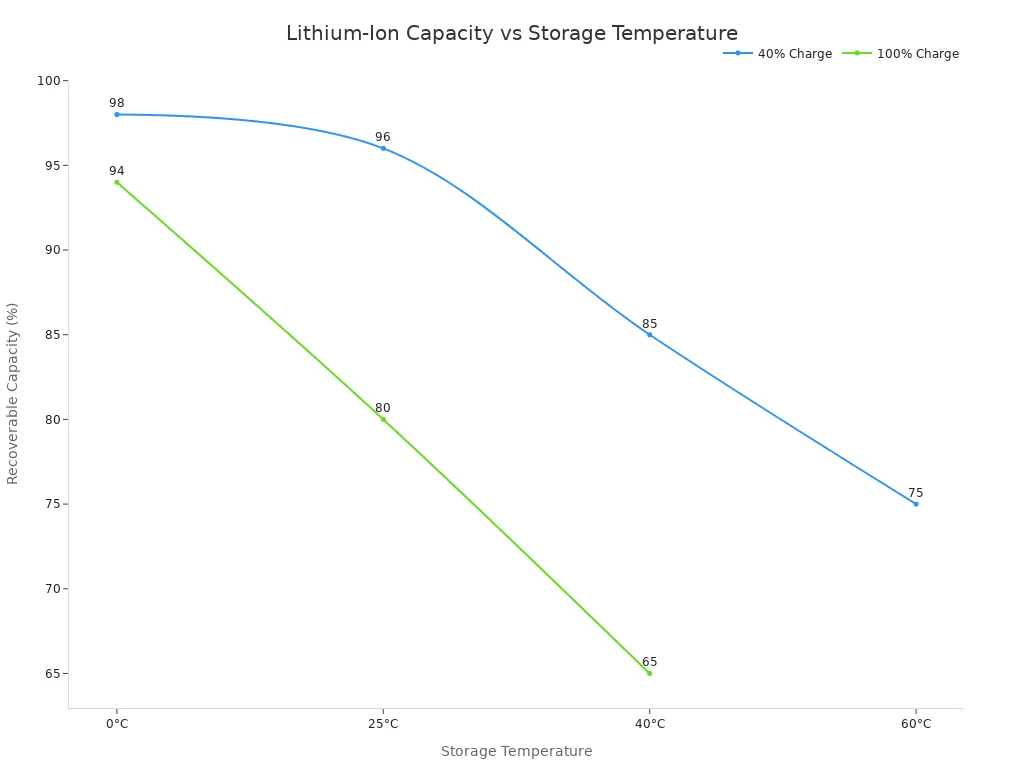
A cool, partly charged lithium-ion cell keeps nearly all its capacity. A fully charged cell kept in heat loses power quickly. Lithium-ion batteries stay healthiest at a charge voltage of 3.92V per cell. That voltage puts less stress on the cell. A 50% charge can increase the lifetime of a vehicle lithium-ion pack by 44–130%, according to Chalmers University of Technology. NiMH batteries lose charge faster in storage than lithium-ion batteries.
NiMH batteries follow the same rule. Store NiMH batteries with a partial charge of about 40–50%. Keep them in a cool, dry, temperature-controlled place out of direct sunlight. Avoid extreme temperatures, because they lower capacity and shorten life. NiMH batteries like a cooler shelf than most rooms offer. Put them in a basement or closet away from heating vents. These habits help every pack last longer.
NiMH Batteries vs Lithium Ion: Which to Choose?
The nimh batteries vs lithium ion decision comes down to one idea. Match the battery to the device. No chemistry wins every job. Each one fits a certain kind of load.
Choose NiMH for Low-Drain Devices
Low-drain devices sip power slowly. A wall clock, a TV remote, and a budget flashlight all fit this group. They run for months on a single charge. They also sit idle for long stretches. Cost and safety matter more here than weight.
Nimh batteries shine in these roles. They cost less at the register. A four-pack of AA cells sells for a few dollars. They are also generally safer than lithium-ion. A remote left on a couch poses little risk. A clock on a wall does not need a protection circuit.
Nimh rechargeable batteries suit buyers who want high capacity in a familiar size. A AA cell may list 2,000 mAh or more. That capacity serves devices where space is not the main concern. A garden sensor or a toy can accept the extra weight. The nimh battery packs in these products stay simple and cheap to replace.
One trade-off deserves a mention. Standard nimh batteries lose 15–30% of their charge each month. Low self-discharge types stay under 5%. Pick the low self-discharge version for a smoke detector or a backup light. It will hold its charge far longer between top-ups.
Choose Lithium-Ion for High-Drain Devices
High-drain devices pull large currents fast. A drone, a laptop, and a power tool all belong here. They need bursts of energy on demand. They also need every gram and every millimeter to count.
Lithium-ion batteries win on energy density. They hold 150–250 Wh/kg, against 60–120 Wh/kg for NiMH. That gap lets a drone fly longer and a laptop stay thin. Lithium ion batteries also last more than 1,000 cycles, so they serve daily charging well. Their self-discharge stays at 1–2% per month. A device left idle for weeks still works.
The nimh vs lithium-ion trade-off is clear in these cases. A power tool needs high C-rate output. Lithium-ion cells handle 1C to 30C or higher. Nimh batteries run from 0.5C to 5C. That limit makes them a poor fit for a drill under load.
Safety needs attention with this chemistry. Lithium-ion batteries require a battery management system. That circuit guards against overvoltage, overcurrent, and heat. Buy packs from makers who build one in.
The nimh vs lithium ion batteries choice is not about a universal winner. It is about the load. Cost-sensitive, high-capacity needs point to NiMH. High-energy, lightweight, long-life needs point to lithium-ion. Check the device first. Then pick the chemistry that fits.
Lithium vs NiMH Battery Packs: Charger Warning
A charger made for one chemistry cannot charge the other. Lithium-ion batteries use a constant-current, constant-voltage profile. Nickel metal hydride chargers stop when they see a voltage drop or a temperature rise.
Never Mix Chargers or Chemistries
Nickel metal hydride battery packs in AA size run at 1.2 volts nominal. A lithium-ion 14500 cell has the same shell but runs at 3.7 volts. nimh batteries are common in AA size, but the voltages are not the same. A lower-voltage charger may never shut off at the right time.
The same rule holds inside a device. Never mix nimh batteries with lithium-ion cells. The bank of nimh batteries will drag the lithium-ion cell down. That cell can send 4.2 volts to the rest of the string. The result is a damaged pack.
Voltage Mismatch Risks
The voltage gap explains the damage. A 14500 lithium-ion battery hits 4.2 volts when fully charged. A standard NiMH AA cell runs at 1.2 volts rechargeable or 1.5 volts primary. A NiMH-rated flashlight may fail right away.
The table compares common cells.
| Battery type | Nominal voltage | Full charge voltage |
|---|---|---|
| NiMH AA | 1.2 V | Not specified |
| Li-ion 14500 | 3.7 V | 4.2 V |
| Li-ion 18650 | 3.7 V | Not specified |
A 14500 battery is a lithium-ion cell with a nominal voltage of 3.7 volts and a full charge voltage of 4.2 volts. A normal Ni-MH AA battery operates at 1.2 rechargeable or 1.5 non-rechargeable volts, so the 4.2V cell can damage equipment. Never mix a 14500 with other AA cells.
Lithium ion batteries in larger formats follow the same rule. Lithium-ion batteries need chargers that stop at the right threshold. The protection circuit in lithium battery packs does not change the algorithm. Many high-drain devices use lithium ion batteries. nimh battery packs cost less, but they still need the right charger.
Before you buy, check the device label and charger rating. For anyone comparing nimh vs lithium battery packs, the voltage check is the quick way. Never use a nimh battery charger for a lithium-ion pack, and never use a lithium ion charger for nimh batteries.
Match each battery to its device, because nimh and lithium-ion each fit different jobs. nimh rechargeable batteries suit low-drain, budget, and safety-first uses like remotes and clocks; they cost less and handle cold well. Lithium-ion wins for high-drain, lightweight, and power-hungry tools such as drones and laptops, and it packs more energy while staying light. Lithium-ion cells demand matched chargers, hold their charge in storage, and recharge quickly. nimh battery packs need no complex BMS and stay safer than lithium-ion cells. Compare nimh vs lithium-ion, check voltage and charger compatibility, and remember no single answer fits every case. nimh batteries stay economical and handle budget tasks, while lithium-ion delivers performance and power.

Written by Jack Elliott from AIChipLink.
AIChipLink, one of the fastest-growing global independent electronic components distributors in the world, offers millions of products from thousands of manufacturers, and many of our in-stock parts is available to ship same day.
We mainly source and distribute integrated circuit (IC) products of brands such as Broadcom, Microchip, Texas Instruments, Infineon, NXP, Analog Devices, Qualcomm, Intel, etc., which are widely used in communication & network, telecom, industrial control, new energy and automotive electronics.
Empowered by AI, Linked to the Future. Get started on AIChipLink and submit your RFQ online today!
Frequently Asked Questions
Can I swap NiMH and lithium cells in the same device?
No. Voltages differ too much. A NiMH AA cell runs at 1.2V. A lithium-ion 14500 cell gives 3.7V. That extra voltage can damage NiMH-rated equipment. lithium-ion batteries also require their own chargers. Never mix chemistries inside one pack.
Which battery chemistry lasts longer?
Cells using lithium-ion chemistry deliver over 1,000 cycles. nimh batteries manage roughly 500. The longer life offsets the higher price. Divide the upfront cost by the cycle count. lithium-ion batteries usually win that math.
Are NiMH cells safer in household devices?
Yes, generally. NiMH chemistry resists thermal runaway. Packs using lithium-ion chemistry need a battery management system. That circuit guards voltage, current, and heat. nimh battery packs work fine with simpler circuits. nimh battery fires burn less intensely.
Do modern NiMH cells still suffer from the memory effect?
Modern nimh batteries rarely show memory effect. That problem plagued old nickel-cadmium cells. lithium ion batteries never had it. Standard NiMH cells lose 15–30% charge monthly. Self-discharge for lithium-ion sits at just 1–2%.
How should I store batteries when not in use?
Store nimh batteries at 40–50% charge. Keep lithium ion batteries cool and partly charged. A fully charged lithium-ion cell degrades fast in heat. Freezing harms lithium-ion packs too. Check stored nimh batteries every few months.