One Slot, 96 Gigabytes: The Single Letter in M321RYGA0PB0 That Explains How Samsung Did It
Standard DDR5 RDIMM math caps out at 64GB per module using conventional DRAM die stacking: eight 8Gb (1GB) chips per rank × 2 ranks × 4 (for x4 organization) gives 64Gb × 4 DRAM packages = 256Gb = 32GB, or with 16Gb dies, 64GB maximum. Sixty-four gigabytes is where most DDR5 server modules stop.
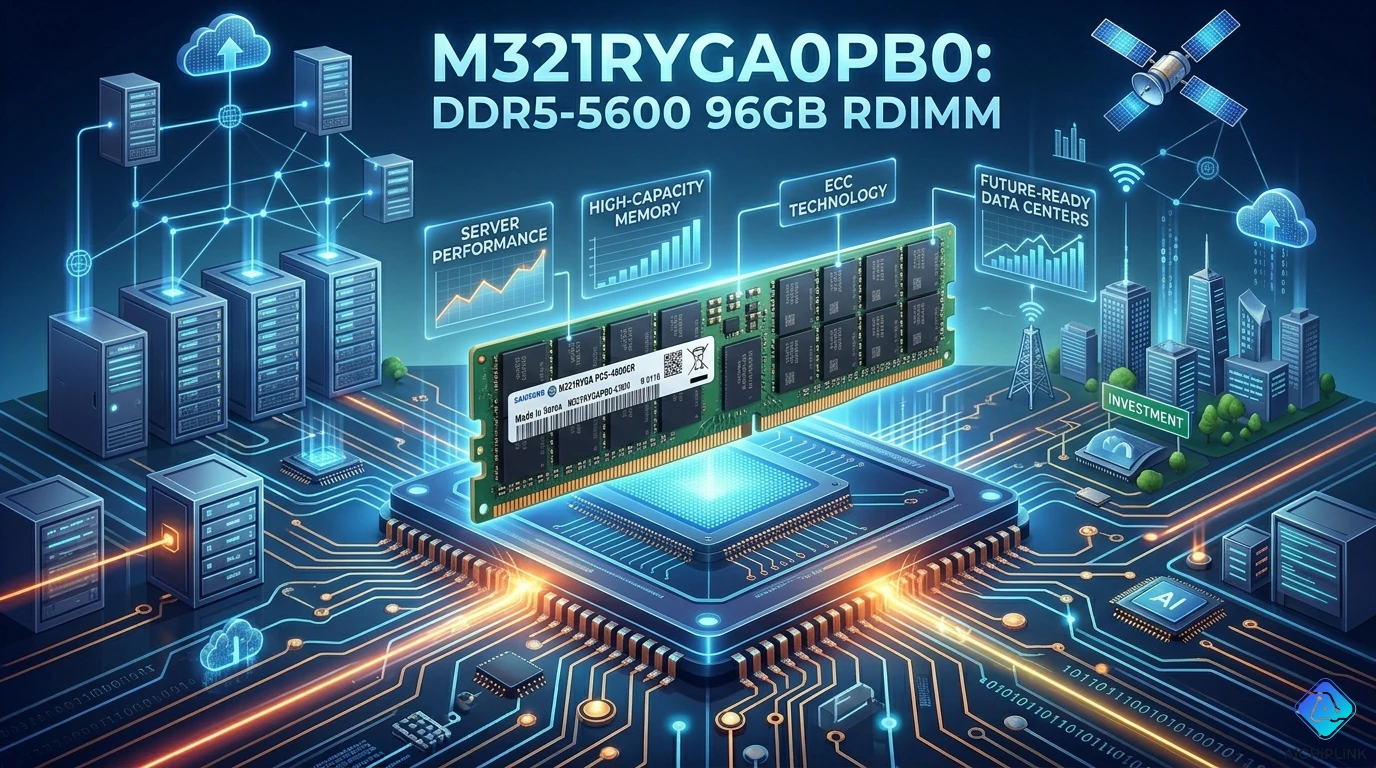
The M321RYGA0PB0 holds 96GB in a single DIMM slot. The letter that explains this is the Y in the part number — Samsung's code for a module built with 3D-stacked DRAM dies, where multiple DRAM die are bonded through-silicon vertically before packaging, allowing higher effective density per physical package than monolithic dies allow.
One 96GB RDIMM does not deliver more bandwidth than a 64GB RDIMM at the same speed — the channel width is the same, the frequency is the same, the bandwidth per slot is identical. What it changes is how much memory a given server can access per memory channel when slots are limited, and how densely AI inference servers, in-memory databases, and HPC nodes can be configured without adding chassis. Understanding M321RYGA0PB0 correctly means understanding not just what it is, but when 96GB per slot justifies its price premium over two 64GB modules.
1.0 Part Number Decoded: Every Field in M321RYGA0PB0-CWM
Samsung server memory part numbers encode every critical parameter. Here is the full decode for M321RYGA0PB0-CWM:
M — Memory product category (Samsung DRAM module)
3 — Module form factor: 3 = RDIMM (Registered DIMM; the register buffers address and command signals, enabling more DIMMs per channel and higher capacity vs UDIMM)
2 — DDR generation: 2 = DDR5 (1 = DDR4 in older Samsung parts)
1 — Channel configuration / memory type subcode (1 = standard SDRAM in RDIMM configuration)
R — Module height / profile: R = Standard height (vs L = Low Profile)
Y — Die technology: Y = 3DS (3D Stacked) — this is the critical letter. Modules without 3DS use different letters in this position. The Y indicates that the DRAM dies inside the module packages are vertically stacked using Through-Silicon Via (TSV) technology, allowing higher effective die density per package.
G — DRAM density per die: G = 16 Gb per die (H = 8Gb; J = 32Gb in some newer designs)
A — Module organization subcode
0 — Rank configuration: 0 = 2 ranks (2R)
P — Data width per chip: P = x4 (the DRAM chips present 4 data bits each to the module's data bus)
B — Speed grade: B = DDR5-5600 (PC5-44800)
0 — Revision / generation marker
-CWM — Ordering suffix:
- C = Commercial temperature range
- W = Standard height (non-low-profile)
- M = Tray packaging
Variant suffixes on the same base module:
| Suffix | Packaging | Notes |
|---|---|---|
| -CWM | Tray | Standard production |
| -CWMXJ | Tray | Alternative speed/screening bin |
| -CWMCJ | Tray | Another qualification variant |
| -CWMKH | Tray | Regional distribution variant |
All suffix variants share the same die, same electrical performance, and same JEDEC specification. The suffix differences reflect packaging, screening, and regional distribution codes rather than electrical differences.
Package marking note: Server DIMM modules typically carry the full part number on a printed label on the PCB. Verify the label against authorized distributor documentation. The full part number should also be readable from the SPD (Serial Presence Detect) EEPROM on the module using tools such as
decode-dimmson Linux.
2.0 Specifications at a Glance
Parameters from distributor data and Samsung product documentation for M321RYGA0PB0-CWM:
- Capacity: 96 GB per module
- Memory type: DDR5 SDRAM
- Speed grade: DDR5-5600 (PC5-44800)
- Effective data rate: 5,600 MT/s per pin
- Module bandwidth: 5,600 MT/s × 64 data bits ÷ 8 = 44,800 MB/s (44.8 GB/s) peak per module
- Form factor: 288-pin RDIMM (Registered DIMM)
- Module height: Standard (not low-profile)
- Rank configuration: 2Rx4 — 2 ranks, x4 DRAM chips
- Chip organization (EC8): 10 DRAM chips per rank × 2 ranks = 20 DRAM chips on module (includes 1 chip per rank for ECC, so 9 data chips + 1 ECC chip per rank)
- Die technology: 3DS (3D Stacked) — multiple DRAM die bonded vertically per package
- ECC: Yes — registered ECC (RDIMM)
- Operating voltage: 1.1V (VDDQ)
- CAS Latency: CL46 (some variant listings show CL40 for different screening bins)
- Operating temperature: 0°C to +85°C (commercial grade)
- RoHS: Compliant
- Target platforms: Intel Xeon Scalable (Sapphire Rapids, Emerald Rapids), AMD EPYC (Genoa, Bergamo, Turin)
- Server compatibility (examples): Dell PowerEdge R760/R860/R960, HPE ProLiant DL380/DL560 Gen11, Supermicro H13 series, Lenovo ThinkSystem SR650 V3
3.0 How 96GB Fits in a Single DIMM: EC8 and 3DS Architecture
Understanding the 96GB density requires understanding two related technologies: the EC8 chip organization and 3D stacking.
Standard DDR5 RDIMM organization:
A standard 64GB DDR5 RDIMM in 2Rx4 configuration uses x4 DRAM chips where each chip contains 16Gb (2GB) of DRAM. With 9 data chips + 1 ECC chip per rank × 2 ranks = 20 chips total, each at 16Gb: 20 × 16Gb = 320Gb total on the module. Divided by 8 bits/byte and considering the ECC overhead: the user-accessible capacity is 64GB.
What "EC8" means:
"EC8" is a DDR5-era module designation indicating that the DRAM chips are organized using x4 die but achieve an effective density equivalent to twice that of a monolithic 16Gb x4 die. The "EC8" designation (Effective Capacity 8x) means the module achieves 8× the effective density of a baseline DDR5 x4 chip through the 3DS stacking described below.
3D Stacking (3DS / TSV technology):
In M321RYGA0PB0, each physical DRAM package on the module contains two DRAM dies stacked vertically. The dies are bonded using Through-Silicon Vias — vertical copper conductors etched through the silicon of the bottom die, connecting it electrically to the die stacked on top. From the module's perspective, this doubles the effective capacity of each package location while maintaining the same PCB footprint and the same DDR5 interface timing.
Result: with two 16Gb dies per package instead of one, each effective chip location contributes 32Gb. With the same 20-package layout as a 64GB module: 20 packages × 32Gb = 640Gb total. Accounting for ECC overhead and 2 ranks: user capacity = 96GB.
What 3DS does and does not change:
3DS increases capacity per slot. It does not increase bandwidth per slot — the DDR5 data bus width (64 bits + 8 ECC) and the operating frequency (DDR5-5600) are unchanged. The effective bandwidth per memory channel is identical to a 64GB DDR5-5600 RDIMM: 44.8 GB/s.
What changes is the amount of memory accessible per memory channel at full operating frequency. In an 8-channel DDR5 server with 2 DIMMs per channel (16 total slots), switching from 64GB to 96GB modules increases total addressable memory from 1 TB to 1.5 TB without adding any additional DIMMs or modifying the system architecture.
4.0 ⚠️ Four Pitfalls When Deploying M321RYGA0PB0 in Production
Pitfall 1: Assuming the server supports 96GB modules just because it supports DDR5
Not every DDR5 RDIMM slot automatically supports 96GB 3DS modules. The memory controller, BIOS, and platform firmware must explicitly support 3DS DDR5 at the required density. Intel Sapphire Rapids and Emerald Rapids Xeon platforms, and AMD EPYC Genoa/Turin platforms, support 96GB 3DS RDIMMs, but the server's specific BIOS version must include the necessary SPD initialization support. Some platforms that are firmware-updated may require a BIOS upgrade before accepting 96GB modules. Always verify your specific server model and BIOS version against the manufacturer's memory qualification list (QVL) before purchasing.
Pitfall 2: Mixing 96GB and 64GB DIMMs in a multi-channel configuration without validating the memory map
Servers with mixed 96GB and 64GB DIMMs across channels will operate correctly in most cases, but the memory controller may impose restrictions on which configurations enable all memory in all channels at rated speed. For example, some Intel Xeon configurations with mixed DIMM populations will fall back from the highest performance mode (1DPC all-channel) to a reduced performance operating mode. For production deployments where maximum memory bandwidth is required (AI inference servers, in-memory databases), use uniform 96GB modules across all populated channels rather than mixing densities.
Pitfall 3: Expecting the same latency as non-3DS DDR5 modules
3DS modules can exhibit marginally higher RAS (Row Address Strobe) latency compared to monolithic DDR5 RDIMMs of the same speed grade, due to the additional electrical path through the TSV interconnects and the stacked die architecture. In practical workloads, this difference is rarely measurable at the application level. However, in latency-sensitive benchmarks (HPC, low-latency trading platforms), verify your system's memory latency profile with M321RYGA0PB0 specifically, rather than assuming it matches non-3DS module performance at the same DDR5-5600 speed.
Pitfall 4: Assuming CL46 means higher latency than DDR4
CL46 sounds higher than typical DDR4 CL timings (CL19–CL22), but the comparison is misleading because DDR5 runs at a much higher clock frequency. Actual memory access latency in nanoseconds:
- DDR4-3200 CL22: tCL = 22 / (3200 MHz / 2) = 13.75 ns
- DDR5-5600 CL46: tCL = 46 / (5600 MHz / 2) = 16.43 ns
DDR5-5600 CL46 has slightly higher first-access latency in absolute nanoseconds than DDR4-3200, but substantially higher bandwidth — the right metric for server workloads depends on whether the application is bandwidth-bound (benefits from DDR5) or latency-bound (less benefit from the frequency increase). Most data center workloads are primarily bandwidth-bound.
5.0 Server Configuration and Platform Compatibility Notes
Intel Xeon Scalable (4th/5th Gen — Sapphire Rapids / Emerald Rapids):
These platforms support DDR5 with up to 2 DIMMs per memory channel and up to 8 memory channels per socket. The M321RYGA0PB0 is certified for Sapphire Rapids and Emerald Rapids platforms. For maximum memory bandwidth (critical for AI and HPC), populate all channels with one DIMM each (1DPC — 1 DIMM per channel). Adding a second DIMM per channel (2DPC) may reduce operating frequency to stay within the memory controller's signal integrity limits.
AMD EPYC (Genoa / Bergamo / Turin):
AMD EPYC 9004 series (Genoa) and 9005 series (Turin) support DDR5 with up to 12 memory channels per socket and up to 2 DIMMs per channel. The M321RYGA0PB0 is compatible. A fully populated 2-socket EPYC Genoa server with 12 channels per socket × 2 DIMMs × 96GB = 2.3 TB per socket or 4.6 TB per dual-socket server — the use case that makes 96GB per slot strategically significant for AI model serving and large in-memory databases.
Memory speed at 2DPC:
At 2 DIMMs per channel, most platforms reduce operating frequency from DDR5-5600 to DDR5-4800 or DDR5-4400 to maintain signal integrity. Verify your platform's specific supported speeds at 1DPC and 2DPC configurations from the server vendor's memory compatibility guide.
6.0 Comparison: When to Use 96GB vs 64GB per Slot
| Scenario | 96GB (M321RYGA0PB0) | 64GB (M321R8GA0PB0) | Verdict |
|---|---|---|---|
| Maximum memory per server (slots limited) | 96 GB/slot | 64 GB/slot | 96GB wins |
| Memory bandwidth per slot | 44.8 GB/s (same) | 44.8 GB/s (same) | Tie |
| Cost per GB | Higher (3DS premium) | Lower | 64GB wins |
| Total cost for 1 TB server | ~11 × 96GB | ~16 × 64GB | Depends on slot count |
| BIOS/platform compatibility | Requires 3DS support | Universal DDR5 support | 64GB safer |
| AI model serving (large models) | Fewer slots needed | More slots needed | 96GB preferred |
| General-purpose server (512 GB) | 6 × 96GB (6 slots) | 8 × 64GB (8 slots) | Similar total cost |
| Latency-sensitive HPC | Slightly higher tCL | Lower tCL potential | 64GB may be better |
The decision in one line: If your server has limited DIMM slots and you need more than 64GB × slot_count of total RAM, M321RYGA0PB0 is the path to higher total capacity without a chassis change. If total capacity fits within 64GB modules and cost per GB is the priority, M321R8GA0PB0 (64GB equivalent) is the better choice.
7.0 Sourcing Authentic M321RYGA0PB0
Pricing context: M321RYGA0PB0-CWM is priced at a significant premium over standard 64GB DDR5 RDIMMs, reflecting the 3DS manufacturing cost. Typical pricing ranges from approximately $1,800 to $5,600 per module depending on the suffix variant and market conditions — a wide range that reflects secondary market and broker pricing versus authorized distribution pricing. The price variation between suffix variants (e.g., -CWMXJ vs -CWM vs -CWMCJ) can be substantial even though the electrical specification is essentially identical.
Authorized sourcing: Samsung does not sell server DIMMs direct-to-consumer. Authorized channels include major IT distributors (Avnet, Arrow, TD Synnex) and server OEMs (Dell, HPE, Lenovo, Supermicro) who sell memory either as accessories or as CTO (Configure-to-Order) options for their server platforms.
Counterfeit and remarked module risk: High-density server modules including 96GB DDR5 RDIMMs are targets for counterfeiting, typically as lower-density modules with SPD data reprogrammed to report false capacity. Counterfeit modules may partially initialize (appearing to enumerate correctly) but fail under memory test or show data corruption under load.
Verification procedure:
- Run
dmidecode --type 17(Linux) or the appropriate Windows memory diagnostic to read SPD-reported capacity, speed, and manufacturer - Run
memtest86+(or server vendor's memory diagnostics) for at least one full pass after installation - Verify the physical module label part number against the distributor's Certificate of Conformance
- For production deployments, use only servers where the module appears on the server vendor's Memory Qualification List (Dell, HPE, Supermicro, and Lenovo all publish QVLs)
For verified authentic Samsung M321RYGA0PB0 server memory with competitive pricing and full traceability, visit aichiplink.com.
8.0 Real Questions from Server Architects
Q: Our Dell PowerEdge R760 shows 96GB DIMMs in slots but only reports 64GB total per DIMM in the BIOS. What is wrong?
A: Most likely a BIOS firmware version issue. Dell's BIOS for R760 required specific updates to support 96GB 3DS DDR5 RDIMMs. Check Dell's support page for the R760's BIOS release notes — search for "96GB" or "3DS" in the change log. Update to the latest BIOS version, then reseat the modules. If the issue persists after a BIOS update, run Dell's DRAM diagnostic tool to verify SPD data is being read correctly. Also confirm the modules appear on Dell's Memory Qualification List for the R760 — not all 96GB DDR5 variants are qualified on all platforms.
Q: Can I mix M321RYGA0PB0 (96GB) with M321R8GA0PB0 (64GB) in the same server to reach a specific total capacity?
A: Technically possible on most platforms, but with caveats. Intel and AMD both support mixed DIMM populations, but the memory controller will operate all channels at the speed supported by the slowest/most-restrictive populated channel. More importantly, for maximum memory bandwidth in an AI inference or HPC configuration, symmetric population (same DIMM type and capacity in all channels) is strongly preferred. If you must mix, populate the 96GB modules in the lower-numbered channels (closest to the CPU) on Intel platforms, which are typically the primary channels for memory interleaving.
Q: What is the actual real-world bandwidth of M321RYGA0PB0 in an Intel Xeon 8490H system?
A: The Intel Xeon 8490H (Sapphire Rapids) supports 8 DDR5 channels per socket at up to DDR5-4800 in 1DPC configuration. With M321RYGA0PB0 (DDR5-5600), the controller will operate at DDR5-4800 maximum. Peak theoretical bandwidth per socket: 8 channels × 4,800 MT/s × 8 bytes = 307 GB/s per socket. Practical measured bandwidth (using tools like stream-triad) typically achieves 85–90% of theoretical: approximately 260–275 GB/s per socket. In a dual-socket configuration, total measured bandwidth approaches 520–550 GB/s, which is in the range required for large language model inference workloads with 100B+ parameter models.
9.0 Quick Reference Card
Part Number Decode — Key Fields:
| Field | Character | Meaning |
|---|---|---|
| Module type | M3 | RDIMM |
| DDR generation | 2 | DDR5 |
| Profile | R | Standard height |
| Die technology | Y | 3DS (3D Stacked, TSV) ← key field |
| Die density | G | 16 Gb per die |
| Rank config | 0 | 2 ranks (2R) |
| Data width | P | x4 chips |
| Speed grade | B | DDR5-5600 |
| Suffix -CWM | C/W/M | Commercial / Std height / Tray |
Key Specifications:
| Parameter | Value |
|---|---|
| Capacity | 96 GB per module |
| Speed | DDR5-5600 (PC5-44800) |
| Peak bandwidth | 44.8 GB/s per slot |
| Configuration | 2Rx4, EC8 (10 chips per rank) |
| ECC | Registered ECC (RDIMM) |
| Voltage | 1.1V |
| CAS Latency | CL46 |
| Form factor | 288-pin DIMM |
Why 96GB fits in one DIMM: Standard 64GB DDR5: 1 × 16Gb die per package × 20 packages = 64GB M321RYGA0PB0 with 3DS: 2 × 16Gb dies stacked per package × 20 packages = 96GB
64GB vs 96GB — Decision Rule:
Choose 96GB when total capacity requirement exceeds 64GB × available DIMM slots.
Choose 64GB when capacity fits within slots — lower cost per GB, broader platform support.
For sourcing Samsung M321RYGA0PB0 server memory with verified authenticity and competitive pricing, visit aichiplink.com.

Written by Jack Elliott from AIChipLink.
AIChipLink, one of the fastest-growing global independent electronic components distributors in the world, offers millions of products from thousands of manufacturers, and many of our in-stock parts is available to ship same day.
We mainly source and distribute integrated circuit (IC) products of brands such as Broadcom, Microchip, Texas Instruments, Infineon, NXP, Analog Devices, Qualcomm, Intel, etc., which are widely used in communication & network, telecom, industrial control, new energy and automotive electronics.
Empowered by AI, Linked to the Future. Get started on AIChipLink and submit your RFQ online today!
Frequently Asked Questions
What is M321RYGA0PB0?
Samsung M321RYGA0PB0 is a 96GB DDR5-5600 ECC Registered DIMM designed for enterprise servers. It features a 2Rx4 configuration, EC8 organization, and 3DS (3D-stacked DRAM) technology, enabling higher capacity per module compared to standard 64GB RDIMMs.
How does a 96GB DDR5 RDIMM work in a single slot?
The 96GB capacity is achieved using 3DS (3D stacking) technology. Each DRAM package contains multiple vertically stacked dies connected via TSV (Through-Silicon Via), effectively doubling density per chip location without increasing the physical DIMM size.
Is M321RYGA0PB0 compatible with all DDR5 servers?
No, compatibility depends on platform and BIOS support. Servers using Intel Xeon Scalable processors or AMD EPYC processors typically support 96GB RDIMMs, but only if the motherboard firmware includes support for 3DS memory modules.
Can I mix 96GB and 64GB DDR5 RDIMMs in the same server?
Yes, but it is not recommended for performance-critical systems. Mixed configurations may reduce memory speed or disrupt channel interleaving. For optimal bandwidth and stability, use identical DIMMs across all memory channels.
What are the advantages of 96GB RDIMM over 64GB modules?
96GB RDIMMs provide higher memory density per slot. They allow servers to reach greater total capacity (e.g., TB-scale memory) without increasing DIMM count, which is ideal for AI workloads, in-memory databases, and virtualization environments—though at a higher cost per GB.