How Centralized BMS Stacks Up Against Distributed BMS
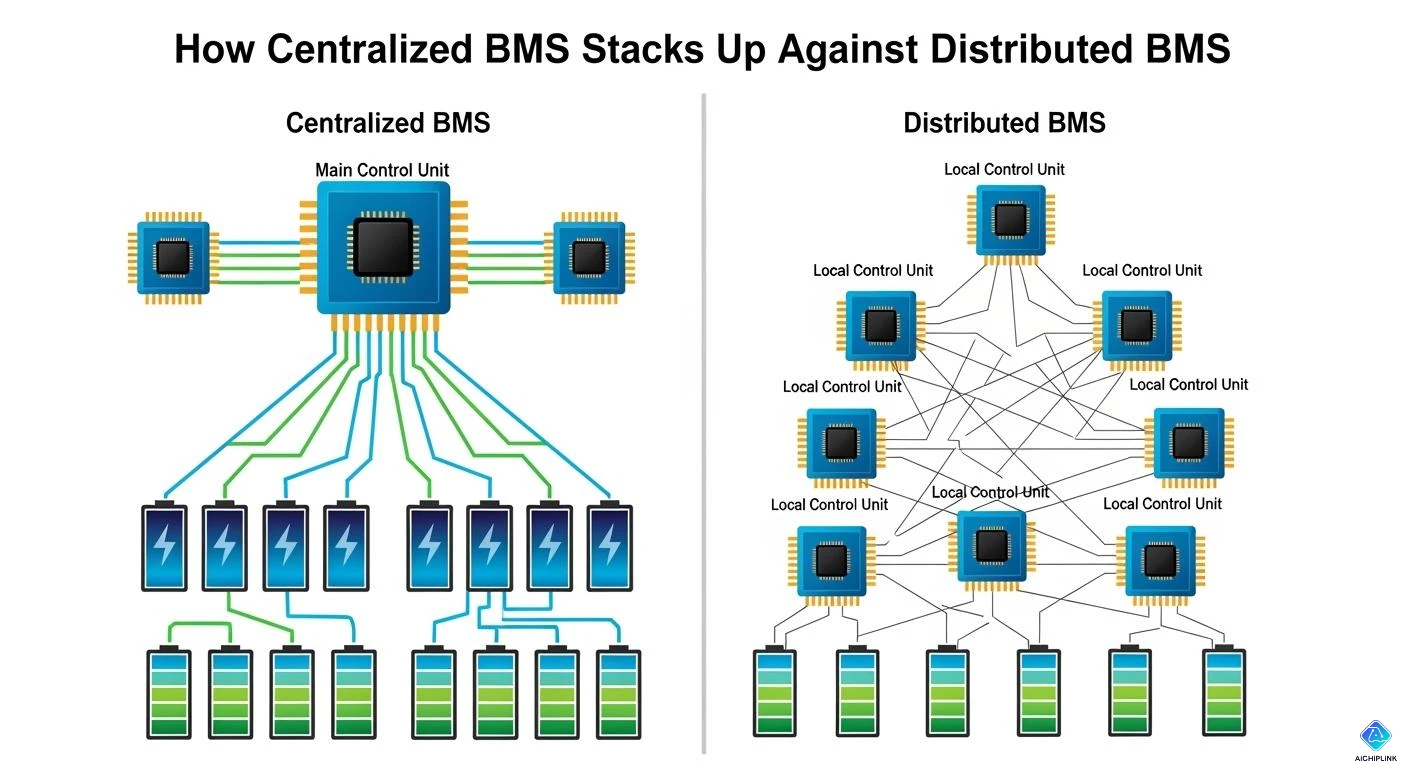
If you want the best battery management system, you should think about cost, reliability, scalability, and maintenance. Many people pick a centralized bms because it costs less at first. But you might pay more later and need more maintenance.
Modular systems are great for scalability and flexibility. You can add more modules as your energy needs grow. They work well in places that change a lot. You can add new modules without stopping what is already working.
Reliability is a big strength of modular systems. The distributed BMS keeps problems in one module. This stops the whole system from failing.
Centralized systems cost less at the start. But they can cost more later because they need more maintenance. They also need lots of protection devices.
The best system depends on your project’s size. It also depends on how much you want easy upgrades and reliable operation.
Key Takeaways
- Centralized BMS costs less at first but can cost more to fix later. Distributed BMS is better for big projects because it grows and works better. Centralized systems work best for small and easy setups. Distributed systems are good for large and growing projects. Distributed BMS lets you upgrade and fix things without turning off everything. Pick the right BMS by thinking about how big your project is, how much money you have, and if you want it to grow later.
Battery Management System Types
Centralized BMS Overview
A centralized bms has one main controller for all battery cells. This controller gathers data from every cell and sends it to one spot. You often see this in small battery packs and some electric vehicles. Centralized bms is good for simple setups. It keeps costs down and wiring easy for small systems. But with bigger packs, the wires can get tangled and hard to handle. If the main controller breaks, the whole system stops working.
Distributed BMS Overview
A distributed battery management system uses many smaller units to control cells. Each unit, called a node, manages a group of cells. These nodes talk to each other and share data. You find distributed battery management system designs in big battery packs, modular battery systems, and advanced evs. This setup lets you add or remove modules easily. You can fix one part without turning off the whole system. Distributed battery management system designs help keep problems in one module. If one module fails, the others still work. This makes modular bms and modular battery systems more reliable and flexible.
Tip: Modular bms can help you build battery systems that grow as you need. This works for both energy storage and electric vehicles.
Key Differences
You should know the main ways centralized and distributed battery management system designs are different. Here is a table to help you compare:
| Feature | Centralized BMS | Distributed Battery Management System (Modular BMS) |
|---|---|---|
| Control Unit | One controller | Many modules with their own controllers |
| Communication | Simple, no talking between modules | Needs modules to talk to each other |
| Scalability | Hard to make bigger | Easy to add more modules |
| Complexity | Not very complex | More complex, but modular |
| Cost | Cheaper for small packs | Costs more, but better for big modular battery systems |
| Fault Tolerance | One failure stops everything | Only one module stops if it fails |
| Maintenance | Must turn off whole system to fix | Can fix one module without stopping the rest |
You will see that modular bms and modular battery systems give you more flexibility and reliability. Centralized bms is best for small, simple setups. Distributed battery management system designs are better for big, growing, or important uses.
Scalability and Flexibility
Centralized BMS Scalability
A centralized bms is simple for small battery packs. It works well if you do not want to make your battery bigger later. You can add a few cells, but only up to a certain number. If you want to add more, it gets hard.
-
The hardware in a centralized bms cannot change for new battery setups.
-
Adding more batteries can slow down how cells talk to each other.
-
The system only works with a set number of batteries. If you reach that number, you must redesign the whole thing to add more.
-
If you use all the connectors, you cannot add extra cells.
-
You cannot mix different battery types in one pack.
-
Making the system bigger takes a lot of time and money because you must change everything.
-
If the main controller breaks, the whole battery stops working.
Big battery systems have trouble with these limits. Centralized systems cannot handle lots of cells at once. This can make the system slow and more likely to fail. One problem can stop the whole system. So, it is hard to make a centralized bms that can grow easily.
Note: Centralized systems are best for small battery packs that do not change. If you want to make your system bigger or change it, you need a more flexible battery management system.
Distributed BMS Scalability
A distributed battery management system is much more flexible. Each battery module has its own controller. You can add or remove modules when you need to. This makes it easy to make your battery system bigger. This is helpful for big projects like renewable energy or large electric vehicles.
Here is a table that shows how distributed systems help you grow:
| Component | Description |
|---|---|
| Independent BMS | Each module controls itself, so you can add or remove modules easily. |
| Thermal Management | Each module has its own cooling and safety systems for better protection. |
| Communication Interfaces | Modules talk to each other for smooth operation and easy upgrades. |
| Scalability | You can expand or change the system as needed, making it very flexible. |
You can make your battery system bigger by adding more modules. This setup is good for projects that get bigger over time. You do not have to turn off the whole system to make changes. You can also use different battery types together.
But, distributed systems have some problems too. Sometimes, modules have trouble talking to each other. If a cable breaks, some modules may not work together. Some systems use wireless or strong networks like CAN to fix this. These networks help the system keep working even if things go wrong. Each module must share enough information to keep everything balanced. This makes the system a bit more complex, but it helps it stay reliable as it grows.
Tip: If you want a battery system that can get bigger as you need, pick a distributed design. It gives you the flexibility and reliability you need for changing projects.
Reliability and Fault Isolation
Centralized BMS Reliability
It is important to know how a centralized bms deals with reliability and faults. One main controller checks all the battery cells. If something is wrong, the system watches closely to find it early. You get warnings if there is an insulation problem or a small fault. This lets you fix things before they get worse. The table below shows how a centralized bms handles faults:
| Feature | Description |
|---|---|
| Active Monitoring | Finds insulation problems in battery packs. |
| Isolation Levels | 2.5kV between chassis and voltage taps; 2kV between pack sensor and control electronics. |
| Fault Detection | Warns users about small insulation problems before they get worse. |
If the main controller breaks, the whole battery management system can stop. You cannot always keep the rest working if one part fails. This setup is best for small packs where you can check and fix things fast.
Note: Centralized systems watch for problems well, but one failure can stop the whole system.
Distributed BMS Reliability
A distributed battery management system gives you better reliability. Each module has its own sensors and controller. These modules use smart algorithms to find and stop faults at the cell, module, or pack level. If one module finds a problem, it can turn itself off. The rest of the system keeps working. This stops small problems from spreading and causing bigger trouble.
The design uses many modules that talk to a master controller. If one module fails, you do not lose the whole system. You can keep running while you fix the broken part. This setup gives you more safety and fault tolerance. You can also add new modules easily, making the system stronger as it grows.
Tip: Pick a distributed system if you want your battery pack to keep working even when one part fails. This design helps you avoid downtime and keeps your energy flowing.
Maintenance and Troubleshooting
Centralized BMS Maintenance
Taking care of a centralized bms is easy for small packs. The main controller is in one spot. You only need to check this place for problems. If you find something wrong, you must turn off everything. This means you cannot use the battery until it is fixed. This can be a problem if you need the battery for important things. You cannot fix just one cell or part. You have to look at all the wires and connections. One small problem can stop the whole battery pack.
Here are some steps you might follow:
-
Turn off the battery system.
-
Look at the main controller for problems.
-
Check all wires for loose or broken spots.
-
Change any parts that do not work.
-
Turn the system back on and see if it works.
Note: You should check your system often to find problems early. This helps you stop big failures before they happen.
A centralized bms is best for small and simple battery packs. You can finish the work fast, but you must stop the whole system to do it.
Distributed BMS Maintenance
Distributed battery management systems make work easier for big batteries. Each module has its own controller. You can fix one module without stopping the others. If one module breaks, the rest still work. This setup makes the system safer and lets you add more modules when you need them.
Tesla uses distributed BMS in its batteries. This way, you can control many cells very well. You can take care of big batteries with less time stopped. You only need to check the module that has a problem. You do not have to look at every wire or cell.
Here is a table that shows how distributed BMS helps with maintenance:
| Feature | Benefit |
|---|---|
| Modular Design | Fix or change one module at a time |
| Fault Isolation | System keeps working if one module fails |
| Scalability | Add new modules easily |
| Targeted Troubleshooting | Focus on the module with a problem |
Tip: Distributed BMS gives you more ways to grow and fix your system. You can take care of big batteries with less work.
You may see more wires and ways for modules to talk. This can make finding problems harder. You need to know how modules share information. Still, you get more choices and safety for large projects.
Energy Efficiency
Centralized BMS Performance
You want your energy storage to work well and last long. A centralized bms helps by balancing loads and stopping battery damage. This system checks each cell’s charge level. It stops batteries from getting too full or too empty. This helps your batteries last longer and need fewer replacements.
Centralized bms has one main controller for all the cells. The controller can use smart tools like AI to change charging speed and power use. These tools help your energy storage work better. You also get more control over charging and using energy. This means your batteries waste less energy when storing and using power.
Here is a table that shows how centralized and distributed systems compare in energy storage:
| Aspect | Centralized BMS | Distributed BMS |
|---|---|---|
| Thermal Management | Uses one method for the whole pack | Uses local methods for each module |
| Scalability | Hard to grow as system gets bigger | Easy to add new modules |
| Fault Tolerance | One failure can stop the whole system | One failure does not stop the rest |
| Maintenance | Must turn off the whole system to fix | Can fix one part while others keep working |
Note: Centralized bms is best for small energy storage systems. It gives you simple control and is easy to set up.
Distributed BMS Performance
A distributed system gives you more energy efficiency, especially for big or changing setups. Each module has its own controller. This lets each part of your battery handle different loads. You get steady voltages and less energy loss.
Distributed systems keep working even if one module fails. You can fix or change one part without stopping the whole system. This design saves you money and time when you do maintenance. You also get better performance as you add more modules.
-
Each module works alone, so you can make each part work its best.
-
You get better temperature and safety control for each module.
-
The system keeps running even if one module has a problem.
Tip: Pick a distributed system if you want your energy storage to grow and stay efficient as your needs change.
You will see the best results in big projects, like renewable energy storage or backup power for buildings.
Cost Comparison
Centralized BMS Cost
A centralized bms is good for saving money on small battery packs. It uses one main controller and not many parts. This makes it cheaper to build and easier to put together. You do not need a lot of wires or connectors. The simple setup means you spend less time and money making it. It is also easier to add to your project.
Centralized bms designs are liked because they are simple and cheap. They use fewer parts, so they cost less. This makes them great for things like phones or simple cars.
Centralized bms has a simple design with fewer parts. This makes it easier to build and use. You save money at the start. You do not need fancy ways for parts to talk to each other. For small jobs, this is the best way to save money.
Distributed BMS Cost
Distributed battery management systems use lots of modules. Each module needs its own controller and ways to talk to others. This makes the system cost more to build and put together. You have to pay for special ways for the modules to talk and for extra checks. The system gets more complicated as you add more modules. You need better ways for them to talk and watch each other, which costs more.
-
Making lots of modules takes more work and checking. This makes it harder to save money when building many at once.
-
You also have to pay for safety checks for each module and the whole system. This can slow things down and cost more.
You pay more money at the start. You also spend more to keep it working and to make changes later. You have to check each module to make sure it is safe. Big projects get more choices, but they cost more. You have to think about saving money and getting a system that works well and can grow.
| System Type | Upfront Cost | Long-Term Cost | Cost-Effectiveness | Best Use Case |
|---|---|---|---|---|
| Centralized BMS | Low | Moderate | High | Small/simple projects |
| Distributed BMS | High | Higher | Moderate | Large/modular projects |
Tip: If you want to save money on small battery packs, pick centralized bms. If you need a system that can grow and is reliable for big jobs, choose distributed bms, but know it will cost more.
Application Suitability for Centralized Battery Systems
Best Uses for Centralized BMS
Centralized battery systems are good when you want something simple and cheap. They work best for small battery packs that do not need to get bigger. Many gadgets use centralized battery systems because they are easy to make and use. You can find them in laptops, smartphones, tablets, wearables, power banks, drones, and power tools. In 2025, about 24.8% of battery management system chip money comes from these products. This is the second biggest group by number of units.
Centralized battery systems are also used in electric vehicles and energy storage that stays in one place. Companies like them because they are easy to set up and save money. Centralized battery systems can control many battery cells or modules at the same time. They will have about 58.67% of the market in 2026. Their simple design and low cost make them a favorite for many uses.
Common applications for centralized battery systems:
-
Consumer electronics (smartphones, laptops, tablets)
-
Wearables and power banks
-
Drones and power tools
-
Small electric vehicles
-
Stationary energy storage systems
Tip: Pick centralized battery systems if you want something easy to put in and take care of. They are a great choice for small and medium projects.
Best Uses for Distributed BMS
Distributed battery systems are best when you need something that can grow, is reliable, and can handle problems. Each cell or group of cells has its own controller in distributed battery systems. This setup is great for big or modular battery packs. Big industries that need lots of energy storage or large car batteries like distributed battery systems. You can add or take away modules as your needs change.
Distributed battery systems are perfect for huge energy storage and big electric vehicles. They give better accuracy and can work with more complicated setups. In 2025, distributed battery systems will make up about 32.4% of market money. Their design lets them have backup parts and strong ways for modules to talk to each other.
Best applications for distributed battery systems:
-
Large automotive battery packs
-
Grid-scale energy storage systems
-
Renewable energy storage
-
Industrial backup power
-
Projects needing high reliability and easy expansion
Note: Use distributed battery systems if your project needs to get bigger, change, or keep working even if one part breaks.
Pros and Cons Summary
Centralized BMS Pros & Cons
A centralized bms is good for small battery packs. It has a simple design and is easy to set up. You do not spend much money to build it. One controller helps connect to other parts of your device. But, if you want a bigger battery, you may have problems. The wires can get messy and hard to handle. The system can slow down if you add more cells. If the main controller breaks, the whole battery stops working.
| Advantages of Centralized BMS | Disadvantages of Centralized BMS |
|---|---|
| Simplicity in design and implementation | Challenges in scaling to larger battery packs |
| Cost-effective for smaller battery packs | Increased complexity of wiring and potential for signal noise |
| Single point of control for system integration | Vulnerability to single-point failures |
| Easier communication with other vehicle components | Potential bottleneck in processing data from numerous cells |
Note: Pick centralized bms if you want simple control and low cost. If you want to make your battery bigger later, you may need a different system.
Distributed BMS Pros & Cons
Distributed battery management systems are more flexible and reliable. You can add new modules when you need more energy. If one module stops working, the others still work. This keeps your battery system safe and strong. Distributed BMS is good for big projects and places that change a lot.
-
Modular design helps you make your battery system bigger.
-
Many controllers keep the system running if one fails.
-
You get better reliability for large battery setups.
-
You can fix or upgrade one module without stopping the rest.
Tip: Choose distributed BMS if you want a battery system that grows with your needs and stays reliable.
Choosing the Right BMS
Key Decision Factors
You need to look at several important factors before you pick a battery management system. Start by thinking about the size of your project. Small battery packs often work best with a centralized bms. Large or growing projects need more flexibility, so a distributed system may fit better. Think about how much you want to spend now and in the future. Some systems cost less at first but may need more repairs later. Reliability matters if you cannot afford downtime. Also, check how easy it is to add more batteries or fix problems. Safety and compliance rules can affect your choice, especially for projects in strict industries.
Remember: The right system should match your needs for cost, reliability, and future growth.
Practical Tips
You can make a better choice by following these tips:
-
Compare off-the-shelf BMS products with custom solutions. Off-the-shelf options save time, but custom designs fit special needs.
-
Learn about your battery cell chemistry and how it performs. Some systems work better with certain battery types.
-
Write down your safety and compliance needs. Some projects must meet strict rules.
-
Think about your budget, where you will build the system, and how much time you have for the project.
-
Plan for future changes. Choose a system that lets you add more batteries or upgrade parts easily.
Tip: Always match your BMS to your project’s real-world needs, not just the specs on paper.
Choosing the right battery management system helps you avoid problems and keeps your project running smoothly.
You can see that picking the right BMS depends on what you need. Centralized BMS is good for small and simple systems. It does not cost much and is easy to use. But if one part breaks, the whole system can stop. Distributed BMS is better for big or growing projects. It lets you fix problems in one part and add new parts easily. But it costs more money and is harder to set up.
-
Electric vehicles use distributed BMS to stay safe and get bigger.
-
Portable electronics use centralized BMS because it is simple.
Think about how much money you want to spend. Also, think about how reliable you want your system to be. Think about if you might want to make changes later. Pick the system that fits your project’s needs. This will help you feel sure you made the right choice.

Written by Jack Elliott from AIChipLink.
AIChipLink, one of the fastest-growing global independent electronic components distributors in the world, offers millions of products from thousands of manufacturers, and many of our in-stock parts is available to ship same day.
We mainly source and distribute integrated circuit (IC) products of brands such as Broadcom, Microchip, Texas Instruments, Infineon, NXP, Analog Devices, Qualcomm, Intel, etc., which are widely used in communication & network, telecom, industrial control, new energy and automotive electronics.
Empowered by AI, Linked to the Future. Get started on AIChipLink and submit your RFQ online today!
Frequently Asked Questions
What is the main difference between centralized and distributed BMS?
A centralized BMS has one controller for all cells. A distributed BMS has many controllers for groups of cells. This affects how you make your battery system bigger. It also changes how you fix and upgrade your system.
Which BMS is easier to install?
Centralized BMS is easier to put in for small packs. It has fewer parts and simple wires. For big systems, distributed BMS can be easier. You just add more modules when you need them.
Can I upgrade my battery system later?
You can make a distributed BMS bigger by adding modules. This gives you more choices. Centralized BMS is harder to upgrade. You might have to change the whole system.
Which BMS is safer for large projects?
Distributed BMS is safer for big projects. Each module can stop problems from spreading. If one part fails, the rest keep working.