Admittance vs Susceptance: Formula, Differences, and AC Circuit Applications
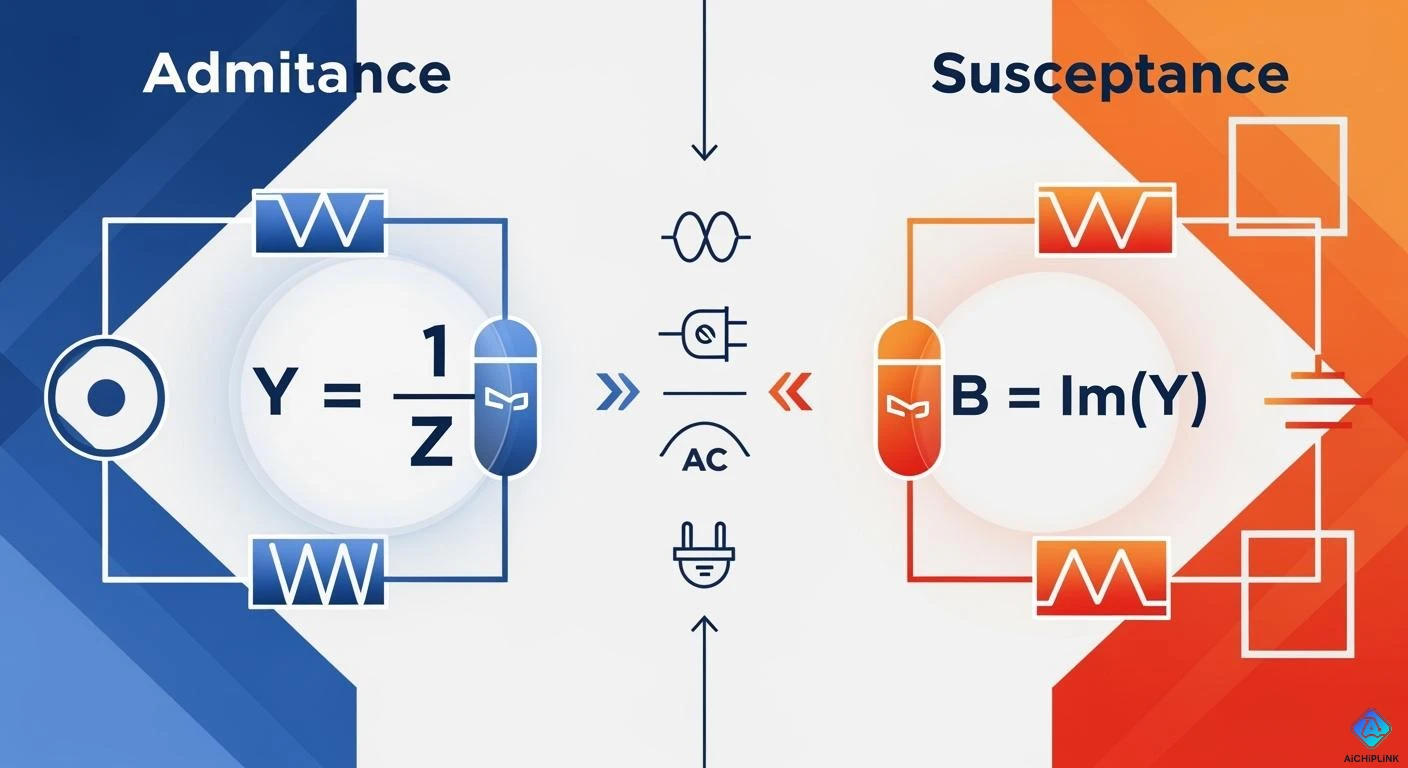
You should know that admittance shows how easily current flows. Susceptance looks at only the reactive part. In ac circuit analysis, this difference helps you see how circuits use and store energy. Admittance mixes conductance and susceptance. Susceptance is the imaginary part. Engineers use Admittance vs Susceptance to make circuit math easier. This is helpful in parallel circuits and power systems. Knowing these words helps you see how resistors and reactances change current flow.
Key Takeaways
-
Admittance shows how easily current moves in a circuit. It mixes conductance and susceptance, so it helps with AC circuit study.
-
Susceptance looks at the reactive part of a circuit. It shows how easily AC goes through things like capacitors and inductors.
-
Both admittance and susceptance use siemens (S) as their unit. They have different jobs when you study circuits.
-
In parallel circuits, you can add admittances to get total current. This makes math easier than using impedance.
-
Knowing these ideas helps make better circuits and saves energy. This is important for power systems and filters.
Definitions
Admittance: Meaning and Unit
Admittance tells us how easily current moves in a circuit. In electrical engineering, admittance is the opposite of impedance. If a circuit has high impedance, admittance will be low. If impedance is low, admittance will be high. The symbol Y stands for admittance. The unit for admittance is siemens (S). One siemens is the same as one over ohm, or 1/Ω. Sometimes, it is written as amperes per volt (A/V).
Tip: Admittance helps you quickly find how much current flows for a certain voltage.
Admittance is useful in AC circuit analysis. It shows how resistors and reactive parts change current flow. In parallel circuits, admittance makes math easier. You can add admittances directly, like adding resistances in series.
-
Admittance (Y): Tells how easily current flows.
-
Unit: Siemens (S)
-
Formula: Y = 1/Z, where Z is impedance.
Susceptance: Meaning and Unit
Susceptance shows how easily AC flows through a reactive part, like a capacitor or inductor. It is the imaginary part of admittance. The symbol B is used for susceptance. Susceptance is measured in siemens (S), just like admittance.
You find susceptance by taking one over reactance. Reactance is what stops current in capacitors and inductors. If reactance is high, susceptance will be low.
-
Susceptance (B): Tells how easily AC flows through a reactive part.
-
Unit: Siemens (S)
-
Formula: B = 1/X, where X is reactance.
Note: Susceptance helps you see how much energy a circuit stores and releases, not just how much it uses.
When you study AC circuits, knowing admittance and susceptance helps you understand everything. Admittance shows the total effect. Susceptance shows the reactive part only.
Formulas
Admittance Formula (Y = G + jB)
The admittance formula helps you see how easily current moves in an AC circuit. Admittance is the opposite of impedance. Impedance mixes resistance and reactance together. To find admittance, you start with the impedance formula:
-
Impedance: Z = R + jX
-
Admittance formula: Y = 1/Z
If you break down the admittance formula, you get this:
- Y = (R − jX) / (R² + X²)
This formula shows two parts. The real part is conductance (G). The imaginary part is susceptance (B). You can write the admittance formula like this:
-
Y = G + jB
-
G = R / (R² + X²)
-
B = -X / (R² + X²)
-
Admittance is used in parallel circuits because it makes math easier. You can add admittances together.
Here is a table to help you see the admittance formula and its parts:
| Component | Formula | Meaning |
|---|---|---|
| Admittance | Y = G + jB | Total ease of current |
| Conductance | G = R / (R² + X²) | Real part |
| Susceptance | B = -X / (R² + X²) | Imaginary part |
Susceptance Formula and Calculation
The susceptance formula tells you how easily AC moves through a reactive part. Susceptance is the imaginary part of admittance. The formula for susceptance is simple:
- Susceptance formula: B = 1/X
X means reactance. Reactance comes from capacitors and inductors. If reactance is high, susceptance is low. If reactance is low, susceptance is high.
Susceptance helps you see how much energy a circuit stores and gives back.
You use the susceptance formula in AC circuits to study capacitors and inductors. It shows how much the reactive part changes current flow.
-
Susceptance is measured in siemens (S).
-
The susceptance formula finds the imaginary part of admittance.
If you want to see how susceptance fits into the admittance formula, remember this:
- Admittance = Conductance + j Susceptance
This link helps you solve AC circuit problems faster.
Admittance vs Susceptance
Comparison Table
You can see the main differences between admittance and susceptance in this table. The table shows how each one works in AC circuits. It also lists their formulas, units, and what they measure.
| Specification | Admittance (Y) | Susceptance (B) |
|---|---|---|
| Definition | Measures ease of current flow | Reactive part of admittance |
| Symbol | Y | B |
| Circuit Role | Total current flow ability | Reactive current behavior |
| Unit | Siemens (S) | Siemens (S) |
| Mathematical Form | Y = G + jB | B = Im(Y) |
| Includes Resistance | Yes (via conductance) | No |
| Includes Reactance | Yes | Yes (only reactive part) |
This table lets you compare admittance and susceptance side by side. Admittance includes both resistance and reactance. Susceptance only looks at the reactive part.
Key Differences in AC Circuits
When you learn about AC circuits, you need to know how admittance and susceptance are different. These differences help you solve problems faster. They also help you design better circuits.
-
Admittance shows how easily current moves through the whole circuit. It mixes conductance (the real part) and susceptance (the imaginary part). You write admittance as Y = G + jB. G means conductance. B means susceptance.
-
Susceptance only looks at the reactive part of the circuit. It shows how much current goes through capacitors and inductors. The symbol for susceptance is B. It is the imaginary part of admittance.
Admittance is like the total "openness" of a circuit to current. Susceptance is just the part that deals with energy storage and release. It does not show energy use. If you want to know how much current a resistor and a capacitor let through together, you use admittance. If you only care about the capacitor, you use susceptance.
Here are some main differences to remember:
-
Admittance measures the total ease of current flow. It includes both resistance and reactance.
-
Susceptance measures only the reactive part. This comes from capacitors and inductors.
-
Admittance uses the formula Y = G + jB. Susceptance uses B = Im(Y).
-
Both use the unit siemens (S). But their jobs in AC circuits are not the same.
You use admittance and susceptance to make AC circuit math easier. Admittance lets you add values directly in parallel circuits. Susceptance helps you see how much energy the reactive parts store and give back.
In real circuits, admittance and susceptance are very important. Admittance helps you find out how much total current will flow. Susceptance helps you change the reactive parts to improve power factor and lower energy loss. You use these ideas in power systems, filter design, and transmission line modeling.
If you want to build or fix AC circuits, you need to know the main differences between admittance and susceptance. This helps you pick the right parts and guess how your circuit will work.
Applications
Admittance in Parallel Circuits
Admittance makes it easier to study parallel circuits. In a parallel AC circuit, each branch gives a path for current. You do not add impedances here. You add admittances instead. This saves time and shows how each part changes the total current. Admittance is the opposite of impedance. It tells you how easily current can move.
Here is a table that lists the main uses and features of admittance in parallel circuits:
| Application/Characteristic | Description |
|---|---|
| Inverse Impedance | Admittance is the opposite of impedance. It shows how easily current flows in parallel circuits. |
| Parallel Circuit Characteristics | It shows how each part adds to the total current in the circuit. |
| Frequency Dependency | Admittance changes with frequency because of capacitors and inductors. |
You can add up the admittance of each branch to get the total. This way, you can split current between branches without hard math. If you work with RF matching or filter design, admittance helps you get better results. You can also use admittance to find problems in circuits.
If admittance changes, it can show loose wires, bad capacitors, or unbalanced branches in a parallel circuit.
Susceptance in Reactive Analysis
Susceptance helps you see how reactive parts act in AC circuits. It is the opposite of reactance. It tells you how easily AC moves through capacitors and inductors. Susceptance is negative for inductors and gets smaller as frequency goes up. You can use susceptance to fix power factor and cut energy loss.
Here is a table that lists the main uses of susceptance in reactive analysis:
| Application | Description |
|---|---|
| AC Circuit Analysis | Makes it easier to study AC circuits by looking at current flow. |
| Power System Analysis | Used to study power lines and grids, making them safer and better planned. |
| Power Factor Correction | Helps adjust reactive power to save energy and work better. |
| Filter Design | Needed for making filters that control signals in communication systems. |
| Transmission Line Modeling | Shows charging effects in power lines, helping keep voltage steady and reliable. |
| Circuit Simulation | Used in computer tools to model AC circuits and improve designs. |
| Load Flow Studies | Helps figure out voltage and power in networks to make them work better. |
You can use susceptance to check capacitors and inductors. This helps you make circuits that work well and save energy. If you want to make AC circuits better, you need to know about admittance and susceptance.
-
Susceptance measures how easily AC flows through capacitors and inductors.
-
It is the opposite of reactance and helps you understand these parts in AC circuits.
-
Inductive susceptance is negative and gets smaller as frequency rises, so less current goes through inductors.
You can use these ideas in power factor correction, filter design, and power line modeling. Each use helps you build circuits that are better and more reliable.
Summary Table
Quick Reference: Formulas and Differences
This table helps you remember admittance and susceptance. It shows their formulas and main differences. You can use it when working with AC circuits.
| Feature | Admittance (Y) | Susceptance (B) |
|---|---|---|
| What it shows | Total ease of current | Ease of reactive current |
| Formula | Y = G + jB | B = 1/X or B = Im(Y) |
| Unit | Siemens (S) | Siemens (S) |
| Symbol | Y | B |
| Includes | Conductance & Susceptance | Only reactive part |
| Used for | Whole circuit | Capacitors & Inductors |
Tip:
Use admittance to find total current in parallel circuits. Use susceptance to study only reactive parts like capacitors or inductors.
Key Points to Remember:
-
Admittance shows how easily current flows in the whole circuit.
-
Susceptance shows how easily current flows through reactive parts.
-
Both use siemens (S) as their unit, but they do different things.
-
You add admittances in parallel circuits to get total current.
-
Susceptance helps you check how much energy reactive parts store and release.
Keep this table nearby. It will help you solve AC circuit problems faster and feel more confident. 🧠
You learned that admittance and susceptance help with AC circuits. Admittance (Y = 1/Z) shows how easily current moves everywhere. Susceptance (B = 1/X) looks at just the reactive parts.
-
Admittance helps you add numbers in parallel circuits.
-
Susceptance tells how capacitors and inductors change current.
| Feature | Susceptance (B) | Admittance (Y) |
|---|---|---|
| Formula | B = 1/X | Y = 1/Z |
| Role | Reactive part only | Total ease of current flow |
Use these ideas when you work on real circuits. Your work will be easier and more correct. 🚀

Written by Jack Elliott from AIChipLink.
AIChipLink, one of the fastest-growing global independent electronic components distributors in the world, offers millions of products from thousands of manufacturers, and many of our in-stock parts is available to ship same day.
We mainly source and distribute integrated circuit (IC) products of brands such as Broadcom, Microchip, Texas Instruments, Infineon, NXP, Analog Devices, Qualcomm, Intel, etc., which are widely used in communication & network, telecom, industrial control, new energy and automotive electronics.
Empowered by AI, Linked to the Future. Get started on AIChipLink and submit your RFQ online today!
Frequently Asked Questions
What is the main difference between admittance and susceptance?
Admittance tells how easily current moves in the whole circuit. Susceptance shows how easily current moves through parts like capacitors or inductors.
Why do you use admittance in parallel AC circuits?
Admittance lets you add numbers right away. This makes solving parallel circuits quick and simple compared to impedance.
How do you calculate susceptance for a capacitor?
You use this formula: `B = 2πfC` _f_ means frequency in hertz. _C_ means capacitance in farads.
Can admittance and susceptance have negative values?
Yes, they can be negative. Inductive susceptance is always negative. Admittance can have a negative imaginary part if the circuit uses mostly inductors.
Where do you see admittance and susceptance in real life?
You find them in power grids and radio circuits. They are also used in filter design. Engineers use these values to make circuits work better and safer.