100BASE-T1 vs 1000BASE-T1 for Choosing the Right Automotive Standard
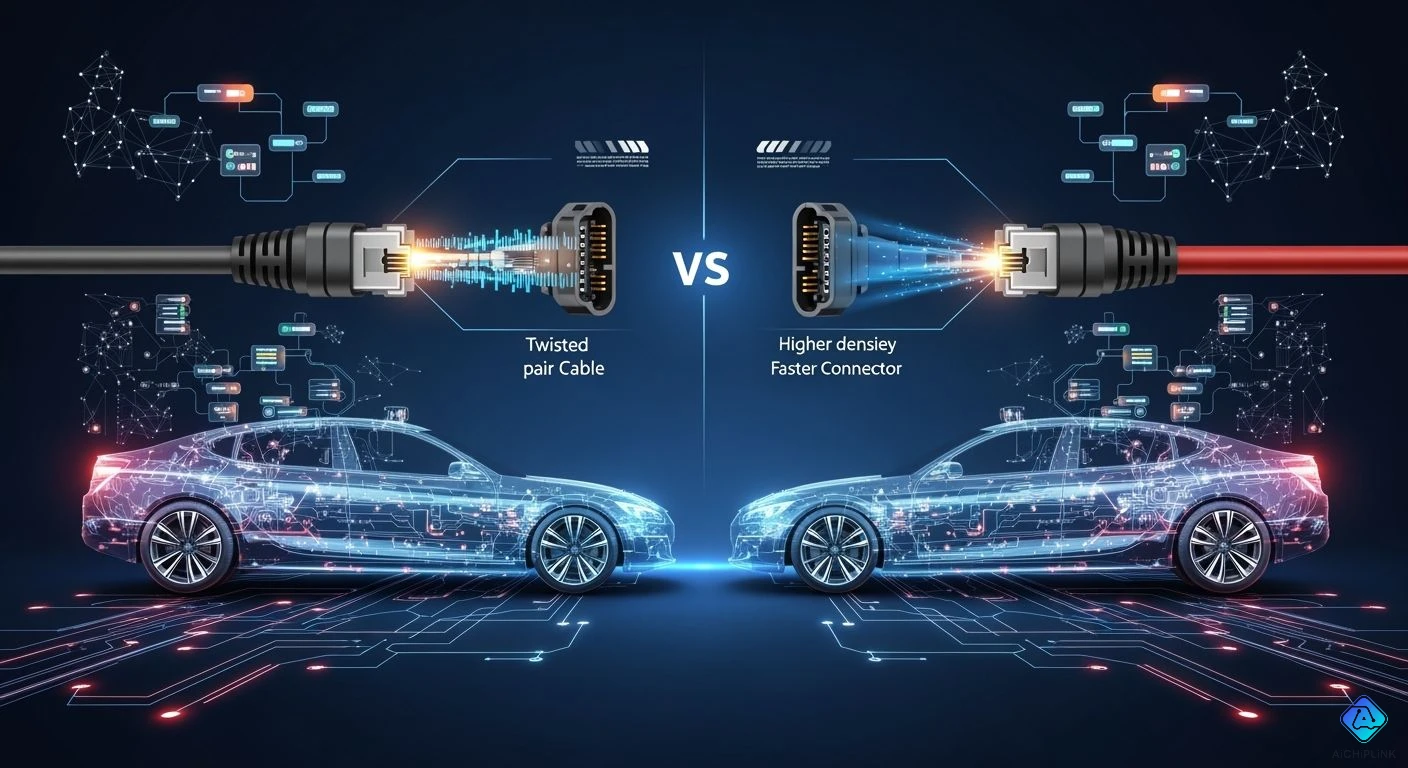
Choosing between 100base-t1 vs 1000base-t1 designs modern cars. The 100base-t1 standard gives 100 Mbps two-way speed. Meanwhile, 1000base-t1 provides 1 Gbps speed. It uses one twisted wire up to 15 meters. Old 100BASE-TX and 1000BASE-T standards need four wires. Single-pair car Ethernet cuts wire weight. It saves a lot of space.
| Ethernet Standard | Market Adoption Rate (2025) | Projected Compound Annual Growth Rate (CAGR) |
|---|---|---|
| 100BASE-T1 | Holds 58% share of total unit volume | Shrinking at a CAGR of 12.4% through 2033 |
| 1000BASE-T1 | Makes up 35% of total market money | Growing at a top CAGR of 26.8% through 2033 |
Engineers check choices about data speed and signal quality. They check power use and wire weight too. This guide helps makers pick the best standard. They use needs, noise limits, and network setups.
Key Takeaways
-
100BASE-T1 gives 100 Mbps for basic car parts. 1000BASE-T1 gives 1 Gbps for smart safety systems.
-
Both standards use just one twisted wire pair. This single-pair design lowers total cable weight. It also saves space inside modern cars.
-
100BASE-T1 uses cheaper unshielded wires. 1000BASE-T1 needs shielded wires. They block heavy electrical noise. They keep data clean too.
-
Engineers mix both standards for smart car networks. This balanced choice keeps total system costs low. It still boosts overall performance.
Technical Differences Between 100BASE-T1 vs 1000BASE-T1
Comparing performance shows big hardware differences here. Cars get distinct speed levels now.
Bandwidth, Symbol Rates, and Signaling Schemes
The 100BASE-T1 protocol gives 100 Mbps. 1000BASE-T1 provides 1 Gbps speed instead. This tenfold speed jump helps smart sensors. Both standards use PAM-3 signaling methods. Yet they run at very different speeds.
| Specification | 100BASE-T1 | 1000BASE-T1 |
|---|---|---|
| Operating Frequency | Low frequency range for less noise | 333.33 MHz clock frequency |
| PAM-3 Symbol Rate | Lower symbol rate via 4B3B/3B2T scheme | 333 MHz symbol rate |
Full-Duplex Transmission over Single-Pair Cabling
Both standards send two-way data together. They use just one wire pair. Digital chips handle complex data rates easily. No separate wires are needed here.
-
Transmitted Signal Tracking: The PHY chip tracks outgoing signals carefully.
-
Hybrid Circuit Coupling: A hybrid circuit links all signals. Local signals overlap with incoming signals. This creates a quick echo.
-
Digital DSP Echo Subtraction: A digital signal processor finds echoes. It removes its own outgoing echo quickly.
-
Clean Signal Extraction: Removing the echo cleans incoming data. This enables fast two-way communication.
PHY Power Dissipation and Thermal Characteristics
Power use rises with faster speeds. Chips work much harder then. Engineers check heat limits inside sealed boxes. Higher symbol rates need more electrical power.
| Transceiver Standard | Typical Power Dissipation |
|---|---|
| 100BASE-T1 | ~100 mW or greater |
| 1000BASE-T1 (Gigabit) | A few hundred mW |
This energy gap changes heat sink needs. Designers choose 100BASE-T1 or 1000BASE-T1 carefully. They balance heat limits with speed goals.
Harnessing and Cabling in Automotive Ethernet
Single Twisted-Pair Cable Limits and 15-Meter Distance
Both protocols use one pair of twisted wires. Engineers set a strict 15-meter distance limit. This maximum length brings several key benefits:
-
Electromagnetic Compatibility (EMC): The 15-meter cap controls signal emissions. It meets strict car noise rules.
-
Power Optimization: Shorter distances reduce total power needs across nodes.
-
Vehicle Size Constraints: Car setups never need wires longer than 15 meters.
-
Weight Reduction: The 15-meter limit cuts total wiring size. This creates lighter cable harness designs.
Unshielded vs Shielded Twisted Pair Performance
Car networks rely on specific cable types. Basic 100base-t1 links use unshielded twisted-pair (UTP) wires. They work well in low-noise areas. Fast 1000base-t1 links need shielded twisted-pair (STP) lines. These shield lines protect signal quality.
Signal frequencies jump at faster data speeds. Cable shields stop bad interference. They keep systems working right.
Engineers check insertion loss and return loss carefully. STP wires block bad radiation in harsh zones.
Connector Selection and Harness Weight Reduction
Single-pair car links cut weight over old cables. Old 100BASE-TX wiring needs four wire pairs. Single-pair setups cut total wire volume fast. Small special connectors save space in tight spaces. Thus, car makers lower build costs easily. They also improve total fuel efficiency.
Electromagnetic Compatibility and Signal Integrity
CISPR-25 Radiated Emissions Compliance
Fast frequencies make big noise problems for 1000BASE-T1 setups.
| Factor / Parameter | Frequency Context | Observed EMC Challenge |
|---|---|---|
| Hardware Symmetry Requirements | Nyquist Frequency of 375 MHz | Cables and parts need much better symmetry |
| Parameter Limits | High Frequencies | Signal noise limits main performance now |
| Frequency Impact | Exceeding 100 MHz | Data quality drops on high speed links |
Engineers choose cheap unshielded wires to save cash:
-
Unshielded Cable Usage: Basic 1000BASE-T1 designs use unshielded wires for low cost.
-
Bundled Interference: Unshielded wire bundles get high signal noise easily.
Noise Immunity and Common-Mode Rejection
Special parts block bad radio noise in noisy cars:
-
Differential Signal Transmission: Matching opposite signals cancel out bad noise fast. Data moves through wires without any trouble.
-
Common-Mode Noise Suppression: Shared noise makes strong magnetic fields here. High resistance blocks unwanted fast electrical noise.
Hardware parts keep good signals using simple metrics:
| S-Parameter Metric | Functional Role in Vehicle Noise Immunity |
|---|---|
| Sdd21 | It keeps data waves clean and clear. |
| Scc21 | It checks how well noise gets blocked. |
| Ssd21 (DCMR) | It stops strong current noise from interfering. |
Cable Degradation and Link Segment Testing
TC9 rules set clear tests for wire quality. Teams test wire sets to spot bad wear early. New chips warn about cable damage before links fail.
Application Mapping Across Vehicle Architectures
Car designers pick network wiring using clear rules. Different car parts need different data speeds.
100BASE-T1 Applications in Body and Sensor Networks
Cars use 100BASE-T1 for normal controls. Air units, body modules, and lights send small data. These parts use little power. They do not need big data speeds. The 100BASE-T1 link connects parking sensors and tools nicely.
1000BASE-T1 Applications in ADAS and Infotainment
Car safety parts need fast speeds now. Advanced driver systems use 1000BASE-T1 for safety.
Fast driver systems need gigabit speeds for sensor data.
The 1000BASE-T1 link helps smart driving setups do work:
-
Multi-Sensor Data Fusion: It handles camera, radar, and LiDAR input data.
-
Heavy Data Load Handling: It moves huge sensor data for safe driving.
-
High Bandwidth Capability: It offers two-way gigabit speeds on light wire.
-
Video Stream Support: It sends HD video and clear camera streams well.
Screen displays need fast data links too. Back seats get clear video without delays.
Integration into Zonal and Domain Controllers
Engineers build car networks with distinct layers. Local hubs gather data from 100BASE-T1 wires. Hubs bundle data and send it to main units. A 1000BASE-T1 wire connects main controllers quickly. This layout saves money and meets key timing goals.
Cost-Benefit Analysis and Hardware Trade-Offs
Choosing between 100base-t1 vs 1000base-t1 means balancing speed and cost. Hardware choices change chips, filters, and wire designs.
PHY Silicon Cost and Microcontroller MAC Interfaces
Basic 100BASE-T1 chips cost less than fast chips. Entry-level layers link to controllers with MII or RGMII. Faster systems need 1000BASE-T1 chips with complex DSP cores. These advanced chips cost more. They need fast SGMII MAC interfaces.
| Standard | PHY Silicon Cost | Common MAC Interface | Processing Complexity |
|---|---|---|---|
| 100BASE-T1 | Low | MII, RMII, RGMII | Low DSP overhead |
| 1000BASE-T1 | Moderate to High | RGMII, SGMII | High DSP overhead |
Faster speeds need advanced PHY chips. These complex chips raise hardware costs.
Overall System Cost and Weight Trade-Offs
Total system pricing includes more than chip costs. High-speed networks need better parts for signal health:
-
Passive Filtering Components: Gigabit links need precise common mode chokes.
-
Shielded Cabling: Fast networks use shielded wire to stop noise.
-
Connector Quality: High-frequency setups need tighter connector fits.
Slower links use cheap unshielded wire. These basic setups lower car wiring expenses.
Migration Strategy for Next-Generation Architectures
Car designers build mixed networks today. Engineers place cheap nodes in simple control zones. They save gigabit speeds for main computer hubs. This smart plan cuts total costs for future upgrades.
Decision Framework for Standard Selection
Car planners check special network rules before picking parts. Choosing between 100base-t1 vs 1000base-t1 needs exact matching for data demands.
Bandwidth and Latency Requirement Analysis
Data speed needs control hardware choices in car systems. Body sensor networks send tiny data packets very slowly. A basic 100base-t1 link handles simple data well. It keeps power use low too.
However, raw video from sharp cameras fills basic links. Smart safety parts run huge data without any delay. A fast 1000base-t1 link gives needed gigabit speeds. Engineers check delay limits to get top speed output.
💡 Architect Note: Car planners match hardware with top data speeds. This action stops bad traffic jams easily.
Parameter Comparison and Selection Matrix
Car planners run clear tests using precise specs. Comparing total costs with signal quality helps hardware choices.
| Key Evaluation Metric | 100BASE-T1 Specification | 1000BASE-T1 Specification |
|---|---|---|
| Bandwidth / Data Throughput | Up to 100 Mbps using simple signals | Up to 1 Gbps using fast clocks |
| Transmission Reach | Standard car distance reaches 15 meters | Moves 15 meters or up to 40 |
| Wiring & Cable Shielding | Single unshielded twisted pair wires | Single twisted pair needing extra shields |
| Electromagnetic Compatibility (EMC) | Low noise risk for car safety | Higher noise risk needing tight filters |
| Hardware & Cable Cost | Lower chip costs and simple plugs | Higher costs but trims wire weight |
| Primary Network Application | Audio, single cameras, and sensor links | ADAS safety lines and main controllers |
Engineers balance these facts against car limits carefully. Slower links save cash on simple nodes easily. Fast lines offer top speeds for key controls.
Testing 100BASE-T1 vs 1000BASE-T1 helps car makers pick well. Simple car controls use 100BASE-T1 for low power. Smart safety tools use 1000BASE-T1 for fast data. Both types use one twisted wire for 15 meters. Speed needs and signal quality guide the final choice.
System builders must test wires and check electrical noise first.

Written by Jack Elliott from AIChipLink.
AIChipLink, one of the fastest-growing global independent electronic components distributors in the world, offers millions of products from thousands of manufacturers, and many of our in-stock parts is available to ship same day.
We mainly source and distribute integrated circuit (IC) products of brands such as Broadcom, Microchip, Texas Instruments, Infineon, NXP, Analog Devices, Qualcomm, Intel, etc., which are widely used in communication & network, telecom, industrial control, new energy and automotive electronics.
Empowered by AI, Linked to the Future. Get started on AIChipLink and submit your RFQ online today!
Frequently Asked Questions
What is the primary speed difference between 100BASE-T1 and 1000BASE-T1?
100BASE-T1 moves data at 100 Mbps. 1000BASE-T1 runs at 1 Gbps speed. It uses a single twisted wire pair. The faster system gives ten times more bandwidth.
Why do vehicle designers choose 1000BASE-T1 for adas applications?
HD cameras and LiDAR make huge data fast. An ADAS needs gigabit speed for safety. Fast standards move high data without delay.
Can both standards use unshielded twisted-pair cables?
Both systems use one twisted wire pair. Yet 1000BASE-T1 needs shielded wires in noise. Fast speeds make gigabit setups collect interference.
How do single-pair standards reduce automotive wiring weight?
Old Ethernet relies on four wire pairs. Car standards need only two copper wires. This trim setup cuts cable harness weight. It saves space in cars too.