What is Visible Light Communication (VLC)?
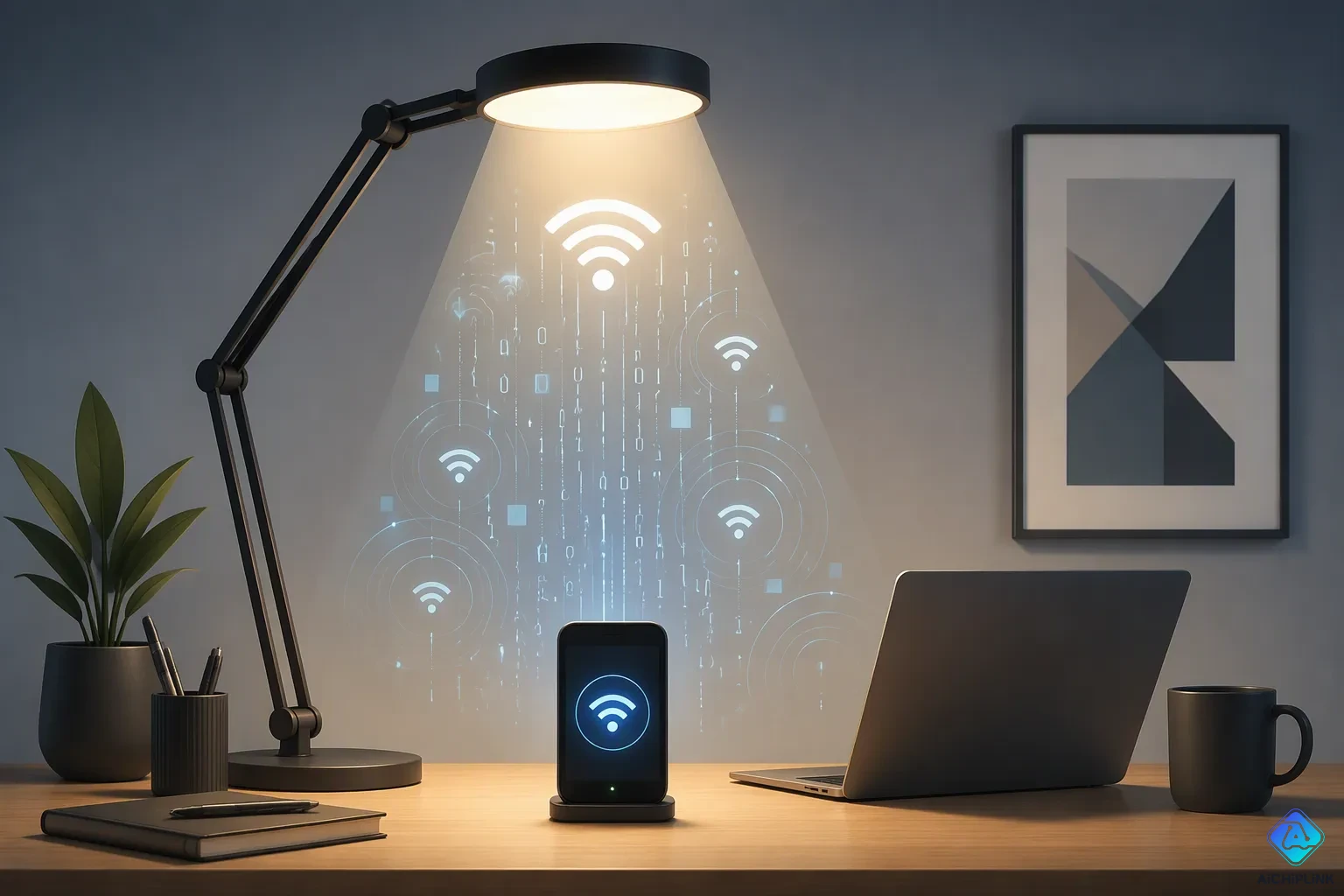
Visible light communication (VLC) is a wireless method that sends data by changing the brightness of a light source. It belongs to optical wireless communication, a family that includes Li-Fi and infrared remote controls. Standard off-the-shelf LEDs act as transmitters, reaching up to 500 Mbit/s over short distances. A photodiode receives the signal and turns it into readable data.
So, what is VLC? It is communication using light from the visible light spectrum to carry information without wires. People often call this technology Li-Fi, and it offers a free spectrum that is not regulated. You will also see the plural form, visible light communications, in research. This method of light communication turns everyday lamps into data transmitters.
Key Takeaways
-
Visible light communication (VLC) sends data by flickering LED lights faster than your eyes can see.
-
VLC keeps your data safe inside a room because light cannot pass through walls.
-
You can use regular LED bulbs for both lighting and sending data at the same time.
-
Li-Fi is a special type of VLC that works like a wireless network for the internet.
How Visible Light Communication Works
Visible light communication turns normal lights into a path for data. It uses common visible light LEDs that you can buy in stores. These bulbs already light up your home. Now they can send data too. The main idea is easy: you send information by changing how bright the light is, much faster than your eyes can see.
The Role of LEDs and Modulation
Light emitting diodes act as the transmitter in any VLC link. These devices turn on and off millions of times each second. Your eye sees a steady glow because the flicker is too quick to notice. Engineers call this process modulating light. The LED drive current changes so the light power follows the signal. A binary 1 might mean the light is on. A binary 0 means it is off. This plan is On-Off Keying, or OOK.
Several modulation formats exist for visible light communications. The table below compares the main options standardized in IEEE 802.15.7.
| Modulation Format | How It Modulates the LED | Key Characteristics |
|---|---|---|
| On-Off Keying (OOK) | Switches the LED between two optical power levels | Simplest scheme; supports data rates up to several hundred Mbps |
| Variable Pulse Position Modulation (VPPM) | Shifts a pulse's position within a time slot | Preserves visible dimming while carrying data |
| Orthogonal Frequency-Division Multiplexing (OFDM) | Spreads the signal over many subcarriers | Can reach gigabit-per-second rates using high-speed blue LEDs |
Advanced schemes like OFDM, CAP, and DMT make better use of the spectrum. Lab tests have gone past 10 Gbps. Real-world VLC systems balance speed, cost, and dimming support. A single white LED can reach 100 Mbit/s with improved equalization circuits. That is fast enough to send data quickly across a room. Light sources that emit at visible wavelengths give you this choice. OOK stays popular because it works with simple driver circuits. VPPM adds dimming control without extra hardware. OFDM needs more processing power but gives higher throughput.
The Reception Process
A photodetector sits at the receiving end. This device turns the incoming visible light signal back into electrical current. The BPW34 photodiode is a common pick. It reacts in microseconds and covers a wide spectral range from 430 to 1100 nm. Other choices include avalanche photodiodes, image sensors, and multi-element detector arrays. The photodetector must match the light source's wavelength for best results. Silicon devices work well with visible light.
The receiver front-end does several steps. An optical filter cuts down background noise. A transimpedance amplifier turns the photodiode current into voltage. Then the signal is filtered and demodulated to get back the original bits. A PIN photodiode with an 80 nm band-pass optical filter centered at 645 nm can handle this job well.
You can set up VLC over free space or through fiber. Free-space links work across a room or between buildings. Fiber-based VLC systems guide the light through a cable. Both methods use the same rule: a light source sends a modulated beam, and a detector gets back the data. Another light source can act as a backup. The technology works with your current lighting. You get light and data transmission from the same fixture. You can send data and light at the same time.
Key Characteristics of VLC
Knowing the characteristics of VLC helps you understand why this technology matters for real-world use. Visible light communication has special traits that make it different from radio-based systems.
Signal Confinement and Security
The biggest advantage comes from a simple physics fact. Visible light cannot go through opaque walls. This means your data stays inside the room. A neighbor or passerby in the hallway cannot grab the signal. Wi-Fi signals, in contrast, often leak beyond walls. You might lose control of security without knowing it.
This signal confinement gives the technology a strong security edge. The table below shows how it compares to Wi-Fi on key security aspects.
| Security Aspect | Visible Light Communication | Wi-Fi |
|---|---|---|
| Physical containment | Light stops at walls and opaque surfaces | Signals may extend beyond intended room boundaries |
| Signal containment | Strong within illuminated zones; reduces cross-room leakage | Lower due to wider signal spread |
| Overall security posture | Adds physical propagation limits that simplify risk controls | Can be highly secure when properly configured |
VLC systems also gain from an important advantage. The visible light spectrum stays unregulated and free. Radio spectrum is crowded and costly to license. The spectrum gives you a huge, open option. You can set up light communication without paying for spectrum rights.
Safety and Energy Efficiency
The technology is safe for human health. Standards like IEC 62471 set photobiological safety guidelines for VLC systems. IEEE 802.15.7 makes sure your VLC setups meet performance and safety rules. FDA guidance on optical radiation safety confirms safe exposure limits. The technology fights electromagnetic interference, so it does not disrupt medical equipment. This makes VLC perfect for hospitals and labs.
Energy efficiency is another strong point. LEDs use about 75% less energy than incandescent bulbs and last 25 times longer. When you add communication to existing LED lighting, you get data transmission without a matching energy increase. The chart below shows how VLC systems can adjust lighting power based on daylight conditions.
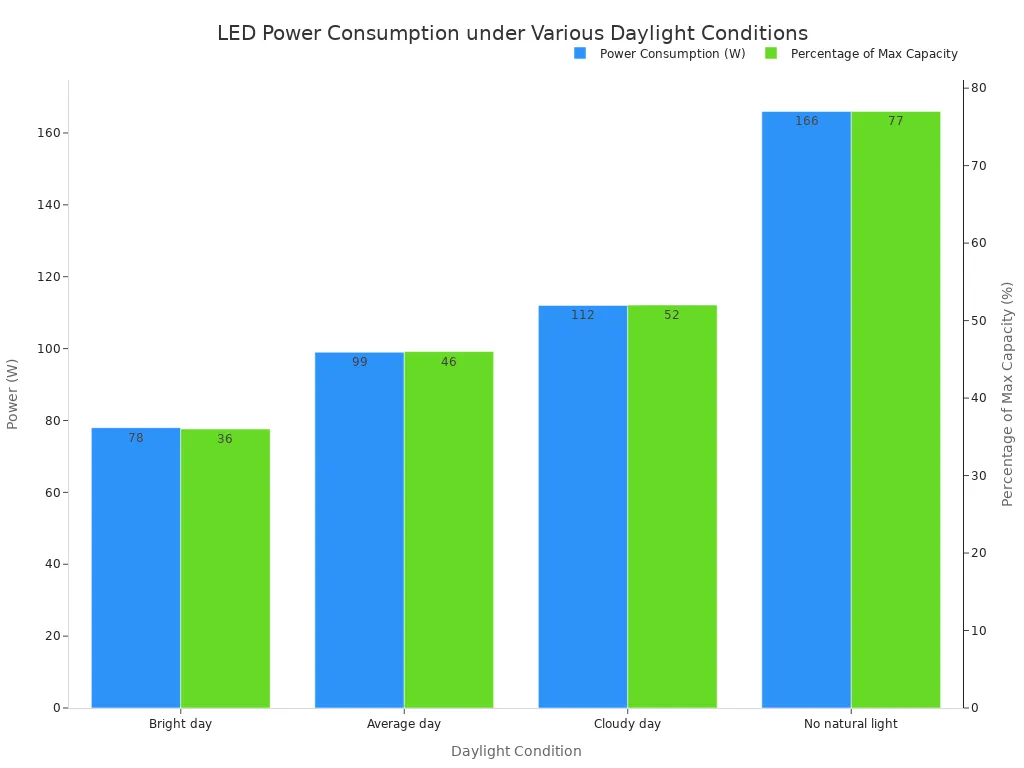
A single light source can serve up to 16 users at once and reach a data rate of 100 kb/s. You get light and data from the same fixture. This dual-purpose design saves energy and cuts the need for separate network cabling.
The Architecture of VLC Systems
Transmitter and Receiver Components
The LED works as one of the main VLC transmitters. You can find these devices in normal lighting. They switch on and off quickly to carry data in VLC systems. Phosphorescent white LEDs reach a modulation bandwidth up to 20 MHz. They support data rates up to 1 Gb/s for one user. Commercial LED devices usually achieve several kHz to a few MHz. The phosphor response creates a bottleneck for speed. Micro-LEDs with an active area under 100 μm get past this limit. Their smaller size and lower RC time constant give higher modulation bandwidth.
The receiver uses photodetectors to catch the modulated visible light. Photodiodes give a low-cost and simple setup. Their data rate depends on response time. Camera-based receivers offer another choice. Modern low-cost CMOS sensors reach up to 8 kbps using rolling shutter. Proprietary sensors reach 20 Mbps. The physical layer changes between visible light and electrical signals.
You can connect VLC systems right into your current lighting. You get light and data transmission from the same light source. A dual-purpose LED driver controls average current for lighting while modulating the waveform for communication. A Bias-T circuit joins DC current with AC signal for data. The Retro-VLC system shows two-way communication using a retro-reflector fabric. It reaches 10 kbps downlink and 0.5 kbps uplink over 2.4 m.
The Protocol Stack and Layers
VLC follows a three-layer protocol stack. The physical layer holds the photodiodes and LEDs. The hardware changes data between optical and electrical domains here. Common modulation techniques include on-off keying (OOK), pulse position modulation (PPM), and pulse amplitude modulation (PAM). Complex systems like CAP-16 QAM reach 5.4 Gbps over 1.5 m.
The MAC layer controls how devices share the channel. It uses Carrier Sense Multiple Access with Collision Avoidance (CSMA/CA). Nodes check the channel before they send data. A Contention Window lets multiple users share the medium. A backoff mechanism depends on the BackoffExponent. After sensing an idle channel, a node sends a frame and waits for an ACK. If delivery fails, the node raises its backoff count. After several failures, the system drops the frame.
The IEEE 802.15.7 standard defines a superframe structure. The superframe splits into active and inactive periods. The active period includes a Contention Access Period (CAP) and a Contention Free Period (CFP). A coordinator sends a beacon frame to sync users. This layered design ensures reliable data transfer for your VLC light source.
VLC and Li-Fi: Understanding the Connection
You will often hear the terms Li-Fi and visible light communication used together. Many articles say they are the same thing. That habit causes confusion, because the two terms actually cover different scopes of the same idea.
What is Li-Fi?
Li-Fi stands for Light Fidelity. It is a visible light communications system that uses the visible light spectrum to give wireless Internet connectivity. The technology works in two directions, so the receiver can also act as a transceiver. Engineers define Li-Fi as high speed, bidirectional, and fully networked wireless communication of data using light. It follows the IEEE 802.15.7 standard, which is like Wi-Fi's IEEE 802.11 in spirit. A Li-Fi setup uses several lightbulbs that together form a wireless network. In July 2023, the IEEE published the 802.11bb standard for light-based networking, giving the Li-Fi market a vendor-neutral option. That standard covers the 800 to 1000 nm near-infrared band and supports a minimum throughput of 10 Mb/s and a maximum of 9.6 Gb/s. Li-Fi's two-way design makes transfer speeds up to 224 Gbps possible in research settings.
The IEEE 802.15.7 standard splits the physical layer into three profiles. Each profile targets a different job.
| PHY Layer | Application Scope | Data Rate Range |
|---|---|---|
| PHY 1 | Outdoor applications | 11.67 kbit/s – 267.6 kbit/s |
| PHY 2 | General indoor use | 1.25 Mbit/s – 96 Mbit/s |
| PHY 3 | Multi-source emissions using Color Shift Keying (CSK) | up to 96 Mbit/s |
VLC vs. Li-Fi
Visible light communication is the broader, umbrella technology. Li-Fi is a specific implementation built on top of it. Both rely on the same core physical setup: an LED source that rapidly modulates its brightness, a free-space optical channel, and a photodetector that decodes the incoming light. Li-Fi inherits VLC's fundamental transmission principle. It then adds networking capabilities such as bidirectional links, standards compliance, and higher-layer protocols. Those additions turn a simple communication method into a full wireless networking solution.
The distinction matters when you compare Li-Fi to Wi-Fi. The table below shows where each technology stands.
| Feature | Wi-Fi | Li-Fi |
|---|---|---|
| Medium | Radio waves (2.4, 5, 6 GHz) | Light waves (visible, IR, UV) |
| Range | High (30–100 m typical) | Short (~10 m) |
| Wall penetration | Yes | No (blocked by opaque surfaces) |
| Interference | High in dense environments | Low (light beams do not interfere) |
| Speed (theoretical) | Up to 46 Gbps (Wi-Fi 7) | Up to 100 Gbps (lab) |
| Hardware cost | Low, globally standardized | Higher, needs special LED drivers |
| Security | Signal leaks beyond walls | Signal contained within room |
| Energy efficiency | Separate radio infrastructure | Reuses lighting infrastructure |
| Regulation | Heavily licensed spectrum | Visible light is unlicensed |
Both technologies use visible light in data transmission and share the same core principles. You get light with data transmission from the same fixture. The transmission of data happens through modulation, and a photodetector recovers the bits. Whether you call it light communication or Li-Fi, the physics stays the same. The label simply tells you how much networking sits on top.
Visible light communication turns a simple lamp into a tool that does two jobs. You get lighting and data transmission from one fixture. The technology keeps your data inside a room, avoids radio interference, and reuses existing LEDs. It also uses the unregulated visible light spectrum. These traits make VLC systems a strong fit for smart homes, hospitals, and secure facilities. You can transmit data where Wi-Fi struggles or poses risks. Think of light communication as a partner to Wi-Fi, not a replacement. VLC systems add a secure layer that radio waves cannot match. The visible light around you already carries power. Now it can carry information too.

Written by Jack Elliott from AIChipLink.
AIChipLink, one of the fastest-growing global independent electronic components distributors in the world, offers millions of products from thousands of manufacturers, and many of our in-stock parts is available to ship same day.
We mainly source and distribute integrated circuit (IC) products of brands such as Broadcom, Microchip, Texas Instruments, Infineon, NXP, Analog Devices, Qualcomm, Intel, etc., which are widely used in communication & network, telecom, industrial control, new energy and automotive electronics.
Empowered by AI, Linked to the Future. Get started on AIChipLink and submit your RFQ online today!
Frequently Asked Questions
Does VLC need special light bulbs?
No. You can use standard off-the-shelf LEDs that already light your home. A driver circuit modulates the light intensity at high speed. Your eyes see a steady glow, and the same fixture still gives you normal lighting.
Can someone outside the room intercept the signal?
No. Visible light cannot pass through opaque walls. The signal stays inside the room, so a person in the hallway cannot grab your data. This physical limit gives you a security edge over Wi-Fi.
Is VLC safe for your eyes and body?
Yes. Standards like IEC 62471 and IEEE 802.15.7 set photobiological safety limits for these systems. The light levels stay within safe exposure ranges. VLC also avoids electromagnetic interference, which suits hospitals and labs.
Do you need a license to use the light spectrum?
No. The visible light spectrum is unregulated and free. Radio spectrum is crowded and costly to license. You can set up a VLC link without paying for spectrum rights.
Is Li-Fi the same thing as VLC?
Not exactly. VLC is the broad term for any data transmission using visible light. Li-Fi is a specific implementation that adds bidirectional, networked communication under the IEEE 802.15.7 standard. Both share the same core principles.