What is SERDES: Definition, Meaning, and Full Form
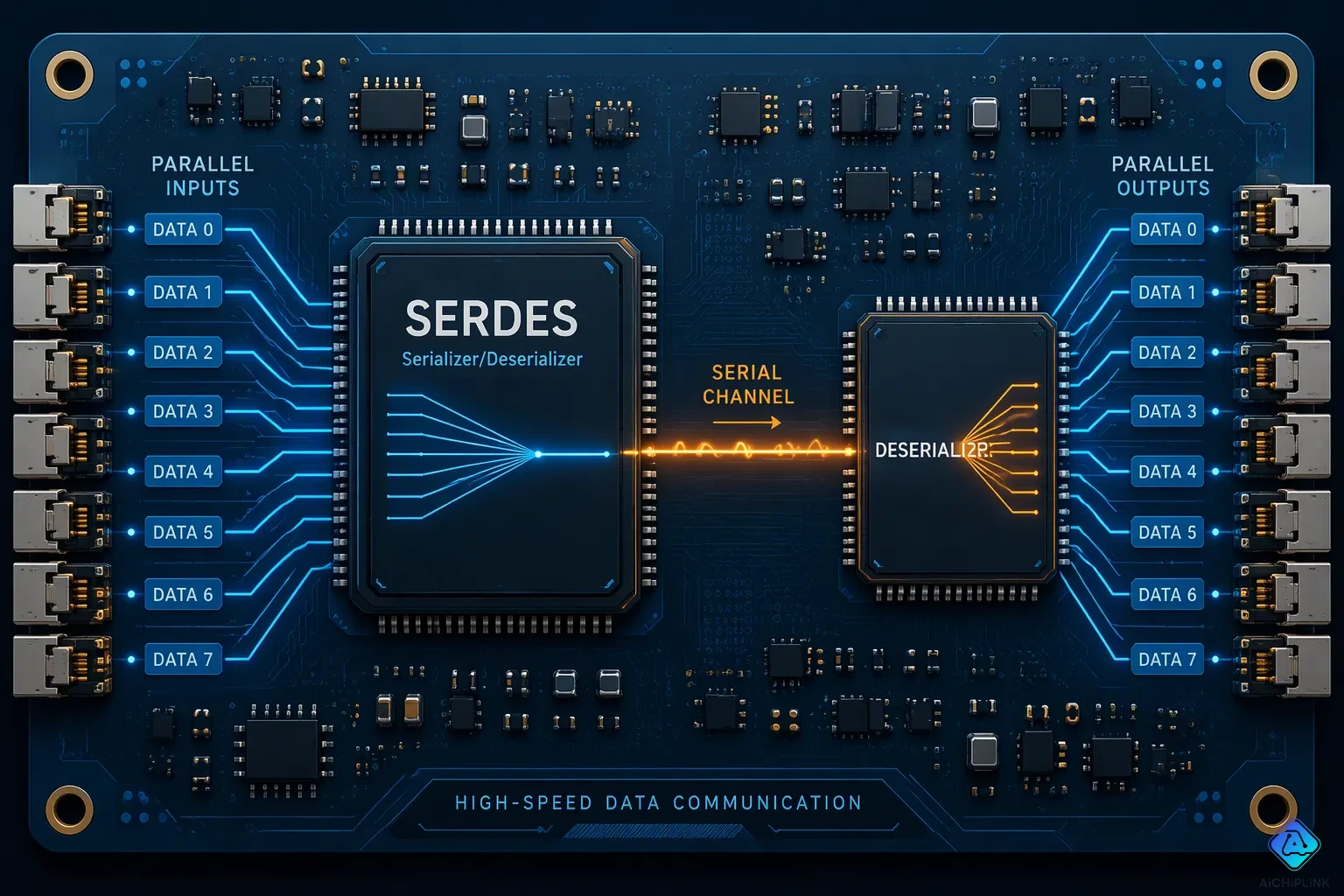
SERDES stands for Serializer/Deserializer. This block changes parallel data into serial data and back again for high-speed communication. The term describes a key input/output setup inside modern chips. This post explains what serdes means, why engineers use it, how it works, and where it shows up in everyday electronics. A serializer takes many slow signals and combines them into one fast signal. A deserializer reverses that process at the other end. This simple idea solves a big problem in digital design. Fewer wires carry more information across a circuit board or cable. Engineers depend on this technology for chip-to-chip links.
Key Takeaways
-
SERDES turns parallel data into serial data and back again for fast communication.
-
It uses fewer wires and pins, so chips get smaller and circuit boards get simpler.
-
Special encoding and equalization help SERDES keep signals strong over long distances.
-
You can find SERDES in USB, PCIe, Ethernet, and many other fast interfaces.
-
Future SERDES will hit speeds such as 112G and 224G in data centers and beyond.
What Is SERDES? Full Form and Definition & Basics
Full Form: Serializer/Deserializer
The name means a pair of circuit jobs. It is a working block built into today's chips. This block turns parallel data into serial data and serial data back into parallel data for fast chip-to-chip communication. The full form shows the two directions of travel. A serializer deserializer system does both conversions using a matched pair of circuits.
In technical terms, the full form hides two separate blocks that work as a team. The transmitter side holds the parallel-in serial-out converter, often shortened to PISO. The receiver side holds the serial-in parallel-out converter, shortened to SIPO. Engineers almost never build these as standalone parts. Instead, they pack both into one silicon core inside a system-on-chip.
On the transmit side, the serializer takes many bits of data coming in side by side and lines them up into one steady stream of bits. The deserializer does the opposite job. It takes one incoming stream of bits and unpacks it into the original words, acting as the serial-in parallel-out block.
The main job of serdes is to move data between chips using fewer physical wires. Instead of running many board traces side by side, the pair carries the same information over one lane or one differential pair. Fewer pins mean smaller packages. Simpler wiring means cheaper circuit boards. Those two benefits explain why this technology shows up in high-performance computing, artificial intelligence, automotive electronics, mobile phones, and IoT gear.
Meaning in Simple Terms
What is serdes in plain language? Think of it as a translator between two ways of sending data. Parallel transmission sends several bits at once over separate wires. Serial transmission lines up bits one after another over a single channel. Long-distance systems prefer serial travel because cable cost drops and synchronization gets much easier.
At its core, this block is a basic I/O architecture. The definition & basics of this technology rest on two steps: merge slow parallel lanes into one fast lane, then split that fast lane back into slow lanes for the receiving chip. That is where the term serdes serial i/o technology comes from — it is the input/output plumbing that lets chips talk at multi-gigabit speeds.
Here is a useful way to picture the definition. A memory controller sends a whole parallel word. The core inside the transmitter takes all those bits, encodes them, and pushes them out in order over a single wire pair. The receiver gathers the bits, recovers the clock, and rebuilds the word. Pin count falls, board routing gets simpler, and signal integrity improves because wide parallel buses suffer less crosstalk and clock skew.
This design shows up across many products. PCIe, Ethernet, USB, and MIPI all rely on the same conversion logic. Each interface uses its own format, but the basic move stays the same: pack the data into a narrow lane, carry it across a short trace or a long cable, then unpack it at the destination. The transformation stays the same even when the protocol changes. That is why the concept remains fundamental to everything from a smartphone to a data center.
Understanding the Basics of SERDES: Why It Is Used
Understanding the basics of serdes starts with a trade. Chips have only so many I/O pins, so designers swap wide buses for one fast serial lane. A serdes turns parallel data into a stream and back again.
Fewer I/O Pins and Simpler Wiring
A serdes is made of two integrated circuits. The serializer takes in parallel data, often 8-bit, 16-bit, or 32-bit wide, and turns it into a serial stream. The deserializer rebuilds the original word. A 32-bit data bus with clock and control lines can need more than 50 pins. One differential pair takes the place of that bundle. Fewer pins make chip packages smaller; simpler wiring makes PCB routing easier.
This is a space-to-time-to-space conversion. Parallel bits travel at the same time over many wires. Serial bits travel one after another over one wire. A 32-bit, 100 MHz parallel bus moves 3.2 Gb/s. One serial lane carries the same rate. To add bandwidth, designers raise the rate or add a lane. Pin count grows far less than with a wider bus. This serial communication technology leads the way in chip-to-chip links.
Higher Data Rates and Signal Integrity
Serial communication technology also makes signal quality better. Parallel buses suffer from skew as speed rises, which causes errors. High-speed serial communication puts data on fewer paths. Differential signal transmission sends equal and opposite signals on two wires. The receiver reads the voltage difference, which rejects noise. Magnetic field cancellation lowers EMI. High-speed serial links stay clean over long traces and cables.
High-speed serial interfaces add encoding and equalization. Schemes like 8b/10b and 64b/66b keep DC balance and embed the clock. Clock-data recovery removes separate clock lines. Pre-emphasis and receiver equalization make up for channel loss, keeping high-speed serial signals strong. Impedance matching near 100 ohms cuts reflections.
High-speed serial interfaces go from 10G and 32G SerDes implementations to 56G and 112G SerDes solutions, with emerging 224G SerDes solutions now being developed.
The chart below shows IP support across these rates.
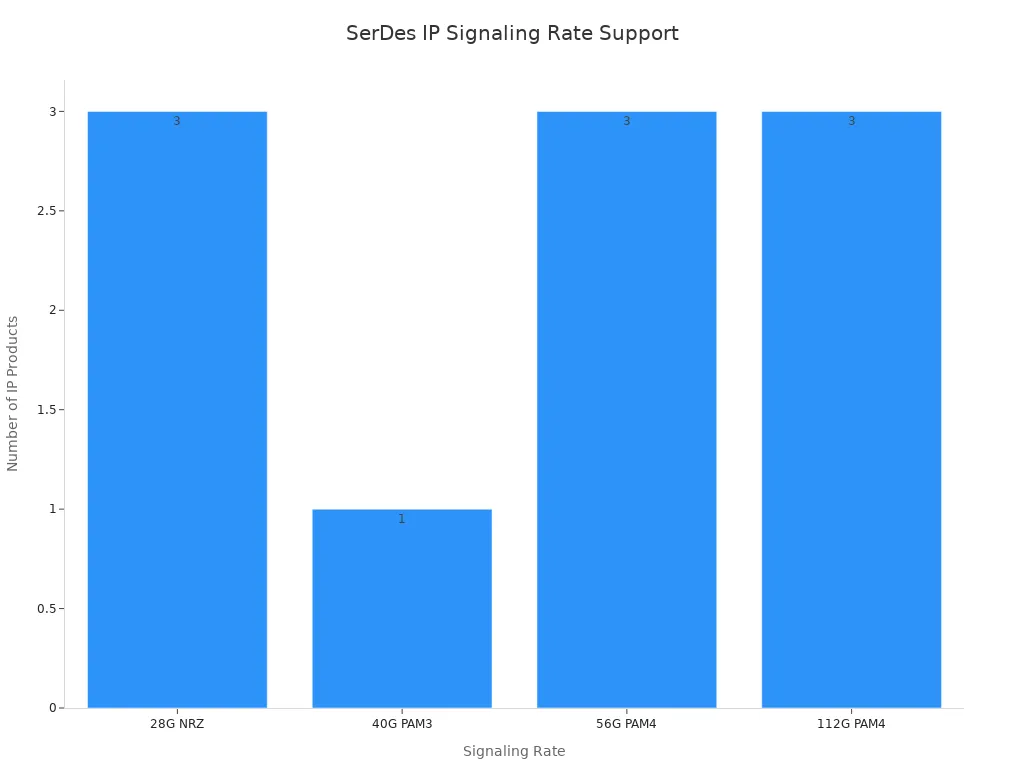
With differential signal transmission and receiver equalization, high-speed serial links deliver multi-gigabit speeds with fewer errors. This high-speed serial communication keeps high-speed serial signals intact across smartphones and data centers.
How Does SERDES Work?
Transmit Path: Serializer and Encoding
The transmit path starts when device logic sends parallel data to the input interface. A serializer then changes this parallel data into a serialized format. It uses a multiplexer tree and a high-speed clock from a phase-locked loop. The parallel bus is usually 8, 10, 16, or 20 bits wide. The serial output becomes a differential pair of analog signals.
Next, an encoding block gets the data stream ready. Common schemes include 8b/10b and 64b/66b encoding. These methods keep DC balance and make sure signal transitions happen often. They also embed clock information so the receiver can pull out timing. Scrambling may also be used to lower electromagnetic interference.
Equalization comes after encoding. Feed-forward equalization pre-distorts the signal to make up for expected channel losses before transmission. This pre-emphasis helps lower distortion before the signal enters the lossy channel. The output driver then sends the serial signal into the transmission medium. Impedance matching is used to reduce reflections.
Receive Path: Clock Recovery and Deserializer
The receive path starts with input termination and a front-end circuit. This circuit detects and boosts the incoming signal. Continuous time linear equalization lifts high-frequency content weakened by the channel. A decision feedback equalizer lowers interference from bits received earlier.
Clock and data recovery (CDR) techniques then pull timing information from the data transitions themselves. The CDR circuit makes a clock aligned with the transmitted signal. It samples the waveform at the right time. A phase detector compares edge and data samples to decide if the clock is early or late. Loop bandwidth controls the trade-off between tracking speed and jitter filtering.
After clock and data recovery, the deserializer does serial-to-parallel conversion. It turns the recovered serial stream back into parallel data. A word aligner finds the correct data-word boundaries. An elastic buffer handles small timing differences between clock domains. This completes the round trip from parallel data into a serialized format and back again.
Where Is SERDES Used?
Common Applications in High-Speed Communications
You will find this technology in nearly every high-speed digital interface. The list below shows the main protocols that need it.
-
JESD204B/C — links ADC and DAC to FPGA or ASIC
-
Serial RapidIO (sRIO) — connects DSPs and embedded processors
-
PCI Express (PCIe) — main link for CPUs, GPUs, and FPGAs
-
Ethernet (10/25/40/100GbE) — networked systems and spread-out signal processing
-
Aurora Protocol — FPGA-to-FPGA data streaming
-
VITA 57/VITA 65 (FMC/VPX) — tough modular platforms
-
CPRI — links remote radio head to baseband unit
-
eCPRI/Open RAN Fronthaul — cloud-native 5G transport
These high-speed serial interfaces share one trait. Each one packs parallel words into a serial stream to send them. PCIe shows this clearly. SerDes is the main enabler of every PCIe generation, from Gen1 at 2.5 GT/s to Gen7 at 128 GT/s using PAM4. Pre-emphasis and equalization, plus lane widths of x1, x4, x8, and x16, give scalable bandwidth. Ethernet follows the same path. Early 1GbE used simple SerDes. The 10GbE XAUI standard bonds four 3.125 Gb/s lanes to reach 10 Gb/s. Modern 400GbE can run as 4x100G, using four channels at PAM4 53 GBaud.
Data centers depend on these high-speed serial data transceivers to talk fast between servers, storage systems, and networking devices. Low-power designs are gaining ground in mobile and edge computing, where saving energy matters most. Consumer electronics, automotive systems, and AI-driven architectures all use this serial communication technology.
Is USB a SerDes?
Yes, USB is a SerDes. USB 2.0 used NRZI differential signaling, which counts as a simple form. USB 3.0 and every later version, including USB4, use a standard SerDes architecture. These standards use full-duplex communication with separate differential transmit and receive channels. On the transmit side, an on-chip serializer turns parallel data into a serial stream. The receiver uses a deserializer to rebuild the original data. The design also uses 128b/130b encoding, clock recovery, and equalization to keep signal integrity.
USB4 v2 takes this further with PAM3 modulation to reach 80 Gbps. This move from NRZ to PAM3 marks a big leap for the next-generation standard. It also brings new challenges in SerDes design and signal integrity analysis. USB is a full protocol standard, but it uses SerDes as its core physical layer. That makes USB 3.0 and above a prime example of high-speed serial communication links in everyday devices.
SERDES stands for Serializer/Deserializer. This technology is key for turning parallel data into serial data and back again. It cuts pin count, raises speed, and keeps signal quality strong in today's electronics. The global SERDES market was valued at $1.4 billion in 2024 and is projected to reach $2.7 billion by 2030, growing at an 11.5% CAGR. The 112G and 224G generations will push future demand. The 4x224G lanes are the leading 800G Ethernet setup. This core technology stays vital for high-speed communication in devices from smartphones to data centers.

Written by Jack Elliott from AIChipLink.
AIChipLink, one of the fastest-growing global independent electronic components distributors in the world, offers millions of products from thousands of manufacturers, and many of our in-stock parts is available to ship same day.
We mainly source and distribute integrated circuit (IC) products of brands such as Broadcom, Microchip, Texas Instruments, Infineon, NXP, Analog Devices, Qualcomm, Intel, etc., which are widely used in communication & network, telecom, industrial control, new energy and automotive electronics.
Empowered by AI, Linked to the Future. Get started on AIChipLink and submit your RFQ online today!
Frequently Asked Questions
What does SERDES stand for?
SERDES means Serializer/Deserializer. The name covers two circuit jobs that work as a team. A serializer changes parallel data into a serial stream. A deserializer changes the stream back into parallel data at the other end.
Why do chips use SERDES instead of parallel buses?
Chips have a limited number of I/O pins. A wide parallel bus needs many pins and traces. One serial lane can carry the same data over fewer connections. This cuts pin count, makes board routing easier, and keeps signals clean at high speeds.
How does SERDES keep data accurate over long distances?
The transmitter codes the data and shapes the signal before sending. The receiver pulls the clock from the signal and shapes the signal again. Differential signaling rejects noise, and coding schemes like 8b/10b keep DC balance for reliable transmission.
Is USB a SERDES?
Yes. USB 3.0 and later versions use a standard SerDes setup. They use separate transmit and receive channels, plus coding, clock recovery, and equalization. USB4 v2 uses PAM3 modulation to reach 80 Gbps.
Where will SERDES technology go next?
The 112G and 224G generations will push future demand. The 4x224G lane setup leads 800G Ethernet designs. Data centers already bring in most SerDes PHY revenue, and growth will keep going as speeds rise.