What is an 8051 Microcontroller: Definition, Features, and Architecture
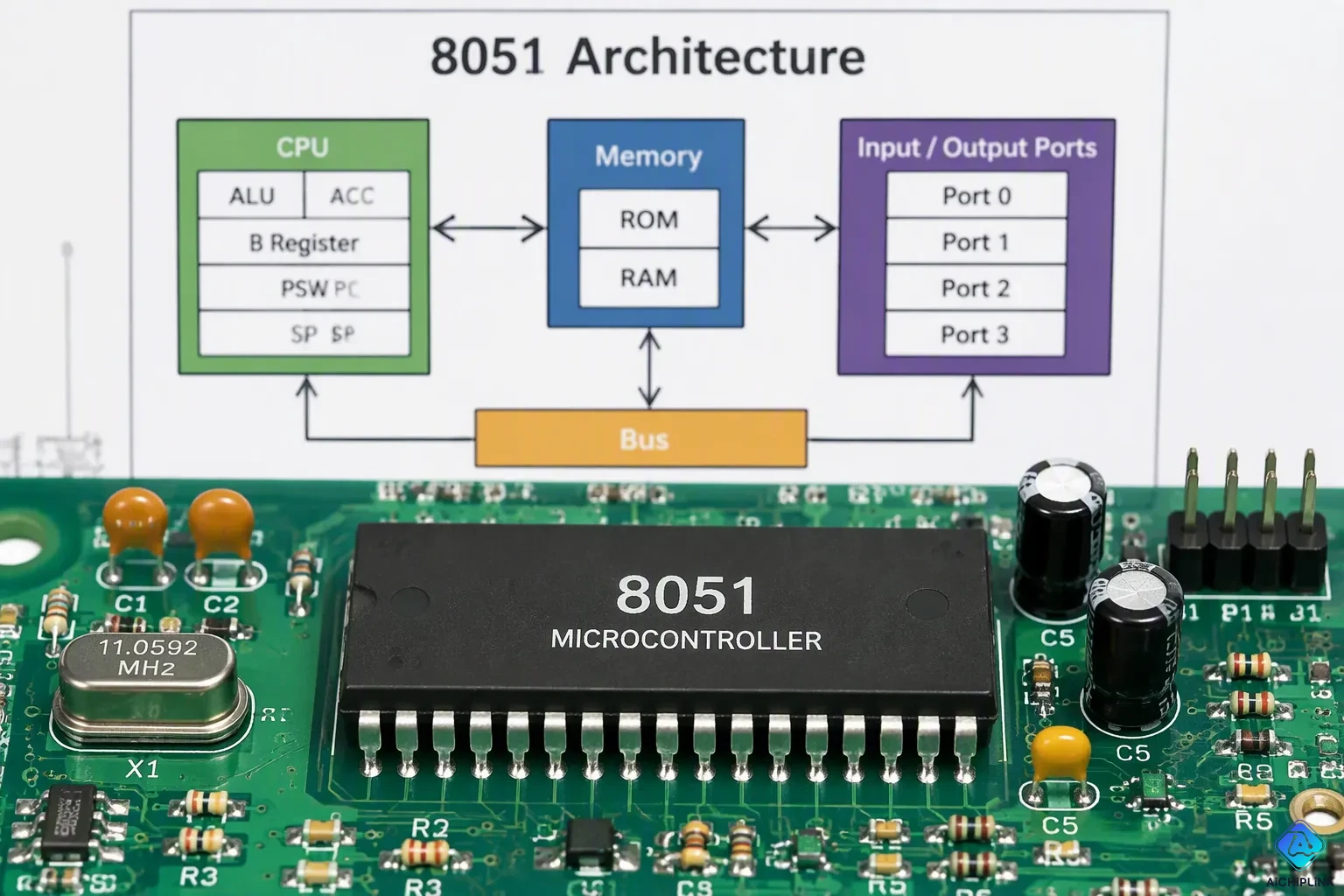
The 8051 microcontroller is an 8-bit chip using Harvard architecture, which Intel made in 1980. It is also called the Intel MCS-51. Program code and data are stored in separate memory spaces inside this microcontroller. That design choice affects how the chip works.
This 8051 microcontroller introduction is for beginners and students. It describes the definition, key features, and architecture of the 8051 microcontroller. It also covers applications, pros, and cons. Readers find out what this microcontroller does and where engineers use it today.
Key Takeaways
-
The 8051 microcontroller uses Harvard architecture, which keeps program and data memory apart.
-
Its 8-bit CPU, 4 KB ROM, and 128 bytes RAM handle simple control jobs well.
-
Students study embedded systems on the 8051 because it has a simple design and a small instruction set.
-
Engineers pick the 8051 for industrial jobs that need low cost, steady timing, and 5V tolerance.
Definition and Features of the 8051 Microcontroller
What Is an 8051 Microcontroller?
The 8051 microcontroller is an 8-bit microcontroller that Intel made in 1980. People in engineering also call it the Intel MCS-51. It uses Harvard architecture, so program code and data are kept in separate memory spaces. This setup lets the processor grab instructions and read data at the same time.
The Intel MCS-51 (often called 8051) is a single-chip microcontroller series built by Intel in 1980 for use in embedded systems.
Intel brought out the 8048 microcontroller in 1976. Its small memory addressability turned into a big weakness within the first year. The 8048 sold well, but its architecture and instruction set had locked in a small address space. By 1977, Intel engineers saw that the 8048 architecture needed a big change. Customers also wanted extra on-chip peripherals like timers and a serial port. These problems pushed Intel to build a follow-up architecture, which turned into the 8051.
The 8051 microcontroller holds a full 8-bit CPU, memory, and input/output interfaces on one chip. This amount of peripheral integration made it a big step forward for embedded control. The architecture supports 255 instructions for writing programs. Many instructions do the same job, so only 111 commands are really different.
Key Features of the 8051 Microcontroller
The features of the 8051 microcontroller cover processing, memory, and communication. Each feature helps with embedded control tasks.
The 8-bit CPU has an arithmetic logic unit (ALU) and an accumulator. The ALU does math and logic operations. Results from the ALU go into the accumulator, which is also called Register A. This register handles addition, subtraction, multiplication, and division. It also moves data between the microcontroller and external memory.
Memory organization keeps program storage apart from data storage. The standard 8051 gives 4 KB of on-chip ROM for program code and 128 bytes of on-chip RAM for data. ROM stands for read-only memory, which holds permanent instructions. RAM stands for random-access memory, which stores temporary data while the chip runs.
The 40-pin DIP package holds the whole system. DIP means dual in-line package, a rectangular housing with two rows of pins. The pinout has four parallel 8-bit ports, named Port 0 through Port 3. These I/O ports hook up sensors, displays, and other devices. Port 3 also gives serial communication ports, external interrupt inputs, and timer inputs.
Two 16-bit timers/counters handle timing and event counting. A serial communication interface lets data move between other devices. Interrupt logic lets the microcontroller react to outside events without constant polling.
Power consumption changes by operating mode. The original MCS-51 at 12 MHz draws the following current:
| Mode | Current Consumption |
|---|---|
| Active (Normal) | 25 mA |
| Idle | 6.5 mA |
These key features made the 8051 microcontroller a flexible choice for many control applications. The modified Harvard architecture and rich set of on-chip peripherals set a standard for future microcontroller designs.
Microcontroller Architecture of the 8051
CPU and Memory Organization
The 8051 microcontroller architecture is made up of a central processing unit, memory, input/output (I/O) interfaces, timers, and serial communication ports. The 8-bit CPU gets and runs instructions through a set cycle. The Program Counter keeps the address of the next instruction and adds to itself after each fetch. The Instruction Register holds the instruction being run right now. The Memory Address Register keeps the address being used, and the Memory Data Register keeps data read from or written to memory. During the fetch cycle, the Program Counter moves to the Memory Address Register, the control unit sends a read signal, the instruction goes into the Memory Data Register, then moves to the Instruction Register, and the Program Counter goes up. The decode cycle checks the opcode and finds operands. The execute cycle does the operation, and the result goes back to memory if needed. The cycle starts at power-up using the first Program Counter value of 0000H.
The 8051 uses a modified Harvard architecture, which means program code and data sit in separate address spaces. This is not the same as pure Harvard architecture because the chip shares some physical pathways. The memory setup keeps 4 KB of on-chip ROM for program code apart from 128 bytes of on-chip RAM for data. The internal RAM map splits into register banks, a bit-addressable area, and general-purpose RAM. Register Banks 0 through 3 take up addresses 0x00 to 0x1F, and the Program Status Word picks the active bank. The bit-addressable area covers 0x20 to 0x2F. General-purpose RAM goes from 0x30 to 0x7F, and the stack grows upward from a default Stack Pointer of 0x07. Special function registers take up addresses 0x80 to 0xFF, though only certain addresses are valid.
I/O Ports, Timers, Serial Communication, and Interrupts
The 8051 microcontroller has four 8-bit I/O ports called Port 0 through Port 3. Port 3 carries alternate functions for external interrupts, timer inputs, and serial communication. P3.0 works as RxD for serial receive, and P3.1 works as TxD for serial transmit. P3.2 and P3.3 handle external interrupts INT0 and INT1. P3.4 and P3.5 take external inputs for Timer 0 and Timer 1. P3.6 and P3.7 give write and read strobes for external data memory.
Two 16-bit timers/counters handle timing and event counting. The TMOD register picks the mode, and the TCON register starts or stops each timer and flags overflow. Setting TMOD to 0x01 picks Mode 1, a 16-bit timer for Timer 0. The TR0 bit in TCON starts the timer, and the TF0 bit signals overflow.
The interrupt system supports five sources: Timer 0 overflow, Timer 1 overflow, External Interrupt 0, External Interrupt 1, and the serial communication interrupt. The IP register sets priority. Setting a bit to 1 gives high priority, and 0 gives low priority. When two interrupts of different priority levels happen together, the higher-priority one is handled first. Two interrupts of the same level follow a fixed internal order. These interrupt handling mechanisms let the microcontroller respond to events without constant polling.
Applications of the 8051 Microcontroller
Common Embedded Use Cases
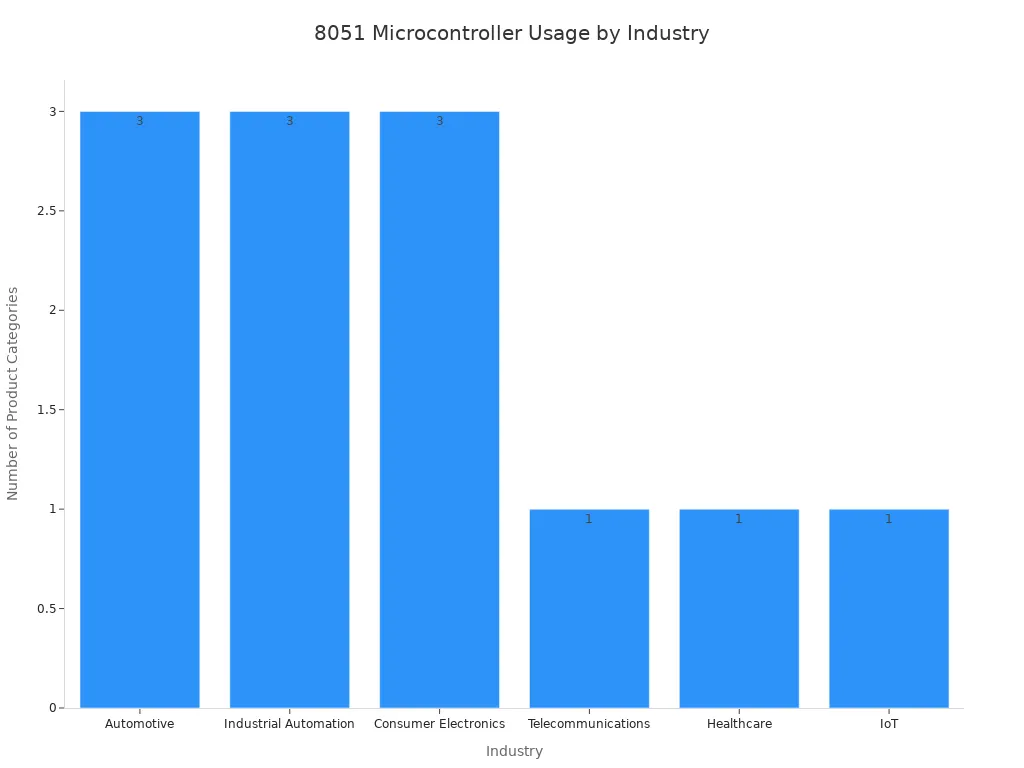
The 8051 microcontroller is still used in many industries today. Engineers use it to control and monitor appliances and automotive systems. Industrial automation depends on it for process control, data acquisition, and monitoring systems. Consumer electronics use the chip in remote controls, toys, digital watches, and security systems. Communication systems use it to connect with peripherals and send data. Automotive uses include engine control, dashboard displays, and body electronics. Daily life depends on it too, from home automation to microwave ovens and medical instruments.
| Industry | Product Categories and Examples |
|---|---|
| Embedded Systems | Control and monitoring in appliances, automotive systems |
| Industrial Automation | Process control, data acquisition, monitoring systems |
| Consumer Electronics | Remote controls, toys, home appliances, digital watches, security systems |
| Communication Systems | Interfacing with peripherals, data transmission |
| Automotive | Engine control, dashboard displays, safety features, infotainment |
| Healthcare | Portable medical devices, precision medicine |
| IoT | Connected devices for smart homes, cities, and industries |
One proven example comes from smart home automation. An AT89C51 microcontroller drives a relay to turn a lamp on and off. The chip responds to Bluetooth commands from an Android app. Automotive subsystems also use 8-bit microcontrollers for anti-pinch window lifters, networked door controls, power seat control, and windshield systems. The C8051F58x family carries an 8051 core and meets AEC-Q100 qualification. It includes CAN 2.0B, LIN 2.1, a 12-bit ADC, and up to 128 kB flash.
Role in Education and Legacy Designs
The 8051 microcontroller is still popular in education for three reasons. Its architecture is simple, its instruction set is small, and its cost is low. Students learn how a microcontroller handles memory, timers/counters, and i/o ports without facing complex pipelines. The chip also teaches why an unsigned int is 16-bit on an 8-bit core but expands to 32-bit on ARM. That lesson matters for reliable firmware.
Legacy industrial machinery keeps the 8051 alive as well. Modern 8051 cores often beat 32-bit alternatives on power, performance, and area. They take up 50% or less silicon area than a minimal 32-bit core. Native 5V operation handles industrial electrical noise that would damage sensitive 3.3V ARM chips. The 8051 also offers pure determinism with rigid clock-cycle precision. Its external memory interface exposes raw address and data bus multiplexing, which legacy designs value. For simple control tasks, the 8051 is fast enough and draws very little power.
Advantages and Disadvantages of the 8051
Strengths Over Modern Alternatives
The 8051 microcontroller is simple, and beginners like that. Its instruction set is small, and its architecture is easy to learn. Students can see how a microcontroller handles memory, timers, and i/o ports without complex pipelines. This simplicity makes the 8051 a strong teaching tool for embedded systems courses.
Low cost and wide availability also help this microcontroller. Manufacturers still make 8051 variants in large numbers, so buyers find them at low prices. A large community of resources supports the chip. Tutorials, forums, and example projects help new users get started quickly. These microcontroller features keep the 8051 useful for cost-sensitive projects.
The 8051 microcontroller also does well in some technical areas. Modern 8051 cores take up 50% or less silicon area than a minimal 32-bit core. Native 5V operation handles industrial electrical noise that would damage sensitive 3.3V ARM chips. The architecture gives pure determinism with rigid clock-cycle precision. For simple control tasks, this microcontroller is fast enough and uses very little power.
Limitations and When to Choose Another Microcontroller
The 8051 microcontroller has clear limits. Its memory is limited to 4 KB of on-chip ROM and 128 bytes of on-chip RAM. This small memory limits program size and data storage. Processing speed is slower than modern microcontrollers. The chip also has fewer peripherals than newer alternatives. Serial communication works, but advanced interfaces like USB or Ethernet need external components.
Engineers should choose the 8051 microcontroller for simple, cost-sensitive tasks. It works well for basic control, timing, and monitoring jobs. Legacy designs often depend on it because of its deterministic behavior and 5V operation. However, modern microcontrollers are better for complex applications. Projects needing large memory, high-speed processing, or advanced peripherals should use a 32-bit microcontroller instead. The 8051 microcontroller features remain valuable, but engineers must match the chip to the task.
The 8051 microcontroller is an 8-bit device with a modified harvard architecture and built-in peripherals. Its main features include 4 KB ROM, 128 bytes RAM, four I/O ports, timers, and serial communication. The architecture keeps program and data memory in separate spaces.
This microcontroller is still important in education and low-cost designs. Students learn embedded basics on it. Modern versions add security, hybrid cores, and low-power modes. These improvements keep the 8051 microcontroller useful.
The 8051 gives you simplicity and low cost. But limited memory and slower speed hold back complex tasks. Engineers should pick it for simple control jobs. For advanced needs, a modern microcontroller works better.

Written by Jack Elliott from AIChipLink.
AIChipLink, one of the fastest-growing global independent electronic components distributors in the world, offers millions of products from thousands of manufacturers, and many of our in-stock parts is available to ship same day.
We mainly source and distribute integrated circuit (IC) products of brands such as Broadcom, Microchip, Texas Instruments, Infineon, NXP, Analog Devices, Qualcomm, Intel, etc., which are widely used in communication & network, telecom, industrial control, new energy and automotive electronics.
Empowered by AI, Linked to the Future. Get started on AIChipLink and submit your RFQ online today!
Frequently Asked Questions
What makes the 8051 different from other microcontrollers?
The 8051 uses a Harvard design. Program code and data stay in separate memory areas. This setup lets the processor get instructions and read data at the same time. Intel made the chip in 1980 and called it the MCS-51. Its built-in parts set a model for later designs.
How much memory does the 8051 have?
The standard 8051 microcontroller has 4 KB of on-chip ROM for program code. It also has 128 bytes of on-chip RAM for data. This small memory limits how large a program can be. Engineers pick this chip for simple control jobs that do not need a lot of storage.
Why do students still learn the 8051?
Students learn this microcontroller because its design is simple. The set of commands is small, and the price is low. Learners see how a chip handles memory, timers, and I/O ports without complicated steps. These lessons give a base for working with embedded systems.
When should an engineer pick a modern microcontroller instead?
Engineers should pick a modern chip for hard jobs. Tasks that need lots of memory, fast processing, or advanced add-ons like USB and Ethernet work better on 32-bit devices. The 8051 microcontroller is still a good choice for simple, low-cost, and older designs.