Photocouplers you need for modern devices in 2026
You use photocouplers to keep your devices safe. They help your devices work well and stay ready for new technology. The top 10 uses for 2026 are power supply feedback isolation, microcontroller signal protection, industrial sensor isolation, noisy circuit signal isolation, motor gate triggering, switching regulator feedback, medical device isolation, renewable energy system safety, smart home interfaces, and automotive electronics isolation.
| Application | 2025 Market Size (USD Million) | 2035 Market Size (USD Million) | CAGR (%) |
|---|---|---|---|
| Consumer Electronics | 800 | 1,650 | 7.5 |
You see these solutions in many places. Fast charging systems use them to stop overcurrent. Smart homes need them for reliable isolation. More industries use automation and want better energy efficiency. Optocouplers are important for protecting sensitive circuits and making things safer.
Key Takeaways
- Photocouplers are important for keeping devices safe and working well. They give electrical isolation to keep sensitive circuits safe. In 2026, optocouplers will be very important for things like power supply feedback, microcontroller safety, and renewable energy systems. Picking the right optocoupler means looking at isolation voltage, current-transfer ratio, and how fast it responds. This helps the device work its best. Optocouplers help cut down power loss and make energy use better. This helps devices last longer and work better. Using optocouplers in smart homes and car electronics makes them safer and more reliable. This gets devices ready for new technology in the future.
Photocouplers and optocouplers overview
What is a photocoupler?
A photocoupler lets signals move between two circuits. It stops electricity from going straight between them. This device uses light to send information. It has three main parts inside. There is a light-emitting diode (LED), a photodetector, and an amplifier. The LED shines when it gets an electrical signal. The photodetector sees the light and changes it back to electricity. The amplifier makes the signal strong for the next circuit. This keeps the circuits apart and protects your devices.
Photocouplers are used in many places. They connect data between circuits. They help find positions in optical encoders. They work in circuits that need an optical link instead of a wire.
Note: An optocoupler is also called an optoelectronic isolator. It uses light to keep circuits safe from voltage spikes and surges.
Why optocouplers are essential in 2026
Optocouplers are important in modern electronics for three main reasons. They give isolation, safety, and reliability. Optocouplers keep dangerous voltages away from sensitive parts. This is very important in healthcare. Devices must protect patients and users. More people use home healthcare and portable diagnostic tools. These devices need strong isolation to stay safe.
Factories use more machines with smart controls. Industry 4.0 brings more automation. This means more need for reliable isolation. Optocouplers replace old relay systems. They work faster and last longer. Cars also need optocouplers. They help meet strict safety rules. Optocouplers protect electronics from high voltages.
Optocouplers help save energy. They lower power losses and control feedback in power systems. This makes devices more efficient and helps them last longer.
-
Optocouplers give electrical isolation and lower power losses.
-
They make systems more reliable and keep voltage steady.
-
They protect sensitive parts from electrical interference.
You can count on optocouplers to keep devices safe, efficient, and ready for the future.
Top 10 photocoupler applications
Power supply feedback isolation
Every modern device needs power supply feedback isolation. Optocouplers are very important here. They keep the input and output sides apart in power converters. These converters can be dc/ac, ac/ac, ac/dc, or dc/dc. This keeps dangerous voltages away from sensitive parts. Ground loop currents can cause noise and damage. Optocouplers help stop these problems. When your device changes power states, optocouplers stop voltage spikes.
-
Optocouplers remove direct paths for electricity. This makes your device safer and better.
-
You stop ground loops and lower noise. This helps your circuits stay steady.
Microcontroller signal protection
Microcontrollers are in many smart devices. Their circuits are sensitive and need protection from high voltages and noise. Optocouplers make a strong wall between low and high voltages. This wall keeps surges away from your microcontroller.
-
You keep signals strong in noisy places, so relay boards work well.
-
Electrical isolation protects sensitive parts from voltage changes.
-
Optocouplers help block noise, so relays do not turn on by mistake.
-
You make your system safer and more stable, even in hard places.
-
Optical ground isolation helps your device work better and fail less.
Industrial sensor isolation
Factories use lots of sensors to watch machines and processes. These sensors have sensitive circuits that need protection from high voltages and noise. Optocouplers give you galvanic isolation. This stops electromagnetic interference (EMI).
-
You lower noise, so your data stays correct.
-
Electrical isolation keeps high voltages away from sensor circuits.
-
You protect sensitive parts and keep data safe in tough factory places.
Signal isolation in noisy circuits
Noisy circuits can hurt your electronics. Optocouplers help by giving signal isolation. Only light goes across the optocoupler, not current.
-
You stop ground loops and block surges.
-
Sensitive parts stay safe from big faults.
-
You keep signals clean and devices working well.
Optocoupler gate triggering for motors
Motors need exact control signals. Optocouplers send gate signals from low-voltage controllers to high-voltage motor drivers. This gives electrical isolation and protects control circuits from high-voltage jumps.
Optocouplers stop interference and keep motor controls working well. You get better performance and longer life for motors in 2026.
Switching regulator feedback
Switching regulators help save energy in new devices. Photocouplers move energy well using light.
-
You use less input current and get better current transfer, with 60% to 85% efficiency.
-
Devices with optocouplers use less power and make less heat.
-
You can get up to 100% more efficiency than old linear regulators.
Medical device isolation
Medical devices must keep patients and users safe from electric shock. Optocouplers give strong electrical isolation and meet tough rules like IEC 60601-1 and UL 1577.
-
Devices must handle over 4000V AC and keep leakage currents low.
-
Optocouplers give ESD protection up to 11 kV.
-
You keep patients safe and follow FDA and EU rules.
| Requirement Type | Voltage Range | Insulation Type | Certification |
|---|---|---|---|
| Type 1 | < 70V | Basic Insulation | UL 1577 |
| Type 2 | > 70V | Reinforced Insulation | IEC 60747-5-2 |
| EMC Requirements | N/A | ESD Protection | 8 kV (air), 6 kV (contact) |
Renewable energy system safety
More renewable energy systems are used each year. Optocouplers keep these systems safe by giving electrical isolation in inverters and grid links.
-
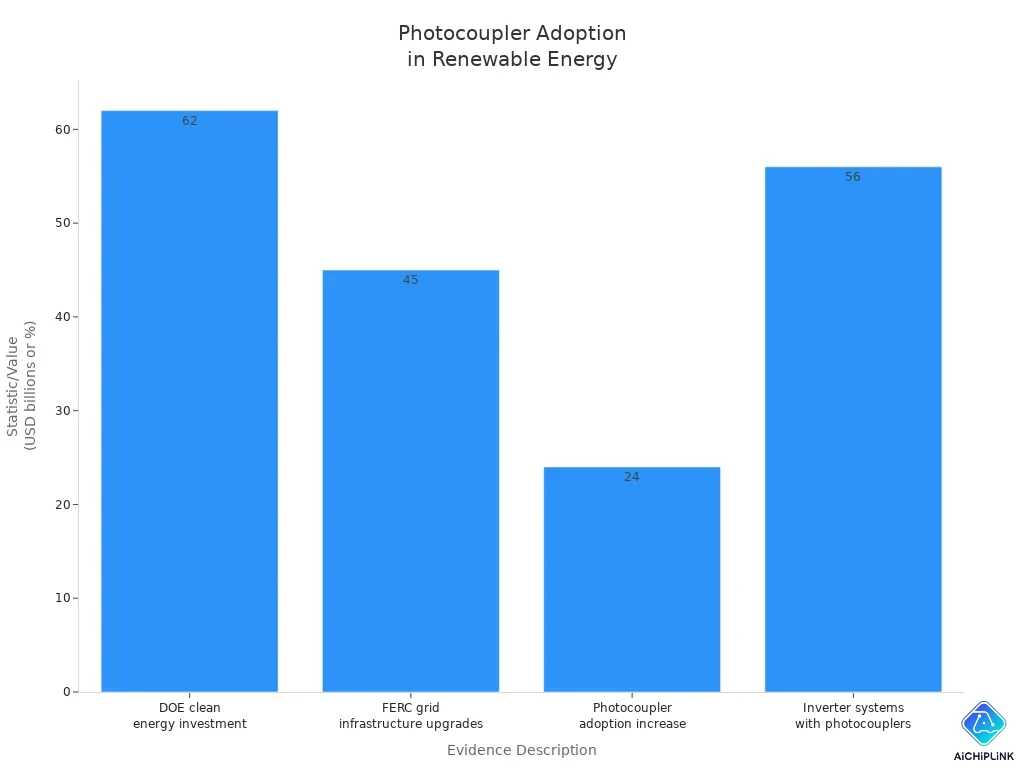
More companies use optocouplers, with a 24% increase.
-
In 2025, 56% of renewable energy inverters used optocouplers for steady isolation.
-
You help stop faults and make systems work better.
| Evidence Description | Statistic/Value |
|---|---|
| Clean energy investment programs | USD 62 billion allocated |
| Grid infrastructure upgrades | Over USD 45 billion |
| Photocoupler adoption increase by inverter manufacturers | 24% increase |
| Renewable inverter systems integrating photocouplers by 2025 | 56% |
Smart home application interfaces
Smart homes need good interfaces for sensors, controllers, and appliances. Optocouplers protect sensitive circuits from voltage spikes and noise.
-
Optocouplers give electrical isolation, so smart home devices last longer.
-
You keep signals correct and your automation safe.
-
Using optocouplers in smart homes helps you get ready for the future.
Automotive electronics isolation
Modern cars have many electronic control units. These need electrical isolation to protect sensitive circuits from high-voltage spikes and noise.
-
Optocouplers stop ground loops and interference, so car systems stay safe.
-
Fast optocouplers meet ISO 26262 rules, giving strong insulation and high noise protection.
-
You keep signals fast and safe for things like ADAS and electronic stability control.
Tip: Fast optocouplers help car systems send data right away, which is very important for safety and how well your car works.
Table: Key advancements in photocoupler design for 2026
| Advancement Type | Description |
|---|---|
| High-speed and high-isolation devices | Make communication systems work better and more efficiently. |
| Miniaturization | Build smaller and better electronic systems. |
| Advanced materials | Use silicon carbide for better heat control and work in tough places. |
| Improved isolation voltage | Help electronic systems work better and safer. |
| Next-generation hermetic optocouplers | Use new materials for planes and military uses. |
You can find optocoupler uses everywhere in 2026. They protect sensitive circuits, help save energy, and keep your devices safe with the right optocouplers.
Choosing the right optocoupler
Key selection factors
When you pick an optocoupler, you need to think about a few things. These things help keep your circuit safe and working well.
-
Always look at the isolation voltage. This tells you how much voltage the optocoupler can block between two parts of your circuit. Most new devices need more than 1000 V. Some need over 2000 V for extra safety.
-
Check the current-transfer ratio (CTR). This shows how much output current you get from the input current. A high CTR means your circuit needs less input current to work.
-
Think about how fast the optocoupler works. Fast switching is important for digital signals and motor control.
-
Make sure the optocoupler can handle changes in humidity and temperature. This helps your circuit stay safe in tough places.
-
Look at the insulation resistance. High insulation resistance means your circuit is safer, even when it is humid.
-
Check if the package is strong. Good packages protect your circuit from damage like cracks or heat problems.
Tip: Do not forget to check the isolation voltage and power ratings. These keep your circuit safe from big surges and faults.
Matching optocoupler types to applications
You need to pick the right optocoupler type for your circuit. Each type works best for certain jobs. Use this table to help you choose:
| Optocoupler Type | Characteristics | Ideal Applications |
|---|---|---|
| Phototransistor | Moderate response time (5-10 µs) | Switching, microcontroller relay circuits |
| Photodiode | Fast response (nanoseconds) | High-speed data communication circuits |
| Triac and SCR | Handles high voltages (up to 600V) | AC power control, dimmer circuits |
| Darlington | High current gain (CTR > 1000%) | High sensitivity circuit applications |
| High-Speed | Data rates up to 10 Mbps or higher | Digital communication circuit interfaces |
Always check the isolation voltage for each type. Some circuits, like medical or car circuits, need higher isolation voltage to be safe.
Practical tips for 2026 devices
You can make your circuit ready for the future by following these tips:
-
Pick optocouplers with high isolation voltage for better safety.
-
Choose ones with high CTR to save energy in your circuit.
-
Use fast optocouplers for digital and motor control circuits.
-
Test your circuit in real conditions, like different humidity and temperatures.
-
Do not ignore things like weather or aging. These can make your circuit less safe over time.
-
Make sure your optocoupler fits the voltage and current your circuit needs.
Note: You keep your circuit safe and better when you pick the right optocoupler for each job.
You can find photocouplers in many devices like power supplies, microcontrollers, sensors, motors, and cars. They are also in noisy circuits, regulators, medical devices, renewable energy, and smart homes. These uses help devices follow safety rules and work better. More factories and homes use smart technology now. You should pick strong optocouplers for your projects. Photovoltaic optocouplers are more important in renewable energy and cars. Look at your designs and add optocouplers where you need safety and isolation.

Written by Jack Elliott from AIChipLink.
AIChipLink, one of the fastest-growing global independent electronic components distributors in the world, offers millions of products from thousands of manufacturers, and many of our in-stock parts is available to ship same day.
We mainly source and distribute integrated circuit (IC) products of brands such as Broadcom, Microchip, Texas Instruments, Infineon, NXP, Analog Devices, Qualcomm, Intel, etc., which are widely used in communication & network, telecom, industrial control, new energy and automotive electronics.
Empowered by AI, Linked to the Future. Get started on AIChipLink and submit your RFQ online today!
Frequently Asked Questions
What does isolation mean in electronics?
Isolation keeps two parts of a circuit apart. It stops electricity from crossing between them. This protects your devices from high voltage. Isolation helps your devices last longer. It keeps your circuits safe. Isolation is very important in today’s electronics.
Why do you need isolation in power supply circuits?
Isolation stops dangerous voltage from touching sensitive parts. It keeps your power supply safe. Isolation blocks faults. It helps your device work better. You can trust your device when isolation is used. Isolation also lowers noise.
How does isolation improve medical device safety?
Isolation protects patients and users. It blocks electric shock. Isolation helps you follow safety rules. It keeps medical devices safe. Isolation lowers the risk of harm. It is required for medical tools. You always need isolation in healthcare.
Can isolation help with signal quality?
Isolation makes signal quality better. It blocks noise and interference. Isolation keeps your signal clean. It helps your device send strong signals. Isolation stops ground loops. It makes your signal more reliable. You get better performance with isolation.
Where do you use isolation in smart homes?
Isolation is used in smart home sensors. It protects your controllers. Isolation keeps appliances safe. It helps your smart home last longer. You use isolation for every signal path. It keeps your system stable. Isolation is always needed for smart home safety.