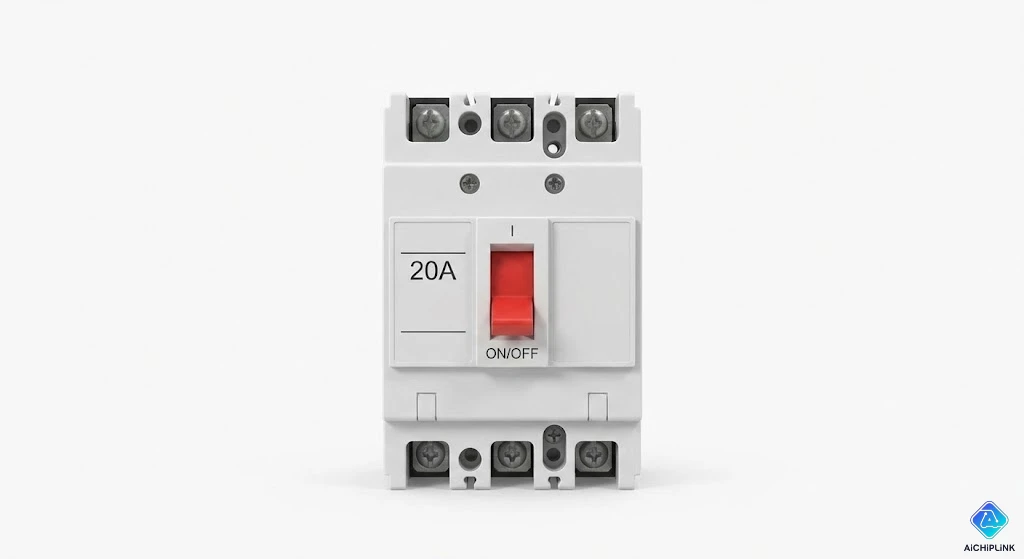
In the world of electricity, safety is a race against time. When a fault occurs—whether a short circuit or an overload—the power must be cut instantly to prevent fire or equipment destruction.
The device responsible for this critical task is the Circuit Breaker.
But not all breakers are created equal. You cannot use a home switch for a power grid substation. The design of a breaker is dictated by one massive challenge: Killing the Arc. When you pull two live contacts apart, the air between them ionizes and turns into plasma (an arc), continuing to conduct electricity.
This guide categorizes circuit breakers by how they extinguish that arc, from Low Voltage (LV) to Extra High Voltage (EHV).
1. Low Voltage (LV) Circuit Breakers (< 1000V)
These are found in residential, commercial, and industrial distribution boards.
1. Miniature Circuit Breaker (MCB)
- Rating: Up to 100A.
- Working: Uses a Bi-metallic strip for overload (thermal) and a Solenoid for short circuit (magnetic).
- Application: Home wiring, lighting circuits, small motors.
- Note: The trip setting is fixed. You cannot adjust it.
2. Molded Case Circuit Breaker (MCCB)
- Rating: Up to 2500A.
- Working: Similar to MCB but robust.
- Feature: Adjustable Trip Settings. You can tune the current limit (Ir) and magnetic trip time.
- Application: Industrial control panels, main distribution for buildings.
3. Air Circuit Breaker (ACB)
- Rating: Up to 6300A.
- Working: It uses purely air to quench the arc, but with massive Arc Chutes (splitters) to stretch and cool the arc.
- Application: Main Low Voltage (LV) panels in factories and skyscrapers.
4. RCCB / ELCB (Leakage Protection)
- Function: Detects current leaking to earth (e.g., if a person touches a live wire). It does not protect against overload, only shock.
2. High Voltage (HV) Circuit Breakers (> 1000V)
Once voltage exceeds 1kV, air is no longer a good insulator. We need better mediums to quench the arc.
1. Vacuum Circuit Breaker (VCB)
- Medium: Vacuum ($10^{-7}$ torr).
- Working: The contacts open inside a sealed vacuum bottle. Since there is no gas to ionize, the arc cannot sustain itself and dies at the first "current zero" crossing.
- Application: 11kV to 33kV. The standard for Medium Voltage (MV) substations.
2. SF6 Circuit Breaker (Sulfur Hexafluoride)
- Medium: SF6 Gas.
- Science: SF6 is highly electronegative. It acts like a sponge for free electrons, absorbing them and rendering the arc non-conductive instantly.
- Application: 132kV, 220kV, 400kV and above. It is the king of High Voltage.
- Pros: Compact, quiet, and extremely reliable.
- Cons: SF6 is a potent greenhouse gas; leaks must be monitored.
3. Oil Circuit Breaker (OCB)
- Medium: Insulating Oil.
- Working: The arc heat vaporizes the oil, creating a bubble of hydrogen gas. The high pressure of this hydrogen bubble suppresses the arc.
- Status: Legacy. Mostly replaced by VCB and SF6 due to fire risk and maintenance mess.
4. Air Blast Circuit Breaker
- Medium: Compressed Air (High Pressure).
- Working: A blast of air at supersonic speed blows the arc away.
- Status: Obsolete. Replaced by SF6 due to noise and the complexity of air compressors.
3. Comparison Summary
| Breaker Type | Voltage Class | Arc Medium | Typical Application |
|---|---|---|---|
| MCB | Low (<100A) | Air | Residential Distribution |
| MCCB | Low (<2500A) | Air | Industrial Feeder |
| ACB | Low (<6300A) | Air (Chutes) | Main LV Panel |
| VCB | Medium (11-33kV) | Vacuum | Grid Substations |
| SF6 | High (132kV+) | SF6 Gas | Transmission Grid |
4. Conclusion
Selecting the right circuit breaker is not just about matching the voltage and current. It is about the environment.
- For a house, an MCB is perfect.
- For an factory main panel, you need an ACB or MCCB.
- For a city substation, reliability dictates a VCB.
- For the national grid, only SF6 can handle the immense power.
Understanding these mechanisms ensures that when a fault happens, the lights go out safely—and come back on quickly.
Sourcing Circuit Protection? Need replacement breakers or protection relays for your facility? Visit Aichiplink.com to search for MCCBs, Vacuum Interrupters, and Protection Relays.

Written by Jack Elliott from AIChipLink.
AIChipLink, one of the fastest-growing global independent electronic components distributors in the world, offers millions of products from thousands of manufacturers, and many of our in-stock parts is available to ship same day.
We mainly source and distribute integrated circuit (IC) products of brands such as Broadcom, Microchip, Texas Instruments, Infineon, NXP, Analog Devices, Qualcomm, Intel, etc., which are widely used in communication & network, telecom, industrial control, new energy and automotive electronics.
Empowered by AI, Linked to the Future. Get started on AIChipLink.com and submit your RFQ online today!
Frequently Asked Questions
What is the main function of a circuit breaker?
A circuit breaker automatically disconnects power during overloads or short circuits to protect people and equipment.
What is the difference between MCB and MCCB?
An MCB is used for low-current residential circuits, while an MCCB handles higher currents and has adjustable trip settings for industrial use.
Why are vacuum circuit breakers widely used in substations?
VCBs extinguish arcs quickly in a vacuum, require low maintenance, and are ideal for 11kV–33kV systems.
Why is SF6 used in high-voltage circuit breakers?
SF6 gas has excellent arc-quenching and insulation properties, making it suitable for 132kV and above transmission networks.
Are oil and air-blast circuit breakers still used today?
They are mostly obsolete, replaced by VCB and SF6 breakers due to safety, maintenance, and environmental concerns.