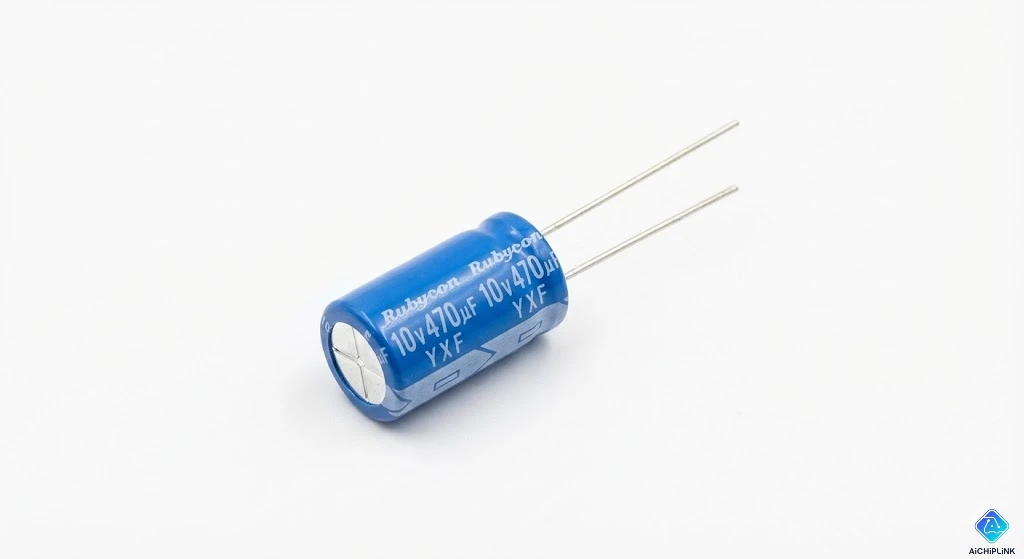
If you open up any power adapter, amplifier, or vintage radio, the largest components you'll see are usually big, cylinder-shaped capacitors. These are Filter Capacitors.
They are the "unsung heroes" of electronics. Without them, your DC power supply wouldn't be DC at all—it would be a bumpy, pulsating mess that causes speakers to buzz and computers to crash.
This guide explains exactly what a filter capacitor does, how to calculate the size you need, and how to tell if one has failed.
Table of Contents
- 1. What is a Filter Capacitor?
- 2. How It Works: The "Water Tank" Analogy
- 3. Calculating the Right Value (Formula)
- 4. Types: Electrolytic vs. Ceramic
- 5. Symptoms of a Bad Filter Capacitor
- 6. Conclusion
1. What is a Filter Capacitor?
A Filter Capacitor is a capacitor placed in a circuit to "filter out" certain frequencies. In the context of power supplies, it is used to filter out the AC component (Ripple) from a pulsating DC signal.
The Goal: Turn the "Bumpy" DC output of a rectifier (diodes) into a smooth, steady DC line that looks like a battery output.
2. How It Works: The "Water Tank" Analogy
Think of electricity like water flowing through a pipe.
- The Rectifier is like a pump that pushes water in spurts (Pulse, Pause, Pulse, Pause).
- The Filter Capacitor is like a Water Tank connected to the pipe.
- Charging (Pulse): When the pump pushes water, it fills the tank.
- Discharging (Pause): When the pump pauses, the water stored in the tank keeps flowing out to the tap.
Result: Even though the pump is pulsing, the water coming out of the tap is a steady, smooth stream. Electrically, the capacitor charges to the peak voltage ($V_{peak}$) and discharges slightly when the voltage drops, maintaining a steady level.
3. Calculating the Right Value (Formula)
How big should your "tank" be? If it's too small, the water runs out between pulses (High Ripple). If it's too big, it stresses the pump (Inrush Current).
For a standard Full-Wave Rectifier, use this formula:
$$C = \frac{I_{load}}{2 \times f \times V_{ripple}}$$
- $C$: Capacitance in Farads.
- $I_{load}$: Load Current (Amps).
- $f$: Frequency of AC mains (50Hz or 60Hz).
- $V_{ripple}$: The acceptable ripple voltage (e.g., 0.5V).
Practical Example
You have a 12V power supply drawing 1 Amp. You want a maximum ripple of 0.5 Volts. (Mains is 60Hz).
$$C = \frac{1}{2 \times 60 \times 0.5} = \frac{1}{60} = 0.0166 F$$
Result: 16,600 µF. This is a theoretical ideal. In practice, engineers often use a Rule of Thumb: 1000µF to 2200µF per Ampere for general loads.
4. Types: Electrolytic vs. Ceramic
Not all capacitors work for filtering.
| Type | Best For | Characteristics |
|---|---|---|
| Aluminum Electrolytic | Bulk Power Filtering | High Capacitance (100µF - 10,000µF). Polarized. Handles low frequency (50/60Hz). |
| Ceramic | High Freq Noise | Low Capacitance (0.1µF). Non-polarized. Filters out high-speed switching noise. |
| X / Y Safety Caps | Mains Line Filtering | Designed to fail safely. Used directly on 110V/220V AC lines to stop EMI. |
Pro Tip: You will often see a large Electrolytic and a small Ceramic connected in parallel. The large one handles the "Power Ripple," and the small one handles the "High-Frequency Noise."
5. Symptoms of a Bad Filter Capacitor
Filter capacitors (especially Electrolytics) are the most common point of failure in old electronics. They contain a liquid electrolyte that dries out over time.
Signs of Failure:
- The "Hum": A loud 50Hz/60Hz buzzing sound from speakers. This is the sound of AC ripple passing through the amp because the cap isn't smoothing it.
- Bulging Tops: The flat silver top of the capacitor looks domed or swollen.
- Leaking: Brown crusty fluid at the base of the capacitor.
- Device Instability: A computer or TV that turns on, works for a minute, and then crashes or reboots randomly.
6. Conclusion
The Filter Capacitor is the backbone of stable power. Whether you are building a linear power supply or fixing a humming amplifier, choosing the right capacitor value (Low ESR, High Ripple Current rating) is the key to clean energy.
Sourcing High-Quality Capacitors? Don't let a $1 part ruin a $1000 machine. Visit Aichiplink.com to search for reliable Nichicon, Rubycon, and Panasonic electrolytic capacitors.

Written by Jack Elliott from AIChipLink.
AIChipLink, one of the fastest-growing global independent electronic components distributors in the world, offers millions of products from thousands of manufacturers, and many of our in-stock parts is available to ship same day.
We mainly source and distribute integrated circuit (IC) products of brands such as Broadcom, Microchip, Texas Instruments, Infineon, NXP, Analog Devices, Qualcomm, Intel, etc., which are widely used in communication & network, telecom, industrial control, new energy and automotive electronics.
Empowered by AI, Linked to the Future. Get started on AIChipLink.com and submit your RFQ online today!
Frequently Asked Questions
1. What does a filter capacitor do?
It smooths ripple voltage from a rectifier, converting pulsating DC into stable DC power.
2. Where is a filter capacitor used?
It is commonly used in power supplies, amplifiers, adapters, and industrial electronics.
3. How do I choose the right filter capacitor value?
Select the capacitance based on load current, ripple voltage, and AC frequency, typically 1000–2200 µF per amp.
4. What happens if a filter capacitor fails?
You may experience humming noise, unstable voltage, random resets, or device failure.
5. Are filter capacitors polarized?
Most high-value filter capacitors are polarized electrolytics and must be connected with correct polarity.