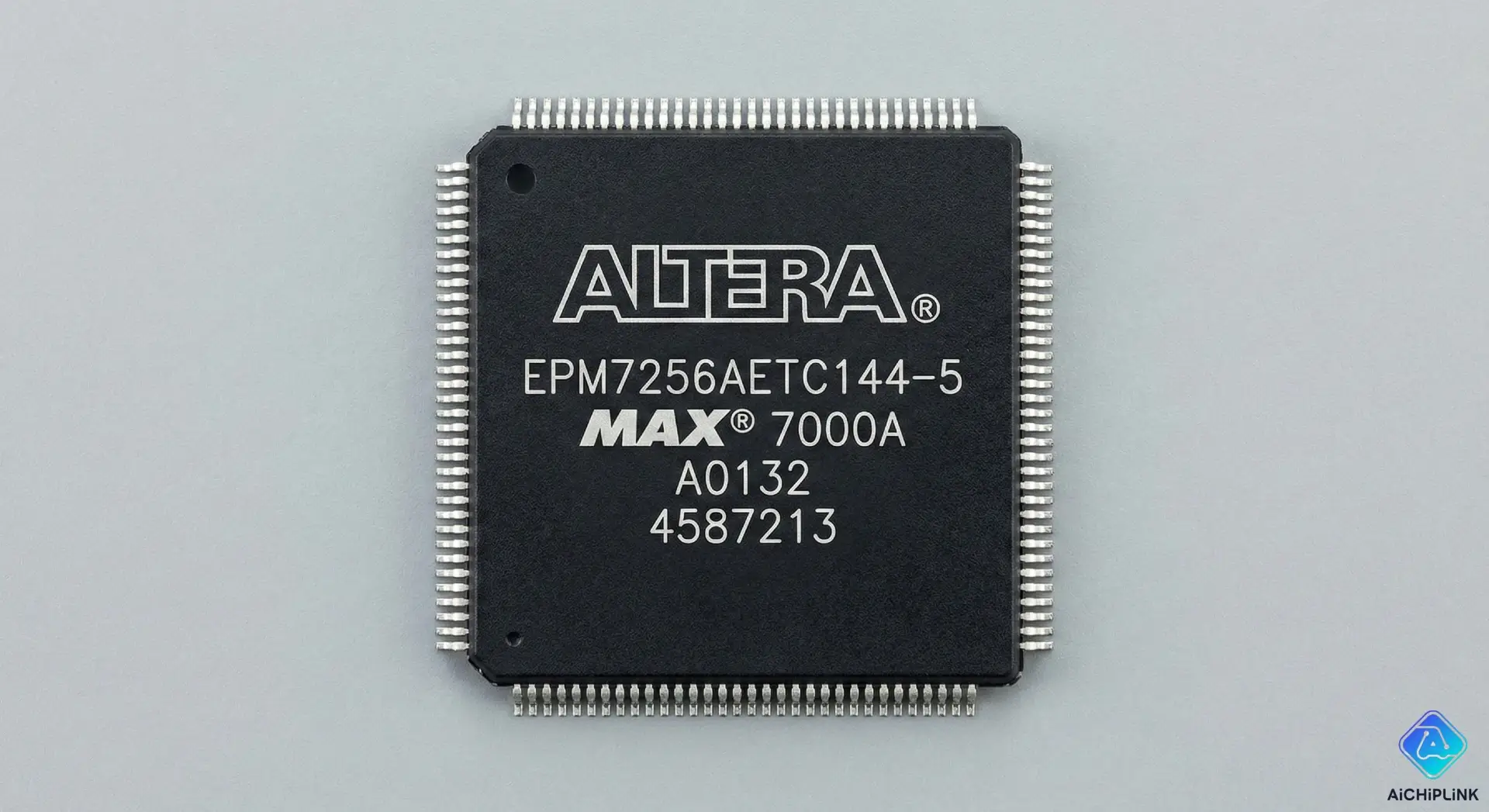
The Altera (now Intel) MAX 7000A series represents a significant evolution in CPLD technology, bridging the gap between legacy 5V systems and modern 3.3V logic. The EPM7256AETC144-5 is a standout member of this family, offering a high density of 256 macrocells with a blazing fast 5ns pin-to-pin delay.
For engineers maintaining industrial control systems or designing high-speed interface logic, this chip offers the perfect balance of "Instant-On" non-volatile performance and ease of use. This guide details everything you need to know about the EPM7256AETC144-5.
Table of Contents
- EPM7256AETC144-5 Datasheet & Technical Specifications
- TQFP144 Package Pinout & PCB Layout
- Programming Guide: JTAG & Software
- Conclusion
EPM7256AETC144-5 Datasheet & Technical Specifications
The part number EPM7256AETC144-5 decodes as follows:
- EPM7: MAX 7000 Family.
- 256: 256 Macrocells (Logic capacity).
- A: 3.3V Core Voltage (High Performance).
- E: Enhanced Feature Set.
- T: TQFP (Thin Quad Flat Pack) package.
- C: Commercial Temperature (0°C to 70°C).
- 144: 144 Pins.
- -5: 5.5 ns Propagation Delay (Speed Grade).
Key Specifications Table
| Feature | Specification |
|---|---|
| Macrocells | 256 |
| Logic Array Blocks (LABs) | 16 |
| Max User I/O | 120 |
| Core Voltage ($V_{CCINT}$) | 3.3V |
| I/O Voltage ($V_{CCIO}$) | 3.3V or 2.5V |
| Speed Grade ($t_{PD}$) | 5.5 ns |
| System Frequency ($f_{MAX}$) | Up to 178.6 MHz |
| Package | 144-pin TQFP |
The "A" Series Advantage: 3.3V & 5V Tolerance
Unlike the older MAX 7000S (which is native 5V), the MAX 7000A is designed for 3.3V systems.
- 5V Tolerance: Crucially, the inputs can safely accept 5V signals. This makes the EPM7256A an excellent level shifter or interface controller between modern 3.3V MCUs/FPGAs and legacy 5V sensors or buses.
- MultiVolt I/O: The $V_{CCIO}$ pins can be connected to 2.5V or 3.3V, allowing outputs to drive different logic standards.
Price Analysis & Availability
As a mature product, the EPM7256A is still in demand for maintenance and specialized low-latency applications.
Note: Finding reliable stock for specific speed grades like -5 is critical for timing-sensitive designs. [Check Stock for EPM7256AETC144-5 at Aichiplink] to browse inventory from verified distributors.
TQFP144 Package Pinout & PCB Layout
The TQFP144 is a surface-mount package offering a high I/O count in a relatively small footprint.
TQFP144 Footprint & Dimensions
- Body Size: 20mm x 20mm.
- Pitch: 0.5 mm.
- Design Tip: The 0.5mm pitch requires precise solder mask definition. Ensure your PCB stencil aperture is optimized to prevent solder bridges during reflow.
Power Management (VCCINT/VCCIO)
Proper power plane design is vital for the -5 speed grade.
- $V_{CCINT}$ (Core): Must be connected to a clean 3.3V supply.
- $V_{CCIO}$ (I/O): Can be 3.3V or 2.5V. If interfacing with 5V logic, power $V_{CCIO}$ at 3.3V; the outputs will drive compatible TTL levels ($V_{OH} > 2.4V$).
- GND: Multiple ground pins must be connected to a solid ground plane to minimize ground bounce.
Programming Guide: JTAG & Software
The EPM7256A supports In-System Programming (ISP) via the standard IEEE 1149.1 JTAG interface.
Choosing the Right Quartus II Version
This is the most common stumbling block.
- Modern Quartus Prime: Does NOT support MAX 7000A series.
- Required Version: You must use Quartus II Web Edition 13.0sp1 (Subscription Edition 13.0sp1 is also fine). This is the last version to include device libraries for the MAX 7000 family. It is available for free download from the Intel website (requires creating an account).
JTAG Chain Configuration
To program the device on-board:
- Hardware: Use an Altera USB-Blaster (or compatible clone).
- Connections:
- TCK (Pin 32) -> Header Pin 1
- TDO (Pin 30) -> Header Pin 3
- TMS (Pin 31) -> Header Pin 5
- TDI (Pin 13) -> Header Pin 9
- VCC -> Header Pin 4 (Target Reference)
- GND -> Header Pin 2, 10
- Pull-ups: Ensure TCK, TMS, and TDI have weak pull-up resistors (1k-10kΩ) to VCC if not provided by the programmer.
Conclusion
The EPM7256AETC144-5 remains a versatile and powerful CPLD for applications requiring instant-on logic, 3.3V/5V mixed-voltage interfacing, and deterministic timing. Its TQFP144 package offers ample I/O for complex glue-logic consolidation.
Securing Authentic Legacy Components Avoid counterfeit chips that plague the legacy market. Trust Aichiplink.com for your supply of Altera MAX 7000A series CPLDs. We connect you with verified global stock.

Written by Jack Elliott from AIChipLink.
AIChipLink, one of the fastest-growing global independent electronic components distributors in the world, offers millions of products from thousands of manufacturers, and many of our in-stock parts is available to ship same day.
We mainly source and distribute integrated circuit (IC) products of brands such as Broadcom, Microchip, Texas Instruments, Infineon, NXP, Analog Devices, Qualcomm, Intel, etc., which are widely used in communication & network, telecom, industrial control, new energy and automotive electronics.
Empowered by AI, Linked to the Future. Get started on AIChipLink.com and submit your RFQ online today!
Frequently Asked Questions
Can the EPM7256AETC144-5 replace the EPM7256SQC208?
Not directly. The packages are different (TQFP144 vs PQFP208), and the "S" series is a 5V core device while the "A" series is a 3.3V core device. You would need a PCB redesign and a voltage regulator (3.3V) to use the "A" series.
Is the configuration volatile?
No. The MAX 7000A uses EEPROM-based CMOS technology. It is **non-volatile**, meaning it retains its programming when power is lost and is "Instant-On" (ready milliseconds after power-up).
What does the "-5" mean?
The "-5" indicates the propagation delay ($t_{PD}$) is **5.5 nanoseconds**. This is the time it takes for a signal to travel from an input pin, through the logic array, to an output pin. This is considered very fast for a CPLD.
Do I need an external oscillator?
Not necessarily. As a CPLD, it is purely logic gates. If your design requires a clock (e.g., for counters or state machines), you must provide one externally to a GCLK pin, as it does not have an internal oscillator block like some MCUs.
Can I use Verilog or VHDL?
Yes, Quartus II 13.0sp1 supports full Verilog (HDL) and VHDL synthesis for the MAX 7000A series, as well as schematic entry.