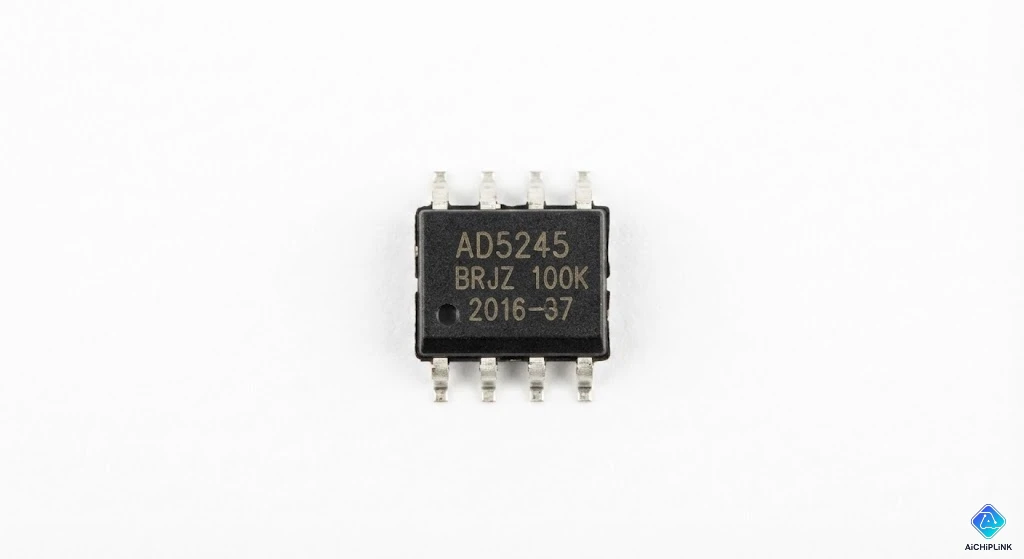
We have all dealt with "scratchy" volume knobs on old radios or amplifiers. That noise is the sound of a mechanical wiper dragging across a carbon track, wearing it down over time.
In modern electronics, we don't need to tolerate that wear and tear.
Enter the Digital Potentiometer (or DigiPot).
This semiconductor device performs the exact same function as a mechanical knob—adjusting resistance to divide voltage—but it does so with zero moving parts, controlled entirely by your microcontroller code.
This guide explores what’s inside these chips, how they work, and how to choose the right one for your audio or sensor project.
Table of Contents
- 1. What is a Digital Potentiometer?
- 2. Inside the Chip: The Resistor Ladder
- 3. Digital vs. Mechanical: Why Switch?
- 4. Selection Criteria: Interfaces & Memory
- 5. Critical Applications
- 6. Conclusion
1. What is a Digital Potentiometer?
A Digital Potentiometer is a mixed-signal Integrated Circuit (IC). It has three analog terminals just like a physical pot:
- Terminal A (High side)
- Terminal B (Low side)
- Wiper (W) (The adjustable tap)
However, instead of turning a shaft with a screwdriver, you send a digital signal (via I2C, SPI, or Up/Down pulses) to move the "Wiper" position. This allows for dynamic control of gain, voltage offsets, and volume without human intervention.
2. Inside the Chip: The Resistor Ladder
How do you make a variable resistor without moving parts?
The internal structure consists of a long string of identical fixed resistors connected in series (a "Resistor Ladder").
- The Taps: Between every resistor, there is a switch (usually a CMOS transmission gate).
- The Logic: When you send a command (e.g., "Set Level 128"), the digital logic closes the 128th switch, connecting that point of the ladder to the Wiper Output.
Resolution: A mechanical pot has infinite resolution. A digital pot has steps.
- 8-bit: 256 steps (Standard).
- 10-bit: 1024 steps (High precision).
3. Digital vs. Mechanical: Why Switch?
| Feature | Mechanical Potentiometer | Digital Potentiometer |
|---|---|---|
| Control | Manual (Hand or Screwdriver) | Software (Microcontroller) |
| Reliability | Low (Wears out, sensitive to dust/vibration) | High (No moving parts, encapsulated) |
| Size | Large (Panel mount or Trimmer) | Tiny (SC70, MSOP, QFN) |
| Noise | "Scratchy" noise during adjustment | Silent (Step artifacts can be filtered) |
| Power Handling | Can be High (Watts) | Very Low (milliwatts) |
⚠️ Critical Warning: A DigiPot is NOT a rheostat for controlling high power. You cannot use it to dim a lightbulb directly. The current flowing through the wiper is typically limited to a few milliamps ($\pm 5mA$). It is designed to control signals, not loads.
4. Selection Criteria: Interfaces & Memory
When buying a DigiPot, check these two specs first:
A. The Interface
- I2C: Uses 2 wires (SDA, SCL). Each chip has an address, so you can control multiple pots on the same bus. Great for complex systems.
- SPI: Uses 3 or 4 wires. Faster than I2C. Good if you need to change resistance instantly.
- Push-Button (Up/Down): No microcontroller needed! You just connect two physical buttons to the chip inputs to step the resistance up or down.
B. The Memory (Volatile vs. Non-Volatile)
- Volatile: When you unplug the power, the wiper forgets its position and resets (usually to the midpoint).
- Best for: Volume control (you usually want volume low on startup).
- Non-Volatile (EEPROM): The chip remembers the last set position even after power loss.
- Best for: System Calibration (e.g., calibrating a sensor offset at the factory).
5. Critical Applications
1. Programmable Power Supplies
You can place a DigiPot in the feedback loop of a standard voltage regulator (like an LM317 or LDO). By changing the resistance digitally, you change the output voltage of the regulator.
2. Audio Volume Control
For audio, don't use a standard Linear taper pot. Look for a Logarithmic (Log) Taper DigiPot, which matches the human ear's hearing curve.
- Feature to look for: Zero-Crossing Detection. This ensures the wiper only moves when the audio signal is at 0V, preventing audible "clicks" or "zipper noise" during volume changes.
3. Sensor Auto-Calibration
Instead of paying a technician to turn a trimmer pot on an assembly line to calibrate a sensor, the microcontroller can read the sensor error and adjust a DigiPot automatically to zero it out.
6. Conclusion
The Digital Potentiometer is the bridge between the analog world of resistance and the digital world of software. By replacing mechanical trimmers with DigiPots, you make your product smaller, vibration-proof, and capable of self-calibration.
Sourcing Digital Potentiometers Whether you need a simple MCP41010 for Arduino or a high-precision Analog Devices AD52xx for audio, finding the right package is key. Visit Aichiplink.com to search for stock of Volatile and Non-Volatile Digital Potentiometers.

Written by Jack Elliott from AIChipLink.
AIChipLink, one of the fastest-growing global independent electronic components distributors in the world, offers millions of products from thousands of manufacturers, and many of our in-stock parts is available to ship same day.
We mainly source and distribute integrated circuit (IC) products of brands such as Broadcom, Microchip, Texas Instruments, Infineon, NXP, Analog Devices, Qualcomm, Intel, etc., which are widely used in communication & network, telecom, industrial control, new energy and automotive electronics.
Empowered by AI, Linked to the Future. Get started on AIChipLink.com and submit your RFQ online today!
Frequently Asked Questions
1. What is a digital potentiometer used for?
It is used to adjust voltage, gain, or signal levels digitally using a microcontroller instead of a mechanical knob.
2. Can a digital potentiometer handle high power or current?
No. DigiPots are for low-power signal control only, typically limited to a few milliamps.
3. What is the difference between I2C and SPI digital potentiometers?
I2C uses fewer wires and supports multiple devices, while SPI is faster and better for real-time adjustments.
4. Do digital potentiometers remember their settings after power loss?
Only non-volatile digital potentiometers retain their wiper position when power is removed.
5. Are digital potentiometers suitable for audio volume control?
Yes, especially logarithmic taper models with zero-crossing detection to prevent noise.

