In the world of industrial communication, RS-485 is king. But as the world moved from 5V microcontrollers (like the 8051) to 3.3V microcontrollers (like STM32, ESP32, and Raspberry Pi), the old standard chips like the MAX485 became a headache. They needed level shifters and extra components.
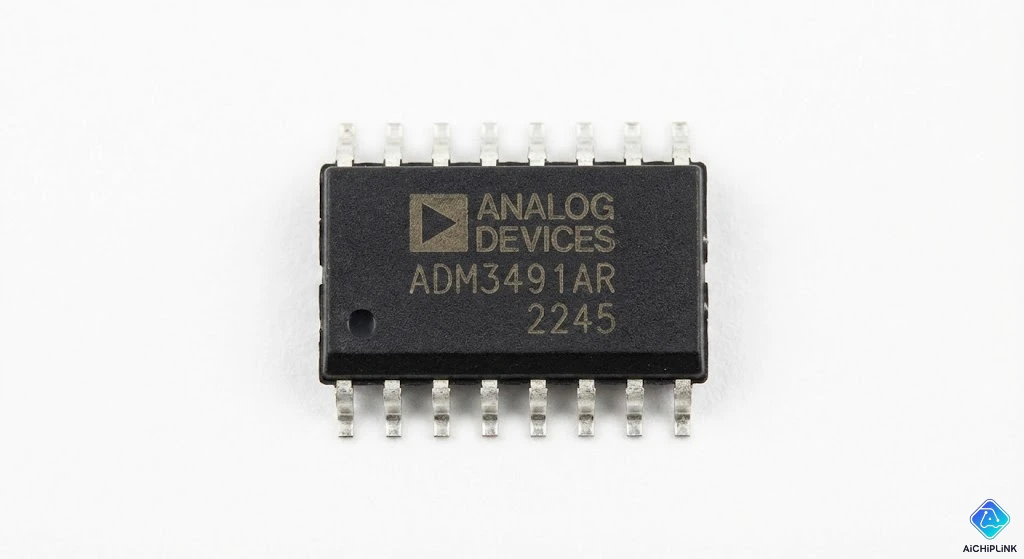
Enter the Analog Devices ADM3491AR.
This chip is the modern standard for 3.3V, Full-Duplex communication. It allows modern low-voltage processors to talk to rugged industrial machinery over long distances without complex voltage translation circuits.
This guide breaks down why this 14-pin chip is essential for your next IoT or automation design.
Table of Contents
- 1. Decoding the Part Number
- 2. Technical Specs: Why 3.3V & Full-Duplex Matter
- 3. Hardware Considerations: SOIC-14 Pinout
- 4. ADM3491 vs. ADM3485: Don't Buy the Wrong One
- 5. Conclusion
1. Decoding the Part Number
Analog Devices part numbers are descriptive. Here is the breakdown for ADM3491AR:
| Segment | Code | Meaning |
|---|---|---|
| ADM | Series | Analog Devices Interface. (High reliability transceivers). |
| 3491 | Device | 3.3V, Full-Duplex RS-485/RS-422. |
| A | Grade | Standard Industrial Temp (Usually -40°C to +85°C). |
| R | Package | SOIC-14 (Small Outline Integrated Circuit). "R" usually stands for standard SOIC in ADI parts (Note: "RZ" means RoHS/Lead-Free). |
Identity: This is a 14-pin chip. If you see an 8-pin chip, it is NOT an ADM3491 (it is likely a Half-Duplex ADM3485).
2. Technical Specs: Why 3.3V & Full-Duplex Matter
The 3.3V Advantage
Most legacy RS-485 chips require a 5V supply. If your MCU is running at 3.3V:
- A 5V chip might blow up your MCU's RX pin.
- You need a Logic Level Converter, which adds cost and board space.
- The Solution: The ADM3491AR runs natively on 3.3V. You connect its RO (Receiver Output) directly to your MCU's UART RX pin safely.
Full-Duplex (4-Wire) Capability
RS-485 can be 2-wire (Half-Duplex) or 4-wire (Full-Duplex).
- Half-Duplex: Only one device talks at a time (like a Walkie-Talkie).
- Full-Duplex (ADM3491): Devices can talk and listen simultaneously (like a Telephone). This requires separate pairs for Transmit (Y, Z) and Receive (A, B).
- Benefit: Lower latency and simpler software protocol (no need to handle bus turnaround timing).
High Speed
It supports data rates up to 10 Mbps. This is crucial for high-speed encoder feedback or fast sensor arrays, where standard 115.2kbps just isn't fast enough.
3. Hardware Considerations: SOIC-14 Pinout
The ADM3491AR uses the standard 14-pin footprint, compatible with the MAX3491.
- Pin 12 (A) & Pin 11 (B): Receiver Inputs. Connect these to the TX pair of the other device.
- Pin 9 (Y) & Pin 10 (Z): Driver Outputs. Connect these to the RX pair of the other device.
- Pin 2 (RO): Receiver Output. Connect to MCU RX.
- Pin 3 (DI): Driver Input. Connect to MCU TX.
- Pin 4 (DE) & Pin 2 (~RE): Control Pins.
- DE (Driver Enable): High = Talk.
- ~RE (Receiver Enable): Low = Listen.
- Tip: In Full-Duplex systems, you can often tie DE to VCC and ~RE to GND to keep the chip always active.
4. ADM3491 vs. ADM3485: Don't Buy the Wrong One
This is the most common mistake on sourcing lists.
| Feature | ADM3485 | ADM3491 (This Part) |
|---|---|---|
| Duplex | Half-Duplex (2-Wire) | Full-Duplex (4-Wire) |
| Pins | 8 Pins (SOIC-8) | 14 Pins (SOIC-14) |
| Wires Needed | A, B + GND | A, B, Y, Z + GND |
| Use Case | Simple sensor networks | Complex, high-speed comms |
Rule of Thumb: If your connector has 5 pins (A, B, Y, Z, G), you need the ADM3491. If it has 3 pins (A, B, G), you need the ADM3485.
5. Conclusion
The Analog Devices ADM3491AR is the unsung hero of modern industrial IoT. It bridges the gap between delicate 3.3V microcontrollers and the rugged world of RS-485 cabling. By offering Full-Duplex capability in a drop-in industry-standard package, it allows engineers to build faster, more responsive control systems.
Sourcing Interface ICs? Need to ensure your RS-485 bus is robust? Visit Aichiplink.com to search for verified stock of ADM3491AR and other ADI transceivers.

Written by Jack Elliott from AIChipLink.
AIChipLink, one of the fastest-growing global independent electronic components distributors in the world, offers millions of products from thousands of manufacturers, and many of our in-stock parts is available to ship same day.
We mainly source and distribute integrated circuit (IC) products of brands such as Broadcom, Microchip, Texas Instruments, Infineon, NXP, Analog Devices, Qualcomm, Intel, etc., which are widely used in communication & network, telecom, industrial control, new energy and automotive electronics.
Empowered by AI, Linked to the Future. Get started on AIChipLink.com and submit your RFQ online today!
Frequently Asked Questions
1: What is the ADM3491AR used for?
It is a 3.3V full-duplex RS-485/RS-422 transceiver for industrial and embedded communication systems.
2: Does ADM3491AR work directly with 3.3V microcontrollers?
Yes. It operates natively at 3.3V, making it compatible with STM32, ESP32, and similar MCUs.
3: Is ADM3491AR full-duplex or half-duplex?
It is full-duplex, requiring separate transmit and receive differential pairs.
4: What package does ADM3491AR use?
It comes in a 14-pin SOIC package, larger than half-duplex RS-485 devices.
5: Can ADM3491AR replace ADM3485?
No. ADM3485 is half-duplex (2-wire), while ADM3491AR is full-duplex (4-wire) and not pin-compatible.