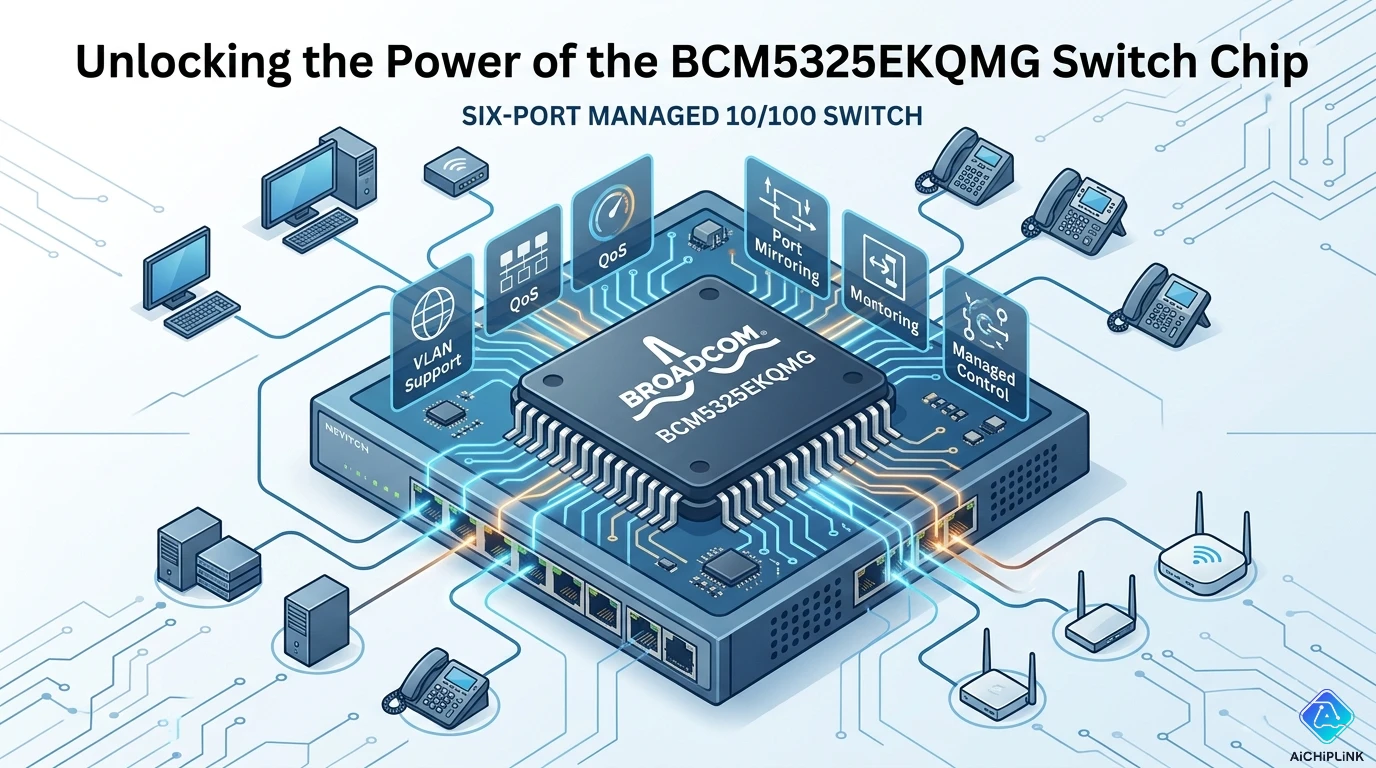
The 10/100 Switch That Powered a Decade of Home Routers and Still Shows Up on Repair Benches in 2025
The Broadcom BCM5325E was introduced around 2004 as a "fourth generation switch on a chip" — Broadcom's ROBOswitch line targeted at SOHO routers, residential gateways, and cost-optimized embedded networking equipment. The same year, Linksys was shipping the WRT54G. Netgear, D-Link, and Asus were building 802.11g routers with identical switching requirements: five 10/100 ports, one uplink to a MIPS or ARM SoC, 802.1Q VLAN for WAN/LAN separation, enough management capability to support OpenWrt and DD-WRT.
BCM5325E became the default. It appeared in so many production routers — Linksys WRT54G, WRT54GL, WRT54GS, D-Link DIR-600, numerous Netgear models, ASUS RT-N10 variants — that it is more accurate to describe the home router market of 2005–2015 as "BCM5325E plus various SoCs" than to enumerate the individual products.
Twenty years later, the chip is still available. Veswin lists over 23,000 units in stock. Repair technicians source it for board-level repair of still-functional routers in commercial and industrial service. Embedded gateway designers in cost-constrained applications specify it because it is characterized, inexpensive, and has a mature Linux driver (b53) that is mainline in the kernel since 4.x. And occasionally, an engineer encounters a BCM5325EKQMG on a BOM for the first time and needs to understand what the "E" means and whether the design should be migrated to something more current.
This guide covers all three audiences.
1.0 What the BCM5325EKQMG Is — and What "ROBOswitch" Meant
Full part number decode:
| Field | Value | Meaning |
|---|---|---|
| BCM | BCM | Broadcom Communications |
| 5325 | 5325 | ROBOswitch product identifier, 5-port 10/100 family |
| E | E | Enhanced variant — adds SPI management interface; pin-compatible upgrade over BCM5325M |
| K | K | Commercial temperature grade (0°C to +70°C junction) |
| Q | Q | MQFP (Metric Quad Flat Package) |
| M | M | 128-pin count |
| G | G | RoHS compliant, lead-free |
BCM5325 family variants:
| Variant | Management interface | Uplink | Notes |
|---|---|---|---|
| BCM5325 | MII-only | MII | Original, basic |
| BCM5325M | MII + MDIO | MII + 7-wire | Mid-tier |
| BCM5325E | MII + MDIO + SPI | MII or Reverse MII | Most capable; this part |
| BCM5325U | MII + MDIO + SPI | MII or Reverse MII | BCM5325E variant for different SoC pin-out |
| BCM5325F | MII + MDIO | MII | Different feature set |
The BCM5325E (EKQMG) and BCM5325U share the same functional feature set. BCM5325E is pin-compatible with BCM5325M; BCM5325U is pin-compatible with BCM5325 (original). This compatibility enabled router manufacturers to design one PCB that could accept either variant depending on supply availability.
"ROBOswitch" branding:
Broadcom's ROBOswitch line was positioned for SOHO (Small Office/Home Office) applications with emphasis on:
- Low power (< 1.0W total — critical for routers without active cooling)
- Single-chip integration (five PHYs + six MACs + switch fabric + management in 128 pins)
- Simple host interface (MII to a BCM63xx DSL modem SoC, or MIPS/ARM application processor)
- Built-in management for WAN/LAN separation without external management processor
The "ROBO" prefix referred to Broadcom's Register-based Operations and Bridging Operations management model — a register-access scheme for switch configuration accessible via MDC/MDIO or SPI, distinct from the full SNMP-based management of enterprise switches.
2.0 Specifications
From the Broadcom BCM5325E datasheet (© 2004 Broadcom Corporation):
Switching:
- Total ports: 6 (5 user ports with integrated PHY + 1 uplink/CPU port)
- PHY standard: IEEE 802.3u 10BASE-T / 100BASE-TX per port (auto-negotiation, auto-MDI/MDI-X)
- MACs: 6 × 802.3x-compliant MACs
- Switch fabric: Non-blocking, wire-speed 10/100 switching
- Packet buffer: 1 Mbit (128 KB)
- Control memory: 512 Kbit (64 KB)
MAC address table:
- Entries: 1,024 (1K) addresses
- Automatic learning and aging
- Supports static entries
Management features:
- 802.1Q VLAN: 16 VLAN entries (port-based and tagged)
- 802.1p QoS: 4 priority queues per port
- 802.1d Spanning Tree Protocol (STP)
- 802.1x EAPOL higher-layer protocol support
- IGMP snooping (Layer 3)
- Storm control: Programmable broadcast/multicast suppression
- Port mirroring
- WAN port and protected port support (traffic isolation for WAN/LAN separation)
- Per-port flow control: 802.3x full-duplex and half-duplex back-pressure
Host uplink (port 6):
- MII (standard, 25 MHz clock, 4-bit data)
- Reverse MII (RMII-compatible): Allows connection to SoCs that present an MII MAC with reversed signal directions
- 7-wire interface: Simplified reduced-pin interface for some SoC integrations
Management access:
- MDC/MDIO: IEEE 802.3 Clause 22 PHY management
- SPI: 3-wire Serial Peripheral Interface for switch register access (the "E" feature)
- Internal oscillator: No external crystal required — simplifies PCB design
Power:
- VDD: 3.3V (I/O) and 2.5V (core) — or single 3.3V with internal regulation in some configurations
- Typical power: < 1.0W (all 5 ports active at 100 Mbps)
Package:
- 128-pin MQFP (PQFP), 28mm × 28mm body with 0.5mm lead pitch
3.0 Operating Modes: MII vs Reverse MII, SPI vs MDIO Management
Uplink port (port 6) configuration:
The BCM5325E's port 6 connects to the host SoC and is configurable as MII or Reverse MII via strap pins. This distinction matters because different SoCs present their Ethernet MAC in different electrical directions:
In standard MII: the SoC MAC drives the transmit clock (TX_CLK) and receives it. The BCM5325E provides the receive clock (RX_CLK). Signal directions are from the SoC's perspective.
In Reverse MII: the BCM5325E drives the clock. Used when the SoC's Ethernet MAC expects the PHY to provide the reference clock (common in older MIPS SoCs where the "reverse MII" interface was an internal MAC that expected an external PHY clock). The BCM5325E can present itself as a PHY to such a MAC.
The strap pin configuration (set by pull-up/pull-down resistors at power-up) selects the mode. Incorrect strap configuration results in no MII link between the BCM5325E and the host — the SoC will show the Ethernet interface as down or unable to negotiate.
Management interface selection — SPI vs MDC/MDIO:
Both SPI and MDC/MDIO access the same register file in the BCM5325E. The choice depends on what the host SoC provides:
- SPI: Available on most MCUs and application processors. The SPI management interface gives full access to all BCM5325E switch registers at SPI bus speeds, making it faster for bulk register configuration at startup.
- MDC/MDIO: Standard IEEE 802.3 management interface, widely supported by Linux kernel Ethernet drivers. The switch registers are accessed via a pseudo-PHY at MDIO address 0x10.
The Linux b53 driver uses MDC/MDIO (via the switch's pseudo-PHY register access) or SPI (via a dedicated SPI driver path) depending on how the device tree configures the management interface.
4.0 External Circuit Requirements
Crystal / oscillator:
The BCM5325E includes an internal oscillator that uses an external crystal as its reference. A 25 MHz crystal connected to the XTALIN/XTALOUT pins is required. Alternatively, a 25 MHz oscillator can drive XTALIN with XTALOUT left unconnected. Crystal specification: 25 MHz, ±50 ppm, load capacitance per BCM5325E reference schematic (typically 18–22 pF). The internal oscillator eliminates the need for a separate clock IC — a cost and BOM simplification.
Magnetics for user ports (ports 1–5):
Each of the five 10/100BASE-T ports requires a standard 10/100BASE-TX isolation transformer. Bob Smith termination is recommended. Place magnetics within 15 mm of the BCM5325E MDI pins. 10/100-only magnetics (not gigabit) are required and are less expensive than GbE transformers.
Power supply:
The BCM5325E requires 3.3V for I/O and an internal regulator generates the 2.5V core. External 2.5V can also be supplied separately depending on the variant and configuration. Decouple 3.3V supply with 10 µF + 100 nF ceramics per supply pin cluster.
5.0 ⚠️ Four Pitfalls in BCM5325E Designs
Pitfall 1: MII/Reverse MII strap mismatch causing no uplink link
The MII interface direction (standard vs reverse) must match what the host SoC expects. A SoC MAC that expects standard MII will not link up if the BCM5325E is strapped for Reverse MII. The symptom is the host SoC showing its Ethernet interface as permanently down, with no link LED on port 6. Diagnosis: read the BCM5325E's port 6 status register via MDIO or SPI to confirm whether the switch side sees a link. If the switch sees no link on its internal port 6 despite the cable being connected (the uplink to the SoC), the strap configuration is likely the cause.
Pitfall 2: Incorrect VLAN configuration allowing WAN traffic to bridge directly to LAN ports
The BCM5325E supports WAN port and protected port modes specifically for preventing WAN-to-LAN direct switching. If VLAN configuration is not explicitly programmed at startup, the default post-reset state may allow traffic from port 6 (the WAN uplink, if the design uses one of the PHY ports as WAN and port 6 as CPU) to be forwarded directly to LAN ports — bypassing any firewall processing in the SoC. This is the same pitfall as described for QCA8337: the switch default forwards traffic freely until explicit VLAN isolation is programmed by the driver. The b53 Linux driver handles this correctly for DSA configurations, but designs using the switch in unmanaged or partially managed modes must explicitly configure port isolation.
Pitfall 3: Using only MDC/MDIO without enabling the enhanced register access
The BCM5325E's VLAN, QoS, and advanced management features are in switch global registers that require the extended indirect MDIO access sequence (write to management address register, then read/write data register) — similar to QCA8337. Standard IEEE 802.3 PHY register reads (which some simpler Linux Ethernet drivers perform) only access the individual PHY registers at addresses 0–4, not the switch management registers. A driver that does only standard PHY MDIO reads will see the five PHY link states but will be unable to configure VLANs or any switch fabric feature. Verify that the management software uses the extended register access protocol for switch configuration.
Pitfall 4: Sourcing from secondary market without verifying the BCM5325E vs BCM5325 distinction
The BCM5325 (without E) and BCM5325E are pin-compatible, but the BCM5325 lacks the SPI management interface and has fewer management capabilities. Counterfeit BCM5325EKQMG chips that are actually BCM5325 or BCM5325M devices will pass basic link testing but fail when the SPI management interface is accessed. If the design relies on SPI for switch register access, verify via register read that the chip responds correctly to SPI transactions at startup.
6.0 Modern Substitutes and When to Upgrade
If the application is new development rather than legacy maintenance, BCM5325E is not the preferred choice for new designs. The 10/100 speed ceiling, 1K MAC table, and 16-entry VLAN table are limiting for many current applications.
Direct functional substitutes in new designs:
| Device | Speed | Ports | Integrated PHY | Linux driver | Notes |
|---|---|---|---|---|---|
| Microchip KSZ8895 | 10/100 | 5+1 | Yes | ksz8795 (mainline) | Near drop-in functional equivalent |
| Microchip KSZ9897 | GbE | 5+2 | Yes | ksz9477 (mainline) | Upgrade: GbE speeds, larger tables |
| QCA8337-AL3C | GbE | 5+2 | Yes | qca8k (mainline) | Upgrade: GbE, 2K MAC, 802.1Q full |
| Marvell 88E6061 | GbE | 5+2 | Yes | mv88e6xxx (mainline) | Upgrade: GbE, enterprise features |
| Realtek RTL8367 | GbE | 5+2 | Yes | Out-of-tree | Upgrade: widely used in newer SOHO |
When to keep BCM5325E:
- Board-level repair of equipment in service: the BCM5325E is available, the board is proven, and replacement is the most cost-effective maintenance action
- Legacy embedded product with a long remaining service life where the 10/100 speed is adequate for the application (industrial sensors, legacy PLC Ethernet, low-bandwidth IoT)
- Cost-constrained designs where 10/100 is sufficient and BCM5325E's < 1W power budget is a genuine advantage
When to migrate to a modern device:
- Any new design where gigabit speeds, larger MAC/VLAN tables, or a commercially supported and actively maintained silicon supply chain are needed
- Designs targeting OpenWrt 23.x and later: the
b53driver remains mainline but receives less active development attention thanqca8korksz9477
7.0 PCB Notes and Driver Integration
PCB layout (128-pin MQFP):
The 128-pin MQFP (28mm × 28mm, 0.5mm pitch) is a QFP (Quad Flat Package) with leads on all four sides — accessible and solderable without BGA equipment. The package can be hand-soldered by experienced technicians or assembled via standard SMT reflow. No underfill or special via structures are required, unlike BGA packages.
Route the MII interface (port 6 to SoC) as matched-length pairs with controlled impedance (50 Ω single-ended). Keep MDI pairs (ports 1–5) matched in length to within ±10 mm per pair.
Linux b53 driver configuration:
The Broadcom b53 driver is the mainline Linux DSA driver for BCM5325 and related switch ICs. Sample device tree for a BCM5325E connected via SPI:
spi@10000b00 {
switch@0 {
compatible = "brcm,bcm5325";
reg = <0>;
spi-max-frequency = <781000>;
ports {
port@0 { reg = <0>; label = "lan1"; };
port@1 { reg = <1>; label = "lan2"; };
port@2 { reg = <2>; label = "lan3"; };
port@3 { reg = <3>; label = "lan4"; };
port@4 { reg = <4>; label = "wan"; };
port@8 {
reg = <8>;
label = "cpu";
ethernet = <ðernet0>;
phy-mode = "mii";
fixed-link { speed = 100; full-duplex; };
};
};
};
};
Note: the BCM5325's CPU port appears at register address 8 (not 5 or 6) in the b53 driver model.
8.0 Sourcing BCM5325EKQMG in 2025
The BCM5325EKQMG is technically an active Broadcom part but is no longer promoted for new designs. Broadcom's focus shifted to GbE switches years ago. Availability comes primarily from two sources:
Secondary market: Large quantities exist (23,000+ units at one broker). These originate from excess production inventory, end-of-life equipment disassembly, and original factory overruns stored for the repair market. Secondary market pricing is typically $1–3 per unit in quantity.
Authorized distribution: Arrow and Avnet may carry small quantities. Lead times for factory-direct stock are long or unavailable. The secondary market is the practical sourcing channel for BCM5325EKQMG.
Counterfeit risk: Given the volume of secondary market stock and the widespread use of BCM5325 family variants, counterfeit risk is moderate. Verification: use SPI to read the BCM5325E's Device ID register (register 0x30 via the ROBO management access). The BCM5325E returns a specific device ID code. If the chip does not respond to SPI management, or returns an incorrect device ID, it may be a BCM5325 (non-E) variant or counterfeit.
For verified authentic BCM5325EKQMG inventory with competitive pricing, visit aichiplink.com.
9.0 Real Questions from Engineers and Repair Technicians
Q: I have a failed BCM5325EKQMG in a Linksys WRT54GL. Is BCM5325UKQMG a drop-in replacement?
A: BCM5325U is pin-compatible with BCM5325 (the original, not the E variant). BCM5325E is pin-compatible with BCM5325M. The E and U variants are NOT pin-compatible with each other — they serve different host SoC pin-out requirements. For a WRT54GL board designed for BCM5325E, you need another BCM5325EKQMG or a BCM5325MKQMG (the E's pin-compatible predecessor). A BCM5325UKQMG would have a different pin-out and cannot be installed in the same footprint. Additionally, the WRT54GL's firmware (Linksys OEM or OpenWrt) is configured for BCM5325E's management interface and register map — a different functional variant may not be recognized correctly.
Q: The OpenWrt b53 driver shows the BCM5325E switch ports as individual interfaces, but LAN clients can still ping each other directly without going through the router CPU. Is this a driver bug?
A: This is the default VLAN behavior, not a driver bug. Without explicit VLAN configuration, the BCM5325E's hardware default allows traffic between all ports. The b53 driver requires a proper DSA device tree configuration with VLAN definitions to isolate ports. In OpenWrt, the switch configuration (in /etc/config/network using the swconfig interface or the newer DSA model) must explicitly configure the VLAN table to place LAN ports and the CPU port in a LAN VLAN and the WAN port in a separate WAN VLAN. Without this configuration, the switch operates as a flat unmanaged switch. Review OpenWrt's wiki for BCM5325 switch configuration to find the correct VLAN setup for your specific target platform.
Q: We are designing a new industrial sensor hub that needs 4 × 10/100 LAN ports. Should we use BCM5325EKQMG or upgrade to a GbE switch?
A: For an industrial sensor hub where sensor data rates are typically 1–10 Mbps per sensor, 10/100 Ethernet is fully adequate. BCM5325E's < 1W power budget is genuinely advantageous for battery-adjacent or thermally constrained designs. However, for a new design, the Microchip KSZ8895 is a better choice than BCM5325EKQMG: same 5+1 port 10/100 architecture, same < 1W power budget, similar feature set, LQFP package, mainline Linux driver, active Microchip production support, and better long-term supply chain reliability than a 20-year-old Broadcom part primarily available from secondary market. If 10/100 is genuinely sufficient, use KSZ8895 for new designs; use BCM5325EKQMG only for replacement of existing deployed equipment.
10.0 Quick Reference Card
Part Number Decode:
| Field | Value | Meaning |
|---|---|---|
| BCM5325 | BCM5325 | Broadcom ROBOswitch 5+1 port 10/100 |
| E | E | Enhanced: adds SPI management interface |
| K | K | Commercial: 0°C to +70°C |
| Q | Q | MQFP (Quad Flat Package) |
| M | M | 128-pin |
| G | G | RoHS compliant, lead-free |
Key Specifications:
| Parameter | Value |
|---|---|
| User ports | 5 (10/100BASE-TX, integrated PHY) |
| CPU/uplink port | 1 (MII or Reverse MII) |
| MAC address table | 1,024 entries |
| VLAN entries | 16 (port-based + 802.1Q) |
| QoS queues | 4 per port (802.1p) |
| Management | MDC/MDIO + SPI (E variant) |
| Internal oscillator | Yes (external 25 MHz crystal only) |
| Power | < 1.0W typical |
| Supply | 3.3V + 2.5V (or 3.3V with internal reg) |
| Package | 128-pin MQFP, 28×28mm |
| Linux driver | b53 (DSA, mainline kernel) |
BCM5325 Variant Comparison:
| Variant | SPI | Uplink | Pin-compatible with |
|---|---|---|---|
| BCM5325 | No | MII | BCM5325U |
| BCM5325M | No | MII + 7-wire | BCM5325E |
| BCM5325E (this part) | Yes | MII + Rev MII | BCM5325M |
| BCM5325U | Yes | MII + Rev MII | BCM5325 |
When BCM5325EKQMG is the right choice:
- ✅ Replacing a failed BCM5325E in deployed legacy equipment
- ✅ New design with genuine 10/100 requirement and < 1W power budget (but prefer KSZ8895)
- ❌ New designs where long-term supply continuity matters → use KSZ8895
- ❌ Applications needing GbE, > 1K MACs, or > 16 VLANs → use QCA8337 or KSZ9897
For sourcing Broadcom BCM5325EKQMG with competitive pricing and traceability, visit aichiplink.com.

Written by Jack Elliott from AIChipLink.
AIChipLink, one of the fastest-growing global independent electronic components distributors in the world, offers millions of products from thousands of manufacturers, and many of our in-stock parts is available to ship same day.
We mainly source and distribute integrated circuit (IC) products of brands such as Broadcom, Microchip, Texas Instruments, Infineon, NXP, Analog Devices, Qualcomm, Intel, etc., which are widely used in communication & network, telecom, industrial control, new energy and automotive electronics.
Empowered by AI, Linked to the Future. Get started on AIChipLink and submit your RFQ online today!
Frequently Asked Questions
What is BCM5325EKQMG used for?
BCM5325EKQMG is a legacy Broadcom 5+1 port 10/100 Ethernet switch controller designed for SOHO routers, embedded gateways, and industrial networking equipment. It integrates five Fast Ethernet PHYs plus one CPU uplink port, making it ideal for classic home routers like the Linksys WRT54G series and still useful today for legacy equipment repair, low-power embedded networking, and cost-sensitive 10/100 Ethernet designs.
What does the “E” in BCM5325EKQMG mean?
The “E” identifies the enhanced BCM5325 variant that adds SPI management access and reverse MII support compared to earlier BCM5325 versions. This makes BCM5325E more flexible for embedded Linux and OpenWrt-based systems because it supports faster switch register configuration, better host SoC compatibility, and expanded management capabilities through Broadcom’s ROBOswitch interface.
Does BCM5325EKQMG support Linux and OpenWrt?
Yes, BCM5325EKQMG is supported by the Linux mainline b53 switch driver and works with OpenWrt through DSA or legacy switch configuration frameworks. This support allows engineers to configure VLANs, monitor switch states, isolate WAN/LAN traffic, and integrate the chip into embedded networking applications without requiring proprietary Broadcom software stacks.
Is BCM5325EKQMG still good for new designs in 2026?
BCM5325EKQMG is still functional for basic 10/100 Ethernet applications, but it is generally not recommended for modern new designs. Its limited MAC table size, small VLAN capacity, and Fast Ethernet-only speed make newer alternatives like Microchip KSZ8895 or QCA8337 more attractive for long-term projects requiring better bandwidth, supply continuity, and stronger software ecosystem support.
What are common BCM5325EKQMG design problems?
The most common BCM5325EKQMG issues include incorrect MII/reverse-MII strap configuration, VLAN misconfiguration that exposes WAN traffic to LAN ports, incomplete MDIO register access setup, and counterfeit or incorrect BCM5325 variants sourced from secondary markets. Proper startup configuration, verifying Device ID over SPI, and matching the correct E-variant pinout are essential for stable operation.