2026 Microprocessor Trends: AI, Chiplets, and Beyond

Three big forces shape microprocessors in 2026: AI-native design, chiplet-based heterogeneous integration, and breakthroughs in interconnect and manufacturing. This year is a turning point. AI workloads have grown past what general-purpose scaling can handle, so packaging now matters as much as the transistor. This change reshapes performance, power, and cost at every level of system design. Engineers who treat packaging and interconnect as secondary will fall behind. Each trend has direct results for how teams build, buy, and budget for compute. The sections ahead link every trend to measurable outcomes, from accelerator efficiency to die-level economics. Readers get a clear view of where innovation delivers real value.
Key Takeaways
-
New microprocessors for AI now include neural processing units that run AI tasks locally, boosting performance and saving energy.
-
Chiplet designs split big processors into smaller chips, boosting the number of good chips and letting teams combine different parts.
-
The open standard UCIe links chiplets from different sellers. It lets them talk fast with very little delay inside one package.
-
Edge AI processors make devices smart, cutting down on delay and keeping your information private for tasks like voice assistants.
AI at the Core of Microprocessors
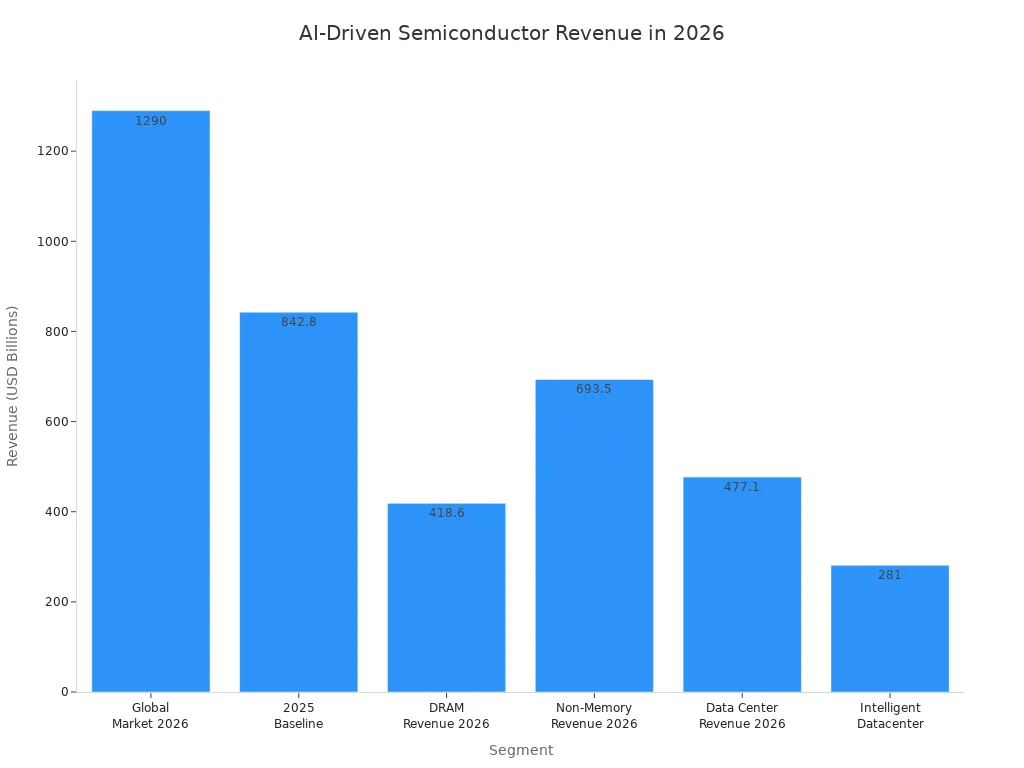
The microprocessor market is worth USD 90.4 billion in 2026. Demand for AI-optimized processors and high-performance chips drives semiconductor growth this year. Global semiconductor revenue reaches $1.29 trillion in 2026, up 52.8% from $842.8 billion in 2025. Data center chips alone make up $477.1 billion of that total.
| Metric | Value |
|---|---|
| Global semiconductor revenue (2026) | $1.29 trillion |
| Year-over-year growth | 52.8% |
| Data center semiconductor revenue (2026) | $477.1 billion |
| Data center semiconductor revenue (2030) | $843.2 billion |
On-Chip Accelerators and NPUs
Neural processing units now sit at the heart of mainstream microprocessors. A dedicated NPU needs at least 40 TOPS to count as an AI-native PC. These units copy how neural networks work by using a special parallel design. They give top-tier parallel processing while using only a modest amount of energy. NPUs take inference tasks off CPU and GPU cores, which frees those cores for other work. The result: faster large language model inference, quicker speech recognition, and lower power draw without thermal throttling. NPUs also match or beat GPUs on short, repetitive matrix multiplications while using far less power. This efficiency supports ultra-low power consumption targets in battery-limited designs.
AI-native PCs show the payoff. One platform pairs a superchip rated at 1 Petaflop with up to 128GB of unified memory and runs local models up to 120B parameters. Entry pricing starts near $1,799. These machines handle on-device agents, large-scale video processing, and creative workflows without cloud APIs. Multi-core architectures blend CPU, GPU, and NPU blocks so each engine handles its best-fit workload.
Integration of AI and Machine Learning
The integration of AI and machine learning changes how chips process data at the edge. Edge AI keeps inference local, which cuts latency for voice assistants and AR overlays. Local processing lowers bandwidth use, strengthens privacy, and supports offline operation in remote areas. Devices from wearables to iot sensors benefit. A microcontroller with a small NPU can run keyword spotting or anomaly detection without a cloud round trip.
Agentic AI pushes design further. The industry moves from L2 (AI Copilot) toward L3 and L4 task and flow autonomy. By 2026, hierarchical multi-agent systems should execute end-to-end design flows, with engineers supervising intent. Explainability matters here. Structured execution traces address the black box problem and improve accountability. AI governance and regulation now rank as emerging priorities for chip teams.
RISC-V cores power many of these designs. This open instruction set gives designers freedom to tune machine learning acceleration. Security features built into silicon guard against vulnerabilities as intelligence moves closer to the user.
Chiplets Reshape the Die
Chiplet designs break a big processor into smaller, special dies. This modular method boosts performance and how well chips are made. A regular CPU core can be replaced by a chiplet built for AI tasks. Heterogeneous integration lets designers mix CPUs, GPUs, and accelerators on one package. Modularity supports custom solutions for data centers, edge computing, and iot devices. Smaller dies lower the chance of defects, which raises yield, cuts cost, and boosts reliability. Testing each chiplet as Known Good Die before final assembly further improves yield and reliability. The semiconductor industry now treats packaging as a first-class design concern.
Modularity and UCIe Interconnects
UCIe is an open industry standard for die-to-die connections. It defines physical, protocol, and software layers. This lets chiplets from different vendors work together. UCIe provides high bandwidth, low latency, and power-efficient on-package connectivity. Teams can assemble systems like building blocks. The standard removes the need for custom interconnects and supports organic, 2.5D, and 3D packaging. UCIe 3.0 raised the supported data rate to 64 GT/s. That bandwidth supports demanding AI and HPC workloads. UCIe 2.0 added 3D packaging support. UCIe also enables optical extension over long distances. This supports memory disaggregation and AI scale-up across GPU clusters. The technology roadmap makes UCIe IP reusable across many multi-die programs.
Yield, Cost, and Security
Chiplet designs beat monolithic chips on yield. A chiplet-based approach with smaller dies and known-good die assembly exceeds 50% yield. A large monolithic chip of similar total area can fall below 30%. Smaller dies have a statistically higher chance of being defect-free. Only known-good dies go into the final package. This avoids the monolithic problem where one fault ruins an entire large chip.
Costs shift in complex ways. Advanced packaging capacity remains limited. Only a few foundries and OSATs produce 2.5D and 3D packages at scale. This creates bottlenecks, longer lead times, and higher packaging costs. Pricing depends on chip combination, packaging complexity, and application needs. Advanced CPUs may contain 10 to 20 or more dies. Chiplet architecture still promises higher return on investment through manufacturing efficiency.
Security and trustworthiness now rank as critical design trends. Multi-vendor supply chains create a fragmented trust model. Attackers can snoop shared bus traffic to steal sensitive information. They can spoof a chiplet to gain unauthorized memory access. Cache coherence exploits force cache misses or bypass protections. Side-channel attacks infer data from power consumption or electromagnetic emissions. Fault-injection attacks induce logic errors to bypass checks. Hardware trojans and IP theft remain real risks.
Built-in protections counter these threats. An active interposer acts as a physically isolated root of trust. Transaction monitors enforce memory-access permissions. Coherence message checkers police cache traffic in real time. PUF-based authentication gives each chiplet a unique identity. A chiplet hardware secure module monitors other chiplets and supports secure boot. 2.5D split manufacturing hides global interconnect logic from untrusted foundries.
At runtime, an active interposer serving as a physically isolated root of trust can embed transaction monitors to enforce memory-access permissions and coherence message checkers to police cache coherence, thwarting the full spectrum of identified threats without modifying the commodity chiplets.
These protections matter for microcontroller designs in iot and automotive markets. Miniaturization pushes more functions into smaller packages. Multi-core architectures and chiplet reuse let teams customize systems for specific workloads. Security must scale with that flexibility.
Beyond: The Next Frontiers
Photonics, 3D V-Cache, and RISC-V
Photonic computing sends data using light rather than electrons. This method lowers delay and power use for links between chips. Second-generation 3D V-Cache puts extra memory under the processor cores so cooling can reach it directly. It stacks more L3 cache on the CPU die, tripling cache space without making the die bigger. All cache layers sit the same distance from the processor, which cuts the time to reach data. These cutting-edge technological developments promise breakthrough per-core performance and lower total cost of ownership.
RISC-V adoption is expected to near 2.5 billion cores shipped each year by 2026, based on RISC-V International's Embedded World 2026 update. This number shows RISC-V moving past research into large-scale production deployment. Ecosystem themes include production readiness, automotive-grade adoption, AI-native designs, validated tooling, safety qualification, and long lifecycle support. This open instruction set lets designers freely tune machine learning acceleration across microprocessors.
Edge Computing Capabilities and Sustainability
Edge AI is a top 2026 trend. It brings AI processing to the edge across devices. AI-native PCs and edge computing boost corporate efficiency. Edge AI processors meet iot needs by doing low-latency, energy-efficient computation right at the data source. Semiconductor process nodes shrinking below 5nm and NPUs built into SoC architectures make AI possible in power-limited edge deployments. This greatly grows the market for specialized edge chips and accelerators. Microprocessor units lift edge computing to a higher level. They run full operating systems like Linux and handle computer vision and natural language processing right on the device. A microcontroller with a small NPU can run keyword spotting or anomaly detection without a cloud round trip. Edge AI depends on three critical components: edge computing hardware, optimized AI models using quantization and pruning, and edge AI software infrastructure.
Sustainable IT and hybrid tech rank as key hardware trends. Sustainability in microprocessor manufacturing and design is a growing priority. Power efficiency is a major focus that addresses energy consumption concerns. AMD states a 4x estimated increase in rack-level energy efficiency for AI training and inference in 2026 within the 2024–2030 period, alongside a longer-term 20x target by 2030.
AMD states a 4x estimated increase in rack-level energy efficiency for AI training and inference in 2026 within the 2024–2030 period, alongside a longer-term 20x target by 2030.
Ultra-low power consumption targets support battery-limited designs. Ultra-low power consumption also allows always-on sensing in remote iot deployments. Miniaturization pushes more functions into smaller packages. Multi-core architectures and chiplet reuse let teams customize systems for specific workloads. Autonomous vehicles and autonomous systems need real-time decision-making at the edge. Autonomy at level 4 and level 5 requires huge on-device intelligence. Autonomous vehicles need low-latency inference for safety-critical tasks. Vehicles also gain from enhanced connectivity options for over-the-air updates. The industry moves toward deeper photonic integration, standardized chiplet marketplaces, and broader RISC-V adoption in AI accelerators by 2027.
AI-native design, chiplet architectures, and advanced interconnect now set how microprocessors perform, use power, and cost. Raw clock speed is no longer what moves progress forward. System-level co-design and packaging innovation are. By 2027, photonic integration will go even further.
Standardized chiplet marketplaces will also grow up. This technology aims at smaller companies and low-volume markets. RISC-V adoption in AI accelerators will widen. Engineers and buyers should keep a close eye on optical I/O chiplets and chiplet marketplaces.

Written by Jack Elliott from AIChipLink.
AIChipLink, one of the fastest-growing global independent electronic components distributors in the world, offers millions of products from thousands of manufacturers, and many of our in-stock parts is available to ship same day.
We mainly source and distribute integrated circuit (IC) products of brands such as Broadcom, Microchip, Texas Instruments, Infineon, NXP, Analog Devices, Qualcomm, Intel, etc., which are widely used in communication & network, telecom, industrial control, new energy and automotive electronics.
Empowered by AI, Linked to the Future. Get started on AIChipLink and submit your RFQ online today!
Frequently Asked Questions
What minimum NPU performance does an AI-native PC require in 2026?
The bar is set at 40 TOPS. A neural processing unit has to reach this level to be called AI-native. This lets it run local guessing without needing the cloud.
How do chiplet architectures improve manufacturing yield versus monolithic designs?
Smaller dies have a better statistical chance of having no flaws. Chiplet-based assembly with known-good dies goes past 50% yield. Monolithic chips of similar total area drop below 30%.
What security threats do multi-vendor chiplet designs introduce?
Attackers can snoop shared bus traffic or fake a chiplet to get unauthorized memory access. Side-channel and fault-injection attacks are still real risks. Active interposers and PUF authentication fight back against these threats.
How fast is RISC-V adoption growing in 2026?
RISC-V International expects close to 2.5 billion cores to ship each year by 2026. The open instruction set moves from research into large-scale automotive and AI production.