What is a Varistor: Definition, Working Principle, and Types
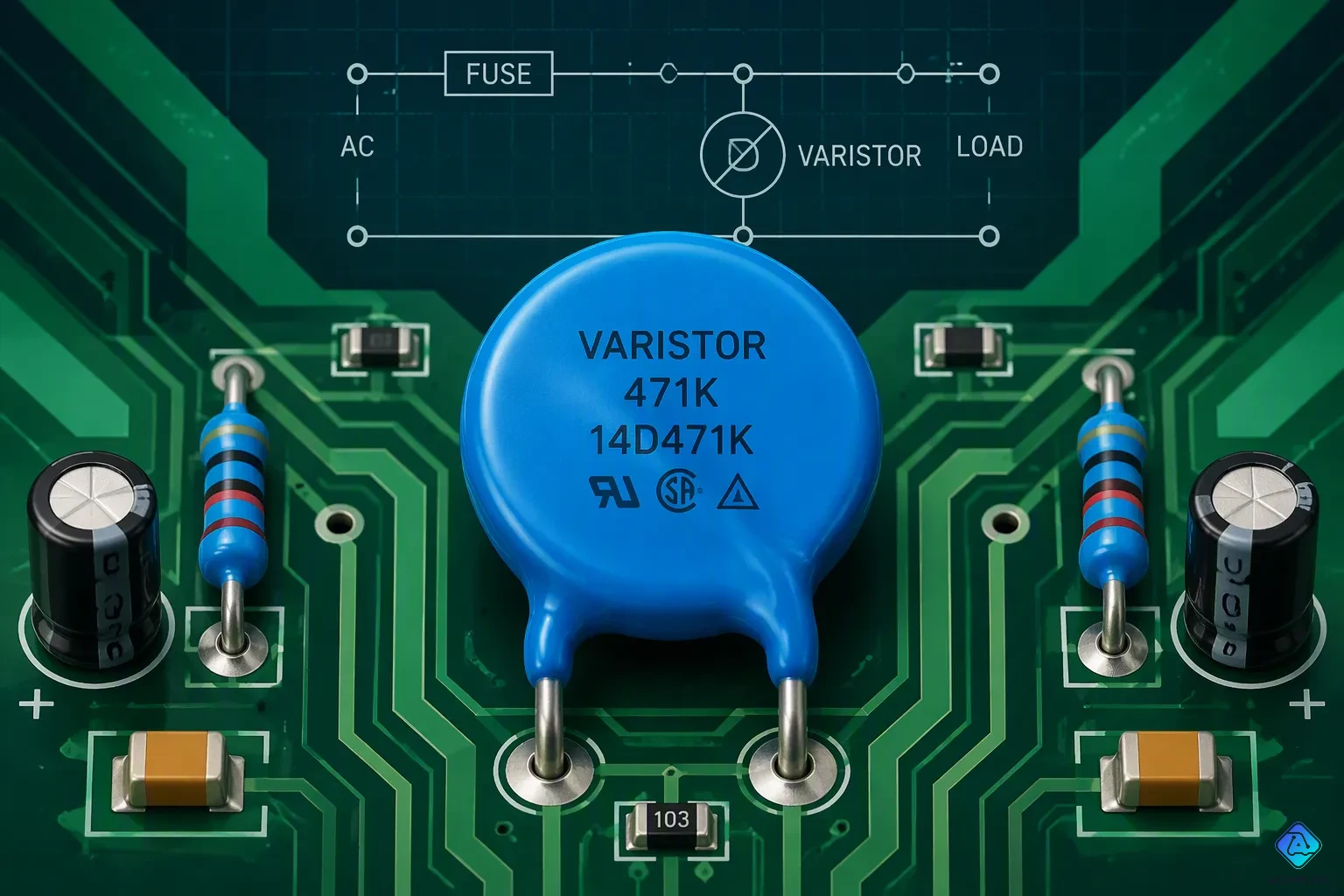
Think of a pressure relief valve on a boiler. When pressure builds up dangerously, the valve opens to release it. A varistor works the same way for your electronics. It is a resistor that changes based on voltage. Under normal voltage, it blocks current. During a surge, its resistance drops a lot, sending excess energy away from sensitive parts.
This short-term protection matters because surge damage is costly. A typical building has many power surges each day, with downtime costing about $130,000 per event. Equipment repairs also add up:
| Equipment | Typical Repair Cost |
|---|---|
| PLCs/Controllers | $5,000-15,000 |
| Motors | $10,000-50,000+ |
The global varistor market shows this importance, expected to reach US$23.9 billion by 2033. This article explains how varistors work and their common types, especially the metal oxide varistor (MOV), for circuit protection against high voltage spikes.
Key Takeaways
-
A varistor changes its resistance based on voltage. It stops current normally and lets surges pass to guard electronics.
-
Metal oxide varistors have zinc oxide grains inside. They soak up surge energy fast and react in nanoseconds.
-
Pick a varistor whose MCOV is 10-15% higher than the line voltage. Make sure its energy rating fits the surge conditions you expect.
-
Varistors reset after each surge. Repeated surges slowly damage them. Look for cracks or low resistance.
-
Metal oxide varistors are good for most jobs. Silicon carbide varistors work better in hot industrial places.
Varistor Definition and Symbol
Varistor Definition
A varistor is a semiconductor part that protects circuits. Its current and voltage are not linear. This means its resistance changes based on the voltage you apply. Under normal conditions, it acts like an insulator with very high resistance, so almost no current flows. But when voltage goes above a certain level, the resistance drops a lot. Then it lets a huge amount of current flow.
Varistors are nonlinear electronic parts that protect circuits from too much voltage or sudden spikes (transients). They are resistors whose resistance changes a lot with voltage.
The name "varistor" comes from "variable" and "resistor," and it describes what it does. Engineers also call it a voltage-dependent resistor (VDR) because its resistance changes with the voltage you apply. You can think of it as a smart switch. It stays off during normal conditions, but it turns on right away when a dangerous voltage appears.
The non-linear volt-ampere characteristic defines how it works. Engineers use piecewise equations to model this. Below the clamping voltage, the part has high resistance (R_off). Above the clamping voltage, it switches to low resistance (R_on). A power-law model adds an exponent alpha that shows how fast the current rises. The higher the alpha value, the sharper the transition from off to on. This sharp transition makes it good for circuit protection.
Varistor Symbol and Ratings
When you look at a schematic, the symbol depends on the standard in your region. The IEC 60617 symbol shows a rectangle with a diagonal line and a small U curve below it. The ANSI/IEEE 315 symbol uses a zigzag line with a diagonal arrow on top. The IEC symbol works both ways, while the ANSI arrow shows voltage direction. Europe, Asia, and global OEMs mostly use the IEC symbol. The United States and Canada use the ANSI symbol.
| Feature | IEC 60617 Symbol | ANSI/IEEE 315 Symbol |
|---|---|---|
| Resistor body style | Rectangle box | Zigzag line |
| Voltage dependency indicator | Diagonal line through box + "U" curve | Diagonal arrow overlaid on zigzag |
| Directionality shown | Bidirectional (standard MOV) | Arrow implies voltage sense direction |
| Primary usage region | Europe, Asia, global OEM | United States, Canada |
| Standard document | IEC 60617 database | IEEE/ANSI 315-1975 (revised) |
| EDA default library | KiCad, Altium IEC mode | Eagle, LTspice, Altium ANSI mode |
Engineers working on projects in many countries must clearly state which symbol standard they use — IEC or ANSI — in the title block. If the symbol is not clear, it can cause assembly errors later.
The key ratings you need to know when choosing a varistor are the maximum continuous operating voltage (MCOV), energy absorption, and response time. For 110V systems, MCOV is usually 170V to 275V. For 230V systems, it is 350V to 470V. A good rule is to pick an MCOV at least 1.2 times the normal line voltage.
The physical size and package type decide the energy rating. Radial disc varistors from 7 to 20 mm have operating ranges from 18V to 1000V and energy ratings from 0.1 to 100 J. Surface-mount (SMD) varistors in sizes 0402 to 1812 cover 5V to 150V with 0.05 to 2 J. Block or bulk MOVs handle 100V to 1200V with 100 to 10,000 J. High-voltage MOVs go from 1kV to over 10kV with energy ratings from 500 to 50,000 J.
Peak current ratings go from 20 to 70,000 A. Peak energy ratings go from 0.01 to 10,000 J. These numbers show there are many varistors for different protection needs. A small SMD varistor protects a single chip on a circuit board. A large block MOV protects a whole building's electrical system.
How Do Varistors Work
Voltage-Dependent Resistance
The secret behind a varistor is in its ceramic microstructure. Inside a metal oxide varistor, there are millions of zinc oxide granules packed together. These granules sit inside a matrix of other metal oxides. The edges between these granules form tiny junctions that act like back-to-back diodes.
At normal voltages, these junctions create a barrier with high resistance. This barrier stops current flow, so the varistor works like an insulator. Only a very small leakage current passes through. You can measure this leakage in microamperes, which is tiny for most circuits.
The non-linear volt-ampere characteristic defines this behavior. When you apply a low voltage, the resistance stays very high. But something big happens when the voltage goes past a critical point. The electric field across the grain boundaries gets strong enough to break down the junctions. Millions of grain boundaries conduct at the same time. The resistance drops by several orders of magnitude in nanoseconds.
This change is not gradual. It happens sharply and fast. The varistor switches from an insulator to a conductor almost instantly. This fast change is what makes the device so useful for protection. The voltage-dependent nature of the resistance means the varistor only conducts when you need it to conduct.
Surge Protection Mechanism
When a sudden overvoltage hits your circuit, the varistor responds right away. The internal depletion layers that stopped carrier flow now break down. The varistor becomes a low-resistance path for the surge current. This action clamps the extra voltage to a safe level.
The clamping voltage is defined at 1mA leakage current. It is usually 1.5 to 2 times the nominal rating. This means a varistor rated for 275V will clamp around 410V to 550V. That range protects your sensitive parts from seeing dangerous voltage levels.
The response time matters here. A varistor responds in tens to hundreds of nanoseconds. Compare that to a gas discharge tube, which takes 25 to 100 nanoseconds or more. While a TVS diode responds in under 1 nanosecond, the varistor's speed is still enough for real-world surges. Most surge events last microseconds, so the varistor reacts well before damage happens.
During the surge, the varistor absorbs energy across its whole volume. This volumetric absorption is unique to zinc oxide devices. A TVS diode can only absorb energy in its small PN junction area. The varistor spreads that energy through its ceramic body. This is why varistors get better energy density performance during surge events.
The varistor starts conducting at a specific voltage level. It stops conducting once the voltage goes below that level. This automatic reset means the varistor goes back to its high-resistance state after the surge passes. The device can handle maximum energy absorption up to 3500A on 2ms impulses. It also recovers thermally after surges, ready for the next one.
This whole process happens without any outside control. The varistor triggers itself based on the voltage it sees. That self-contained operation makes it a reliable first line of defense for your circuit.
Types of Varistors
Metal Oxide Varistor (MOV)
The metal oxide varistor leads the market today. You will see it in power strips, surge protectors, and many electronic devices. Its build starts with zinc oxide powder, which forms about 90% of the total weight. The other 10% uses oxide additives like cobalt, manganese, and bismuth. These additives adjust the non-linear voltage-current behavior and manage grain growth during production.
The making process follows several exact steps:
-
Weighing & Mixing: Zinc oxide blends with additives and organic solvents to create a slurry.
-
Spray Drying: The slurry goes into spray dryers to remove liquid, making oxidized granulation powder.
-
Pressing: The powder presses into a starting block shape using dry pressing.
-
Pyrolyzing & Sintering: Blocks heat to 1050°C to remove binders and form grains, causing about 17% volume loss.
-
Passivation: A glass coating covers the lateral surface for environmental protection.
-
Electrode Application: Aluminum electrodes about 0.1 mm thick attach to ground surfaces.
-
Testing: Electrical tests check reference voltage, residual voltage, and impulse performance.
The MOV's inner structure explains how it works. Grain boundaries act as tiny PN junctions, forming many series and parallel diodes. This structure gives the MOV high surge-handling capacity, absorbing large energy amounts in short bursts. It also offers a fairly low clamping voltage, which protects sensitive parts well. Response time reaches the nanosecond range, vital for fast-rising overvoltage events. The MOV has a positive temperature coefficient, so resistance rises slightly with heat, helping limit current flow when hot.
| Feature | Metal Oxide Varistor (MOV) | Silicon Carbide Varistor (SiC) |
|---|---|---|
| Construction Material | Zinc oxide ceramic powders with metal oxide additives | Silicon carbide grains |
| Surge Handling | High energy absorption for short bursts | More limited surge capability |
| Response Time | Nanosecond range | Slightly slower |
| Temperature | Positive coefficient | Better high-temperature performance |
| Capacitance | 100-1000 pF, affects high-frequency signals | Not specified |
Silicon Carbide Varistor (SOV)
The silicon carbide varistor stands for older technology. You will rarely see it in modern consumer electronics. Yet it still works in high-power uses where its traits prove valuable.
SiC varistors shine in specific industrial settings. You will find them in generator protection, absorbing high energy in field windings during shutdown. Large electromagnetic lifting magnets use them for safe energy release. Synchronous motor de-excitation relies on them to cut field current quickly. They also guard switch contacts with inductive loads and handle high switch-off voltages in transformers. For mains overvoltage protection, they shield against lightning and coupling surges.
The SiC varistor handles high voltages well but offers more limited surge-handling ability than the MOV. Its response time is a bit slower, though still enough for many industrial cases. High-temperature performance stands as its main advantage. The material resists heat better than zinc oxide, making it fit for harsh environments.
When you pick between these two types, think about your application's needs. The metal oxide varistor fits most modern circuit protection needs with its fast response and high energy absorption. The silicon carbide varistor stays useful only for specialized high-power, high-temperature industrial use.
Varistor Applications and Selection
Typical Circuit Protection Uses
You can find varistors in power strips, surge protectors, and many electronic devices. These parts protect both AC and DC circuits. When AC line voltage stays normal, the varistor has very high resistance and lets current pass without issues. The moment a voltage spike goes past the clamping limit, resistance drops fast. The varistor sends the surge energy to ground before it can harm other parts.
The setup follows a clear order. First, the varistor sits in the power supply circuit to watch for voltage surges or spikes. When a spike happens, the varistor takes in the extra voltage instead of letting it reach sensitive parts. This action makes sure downstream circuits get only the steady voltage they need. By holding the voltage to a safe level, the varistor stops damage that could cause data loss or breakdowns.
A metal-oxide varistor (MOV) uses a bulk semiconductor material that can carry large currents when voltage goes above its rated level. MOVs usually limit voltages to about 3 to 4 times the normal circuit voltage by redirecting surge current. Modern surge strips and house protectors include circuit breakers and temperature fuses to avoid serious issues, with a thermal fuse disconnecting the MOV when it gets too hot, leaving the rest of the circuit working but without surge protection.
Key Selection Criteria
Picking the right varistor means looking at several factors. Start with the Maximum Continuous Operating Voltage (MCOV). Choose a varistor whose top rated voltage is 10–15% higher than the actual line voltage. This gap keeps the varistor from conducting during normal use. Next, figure out the energy absorption need. Calculate the surge energy the circuit will face based on the highest load during an environmental surge. Pick a varistor with an energy rating equal to or a bit higher than this calculated surge energy.
| Parameter | Definition | Selection Criterion |
|---|---|---|
| MCOV | The highest voltage the varistor can handle continuously | Must be above the highest voltage the varistor will see in use to stop early failure |
| Energy Absorption Capability | The energy (in Joules) the varistor can take before it stops working | Must be enough to handle expected surge conditions; too low a rating can cause total circuit failure |
Leakage current also matters because it affects how fast the varistor ages. By putting a gas discharge tube in series to almost remove leakage current, the varistor's reference voltage can be set lower without adding leakage worries. This directly improves the clamping voltage: during a surge, the series branch gives a lower clamping voltage than a single MOV, offering better safety. The varistor voltage choice follows the formula VmA = av/bc, keeping the nominal voltage about 1.5 times the DC working voltage. This balance keeps leakage small in normal conditions yet clamps overvoltages well.
Environmental factors change performance too. Stay away from high heat, high moisture, direct sun, wind, rain, water vapor, sand dust, salt dew, and harmful gases. Use a protective box if needed. Keep a gap over 3mm from heating or flammable parts. Store below 40°C and at relative humidity under 75% RH. When surge current happens again and again, the peak surge current and surge energy must not go past the pulse duration limits set for the varistor. These steps ensure strong overvoltage protection and steady transient voltage suppression for lightning protection and everyday circuit safety needs.
A varistor protects your electronics by clamping dangerous transient voltages. Its non-linear resistance keeps it inactive during normal operation, then switches to a low-resistance path during surges. The metal oxide varistor (MOV) remains the most common type for both AC and DC circuits.
When selecting one, match the maximum continuous voltage and energy rating to your circuit's needs. Choose an MCOV at least 10-15% above your line voltage. Check the energy absorption capability against expected surge conditions.
Always consult the manufacturer's datasheet before finalizing your choice. Consider trade-offs like leakage current and response time. You might also explore TVS diodes for faster protection in sensitive applications.

Written by Jack Elliott from AIChipLink.
AIChipLink, one of the fastest-growing global independent electronic components distributors in the world, offers millions of products from thousands of manufacturers, and many of our in-stock parts is available to ship same day.
We mainly source and distribute integrated circuit (IC) products of brands such as Broadcom, Microchip, Texas Instruments, Infineon, NXP, Analog Devices, Qualcomm, Intel, etc., which are widely used in communication & network, telecom, industrial control, new energy and automotive electronics.
Empowered by AI, Linked to the Future. Get started on AIChipLink and submit your RFQ online today!
Frequently Asked Questions
How can you tell if a varistor has failed?
Check for physical damage first. A broken varistor may show cracks, burn marks, or color changes. You can also use a multimeter set to high resistance mode. If the reading is low, the varistor has likely failed.
How do you test a varistor properly?
Turn your multimeter to high resistance mode. Put the probes on the varistor terminals. In normal conditions, you should see very high resistance. This test helps you confirm the part works correctly.
Why do varistors fail over time?
Every surge damages the internal grain boundaries a little. After many small surges, the signs of a damaged varistor show up. At some point, the varistor cannot clamp voltage properly anymore. It fails short circuit to protect your equipment.
Can a varistor handle a lightning strike?
A varistor can handle many small surges. But large lightning strikes may go beyond its energy rating. Pick a varistor rated for the surge levels you expect. Testing it properly during installation ensures correct surge protection.