Understanding the TDA2050 32W Hi-Fi Audio Power Amplifier
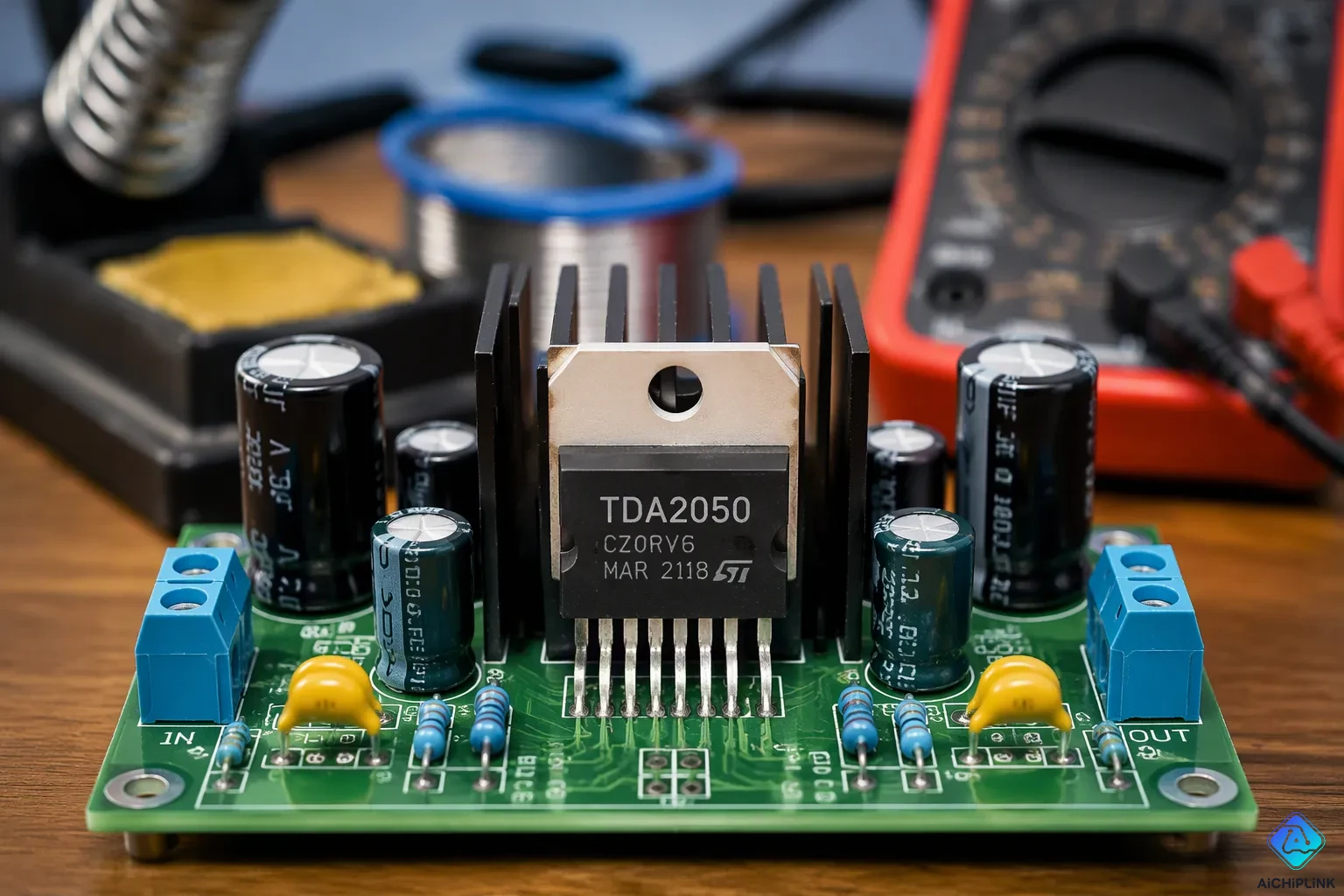
The TDA2050 is a single-chip Class AB audio power amplifier IC in a Pentawatt package. It gives a rated 32W output, and some sources list up to 50W. This chip provides high-fidelity sound with enough power for Hi-Fi audio applications. It can drive speakers with up to 5A of current.
The TDA2050 32W device works well for many audio amplification tasks. Its simple circuit makes it a popular choice for DIY and commercial projects. Builders like the flexible supply voltage range and the steady performance of this hi-fi audio amplifier IC. A 4 Ω speaker draws 28W at 10% harmonic distortion. The amplifier handles real audio loads with ease.
Key Takeaways
-
The TDA2050 delivers 32W of clean RMS power and handles up to 50W for short music peaks.
-
Always add a heatsink to the TDA2050 to prevent overheating and thermal shutdown.
-
The simple circuit design includes a Zobel network to keep the amplifier stable with real speakers.
-
Built-in protections guard against short circuits and overheating, making the chip reliable.
-
The TDA2050 offers more power and lower distortion than the TDA2030, and you can swap them on the same board.
TDA2050 32W Amplifier Specifications
Power, Voltage, and Current Ratings
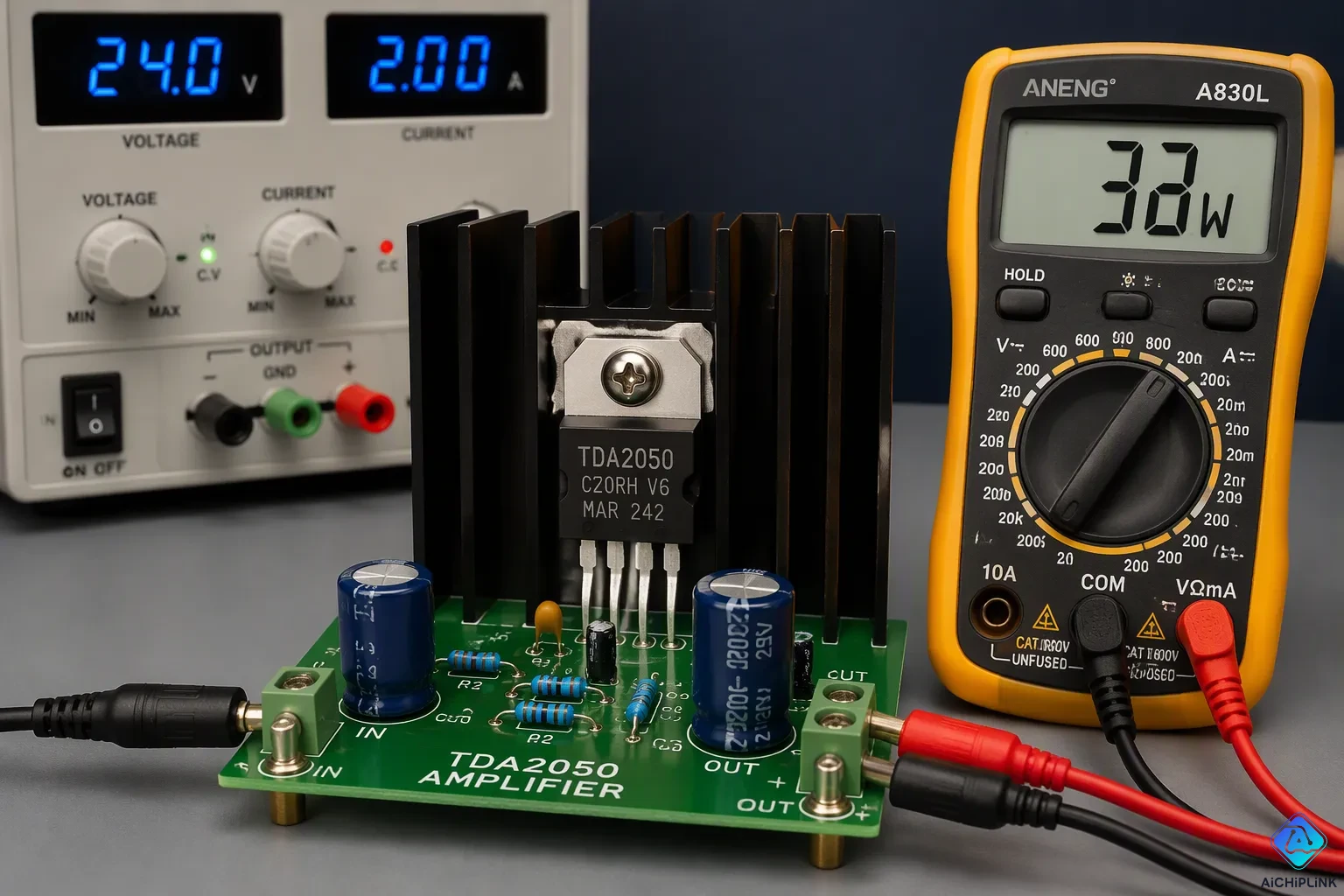
The TDA2050 32W amplifier specs focus on a few key numbers. These numbers show what the chip can do. The table below puts the main ratings in one place.
| Parameter | Value | Condition |
|---|---|---|
| Rated output power | 32W (true RMS) | 8 ohm load, ±22V supply, 1 kHz, THD = 10%, continuous |
| Typical music power | 50W | 4 ohm load, 22.5V supply, 1 kHz, over 1 second, IEC 268.3 rules |
| Peak output current | 5A | Speaker drive capability |
| Package | Pentawatt (5-pin TO220 package) | Vertical mounting with heatsink tab |
| Supply voltage range | Up to 50V total | Split or single supply designs |
People often see two different power numbers and ask which one is right. The 32W number is the true RMS rating. It shows steady output into an 8 ohm load with a 10% distortion limit. The 50W number is music power, measured for about one second into a 4 ohm load under IEC 268.3 rules. Both numbers are correct. They just come from different test setups. If you plan to listen for a long time, pick your supply and heatsink based on the RMS rating. If you want short loud peaks, you can trust the higher music power number.
The 5A current ability matters for real speakers. Speaker impedance changes with frequency, and a 4 ohm speaker can drop well below its stated value. The chip's extra current keeps the sound clean during those drops. This is one reason the device stays low in distortion even at high volume.
Package and Thermal Characteristics
The Pentawatt case is a 5-pin TO220 package with a metal tab you can see. The pins for input, supply, and output are in a set order, so you can follow the datasheet drawing directly for layout. The tab makes heatsink mounting easy. One screw or a compression clip is enough to attach an outside heatsink.
The maximum allowable power dissipation depends upon the thermal resistance junction-ambient. ... The power dissipated in the circuit must be removed by adding an external heatsink. Thanks to the PENTAWATT package, the heatsink mounting operation is very simple, a screw or a compression spring (clip) being sufficient.
The datasheet lists a top thermal resistance from junction to case and a total power dissipation rating at a case temperature of 75 °C. The source text for these detailed specs is partly unreadable, so this article does not give exact numbers. The practical advice is still clear. The package by itself cannot get rid of the heat from a 32W amplifier. Builders must add a heatsink sized for the expected steady power. A large heatsink keeps the junction cool and stops the internal thermal shutdown from turning on during normal play.
Together, these ratings show a chip with real power to offer and a thermal path that pays off with careful mechanical design.
Amplifier Features and Protections
High Output Power and Voltage Range
The TDA2050 gives its rated output power over a wide range of operating voltages. Designers can power the chip with a total supply of up to 50V. This can be split into positive and negative rails, or fed from a single rail. This flexibility works for both single and dual power supplies. So a builder can match the chip to a transformer they already have instead of buying a new one. A higher supply voltage raises the power available before clipping. A lower voltage keeps heat down in small enclosures.
The wide operating voltage range also helps during repair work. A technician can put the chip into a chassis that already gives a suitable rail. The amplifier then works without redesigning the power section. This range covers most home Hi-Fi and car audio needs. It also leaves headroom for builders who want extra margin.
Built-in Protection Circuits
The chip has short-circuit and thermal protection built onto the die. If the output terminals short during a wiring mistake, the internal limiter holds the current in check. This protects the output stage. If the junction temperature climbs too high, thermal shutdown cuts the drive until the die cools. These safeguards make the amplifier strong in real audio use, where speakers, cables, and ventilation vary from one build to the next.
The protection blocks work together with the external heatsink. A well-sized heatsink keeps the die cool during normal play, so thermal shutdown rarely triggers. Builders still get a safety net for loud passages, blocked vents, or a fan failure. This mix of internal guards and simple external cooling supports reliable audio amplification in both hobby and commercial designs. The circuit stays simple, and the chip protects itself when conditions turn harsh.
TDA2050 Circuit Design and Operation
Class AB Operation and Internal Blocks
The chip has two amplifier stages inside one Pentawatt case. A differential input stage takes the signal from the input pins. Then a drive stage feeds a push-pull output pair. This pair runs in Class AB mode. Each transistor conducts for more than half of the signal cycle, and the two share the load near the zero crossing. This setup removes the crossover distortion that troubles simple Class B designs. It also wastes much less power than a pure Class A stage. The result is clean audio with reasonable heat loss.
The internal blocks also include a bias network and the protection circuits described earlier. The bias network sets the idle current through the output pair. A steady bias keeps distortion low across the whole supply voltage range. Builders do not adjust this bias from outside. The chip sets it internally, and that saves time during assembly.
Zobel Network and Circuit Simplicity
A typical tda2050 circuit design adds a small resistor and capacitor in series from the output to ground. Designers call this pair R6C6, and it forms the Zobel network. The network gives the amplifier a stable load at high frequencies. Real speakers act like inductors at some frequencies, and their impedance rises with frequency. The Zobel network offsets that rise and holds the impedance at the output terminals near a steady value. This stops the amplifier from oscillating and keeps the sound clean.
The rest of the circuit is surprisingly short. A few resistors set the gain and the feedback path. Two capacitors handle input coupling and supply decoupling. The pin setup follows the datasheet drawing, so a builder can copy the layout with little study. A beginner can put the whole board together on a breadboard in an evening. An experienced builder can lay out a compact PCB with the same few parts. This simplicity explains why the tda2050 circuit design shows up in so many hobby projects. The circuit design rewards careful grounding and short output traces, and it asks for nothing exotic.
The supply needs only a transformer, a bridge rectifier, and filter capacitors. A split supply gives the cleanest result, and a single supply works with a coupling capacitor at the output. Either way, the circuit design stays within reach of anyone who can read a schematic. The low parts count also keeps cost down and makes repairs easy. A failed part is simple to find and simple to replace.
Audio Applications and Use Cases
Mono and Stereo Amplifier Setups
People use the TDA2050 in both mono and stereo hi-fi setups. A single-channel build gives 35W from a 22V dual power supply. A stereo build uses two chips for 35W plus 35W, and the design can raise this to 50W plus 50W for a maximum of 75W. The stereo version runs from a 25V center-tapped supply with a high-current transformer and an RFI filter. Four 2,200µF 50V capacitors sit in parallel on that rail. The stereo board adds volume, tone, and balance controls. Builders can raise the output more with 2N3055 and MJ2955 transistors.
| Configuration | Power Output | Supply | Notes |
|---|---|---|---|
| Mono amplifier | 35W | 22V dual power supply | Single-channel TDA2050 circuit |
| Stereo power amplifier | 50W–75W (35W + 35W, boostable to 50W + 50W / max 75W) | 25V CT–25V high-current supply with RFI filter (4 × 2,200µF 50V in parallel) | Stereo build with volume, tone, and balance adjustment; boostable with 2N3055 and MJ2955 transistors |
Car Audio and Breadboard Prototyping
Car audio is another common place for this chip. The 32W amplifier works with voltages up to 25V, and it takes both single and dual power supplies. That range fits the electrical setting of a vehicle. The chip sends up to 5A to the speakers, so 4-ohm speakers stay well driven. The datasheet has practical circuit designs, and builders can change them for a specific install.
Breadboard work completes the list. The chip fits a breadboard, so a beginner can test a full audio amplification stage before soldering anything. An experienced builder can use the same setup to try a new tone network or a different supply. This versatility makes the TDA2050 a strong pick for learners and veterans alike. The tda2050 circuit design supports high-quality audio amplification in the home, the car, and on the bench.
TDA2050 vs. TDA2030 Comparison
Technical Performance and Power Output
The two chips come from the same family, but their ratings differ in ways that matter. The table below puts the main numbers side by side.
| Specification | TDA2030 | TDA2050 |
|---|---|---|
| Output Power | 14W (dual supply) | 25W (dual supply) |
| Supply Voltage | ±9V to ±18V | ±4.5V to ±25V |
| THD | <0.1% | <0.05% |
The TDA2030 handles peak output currents up to 3.5A. That current drives low-impedance and tough speaker loads with steady short-term response. The TDA2050 does better on every line of the table.
The TDA2050 can take a higher supply voltage (max 2x25VDC, recommended 2x18-22VDC) and gives more watt power output (more current out) with less distortion than the TDA2030.
A builder who needs more output power from a given rail should check the TDA2050 first. A builder with modest needs can stay with the TDA2030 and save on heat sinking.
Application Fit and Design Considerations
Each chip fits a different job. The TDA2050 suits higher-power audio needs, and the TDA2030 fits lower-power designs. Both are still solid choices for an audio amplifier project.
-
The TDA2030, TDA2050, and TDA2040 form a pin-compatible family. A designer can swap between them as an easy upgrade path without redesigning the board layout.
-
For bridge-tied-load mono operation, the TDA2030 is not a safe choice. It lacks internal half-bridge drivers and phase-splitting circuitry. Bridging it needs external op-amps and exact matching, which causes instability. The TDA2050 is recommended instead for BTL mode.
Check the detailed specs before choosing a supply setup. A single-supply circuit needs an output DC decoupling capacitor in series with the speaker. Dual-rail designs skip that part. The TDA2050 also uses a larger 1000µF decoupling capacitor, so higher-power designs need bigger decoupling values. Builders driving 4-ohm speakers should size the heatsink for steady output, since thermal margin matters more as power rises. Read the voltage rating on every capacitor and leave headroom above the rail.
The TDA2050 32W chip is a strong Class AB hi-fi audio amplifier IC in a Pentawatt case. Its 5-pin TO220 package mounts easily on a heatsink. The device gives 32W rated output power, with 50W typical for music peaks, and it drives 5A into real speakers.
Key strengths make this amplifier stand out. Built-in protections, including thermal shutdown, guard the die during harsh use. A simple circuit design with a Zobel network keeps the load stable. The wide supply voltage range gives builders flexible power options.
Beginners and experienced hobbyists both benefit from this part. This small circuit serves audio amplification projects and repairs with reliable, clean sound.

Written by Jack Elliott from AIChipLink.
AIChipLink, one of the fastest-growing global independent electronic components distributors in the world, offers millions of products from thousands of manufacturers, and many of our in-stock parts is available to ship same day.
We mainly source and distribute integrated circuit (IC) products of brands such as Broadcom, Microchip, Texas Instruments, Infineon, NXP, Analog Devices, Qualcomm, Intel, etc., which are widely used in communication & network, telecom, industrial control, new energy and automotive electronics.
Empowered by AI, Linked to the Future. Get started on AIChipLink and submit your RFQ online today!
Frequently Asked Questions
What does the 32W rating on the TDA2050 mean?
The tda2050 32w figure is a true RMS rating. It shows steady output into an 8 ohm load at a 10% distortion limit. The 50W number is music power, measured briefly into a 4 ohm load. Both figures are correct, and each comes from a different test setup.
Does the chip need an external heatsink?
Yes. The Pentawatt package cannot remove the heat from a 32W amplifier on its own. Builders must add a heatsink sized for the expected steady power. A large heatsink keeps the junction cool and prevents thermal shutdown during normal play.
Why does the circuit include a Zobel network?
The Zobel network, made of R6C6, holds the impedance at the output terminals near a steady value. Real speakers act like inductors at some frequencies. The network offsets that rise, stops oscillation, and keeps the audio clean.
Can a builder use a single supply voltage?
Yes. The chip accepts a total supply of up to 50V, split into positive and negative rails or fed from a single rail. A single-rail design needs an output coupling capacitor in series with the speaker. A dual-rail design skips that part.
Can a TDA2030 drop into the same board?
The TDA2030, TDA2040, and TDA2050 share a pin-compatible family, so a designer can swap between them without redesigning the layout. The TDA2050 handles more power and current. The TDA2030 fits lower-power designs with modest heat sinking.