Snapdragon 888 Explained A Comprehensive Overview
The Snapdragon 888 is Qualcomm's top mobile processor, launched in late 2020. It brings big upgrades: a Samsung 5nm process, an X60 5G modem built in, Kryo 680 CPU, Adreno 660 GPU, triple ISP, and Hexagon 780 AI engine. These features give you amazing 5G, camera, AI, and gaming experiences. Benchmark results show huge gains over the Snapdragon 865. AnTuTu scores jump from 576,146 to 735,439, and Geekbench single-core hits 1,135. You will get a full breakdown of each part and a direct comparison with the Snapdragon 870. This chip still powers many high-end phones today, so it is important for you to understand.
Key Takeaways
-
The Snapdragon 888 uses a 5nm process to provide faster speeds and longer battery life.
-
The built-in X60 5G modem gives you fast 5G speeds worldwide and uses less power.
-
The Kryo 680 CPU and Adreno 660 GPU make games run smoothly and apps open quickly.
-
The triple ISP and Hexagon 780 AI engine make photos better and improve AI tasks on the device.
-
The Snapdragon 888 beats the Snapdragon 870. It uses a smaller process and has a built-in modem.
Snapdragon 888 5nm Foundation
The Snapdragon 888 is built on a 5nm manufacturing process. This process gives a 35% performance boost over the last generation. You also get better power efficiency. Your phone can do more work without draining the battery fast.
5nm Manufacturing Advantage
The 5nm node packs billions of transistors into a tiny space. Transistors are switches that process instructions. More transistors mean the chip can handle complex tasks at the same time. The smaller size also lowers electrical resistance. This cuts down heat and power waste. You get cooler operation and longer battery life. The 35% speed improvement comes straight from this advanced process. Apps open faster, games run smoother, and multitasking feels instant. The 5nm process also lets Qualcomm put more parts on one die. You get a smaller chip that fits into slimmer phone designs. The result is a platform that feels responsive for years.
Integrated Snapdragon X60 Modem
The Snapdragon 888 puts the X60 5G Modem-RF System right on the chip. An integrated modem saves space and power. Your phone does not need a separate 5G chip. This cuts latency and improves battery life. The X60 supports a wide range of 5G features. The table below shows its key capabilities:
| Feature | Support |
|---|---|
| 5G sub-6 carrier aggregation | Yes |
| mmWave | Yes |
| Peak download speed | 7.5 Gbps |
| Dynamic Spectrum Sharing | Yes |
| Global 5G multi-SIM | Yes |
This table gives you a clear picture of what the X60 offers. With mmWave and sub-6 carrier aggregation, you get fast speeds on different network types. Carrier aggregation combines multiple 5G channels for higher throughput. Dynamic Spectrum Sharing lets carriers run 4G and 5G on the same frequencies. This spreads coverage into more areas. Global 5G multi-SIM makes it simple to manage multiple numbers. You can have a personal line and a work line on one device. You can also put in a local SIM when traveling abroad. This makes international roaming easy. The X60 also supports networks worldwide. You connect reliably across different countries and carriers. The peak speed of 7.5 Gbps means you can stream 8K video, download large files, and play cloud games without stutter. The integrated design keeps power use low even during heavy 5G use. Overall, the X60 modem turns the Snapdragon 888 into a true global 5G powerhouse.
CPU and GPU Architecture
Qualcomm builds the Snapdragon 888 around a three-cluster CPU design. This setup balances raw speed with power savings. You get fast performance for heavy tasks and low power draw for simple ones.
Kryo 680 CPU Configuration
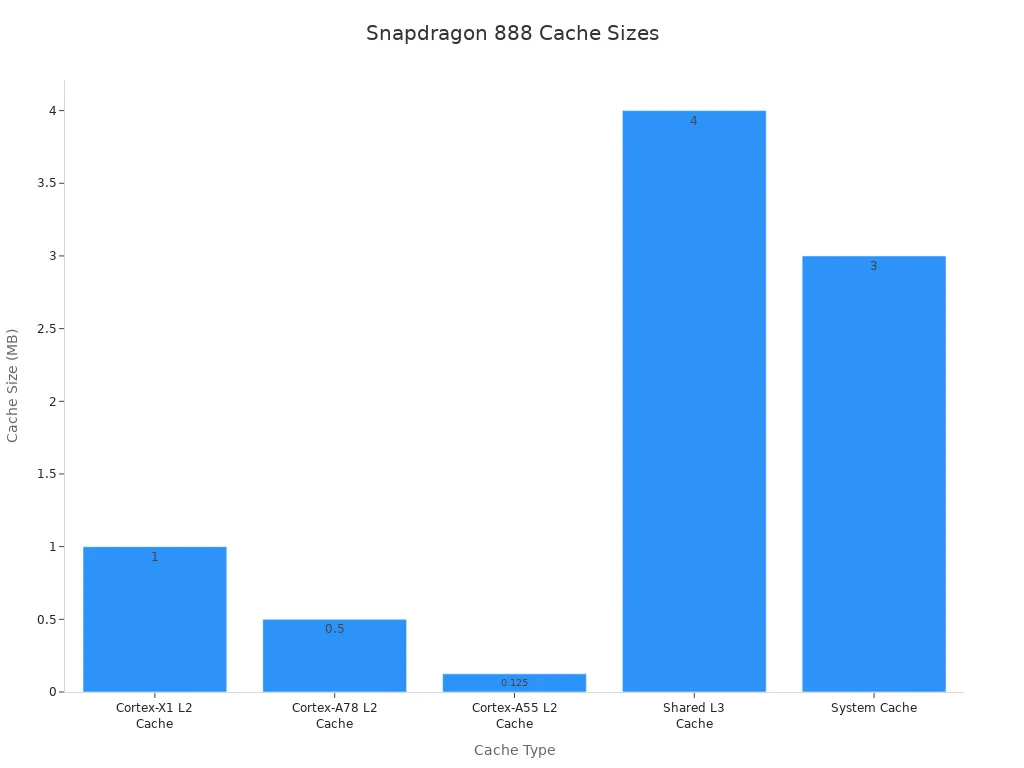
The Kryo 680 uses a prime core, three performance cores, and four efficiency cores. The table below shows the details:
| Core Type | Count | Clock Speed | L2 Cache |
|---|---|---|---|
| Cortex-X1 Prime | 1 | 2.84 GHz | 1 MB |
| Cortex-A78 Performance | 3 | 2.4 GHz | 512 KB each |
| Cortex-A55 Efficiency | 4 | 1.8 GHz | 128 KB each |
| Shared L3 Cache | — | — | 4 MB |
| System Cache | — | — | 3 MB |
The prime core handles the heaviest single-threaded work. It runs at 2.84 GHz. The three performance cores run at 2.4 GHz and manage multi-threaded tasks. The four efficiency cores run at 1.8 GHz and handle background jobs. This design gives you a 25% overall performance lift over the previous generation. The large caches keep data close to the cores. Your apps launch faster and run smoother.
Adreno 660 Graphics
The Adreno 660 GPU delivers a 35% faster graphics rendering than the Adreno 650. You get smoother gameplay and higher frame rates. The GPU supports variable rate shading. This feature focuses rendering power on the parts of the screen you actually look at. It saves power and boosts performance. The Adreno 660 also drives high refresh rate displays. You enjoy fluid scrolling and responsive touch input. Qualcomm calls this their fastest Adreno GPU yet. For gamers, the upgrade means console-quality graphics on your phone.
Imaging and AI Capabilities
Triple ISP and Computational Photography
This chip comes with the Spectra 580 triple image signal processor. This ISP handles three camera feeds at the same time. You can record 4K HDR video from all three rear cameras together. You can also take 28MP still photos from each sensor at once. The ISP processes 2.7 gigapixels every second. This huge speed handles complex multi-frame math. You can shoot bursts of 120 12MP images each second. This speed catches fast action without blur. You can switch between wide, ultra-wide, and telephoto lenses right away. The change feels smooth with smooth zoom technology. Each camera gets its own dedicated ISP pipeline. Images stay sharp at every zoom level.
The triple ISP supports computational HDR for photos and video. It takes three different exposures per frame. It blends them in real time for higher dynamic range. Low-light performance goes down to 0.1 lux. You get brighter, clearer images in near darkness. The 10th generation 3A algorithms use AI for autofocus, auto-exposure, and auto white balance. Eye-tracking data from XR headsets trains these algorithms. They keep subjects in focus and properly exposed. You can capture 10-bit HDR HEIF photos with over a billion colors. This ISP gives you professional-grade imaging capabilities in your pocket. Your photos match those from dedicated cameras.
Hexagon 780 AI Engine
The Hexagon 780 AI engine delivers 26 trillion operations per second. This is a jump of 11 TOPS over the last generation. The table below shows the improvement:
| DSP | Snapdragon SoC | AI Performance (TOPS) |
|---|---|---|
| Hexagon 698 | Snapdragon 865 | 15 |
| Hexagon 780 | Snapdragon 888 | 26 |
This performance jump changes on-device AI. You get faster voice recognition and real-time language translation. The AI engine powers smart camera features. It allows subject tracking, scene detection, and smart exposure. It makes noise reduction and HDR rendering better for photos. It supports smart assistants that understand natural language commands. The AI engine also handles multiple AI tasks at once. Your phone can run voice, camera, and gaming AI at the same time. All processing happens on your device. Your data stays private and secure. The Hexagon 780 makes this chip a true AI powerhouse.
Connectivity and Wireless Standards
The Snapdragon 888 links you to the world using modern wireless tech. Qualcomm puts several standards into one platform. You get quick speeds, low delay, and steady connections wherever you are.
Wi-Fi 6E, Bluetooth 5.2, and Location
The FastConnect 6900 system takes care of Wi-Fi and Bluetooth on this chip. Wi-Fi 6E opens the 6 GHz band for more room. You deal with less interference from other devices. Speeds go up to 3.6 Gbps. That speed handles 4K streaming, cloud gaming, and big file transfers with no lag.
Bluetooth 5.2 brings two Bluetooth antennas to your phone. These antennas make the signal steadier and extend its range. The Qualcomm aptX suite gives you high-quality wireless audio. Broadcast audio lets you share sound with devices nearby. Better modulation and coding keep your connection strong.
| Wireless Standard | Details |
|---|---|
| Wi-Fi 6 | Up to 3.6 Gbps via FastConnect 6900 |
| Wi-Fi 6E | 6 GHz capacity via FastConnect 6900 |
| Bluetooth 5.2 | Dual antennas via FastConnect 6900 |
| Bluetooth audio | aptX suite, broadcast audio |
Location tracking also gets better with these standards. You get exact positioning for maps and navigation.
mmWave and Sub-6 5G Speeds
The built-in X60 modem works with both mmWave and sub-6 5G. mmWave gives very fast speeds in crowded places like stadiums and airports. Sub-6 reaches farther and goes through buildings better. You stay connected on either kind of network.
Peak download speeds hit 7.5 Gbps. You can grab a whole movie in seconds. Cloud gaming feels quick with low delay. Video calls stay clear and smooth. The modem also works with 5G sub-6 carrier aggregation. This feature joins multiple channels for higher throughput. You get the best speed possible from the spectrum you have.
Security and Power Efficiency
Qualcomm Secure Processing Unit
The Snapdragon 888 has a special security layer called the Qualcomm Secure Processing Unit. This unit works like a safe inside your phone. It keeps your passwords, banking details, and biometric data in a locked space. Other parts of the chip cannot reach this safe directly. You get strong protection from malware and physical attacks.
The SPU does encryption and decryption jobs by itself. It also handles secure payments and stores digital keys. When you unlock your phone with your fingerprint or face, the SPU checks who you are. It does this without sending your raw biometric data to the main processor. This setup keeps your private information safe even if another app gets hacked. You can trust your phone with money transactions and private messages.
Power Management and Thermal
Qualcomm puts several power-saving features into this platform. The 5nm process plays a big part here. Smaller transistors need less voltage to turn on and off. This lowers the total power used across the chip. You get more screen-on time and less heat during heavy use.
The built-in X60 modem also helps control power. A separate 5G chip would use extra energy and make more heat. With the modem built into the main die, your phone avoids that problem. The Kryo 680 CPU adds another layer of control. Its four efficiency cores handle background tasks at low clock speeds. Your phone stays cool when you check messages or listen to music. During gaming, the Adreno 660 GPU and the thermal management system work together. They balance speed against temperature. You get steady frame rates without the phone getting too hot to hold.
Snapdragon 888 vs Snapdragon 870
You may wonder how the Snapdragon 888 stacks up against the Snapdragon 870. Both chips target premium phones. They share some features. They also differ in important ways. This section breaks down the key gaps for you.
Process Node and CPU Differences
The manufacturing process marks the first big difference. The Snapdragon 888 uses a 5nm node. The Snapdragon 870 uses a 7nm node. This gap changes everything about performance and power.
A smaller node packs more transistors into the same space. The 5nm process lets the 888 run at higher speeds. It also uses less power for the same work. You get a 35% faster overall performance with the 888. That speed shows up in games, apps, and multitasking.
The CPU cores also differ. The 888 has a Cortex-X1 prime core. This core runs at 2.84 GHz. The 870 uses a Cortex-A77 prime core. The X1 design handles heavy tasks better. It processes instructions faster. You feel the difference when you open big apps or play intense games.
The 888 also has larger caches. More cache means the CPU finds data faster. Your phone responds quicker. The 870 still performs well for daily tasks. The 888 pulls ahead for demanding work.
Baseband and Feature Differences
The modem setup creates another major gap. The Snapdragon 888 has the X60 modem built into the chip. The Snapdragon 870 uses the X55 modem as a separate part. This table shows the difference:
| Processor | Baseband | Integration |
|---|---|---|
| Snapdragon 870 | X55 | External |
| Snapdragon 888 | X60 | Built-in |
An integrated modem saves space inside your phone. It also uses less power. You get better battery life during 5G use. The X60 supports mmWave and sub-6 5G. It handles global multi-SIM. You can manage work and personal lines on one device.
The external X55 modem in the 870 works well. It still delivers 5G speeds. It just needs more space and power. The separate chip also adds a bit of latency. The built-in design in the 888 cuts that delay.
Other features separate these two chips. The 888 has the Adreno 660 GPU. The 870 uses the Adreno 650. The 888 renders graphics faster. You get smoother gameplay and higher frame rates. The 888 also has the Hexagon 780 AI engine. It delivers 26 TOPS. The 870 has a less powerful AI unit. You get faster voice recognition and camera AI with the 888.
The Spectra 580 ISP in the 888 handles three cameras at once. The 870 has the Spectra 480. It processes fewer feeds. You get more creative options with the 888.
Both chips support Wi-Fi 6 and Bluetooth 5.2. The 888 adds Wi-Fi 6E for the 6 GHz band. You face less interference in crowded areas.
The Snapdragon 888 costs more. It targets true flagship phones. The 870 offers great value for slightly older designs. Your choice depends on your budget and your need for top speed.
The Snapdragon 888 changed what you can expect from a premium phone. It set new standards for 5G speed, AI power, camera quality, and gaming performance. The 5nm process and the built-in X60 modem gave you faster speeds with less battery drain. Newer chips have arrived since then. The 888 still handles demanding tasks with ease. You get smooth gaming, sharp photos, and reliable 5G connections every day. Which Snapdragon 888 device impressed you the most? Share your pick in the comments below.

Written by Jack Elliott from AIChipLink.
AIChipLink, one of the fastest-growing global independent electronic components distributors in the world, offers millions of products from thousands of manufacturers, and many of our in-stock parts is available to ship same day.
We mainly source and distribute integrated circuit (IC) products of brands such as Broadcom, Microchip, Texas Instruments, Infineon, NXP, Analog Devices, Qualcomm, Intel, etc., which are widely used in communication & network, telecom, industrial control, new energy and automotive electronics.
Empowered by AI, Linked to the Future. Get started on AIChipLink and submit your RFQ online today!
Frequently Asked Questions
Does the Snapdragon 888 support Wi-Fi 6E?
Yes. The FastConnect 6900 system gives you Wi-Fi 6E support. It opens the 6 GHz band for faster connections with less crowding. You get top speeds up to 3.6 Gbps.
How does the Snapdragon 888 handle multi-camera recording?
The Spectra 580 triple ISP handles three separate camera feeds at the same time. You can record 4K HDR video from all rear cameras at once. This gives you smooth zoom changes and professional-quality footage.
What advantage does the X60 modem give you over older Snapdragon chips?
The X60 modem is built right into the Snapdragon 888 chip. It saves space and power. You also get global 5G multi-SIM support. This lets you manage personal and work lines easily on one device.
Is the Snapdragon 888 still good for gaming today?
Yes. The Adreno 660 GPU delivers 35% faster graphics than the last generation. It supports variable rate shading to save power. You get smooth frame rates at high refresh rates.
Can you use the Snapdragon 888 for professional photography?
Yes. The triple ISP handles 28MP photos from each sensor at once. Low-light performance reaches 0.1 lux. The AI engine tracks subjects and adjusts exposure on its own for sharp, vivid images.