AichipLink September 2026 Semiconductor Market Analysis: AI, Memory, MCU & Power Chip Trends
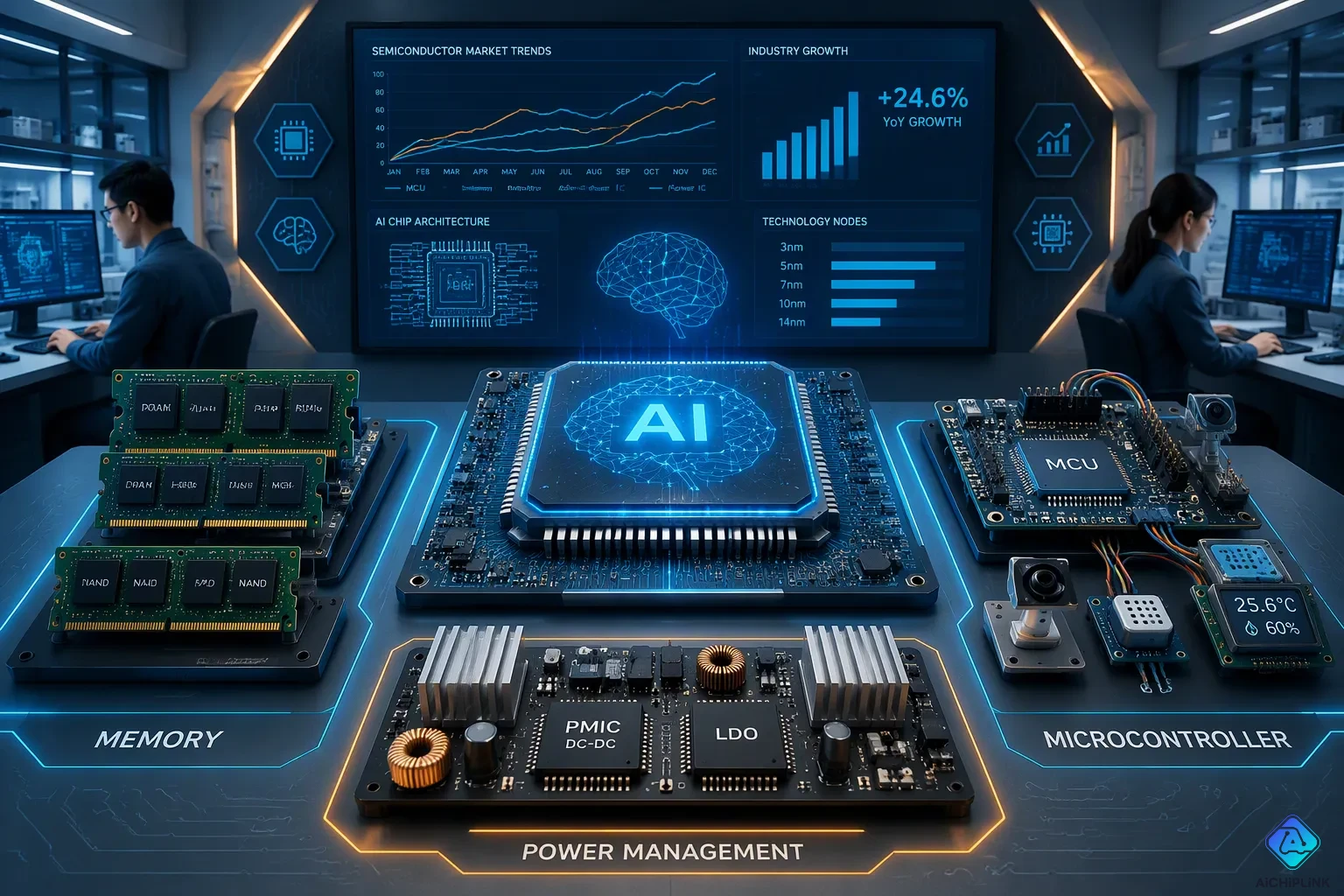
September 2026 marks a turning point for the global chip industry. AI is steadily siphoning mature-process capacity away from traditional applications. This creates severe memory shortages, MCU lead times exceeding 54 weeks, and power chip price hikes across the industry. This semiconductor market analysis makes the risk clear: power IC, memory, and MCU lead times now depend on each other because they share fab capacity. Eight-inch mature-node utilization is near 90%, and auto-grade MCU prices rose 15-20%. ST raised prices three times in five months; TI five times in twelve months. TrendForce predicts regular DRAM contract prices could jump 90-95% quarter over quarter. How did the market reach this structural repricing, and what should industry players do now?
Key Takeaways
-
AI chips use most of the factory space. This makes other chips like memory and MCUs harder to find.
-
Memory prices are rising fast. DDR5 and NOR Flash are in short supply. Buyers should plan ahead.
-
MCU and power chip lead times are very long. Some wait times are over 50 weeks. Buyers should secure supply early.
-
Smart buying means checking each part number. Qualify multiple suppliers and lock in prices early.
-
Watch lead times and prices closely. The market may stay tight through 2027. Act now to avoid problems.
2026 Global Semiconductor Industry Outlook: Market Overview
Revenue, Growth, and AI's Revenue Share
Global semiconductor revenue is expected to hit $975 billion in 2026. That is a 26% increase from the year before. This number is the base of the 2026 global semiconductor industry outlook. Generative AI chips by themselves will bring in almost $500 billion. That is about half of all global chip sales. These chips make up fewer than 20 million units, or about 0.2% of total chip volume. The AI chip market is expected to reach $125 billion in 2026. That is a 35% jump from the year before.
This heavy revenue coming from a tiny unit share shapes the current semiconductor market analysis. AI data centers take in most of the leading-edge output. The rest of the global semiconductor industry fights over what is left.
Segment Breakdown and Structural Divergence
The table below shows how each segment does in this semiconductor industry outlook.
| Segment | 2026 Trend | Key Driver |
|---|---|---|
| AI / data center | Strong growth | Hyperscaler capex |
| Memory | Tight supply | HBM and DDR5 demand |
| MCU | Long lead times | Mature-node capacity loss |
| Analog | Price increases | Industrial and AI power |
| Power | Price increases | 800V server architectures |
| MLCC | High-end shortage | AI server content growth |
| RF / sensors | Mixed | Drone and wearable demand |
Packaging, memory, power, and communications semiconductors all feel the same squeeze. Advanced packaging capacity is still the tightest link in the AI supply chain. Fortune Business Insights, Polaris, and Roots Analysis all project more growth through the decade. Their forecasts show the long-term path without changing the near-term picture.
AI's Siphoning Effect on the Global Semiconductor Industry
How AI Consumes Mature-Node Capacity
The global chip industry has a big, lasting problem. Top foundries now make AI chips first. This changes how they use factory space at every node. The AI chip market is causing this change. Foundries give more 8-inch and 12-inch wafer space to AI products. These products include power devices, interposers, and FPGAs. The AI data center boom makes this faster.
TSMC and Samsung made less on 8-inch older factories. This makes supply tighter and uses more of their factory space. For 12-inch older factories, TSMC plans to cut back. This gives other foundries a chance to get orders. Strong need for power chips on 55nm and bigger nodes makes high-voltage work full at Taiwanese foundries. Some orders move to Chinese suppliers.
Smaller foundries give their limited space to AI products that make more money. These products include PMICs, power parts, interposers, and optical chips. Foundries make less of low-profit items like CIS and DDICs. For 12-inch older processes, AI need raises wafer use for power devices, interposers, and FPGAs. This helps Chinese foundries get extra orders from overflow.
The AI building boom pulls capacity away. Older factories have less room for MCUs, power chips, and analog chips. AI data centers use up resources that used to go to normal markets.
Upstream Price Transmission: Wafers to Distribution
The price increase chain is now working at full speed. This chain has four steps: raw materials, chip making, chip design, and stock in distribution. Each step sends higher costs to the next.
IDMs have announced multiple price increases: STMicroelectronics raised prices three times in five months, Texas Instruments five times in twelve months, and Infineon announced increases of 10–20%. Renesas Electronics raised its stock target from 120 days to 150 days. This change handles risks in demand and making chips. The company adds extra chip stock as a safety buffer. Renesas is building stock before closing its Takasaki 6-inch factory. More stock does not mean all products are short. It shows managers see demand and supply risks clearly. This is different from the panic buying in 2021. The current stock increase is a smart move by makers to real supply problems.
AI training and inference work drives need for AI accelerator chips. These chips need special packaging. That packaging is the hardest part to get in the supply chain. AI chip need for data centers keeps rising. This market analysis shows how AI chips for data centers change the whole supply chain. AI data centers that run AI tasks use up capacity at every level. This causes the big price changes now seen across the market.
Memory Landscape: DRAM, NAND, and NOR Flash
DRAM: DDR5 Strength and DDR4 Divergence
The DRAM market is split sharply between older and newer types. DDR5 16Gb eTT prices keep going up, and DDR4 prices continue to rise. A 32GB DDR5 kit that cost about $95 to $250 in mid-2025 now sells for $550 to $650 in 2026. Cloud providers lock in a full year of supply using long-term deals.
This jump is not a normal cycle. Samsung, SK Hynix, and Micron control about 95% of all DRAM made worldwide. They send their wafer capacity toward high-bandwidth memory instead, because AI accelerator buyers pay more. One HBM wafer uses as much capacity as 3 to 4 normal DDR5 wafers. HBM's share of global DRAM wafer output grew to about 23% in 2026, up from around 8% in 2024. This leaves a 22-exabyte DDR5 shortage.
"HBM memory forecasts have increased across all three manufacturers from 34 exabytes to 40 exabytes... one wafer of HBM memory consumes between 3 and 4 normal DDR5 DRAM wafers."
— Andrew Czuczwa, Market Research Manager, Fusion Worldwide
A 32GB DDR5 kit that cost about $95 to $250 in mid-2025 now sells for $550 to $650 in 2026. Experts think prices have not peaked yet. New factory capacity will not arrive until late 2027 or 2028. The supply, demand, and pricing picture stays tight for advanced memory across ai gpus, cpus, and memory platforms.
NAND Weakness and NOR Flash Tightness
NAND flash prices have surged dramatically. NAND wafer pricing in Q1 2026 was up 246% year-over-year (Kingston). Enterprise SSD demand is the only real support. Buyers stay careful about the consumer market and wait instead of buying in large amounts.
NOR Flash is a different story. Contract prices for high-capacity NOR Flash have risen significantly in 2026 and are expected to continue increasing. AI servers use more NOR Flash than traditional servers. Each retimer needs its own NOR Flash to load firmware. This adds demand for high-capacity and Octal SPI NOR products. Procurement teams should focus on 256Mb+ products for supply planning.
| Item | Time Period | Price Change |
|---|---|---|
| NAND wafer pricing | Q1 2026 vs Q1 2025 | +246% (Kingston) |
| Samsung NAND contract prices | Q4 2025 vs Sep 2025 | +30% to +60% |
| NAND flash overall (TrendForce projection) | Q1 2026 QoQ | +33% to +38% |
| Consumer SSD 1TB | Late 2025 | ~$45 to ~$90 (doubled) |
The shift of wafer production toward hbm stacks cuts capacity for commodity dram and nand supply. New fabs will not reach real volume until late 2026 or 2027. Lead times for larger orders go past 40 weeks. This makes many setups unworkable for fiscal 2026 planning. Automotive electronics growth also drives steady demand for embedded dram / nand / emmc memory. Self-driving cars and ADAS depend on embedded memory, so this demand is less tied to cycles. Industrial IoT use supports long-term demand for rugged, high-reliability memory. Enterprise data centers and cloud service providers are high-growth segments with CAGR estimates above 15%, driven by AI workloads and data analytics. The ai data centers buildout makes scarcity worse for enterprise buyers across all memory tiers.
MCU and Power Chips: Electronic Component Lead Times 2026
The MCU and power chip markets show the deepest structural stress of the current cycle. Understanding electronic component lead times 2026 means tracking two crises happening at the same time. MCUs remain stuck in mature-node bottlenecks. Power semiconductors face disappearing 8-inch capacity.
MCU Lead Times and Order Diversification
Component lead times by category show STMicroelectronics MCUs have reached about 52 weeks. STM32 and H series parts sit at 48 to 54 weeks. ST has raised prices three times in five months. Automotive MCU spot prices have gone up 15 to 20 percent. These conditions push buyers to look for other options.
Taiwanese MCU manufacturers have also raised prices and extended lead times. Chinese MCU makers are accelerating industrial qualification and some have announced price increases. ST lead times are around 52 weeks and could extend further.
Electronic component lead times for MCUs now match the tightest categories.
Power Semiconductors and 8-Inch Capacity Decline
Power semiconductors face their own supply crisis. Infineon, TI, ST, and onsemi have all raised prices. onsemi's increase takes effect in October. High prices may last through 2027. Renesas is implementing a new pricing system. Lead times for power semiconductors have extended significantly.
The root cause is structural. Global 8-inch effective capacity is declining. TSMC phases down its 8-inch capacity with full exits planned by 2027. Samsung cuts 8-inch production the same way. Average global 8-inch fab utilization rises to 85 to 90 percent in 2026 from around 75 to 80 percent in 2025. Demand for power ICs, PMICs, analog, and automotive chips stays strong. These components increasingly connect to ai data centers, EVs, and industrial electronics.
Advanced packaging also competes for capacity. Power ics, memory and mcus now compete for the same tight resource pool. AI rack power requirements are very high, driving a move to higher-voltage architectures with strong demand visibility.
Analog Chips and MLCCs: Pricing Pressure Spreads
The ai chip market is now changing prices for analog and passive parts too. Price pressure is spreading to every kind of use. TI and ADI are leading several rounds of price hikes. High-capacitance MLCCs are very hard to find in the spot market.
TI and ADI Price Increases by Application
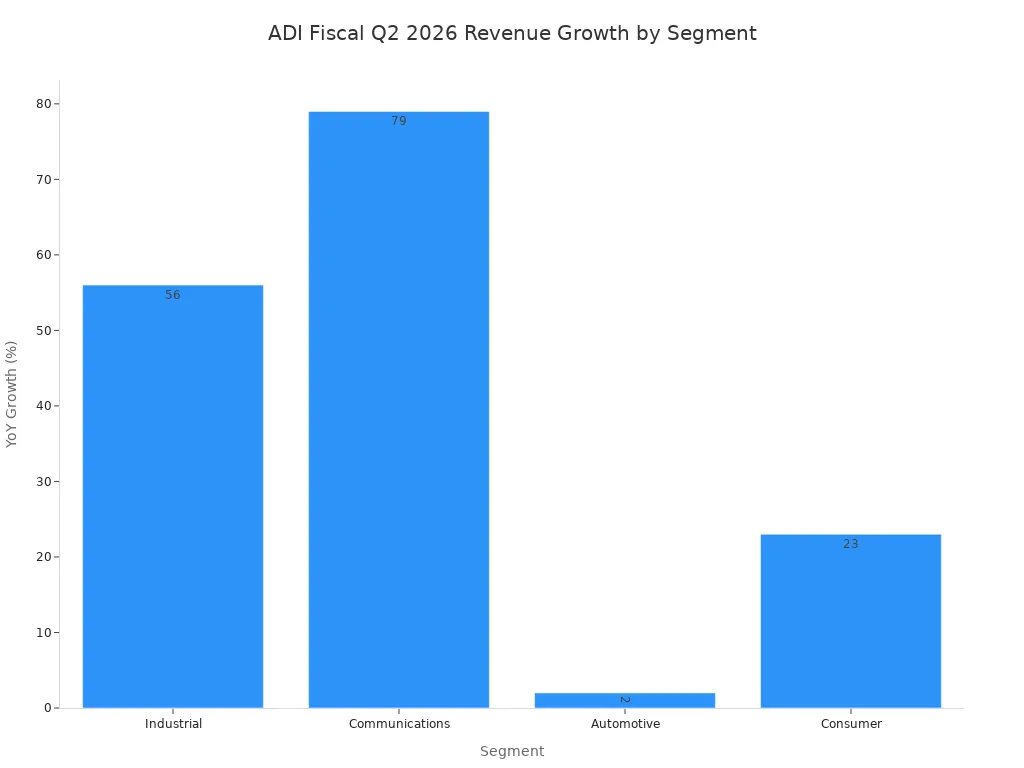
TI has implemented price increases varying by product category. ADI implemented a broad price increase and reported strong revenue growth, particularly in industrial and data-center segments. TI and ADI both say strong demand comes from ai data centers, where power management ICs sell at a premium price.
High-Capacitance MLCC Shortages and Substitution
High-capacitance MLCCs in Huaqiangbei now get a new price every hour. Prices for high-capacitance MLCCs have surged in the spot market. AI servers use significantly more MLCCs than standard servers. Both ai training and inference work drive more servers. The ai data center boom keeps supply tight through 2027. Both ai and automotive suppliers answer with price increases. Several MLCC manufacturers have raised prices on high-capacitance models. Consumer 0603-104 prices fell from RMB 30 back to RMB 10. Murata is a leading supplier in the AI server MLCC market with a significant technology lead.
RF, Sensors, and FPGA: Other Tight Categories
RF Front-End and IMU Price Changes
Some RF chip makers have raised prices on select products. Six-axis IMUs are in high demand from drone and wearable device makers, leading to tight supply. Supply stays tight through Q4 with no quick relief. AI vision SoCs are gaining from growing edge AI camera demand. ST completed an acquisition to strengthen its sensor portfolio.
FPGA Lead Times and Gray-Market Risks
FPGA lead times remain extended. AI servers, communications equipment, and industrial automation all compete for the same limited FPGA supply. Mid-range and high-end FPGAs show no improvement through Q4 2026. AMD and Intel keep allocation tightly controlled.
Gray-market risks grow alongside these shortages. Used, fixed-up, and salvaged FPGAs now move in increasing volumes. The price gap between legitimate and questionable sources widens every week. Procurement teams must check lot numbers, markings, traceability, and authenticity for every FPGA purchase. Authorized distribution channels remain the safest option. A counterfeit FPGA can cause system failures, thermal issues, or functional errors that show up only during field operation. Teams should ask for factory traceability documents, inspect package markings against known good samples, and confirm date codes match production records. Spending extra time on verification now prevents costly rework and production delays later.
Key Risks Reshaping the Semiconductor Industry Outlook
Gray-Market, Price Absorption, and Certification Risks
Fake chip risk is going up fast. Used, fixed-up, and salvaged FPGAs now show up in growing numbers. Power semiconductors and MCUs have the same issue. Buyers should check lot numbers, markings, and traceability before each purchase.
Price absorption is the second danger. Buyers further down the chain cannot always pass higher costs to their own customers. The 0603-104 MLCC shows this well. Its price climbed to about RMB 30, then dropped back to around RMB 10. Quoted prices can stay high while real sales dry up.
The certification trap is the third risk. Domestic replacement for MLCCs moves slowly. Swapping one for one is hard because part numbers and electrical specs differ a lot. Murata maintains a significant technology lead. Teams must qualify replacements part by part, not category by category.
Inventory Strategy Shifts and Supply Tightening
Renesas raised its inventory target from 120 days to 150 days. This move builds a maker-side buffer against shortages. Other IDMs may do the same. If they do, distribution supply could get even tighter.
The wider supply chain shows the same pattern. Bookings are rising, some categories are tightening, and distribution inventory is falling. STMicroelectronics reported that distribution inventory is below its normal target and industrial revenue is growing strongly. onsemi widened its pricing action into October.
| Supply Chain Stage | Upcycle (Tightening) | Downcycle (Loosening) |
|---|---|---|
| Demand | Increases | Falls |
| Bookings | Increase | Weaken |
| Distributor Inventory | Falls | Rises |
| Lead Times | Extend | Normalize |
| Pricing | Spot premiums increase | Channel discounting increases |
The semiconductor supply chain passes along not just shortages but also weak demand. When an OEM cuts its production forecast, new distributor orders drop, yet material ordered earlier keeps arriving, so distributor inventory goes up.
This delay explains why downturns often last longer than the original drop in demand. Every layer must cut its own stock and reorder level. Risk assessment belongs at the part-number level, not the brand level.
Procurement and Risk Mitigation Strategies
Part-Number-Level Sourcing and Strategic Supply Locking
The market now calls for three big changes. Buyers must stop buying by brand and start buying by part number. They must move from just-in-time purchasing to locking in supply ahead of time. They must go from using one supplier to qualifying several sources. These changes show a simple truth: two products from the same maker can have very different supply situations.
Good part-number-level sourcing takes steady, careful work. Teams should check single-source dependencies for each part number. They should qualify other manufacturers before shortages hit. They should lock in strategic pricing when they can. They should get a clearer view of tier-2 and tier-3 suppliers. They should watch BOM exposure to high-risk component types. They should build stronger ties with authorized distribution and sourcing partners.
From: Reactive Buying → Single Source → Lowest Price → Short-Term Planning To: Strategic Sourcing → Multiple-Source → Total Cost → Long-Term Planning
"In a chip-constrained world, the best procurement strategy is not buying cheaper—it is securing the right chips, from the right sources, at the right time."
The table below lists suggested actions by category.
| Category | Recommended Action |
|---|---|
| MCU | Secure capacity 3–6 months ahead; qualify domestic alternatives |
| Analog / power management | Lock prices for AI and industrial demand; buy consumer parts on actual need |
| High-capacitance MLCC | Secure capacity 3–6 months in advance; qualify domestic alternatives |
| NOR Flash | Prioritize 256Mb+ products; secure supply early |
| DRAM | Purchase in batches for critical demand; avoid aggressive consumer buying |
| Power semiconductors | Prepare inventory early; qualify second sources |
| FPGA | Verify authenticity and lot information; avoid low-priced spot inventory |
Multi-Source Qualification and Domestic Alternatives
Multi-source qualification keeps production safe when main suppliers cannot deliver. A case study from the 2018 capacitor shortage shows this clearly. One company had already set up a structured multi-sourcing framework. It worked with partners to label MLCCs as high-risk, because suppliers were few and lead times were long. It also pre-qualified several suppliers with matching specs and certifications. As a result, the company kept production running with very little disruption. Competitors either stopped production or had to redesign their boards. The company's BOMs already held approved alternates, and its PLM system tracked supplier performance and compliance. ECOs documented every substitution for full traceability and regulatory alignment.
Building a central repository of AEC-Q qualification data for all critical BOM items can significantly streamline second-source evaluation and reduce the risk of inadvertently introducing non-automotive parts into safety-related designs.
Domestic substitution follows a slow path. The process moves from qualifying one part number to customer certification to small-batch production to wider use. This path is more broken up than in memory. The huge number of part numbers and electrical spec combinations makes one-to-one replacement hard. Teams must judge domestic alternatives by each part number and use case. The semiconductor industry outlook for 2027 depends in part on how fast this qualification work moves. Buyers who start now will have more choices when ai data centers and industrial uses compete for the same tight supply.
Forward Signposts for the Semiconductor Industry Outlook
Indicators to Watch Through Q4 2026
A few clear signals will show if the market gets tighter or starts to balance out. ST MCU lead times remain around 52 weeks and could extend further. Financial results from Taiwanese MCU makers may show redirected orders. Domestic MCU qualification progress in industrial control will show how fast Chinese alternatives gain ground. ADI's price increase is moving through distribution channels. onsemi's pricing decision will test whether high power semiconductor pricing holds. High-capacitance MLCC shortages may persist. Other IDMs might copy Renesas' inventory strategy, which could make distribution supply even tighter.
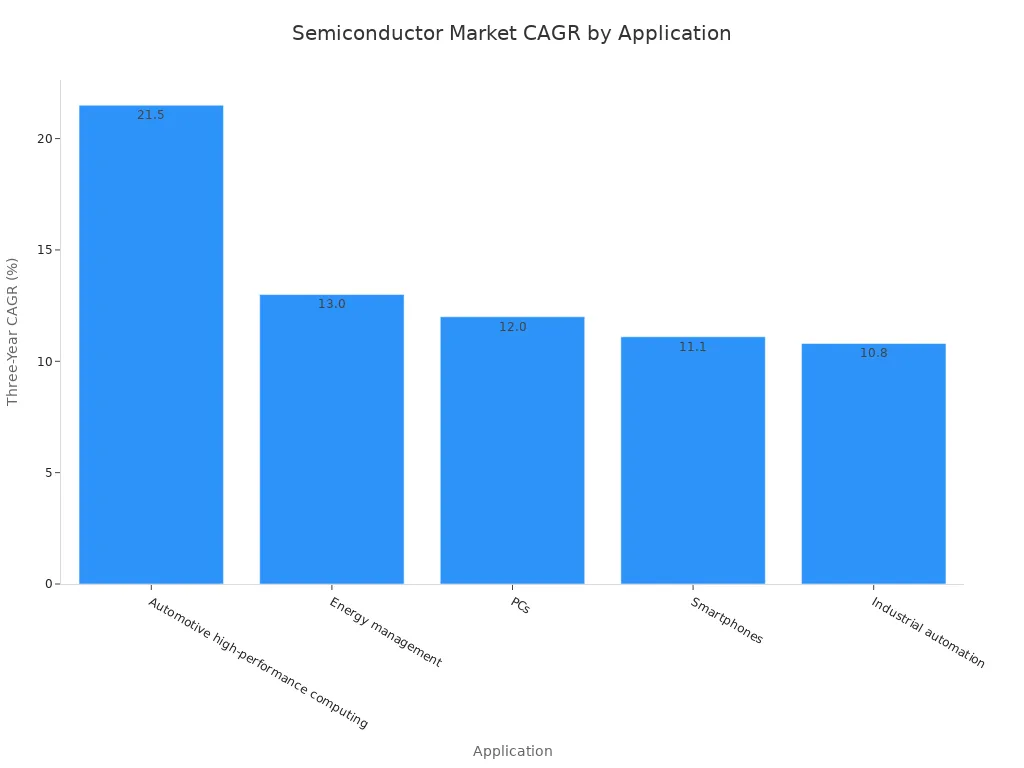
The served semiconductor market value continues to grow strongly. These numbers back the 2026 global semiconductor industry outlook.
Strategic Playbook for Buyers, Investors, and Suppliers
Buyers should lock long-lead-time supply and qualify second sources now. Electronic component lead times for MCUs, power devices, and analog chips stay long. DRAM lead times go past 26 weeks. Programmable logic lead times come close to 52 weeks. Teams that wait will face higher costs and allocation risk.
Investors should watch part-number-level pricing power instead of brand-level trends. Automotive high-performance computing and energy management segments show strong compound annual growth. These segments reward focused analysis.
Suppliers should watch mature-node capacity allocation and 8-inch capacity trends. The semiconductor industry outlook depends on how foundries balance AI demand against traditional markets. Companies serving ai data centers will see steady pressure on mature-node supply through 2027.
Three big forces shape September 2026. AI chip demand pulls mature-process capacity away from older markets. Memory and MLCC shortages continue for server-grade parts. MCU and power chip lead times stretch past 50 weeks, which changes how the global semiconductor industry buys parts. For October, industrial and automotive parts stay tight, along with server memory. Consumer electronics still feel pressure downstream. Domestic substitution speeds up, but qualification stays a long-term challenge. Buyers should watch part-number-level supply and demand through Q4 2026. Lead time trends, price flow through distribution, and IDM inventory plans will show if the market tightens more or starts to rebalance. This semiconductor market analysis shows that structural repricing driven by artificial intelligence demand will shape the market through the end of the year and into 2027.

Written by Jack Elliott from AIChipLink.
AIChipLink, one of the fastest-growing global independent electronic components distributors in the world, offers millions of products from thousands of manufacturers, and many of our in-stock parts is available to ship same day.
We mainly source and distribute integrated circuit (IC) products of brands such as Broadcom, Microchip, Texas Instruments, Infineon, NXP, Analog Devices, Qualcomm, Intel, etc., which are widely used in communication & network, telecom, industrial control, new energy and automotive electronics.
Empowered by AI, Linked to the Future. Get started on AIChipLink and submit your RFQ online today!
Frequently Asked Questions
Why do MCU lead times keep getting longer in 2026?
AI chips take priority at leading foundries. That leaves less mature-node capacity for MCUs. ST lead times now reach about 52 weeks, and they could extend further in October. Buyers should secure supply early and qualify domestic alternatives like GigaDevice and Nations Technologies.
What does Renesas' inventory change signal to the market?
Renesas raised its inventory target from 120 days to 150 days. The company is building a buffer against real supply shortages. This differs from the speculative buildup in 2021. If other IDMs follow, distribution supply could tighten further.
Should buyers chase consumer memory prices right now?
No. NAND spot prices have risen significantly, and consumer demand stays soft. Enterprise SSD demand provides the only real support. Buyers should purchase DRAM in batches for critical needs and avoid aggressive consumer memory buying. A 32GB DDR5 kit now sells for $550 to $650.
Which NOR Flash products deserve priority in supply planning?
High-capacity parts matter most. Contract prices for high-capacity NOR Flash have risen significantly. AI servers use more NOR Flash than traditional servers, and each retimer needs dedicated NOR Flash.
How should procurement teams respond to rising MLCC prices?
Teams should secure capacity three to six months ahead and qualify domestic alternatives. AI servers use significantly more MLCCs than general-purpose servers. High-capacitance parts remain tight, while consumer 0603-104 prices fell from about RMB 30 back to RMB 10.