Key Takeaways
- Function: It converts low DC voltage to higher DC voltage (Step-Up/Boost only).
- Input Range: 2V to 24V DC.
- Output Range: Adjustable up to 28V DC via an onboard potentiometer.
- Current Limit: Maximum peak current is 2A (continuous usage recommended at 1A or less without cooling).
- Crucial Tip: New modules often require turning the potentiometer counter-clockwise 10-20 times before the voltage starts changing.
- Application: Ideal for powering Arduino, LEDs, or motors from single-cell Li-Ion (3.7V) batteries.
Introduction
In the world of DIY electronics and portable power, voltage mismatch is a common headache. You might have a 3.7V Lithium-Ion battery, but your project requires 9V for a multimeter or 12V for an LED strip.
Enter the MT3608 DC-DC Step-Up Module.
Small, cheap, and surprisingly powerful, this tiny board allows you to "boost" voltage efficiently. Whether you are building a portable power bank or fixing a power supply mismatch, the MT3608 is an essential component for your toolkit.
What is the MT3608 Module?
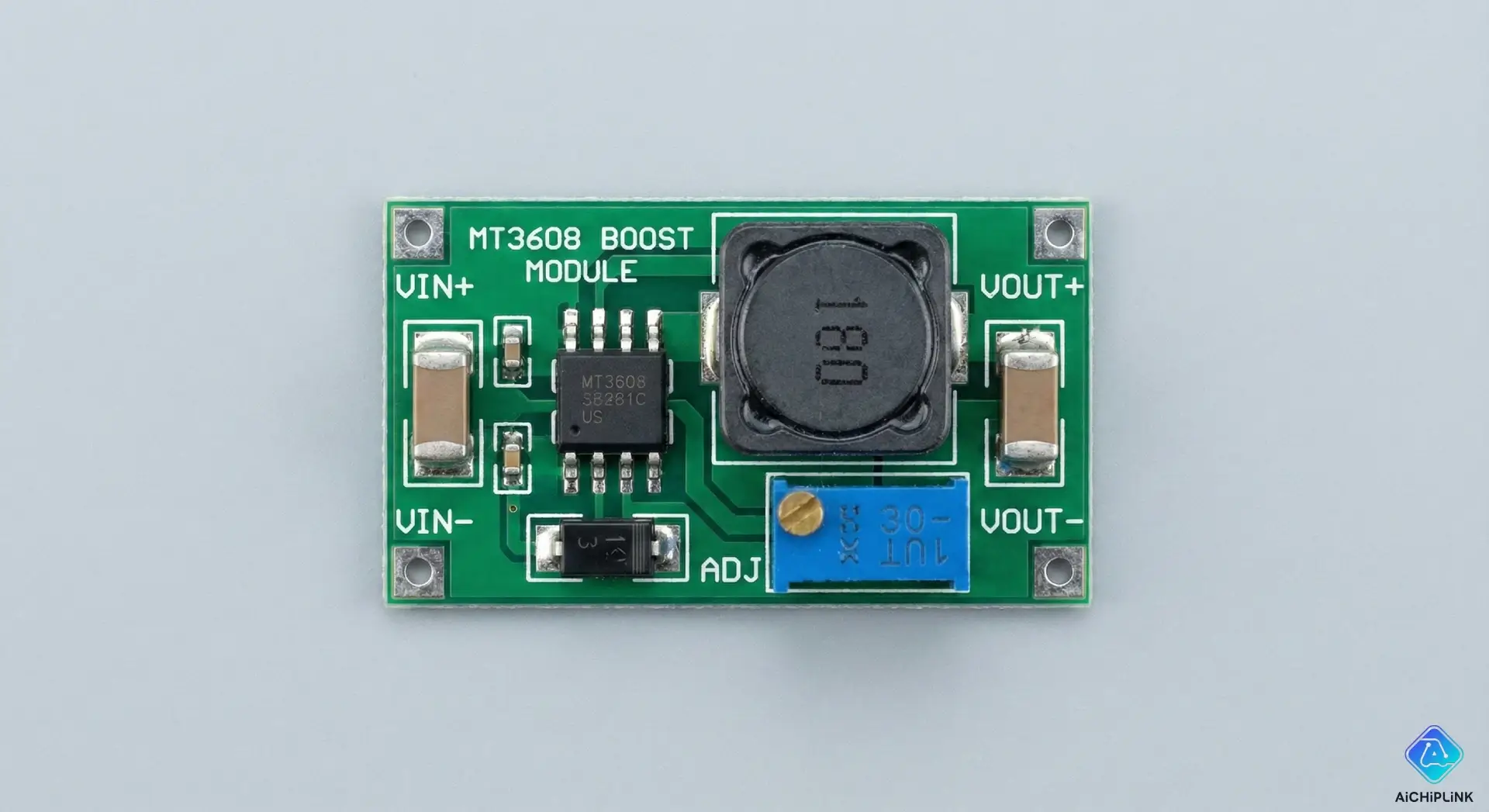
The MT3608 is a constant frequency, current mode step-up converter. The module typically sold online is a breakout board containing the MT3608 chip, an inductor, a diode, capacitors, and a multi-turn potentiometer for adjustment.
Note: This is a Boost Converter, meaning output voltage is always higher than or equal to the input voltage. It cannot step down voltage.
Technical Specifications
| Feature | Specification |
|---|---|
| Input Voltage | 2V to 24V |
| Output Voltage | Adjustable, Max 28V |
| Maximum Output Current | 2A (Peak) |
| Efficiency | Up to 93% |
| Switching Frequency | 1.2 MHz |
| Dimensions | Approx. 36mm x 17mm x 14mm |
Pinout and Connections
The module usually has four solder pads (or holes) clearly labeled on the PCB:
- VIN+: Connect to the Positive (+) terminal of your power source (Battery).
- VIN-: Connect to the Negative (-) terminal of your power source.
- VOUT+: Positive (+) output to your load/device.
- VOUT-: Negative (-) output to your load/device.
How to Use the MT3608 (And The #1 Common Problem)
Using the module is simple, but there is one specific quirk that makes users think the module is broken.
The "Endless Turn" Issue
When you first connect the module, the output voltage might match the input voltage exactly. You turn the screw on the blue potentiometer, but nothing happens.
The Solution: The potentiometers used on these boards are often set to their maximum resistance at the factory. You must turn the small brass screw Counter-Clockwise (to the left) for a long time—sometimes 10 to 20 full rotations—before the voltage begins to rise.
Step-by-Step Setup:
- Connect your input power source to VIN+ and VIN-.
- Connect a multimeter to VOUT+ and VOUT- to monitor voltage.
- Turn the potentiometer screw Counter-Clockwise until you see the voltage on the multimeter rise to your desired level.
- Once set, connect your load (device).
Practical Applications
1. Powering 12V Fans from USB
Standard USB provides 5V. By using an MT3608, you can boost that 5V up to 12V to run standard PC cooling fans for DIY ventilation projects.
2. Lithium Battery Projects
Single-cell Li-Po or 18650 batteries provide 3.7V to 4.2V. The MT3608 can step this up to 5V (for USB charging), 9V (for smoke detectors or multimeters), or 12V (for LED strips).
3. Arduino/ESP32 Power Supply
If you are running a microcontroller project from AA batteries (3V total), you can use this module to boost the voltage to a stable 5V for the logic pins.
Safety and Limitations
- Heat Dissipation: While rated for 2A, the module gets very hot above 1A. If you plan to draw more than 1A continuously, you need to add a small heatsink to the chip.
- Input Current Physics: Remember that Power (P = V × I) is conserved. If you boost voltage up, the input current goes up.
- Example: If you output 12V at 1A (12 Watts), and your input is 4V, your input current will be 3A (plus efficiency loss). This might overload your battery.
- No Reverse Protection: If you connect VIN+ and VIN- backwards, you will likely fry the chip instantly. Double-check polarity!

Written by Jack Elliott from AIChipLink.
AIChipLink, one of the fastest-growing global independent electronic components distributors in the world, offers millions of products from thousands of manufacturers, and many of our in-stock parts is available to ship same day.
We mainly source and distribute integrated circuit (IC) products of brands such as Broadcom, Microchip, Texas Instruments, Infineon, NXP, Analog Devices, Qualcomm, Intel, etc., which are widely used in communication & network, telecom, industrial control, new energy and automotive electronics.
Empowered by AI, Linked to the Future. Get started on AIChipLink.com and submit your RFQ online today!
Frequently Asked Questions
Why is my MT3608 output voltage not changing when I turn the screw?
This is the most common issue. The potentiometer usually needs to be turned **Counter-Clockwise for 15-20 full turns** before it engages. Keep turning until you see the voltage on your multimeter start to rise.
Can I use the MT3608 to step down voltage (e.g., 12V to 5V)?
No. The MT3608 is a **Boost (Step-Up)** converter only. If your input voltage is higher than your set output voltage, the output will simply equal the input (minus a small drop). For stepping down, you need a "Buck" converter (like the LM2596).
What is the maximum safe current for this module?
Although the datasheet says 2A, this is a peak rating. For continuous use without a heatsink, it is recommended to keep the current **under 1A**. Pushing it to 2A for long periods will cause it to overheat and potentially fail.
Does the MT3608 have short-circuit protection?
Generally, no. Most basic MT3608 modules do not have built-in short-circuit protection. If you short the output, you risk burning out the module or your battery. Adding a fuse on the input side is a good safety practice.
How efficient is the power conversion?
The MT3608 is highly efficient, typically between **93% and 97%**. However, efficiency drops if the difference between input and output voltage is very large (e.g., boosting 2V to 24V is less efficient than boosting 5V to 9V).