For years, enterprise wiring closets were dumb. They simply moved packets from A to B. But as campus networks evolve to handle IoT security, video surveillance, and cloud connectivity, "dumb" switches are no longer enough.
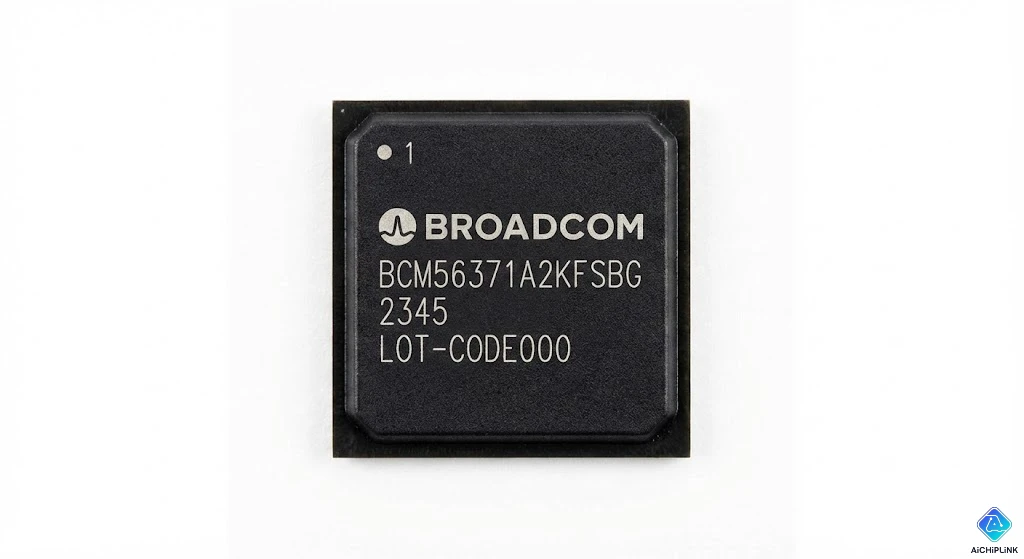
Enter the Broadcom BCM56371A2KFSBG.
Part of the revolutionary Trident 3-X3 (TD3-X3) family, this chip brings the programmable power of a hyperscale data center directly to the enterprise edge. It allows a standard 48-port Gigabit switch to perform deep flow analytics, VxLAN tunneling, and advanced security filtering—all at line rate.
If you are designing or sourcing for next-gen Enterprise Access switches, understanding this chip is mandatory.
Table of Contents
- Decoding the Part Number: BCM56371A2KFSBG
- Architecture: Trident 3-X3 Power
- Port Configuration: Optimized for Gigabit Edge
- Key Features: Programmability & Analytics
- Comparison: BCM56370 vs. BCM56371
- Conclusion
1. Decoding the Part Number: BCM56371A2KFSBG
Broadcom part numbers are dense with information. Here is the specific breakdown for this SKU:
| Code Segment | Meaning | Detail |
|---|---|---|
| BCM56371 | Base Model | Trident 3-X3 Family. Configured for 48x 1GbE Downlinks. |
| A2 | Revision | Rev A2. A mature silicon stepping, ensuring bug fixes and yield optimization over initial A0 silicon. |
| K | Temp Grade | Commercial. Designed for standard operating environments (typically 0°C to 70°C ambient), fitting for air-conditioned wiring closets. |
| FSBG | Package | Flip-Chip BGA. A 29mm x 29mm package designed for high-density signal routing and thermal efficiency. |
2. Architecture: Trident 3-X3 Power
The BCM56371 is built on the StrataXGS® Trident 3 architecture. Historically, Trident chips powered the core of the world's largest data centers. The "X3" variant optimizes this architecture for the Campus Edge.
- Switching Capacity: 348 Gbps (Unidirectional) / 696 Gbps (Bidirectional). This ensures that even if all 48 ports are blasting data, the high-speed uplinks won't choke.
- Integrated CPU: Features a powerful ARM Cortex-A72 core. This allows the switch to run complex control plane software or telemetry agents directly on the silicon, potentially reducing the need for an expensive external CPU.
- Process Technology: Built on a modern 16nm process (typical for TD3 era), balancing performance with the power constraints of a fanless or quiet office switch.
3. Port Configuration: Optimized for Gigabit Edge
The BCM56371 is the "Workhorse" configuration of the family.
- Downlinks: 48x 10/100/1000BASE-T.
- Designed to connect standard desktops, IP phones, printers, and IoT sensors.
- Uplinks: Flexible high-speed SerDes support:
- 4x 25GbE (SFP28): Perfect for high-speed connections to the distribution layer.
- 2x 100GbE (QSFP28): Can be used for massive uplink bandwidth or for Stacking multiple switches together to form a single logical unit.
4. Key Features: Programmability & Analytics
What makes the BCM56371 specialized is not just speed, but intelligence.
FleXGS™ Programmable Pipeline
In older switches, protocols were "hard-coded." If a new tunnel protocol came out, you had to buy new hardware.
- With BCM56371: The pipeline is programmable. You can update the switch firmware to parse new packet headers (like Geneve, VxLAN, or custom IoT protocols) without replacing the chip.
BroadScan™ Flow Analytics
This feature brings "X-Ray Vision" to the network.
- Instead of just counting bytes, the chip tracks individual flows (e.g., a specific Zoom call or database query).
- Benefit: It allows IT admins to detect Microbursts (sub-second congestion spikes) that cause jitter in VoIP calls, which standard SNMP polling tools would miss entirely.
Native VxLAN Support
It enables "DC On-Ramp". You can extend a virtual network (Overlay) from the Data Center directly to the user's desk, improving security and mobility.
5. Comparison: BCM56370 vs. BCM56371
These two chips are siblings, often confusing buyers. Here is the critical difference:
| Feature | BCM56370 | BCM56371 (This Chip) |
|---|---|---|
| Primary Use | Wi-Fi 6 Access Point Aggregation | General Desktop / IoT Connectivity |
| Downlink Speed | Multi-Gigabit (1G / 2.5G / 5G / 10G) | Gigabit (10M / 100M / 1G) |
| Cost | Premium | Cost-Effective |
| Best For | Connecting high-speed APs that need >1Gbps. | Connecting PCs, IP Phones, and Cameras. |
Selection Rule: If you don't need 2.5G/5G ports for every user, the BCM56371 is the far more economical choice while retaining all the Layer 3 and Telemetry features of the premium chip.
6. Conclusion
The Broadcom BCM56371A2KFSBG redefines what an "Access Switch" can do. It moves beyond simple connectivity to become an intelligent sensor at the edge of the network. With its combination of 48-port Gigabit density, 100G stacking capability, and programmable telemetry, it is the ideal silicon foundation for modern, secure, and observable enterprise networks.
Sourcing Broadcom Trident 3 Series Looking to secure BCM56371 silicon for your next switch design? Visit Aichiplink.com to check stock and lead times for the BCM56371A2KFSBG.

Written by Jack Elliott from AIChipLink.
AIChipLink, one of the fastest-growing global independent electronic components distributors in the world, offers millions of products from thousands of manufacturers, and many of our in-stock parts is available to ship same day.
We mainly source and distribute integrated circuit (IC) products of brands such as Broadcom, Microchip, Texas Instruments, Infineon, NXP, Analog Devices, Qualcomm, Intel, etc., which are widely used in communication & network, telecom, industrial control, new energy and automotive electronics.
Empowered by AI, Linked to the Future. Get started on AIChipLink.com and submit your RFQ online today!
Frequently Asked Questions
What is the BCM56371A2KFSBG used for?
It is an enterprise access switch ASIC designed for 48×1GbE downlinks with high-speed uplinks and advanced Layer 2/3 features.
How much switching capacity does BCM56371 provide?
It supports up to 696 Gbps bidirectional switching bandwidth, suitable for campus and wiring-closet deployments.
Does the BCM56371 support high-speed uplinks?
Yes. It supports 4×25GbE or 2×100GbE uplinks, commonly used for aggregation or switch stacking.
What makes Trident 3-X3 different from older access switch chips?
It adds programmable pipelines (FleXGS), advanced telemetry, and VxLAN support at line rate.
How does BCM56371 differ from BCM56370?
BCM56371 targets standard Gigabit access, while BCM56370 supports multi-gig (2.5G/5G/10G) ports for Wi-Fi 6 access points.