Table of Contents
- 1.0 What is the AD8023AR? (The High-Current Specialist)
- 1.1 Why "Triple" Matters: RGB and Component Video
- 1.2 Key Features: 70mA Output Current & 250 MHz Bandwidth
- 1.3 Decoding the Part Number: AD8023AR vs. ARZ
- 2.0 AD8023AR Pinout and Package Details
- 2.1 14-Lead SOIC Pin Configuration
- 2.2 Pin Functions: Inputs, Outputs, and Power
- 3.0 Technical Specifications & Performance
- 3.1 Current Feedback Architecture Explained
- 3.2 Core Specs: Slew Rate and Gain Flatness
- 4.0 Applications and Design Circuits
- 4.1 Driving 75Ω Video Cables
- 4.2 Design Tips: Layout and Thermal Management
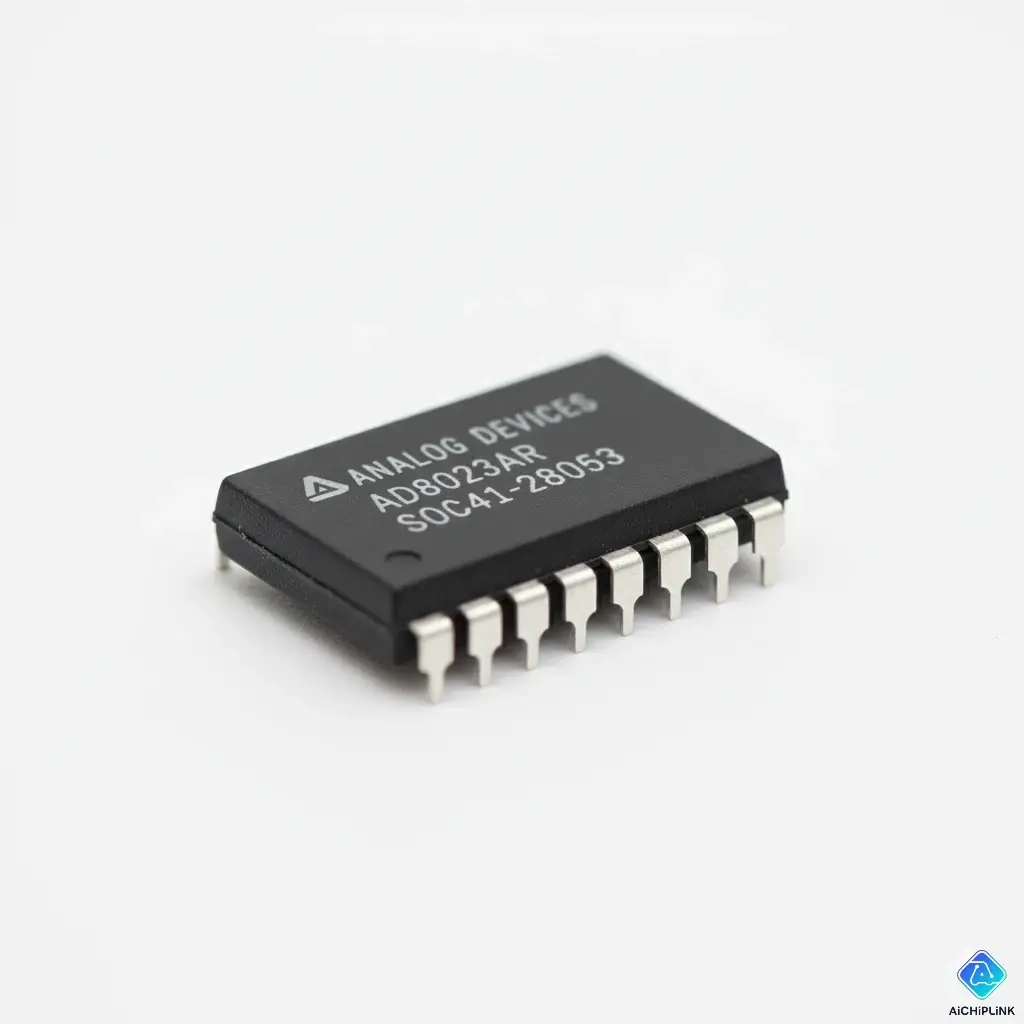
In the world of professional video and high-speed signal distribution, signal integrity is everything. Whether you are designing an RGB line driver for a CRT monitor, a video distribution amplifier, or a high-speed data acquisition front-end, you need an amplifier that can handle the speed and the load. Enter the AD8023AR Triple Video Amplifier.
Manufactured by Analog Devices, the AD8023AR is a high-current, triple operational amplifier designed specifically to drive low-impedance loads—like standard 75Ω video cables—without breaking a sweat. While general-purpose op-amps might struggle with the current demands of video transmission, the AD8023AR thrives on it.
This guide provides a comprehensive technical overview of the AD8023AR, dissecting its datasheet, pinout, and unique current-feedback architecture to help you understand why it remains a top choice for high-performance video applications.
1.0 What is the AD8023AR? (The High-Current Specialist)
The AD8023AR is a monolithic integrated circuit containing three independent, high-speed current feedback operational amplifiers. It is optimized for video applications where you need to drive multiple channels simultaneously.
1.1 Why "Triple" Matters: RGB and Component Video
Video signals rarely travel alone. * **RGB Systems:** Require three separate channels (Red, Green, Blue). * **Component Video (YPbPr):** Requires three channels (Luma, Blue difference, Red difference). * **VGA:** Requires three color channels.Instead of using three separate single-channel op-amps, which consume more board space and introduce potential variance between channels, the AD8023AR provides three matched amplifiers in a single package. This ensures consistent performance across all color channels, which is critical for maintaining color balance.
1.2 Key Features: 70mA Output Current & 250 MHz Bandwidth
The standout feature of the AD8023AR is its **High Output Drive**. * **Current Drive:** It can source or sink at least **70 mA** of current. This is significantly higher than standard op-amps (which often top out at 20-30 mA). * **Why it matters:** Standard video cables (coaxial) have a characteristic impedance of 75Ω. To drive a video signal (typically 1V to 2V peak-to-peak) into such a low impedance requires substantial current. The AD8023AR can drive double-terminated cables (effective load of 37.5Ω) with ease. * **Speed:** With a **250 MHz bandwidth** (at -3dB), it supports high-resolution video formats effortlessly.1.3 Decoding the Part Number: AD8023AR vs. ARZ
When sourcing components, suffixes define the package and compliance.| Part Number | Package | Compliance | Status |
|---|---|---|---|
| AD8023AR | 14-Lead SOIC | Standard (Leaded) | Legacy/Obsolete |
| AD8023ARZ | 14-Lead SOIC | RoHS Compliant (Lead-Free) | Active / Preferred |
| AD8023ARZ-REEL | 14-Lead SOIC | RoHS (Tape & Reel) | For Automated Assembly |
2.0 AD8023AR Pinout and Package Details
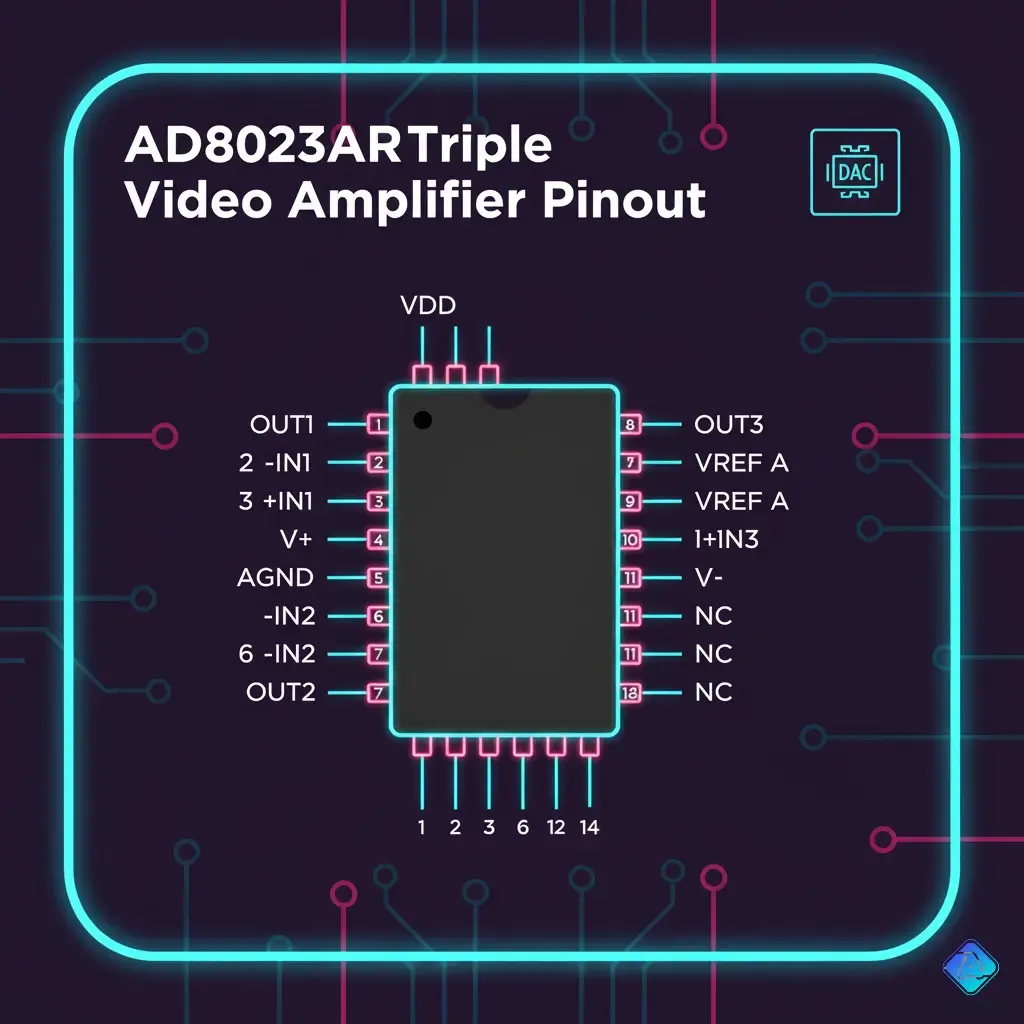
The AD8023AR uses a standard 14-Lead SOIC (Small Outline Integrated Circuit) package, making it easy to integrate into compact PCB designs.
2.1 14-Lead SOIC Pin Configuration
2.2 Pin Functions: Inputs, Outputs, and Power
The pinout follows the industry-standard configuration for quad op-amps (though this is a triple, leaving two pins often as No Connect or V- depending on the layout).- Power Pins (V+ and V-): Supply voltage. Typically ±5V (dual supply) or +5V to +12V (single supply). Proper bypassing with 0.1µF capacitors is mandatory.
- Inputs (+IN, -IN): High-impedance non-inverting inputs and low-impedance inverting inputs (characteristic of current feedback amps).
- Outputs (OUT): The high-current drive pins connected to your load.
3.0 Technical Specifications & Performance
3.1 Current Feedback Architecture Explained
Unlike standard "Voltage Feedback" op-amps, the AD8023AR uses **Current Feedback (CFB)** topology. * **Advantage:** In a CFB amp, the bandwidth is relatively independent of the gain. This means you can set a high gain (e.g., G=+2 for video line driving) without sacrificing the high-frequency performance needed for sharp video edges. * **Requirement:** CFB amplifiers require a feedback resistor ($R_F$) to stabilize the amplifier. You generally cannot put a capacitor directly in the feedback loop of a CFB amp.3.2 Core Specs: Slew Rate and Gain Flatness
* **Slew Rate:** **1200 V/µs**. This is extremely fast. It ensures that rapid transitions in the video signal (like black text on a white background) remain sharp and distinct, without "smearing." * **0.1 dB Gain Flatness:** **30 MHz**. This ensures that color fidelity is maintained across the video spectrum. * **Differential Gain/Phase:** 0.02% / 0.06°. Critical for composite video to prevent color distortion.4.0 Applications and Design Circuits
4.1 Driving 75Ω Video Cables
The most common circuit for the AD8023AR is a **Cable Driver** configured for a gain of +2.- Input: Video signal enters the non-inverting input (+IN).
- Gain: Feedback resistors set the gain to +2. Why +2?
- Output: The signal goes through a 75Ω series termination resistor and then into the 75Ω cable.
- Result: The voltage divider formed by the series resistor and the cable's load resistor cuts the signal in half (-6dB). The amplifier's +2 gain (+6dB) compensates for this exactly, delivering a net gain of 1 (unity) to the destination.
4.2 Design Tips: Layout and Thermal Management
* **Heat:** Since the chip drives high current, it can get warm. Use a large ground plane on the PCB to act as a heatsink. * **Capacitance:** Avoid stray capacitance on the inverting input (-IN). Remove the ground plane directly under this pin to prevent instability. * **Bypassing:** Place tantalum and ceramic capacitors as close to the power pins as possible to prevent oscillation.In Conclusion
The AD8023AR Triple Video Amplifier is more than just an op-amp; it is a specialized driver built to handle the rigorous demands of high-speed video transmission. Its combination of 70mA output drive, current feedback architecture, and triple-channel layout makes it the ideal solution for RGB and component video systems. Whether you are maintaining legacy broadcast equipment or designing robust signal distribution networks, the AD8023AR provides the power and bandwidth you need.
Ready to secure your components? Explore our full selection of Amplifiers to find the perfect match for your high-speed design requirements.

Written by Jack Elliott from AIChipLink.
AIChipLink, one of the fastest-growing global independent electronic components distributors in the world, offers millions of products from thousands of manufacturers, and many of our in-stock parts is available to ship same day.
We mainly source and distribute integrated circuit (IC) products of brands such as Broadcom, Microchip, Texas Instruments, Infineon, NXP, Analog Devices, Qualcomm, Intel, etc., which are widely used in communication & network, telecom, industrial control, new energy and automotive electronics.
Empowered by AI, Linked to the Future. Get started on AIChipLink.com and submit your RFQ online today!
Frequently Asked Questions
What is the output current of the AD8023AR?
The **AD8023AR** features a high output drive capability of at least **70 mA**. This allows it to drive difficult loads, such as double-terminated 75-ohm video cables, with ample headroom.
Can I use the AD8023AR for audio?
While you *can*, it is generally over-spec'd for audio. Audio requires very low noise and low distortion at low frequencies (20Hz-20kHz). The AD8023AR is optimized for high speed (MHz range). Better choices for audio would be the AD8599 or OP275.
What is the difference between AD8023AR and AD8023ARZ?
The **"Z"** suffix indicates compliance with **RoHS (Restriction of Hazardous Substances)** regulations, meaning the AD8023ARZ is lead-free. For new designs or products shipping to the EU, you should choose the "Z" version.
Does the AD8023AR require a heat sink?
Typically, no external heat sink is required for standard video applications. However, the **SOIC-14 package** relies on the PCB copper to dissipate heat. Ensure your PCB layout has adequate ground planes connected to the device's power or ground pins to manage thermal rise.
Where can I buy the AD8023AR?
The AD8023AR is a widely used component available from major electronic distributors. For competitive pricing and stock availability on Analog Devices components, check out AichipLink's inventory.