What Is a Hall Effect Transducer and How It Works
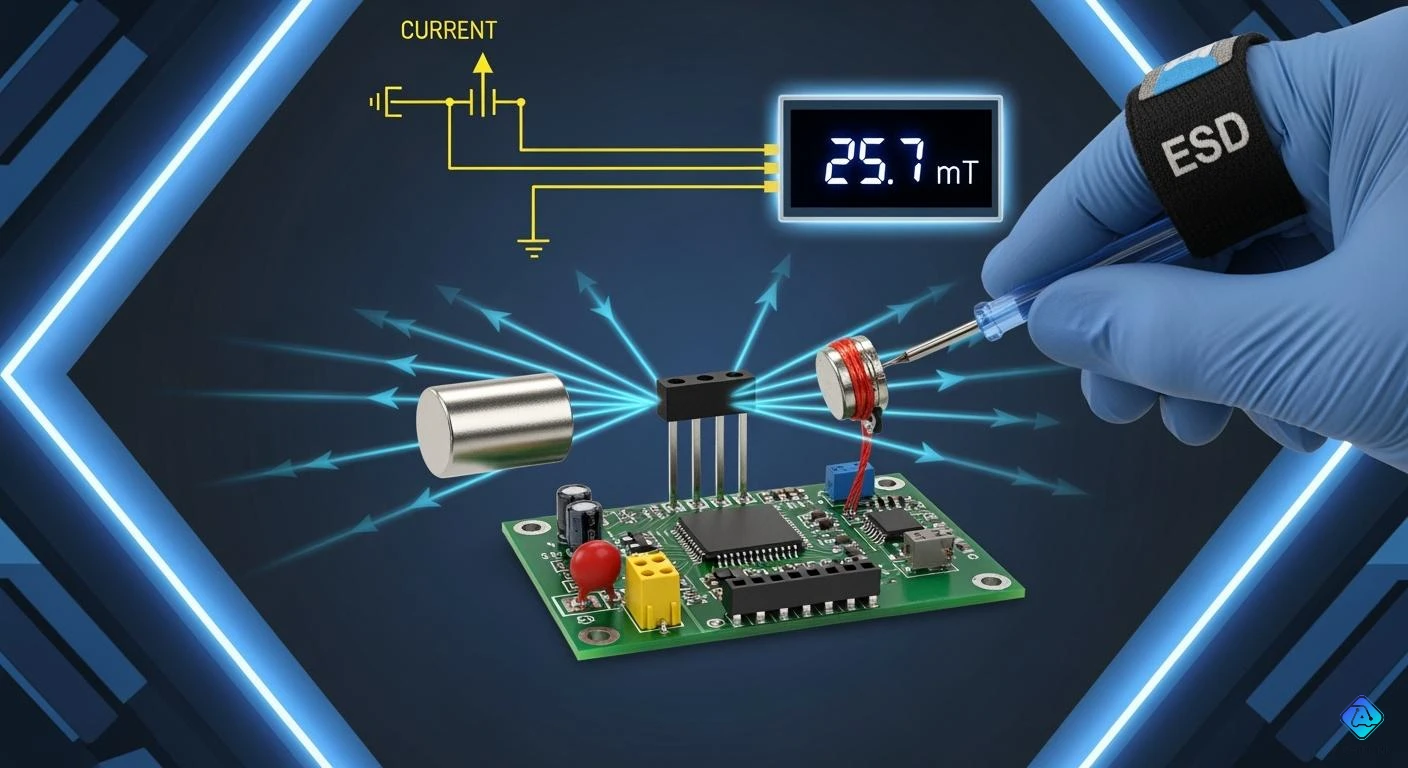
A hall effect transducer helps you measure magnetic fields. It changes magnetic fields into electrical signals. You use this device to find magnetic strength, current, or motion very accurately. The hall effect sensor works because it has a semiconductor part inside. This part makes a voltage when a magnetic field crosses the current path at a right angle. The voltage gets bigger as the magnetic field gets stronger. Hall effect sensing is very important in many things you use every day. You can find it in cars, automation machines, and electronics.
Stat Snapshot:
Year Market Share Applications 2025 Largest Industrial automation, automotive, consumer electronics
Key Takeaways
-
Hall effect transducers find magnetic fields. They turn them into electrical signals. These are important in cars and electronics.
-
The hall effect happens when a magnetic field meets a conductor with current. This makes a voltage called hall voltage. Hall voltage helps sensors work.
-
There are different hall effect sensors. Some are linear, and some are digital. Linear sensors measure things exactly. Digital sensors give simple on or off signals. They help detect speed.
-
Hall effect sensors last a long time. They work well in tough places. They do not need to touch anything. This makes them last longer. It also means less fixing is needed.
-
When picking a hall effect sensor, think about accuracy. Also check the temperature range. Make sure you install it right. This helps it work best.
Hall Effect Principle and Operation
What Is the Hall Effect?
The hall effect happens inside a conductor. When you run a current through it and put it in a magnetic field, something special happens. The moving electrons feel a force called the Lorentz force. This force pushes the electrons to one side. One side gets more negative charges. The other side gets more positive charges. This makes a voltage across the conductor. This voltage is called the hall voltage. The hall effect is how every hall effect sensor and hall effect transducer works.
Tip: The hall effect only happens if the magnetic field is at a right angle to the current.
Hall Voltage Generation
The hall voltage is the main signal you measure in hall effect sensors. You pass a current through a thin piece of semiconductor material. If you put this sensor in a magnetic field, the hall effect makes a voltage across the material. The size of this voltage depends on three things. It depends on the strength of the magnetic field, the amount of current, and the type of material.
The table below shows how these things are related:
| Variable | Description |
|---|---|
| VH | Hall voltage (Volts, V) — the electric potential difference developed across the conductor perpendicular to both current flow and magnetic field |
| RH | Hall coefficient (m³/C) — material property relating hall voltage to current, magnetic field, and thickness; positive for p-type, negative for n-type semiconductors |
| I | Current (Amperes, A) — electric current flowing through the conductor in the x-direction |
| B | Magnetic field (Tesla, T) — magnetic flux density applied perpendicular to the current direction, usually in the z-direction |
| t | Sample thickness (meters, m) — physical size of the conductor in the direction of hall voltage measurement (y-direction) |
The hall voltage gets bigger if you make the magnetic field or current stronger. The thickness of the sensor also changes the voltage. Hall effect sensors use this to measure magnetic fields in many devices.
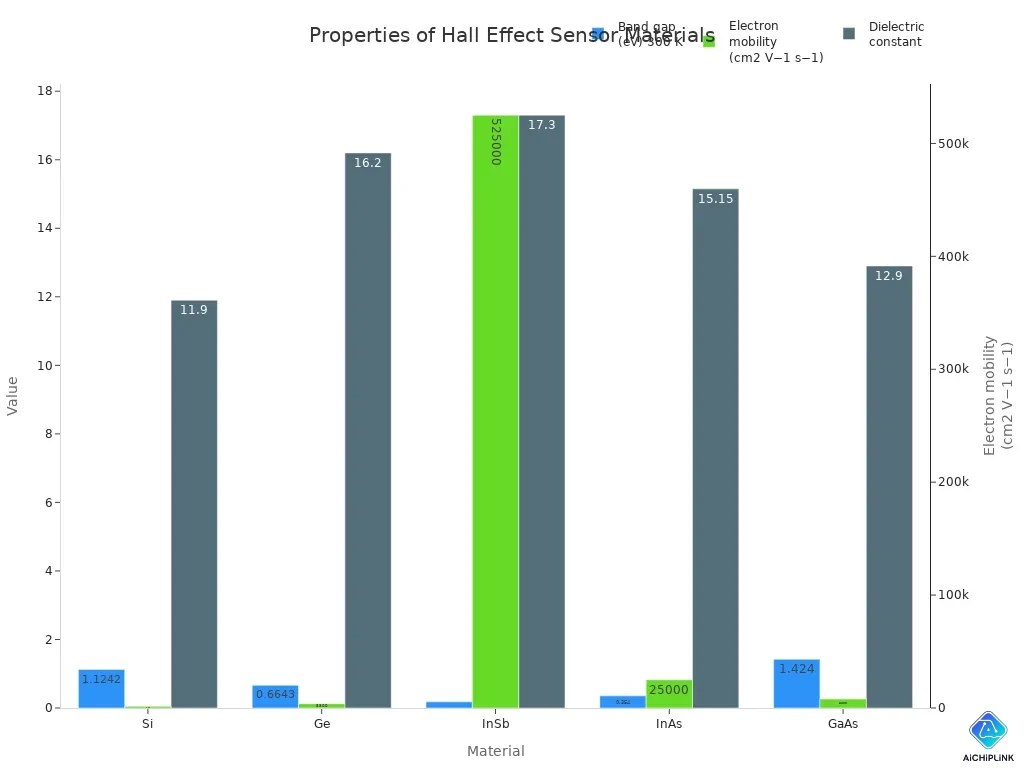
Different materials make sensors work better or worse. For example, indium antimonide (InSb) and indium arsenide (InAs) have high electron mobility. This makes the sensor more sensitive. But these materials need special care to work at different temperatures. Silicon is less sensitive but is easy to use in many electronics.
| Material | Band gap (eV) 300 K | Electron mobility (cm² V⁻¹ s⁻¹) | Dielectric constant |
|---|---|---|---|
| Si | 1.1242 | 1450 | 11.9 |
| Ge | 0.6643 | 3800 | 16.2 |
| InSb | 0.18 | 5.25 × 10⁵ | 17.3 |
| InAs | 0.354 | 2.50 × 10⁴ | 15.15 |
| GaAs | 1.424 | 8000 | 12.9 |
Hall Effect Sensing Mechanism
You use hall effect sensing to change magnetic field changes into electrical signals. The hall effect sensor measures the hall voltage that appears when a magnetic field crosses the sensor. This voltage is very small. You need special tools to measure it. You use a constant-current source to send current through the sensor. You also use a high input impedance voltmeter to measure the hall voltage. A magnet makes the magnetic field. A sample holder keeps the sensor in place.
| Instrumentation | Purpose |
|---|---|
| Constant-current source | Sends current based on sample resistance, adjustable for low to high resistivity materials. |
| High input impedance voltmeter | Measures hall voltage accurately, good for low voltage ranges. |
| Permanent or electromagnet | Makes the magnetic field for hall effect measurements. |
| Sample holder | Holds the sample steady during measurements. |
| Switch matrix | Lets you test many samples and connections easily. |
You can also use a current-limiting resistor and lock-in amplifiers for better accuracy. The hall effect transducer is simple, strong, and not expensive. Other technologies, like magnetoresistive or fluxgate sensors, use different ideas and are often more complex.
| Feature | Hall Effect Transducers | Other Technologies (e.g., Magnetoresistive, Fluxgate) |
|---|---|---|
| Principle | Hall effect making voltage across a conductor | Different ideas for magnetic field detection |
| Measurement Method | Measures magnetic fields and changes to electrical signals | Changes by technology |
| Advantages | Simple, strong, not expensive | Special for certain uses |
Hall effect sensors can find very small magnetic fields. Some sensors can sense fields as low as 200 nanotesla (nT). The best ones can sense down to 20 nT. The sensitivity of hall effect sensors can be from 5.5 to 280 millivolts per tesla (mV/T). This depends on the material and design.
Note: Hall effect sensing gives you a reliable and non-contact way to measure magnetic fields, current, and position in many uses.
Types of Hall Effect Transducers
There are different types of hall effect transducers you can use. Each one works in its own way to help with different jobs. The main types are linear hall effect transducers, digital hall effect sensors, and current sensing hall effect transducers.
Linear Hall Effect Transducer
A linear hall effect transducer gives a smooth analog signal. The output voltage goes up or down as the magnetic field changes. You use this sensor when you need exact measurements. For example, it can measure how far something moves or how strong a magnetic field is. Linear hall effect sensors react very fast, sometimes in just microseconds. They do not have much hysteresis, so results stay steady. Many sensors have temperature compensation to keep the output from changing too much.
You can use linear hall effect sensors to sense position in printers or smartphones. These sensors help you track movement very well.
| Feature | Linear Hall Effect Transducers |
|---|---|
| Output | Analog, proportional to magnetic field |
| Response Time | Fast, microseconds |
| Hysteresis | Minimal |
| Temperature Stability | Often compensated |
Digital Hall Effect Sensor
A digital hall effect sensor gives a simple on or off signal. The sensor turns on when the magnetic field reaches a certain level. You use this sensor for things like speed detection or position sensing. Digital hall effect sensors use hysteresis to stop the output from switching back and forth too much. They work well in tough places because they are not bothered by dust or water. You can connect these sensors to electronic circuits easily.
| Feature | Description |
|---|---|
| Non-Contact Operation | Detects magnetic fields without touching the object |
| High Sensitivity | Finds small changes in magnetic field strength |
| Binary Output | Gives on/off signal for easy use |
| Robustness | Works in tough conditions like dust or moisture |
| Compact Size | Fits into small spaces |
Digital hall effect sensors help with speed sensing in cars or finding the position of a floating part in a fuel tank.
Current Sensing Hall Effect Transducer
A current sensing hall effect transducer measures the magnetic field made by current in a wire. You use this sensor to check current without touching the wire. The sensor has three terminals. You put voltage on two of them, and the third terminal gives a voltage that matches the current. This keeps your circuit safe and does not add extra resistance.
-
You can use current sensing hall effect transducers in electric airsoft guns, paintball guns, and car fuel-level indicators.
-
These sensors also help with position sensing in printers and smartphones.
Hall effect sensing lets you measure current safely and easily. You do not have to break the circuit or add more parts.
Applications of Hall Effect Sensors
Automotive Magnetic Field Measurements
You can find hall effect sensors in almost every new car. These sensors do many important jobs.
-
Battery management sensors watch the current and check battery health in electric cars.
-
Parking sensors help you park by measuring how close things are to your car.
-
Engine speed sensors check how fast the crankshaft spins.
-
Wheel speed sensors watch each wheel and help with anti-lock brakes.
-
Crankshaft position sensors help control when the engine fires and adds fuel.
-
Other uses are EGR valve sensors, seat belt switches, airbag sensors, and wiper fluid level sensors.
About 35% of all hall effect current sensors are used in cars. You see these sensors in driver-assist systems, electric cars, and motor control. They make cars safer, work better, and use less energy. More electric and hybrid cars means we need better magnetic field measurements.
Industrial Hall Effect Sensing
Factories and machines use hall effect sensing a lot.
-
These sensors check the position and speed of conveyor belts and assembly lines.
-
They watch how fast motors and generators turn.
-
You can use them to see if metal objects are there or missing.
-
They help check the level of liquids or small materials.
-
Hall effect sensors also watch current in power systems and warn if there is too much current.
These sensors give you good, non-contact magnetic field readings. You can count on them for quick and correct sensing in hard places.
Consumer Electronics Applications
You can find hall effect sensors in many things at home.
-
Gaming keyboards use these sensors for fast and exact key presses.
-
Some game controllers, like Sega Saturn and Dreamcast, use them for smooth control.
-
New home appliances use these sensors for position and safety.
Hall effect sensors make your electronics smarter and faster. Your devices work better and last longer.
Proximity and Speed Detection
Hall effect sensors help you find position, speed, and movement without touching anything.
-
These sensors make a voltage when a magnetic field crosses a wire with current.
-
You can use them to sense if a magnetic object is there, where it is, or how it moves.
-
Hall effect sensors can track fast things, with response times in microseconds.
You use hall effect sensing for speedometers, tachometers, and switches that sense nearby things. These sensors give you quick, correct, and steady measurements in many uses.
Advantages and Limitations
Benefits of Hall Effect Transducers
Hall effect sensors have many good points. They work in lots of places, like cars and factories. You do not have to touch what you want to measure. This means the sensor lasts longer and does not wear out fast. The sensor gives results quickly and they are correct. You can trust the numbers because they stay steady over time. You do not need to reset them often.
Some main advantages are:
-
Hall effect sensors work well in tough places. They can handle dust, water, and changes in temperature.
-
These sensors last longer than ones with moving parts.
-
They respond fast, which is good for speed and position jobs.
-
You can change how sensitive they are using software. This makes them useful for many things.
-
They need little care and still work after bumps or shocks.
| Advantage | Description |
|---|---|
| Drift-Free Precision | The sensor stays accurate without needing resets. |
| Extended Durability | It lasts longer than mechanical sensors. |
| Rapid Response | It reacts fast to changes. |
| Environmental Resistance | It works in hard conditions. |
| Low Dead Zone | It finds small changes in magnetic fields. |
| Consistent Calibration | It keeps its starting point steady. |
| Reduced Maintenance | You do not need to clean or oil it. |
Hall effect sensors let you measure position and current without touching anything. This is great for cars and machines that must work a long time.
Limitations of Hall Effect Sensors
There are some limits you should know. Changes in temperature can affect the sensor’s output. If it gets too hot or cold, the readings may change. This is important if you need very exact numbers. Electromagnetic interference can also cause small mistakes, but temperature matters more.
Other magnetic sensors, like AMR or GMR, can be more sensitive. But they might use more power or have more noise. Hall effect sensors may not work well for very weak magnetic fields. You should check if the sensor is right for your job.
| Limitation | Impact on Use |
|---|---|
| Temperature Drift | Output can change with heat or cold |
| Sensitivity | May not find very weak fields |
| Interference | Strong electromagnetic fields can cause mistakes |
| Mounting Needs | Some jobs need special ways to mount or protect it |
Practical Considerations
When you choose a hall effect sensor, think about these things:
-
Check how accurate you need it to be. Most sensors are 1.0% to 2.0% accurate, but you can get better with signal correction.
-
Make sure the sensor faces the magnetic field the right way. The output is strongest when the field is at a right angle to the sensor.
-
Look at the temperature range. Some sensors work better in hot or cold places.
-
Do not use more current than the sensor can handle. Too much current can change the output.
-
Think about how you will mount the sensor. Some sensors are fragile and need protection.
Tip: Always read the manufacturer’s guide to get the best results from your hall effect sensor.
You use a hall effect transducer to check how strong a magnetic field is and which way it goes. This device turns the magnetic field into an electrical signal called hall voltage. Hall sensors are found in cars, factories, and electronics because they work without touching anything. They help you find position, speed, and current very accurately. Hall sensors last for years and do not need much care. New hall technology adds ways to handle temperature changes and uses digital tools for better results. When you make a project, you should look at sensitivity, voltage, and temperature range. Hall sensing gives you reliable and exact detection for many jobs.

Written by Jack Elliott from AIChipLink.
AIChipLink, one of the fastest-growing global independent electronic components distributors in the world, offers millions of products from thousands of manufacturers, and many of our in-stock parts is available to ship same day.
We mainly source and distribute integrated circuit (IC) products of brands such as Broadcom, Microchip, Texas Instruments, Infineon, NXP, Analog Devices, Qualcomm, Intel, etc., which are widely used in communication & network, telecom, industrial control, new energy and automotive electronics.
Empowered by AI, Linked to the Future. Get started on AIChipLink and submit your RFQ online today!
Frequently Asked Questions
What does a Hall Effect transducer measure?
You use a Hall Effect transducer to measure magnetic fields. It can also help you find current, position, or speed in many devices. The sensor changes the magnetic field into an electrical signal you can read.
How do you install a Hall Effect sensor?
You place the sensor near the magnetic field you want to measure. Make sure the sensor faces the field at a right angle. You connect the sensor to your circuit using the correct wires.
Can Hall Effect sensors work in wet or dusty places?
Yes, you can use Hall Effect sensors in tough environments. The sensor does not need to touch anything, so dust or water will not stop it from working. Many sensors have strong cases to protect them.