Top 10 Wi-Fi Smart Relay Modules for Home Automation

You want app control of your lighting, fans, and garage door. You do not want to replace fixtures or wall switches. A Wi-Fi relay module solves that. It is a small in-box switch, and you control it from your phone. Most smart relays need no hub. These relays fit behind a switch or in a ceiling box.
This guide ranks the ten best Wi-Fi smart relay modules for home automation. Each pick gets judged on performance, application fit, compliance (UL/ETL, FCC), and cost. Motors and LED drivers are tough loads, so size the relay with headroom.
Start with the comparison table for a shortlist. Then read the detailed reviews and job-matching guide.
Key Takeaways
-
Match the relay to your load type and mounting spot for a safe, working retrofit.
-
Check for UL or ETL certification on the module itself for permanent wiring.
-
Keep local control with a wall switch or Matter hub when the internet goes down.
-
Choose finished modules for quick, compliant installs; pick ESP32 boards for full DIY control.
-
Plan for hidden costs like box depth and neutral wire needs before you buy.
Comparison Table at a Glance: Best Wi-Fi Smart Relay Modules
Specs, Price Bands, and Ratings
The table below lines up all ten picks on the specs that decide a retrofit. Scan the contact type first. A dry-contact unit switches a voltage-free circuit, so it suits garage doors and gates. A live-output unit feeds the light or fan directly.
| Model | Wi-Fi | Contact | Max Load | Neutral | Switch Input | Matter | Cert | Price | Best Job |
|---|---|---|---|---|---|---|---|---|---|
| Shelly Plus 1 | 2.4 GHz | Dry/live | 16 A | No | Yes | No | UL | Mid | Multi-use |
| Shelly Plus 1PM | 2.4 GHz | Live | 16 A | No | Yes | No | UL | Mid | Metering |
| Shelly 1 Mini Gen4 | 2.4 GHz | Dry/live | 8 A | No | Yes | No | UL | Mid | Switch boxes |
| SONOFF MINIR4 | 2.4 GHz | Live | 10 A | No | Yes | No | ETL | Budget | Ceiling lights |
| SONOFF BASICR4 | 2.4 GHz | Live | 10 A | Yes | No | No | ETL | Budget | Inline wiring |
| SONOFF MINIR4M | 2.4 GHz | Live | 10 A | No | Yes | Yes | ETL | Budget | Matter setups |
| SONOFF DUALR3 | 2.4 GHz | Dry/live | 10 A per channel | Yes | Yes | No | ETL | Budget | Two loads |
| Aqara T2 | 2.4 GHz | Dry/live | 10 A | No | Yes | Yes | ETL | Mid | Fans, blinds |
| Aeotec Pico Switch | 2.4 GHz | Dry | 10 A | No | Yes | No | UL | Premium | Gates, doors |
| ESP32 board | 2.4 GHz | Live | Varies | Varies | Yes | Via firmware | None | Budget | Tinkerers |
How to Read the Table
Start with the neutral column. A "No" means the module runs without a neutral wire at the switch, which saves you a rewire. Next, check the load rating against your fixture. LED drivers and fan motors pull a surge at startup, so leave headroom.
The contact column deserves a closer look. Owon Smart explains that a dry contact relay provides voltage-free switching, so the relay opens or closes an isolated circuit instead of feeding power to the load. That makes these relays safe for control signals on openers and gates.
How to Choose Wi-Fi Smart Relay Modules
Mounting Location and Enclosure
Where the module lives decides which models even fit. You have three spots: behind the wall switch, inside the ceiling box, or in the electrical panel. Each spot brings its own limits.
Switch boxes get crowded fast. SmartThings community users report that a relay often fits a one-gang box but two will not squeeze into a two-gang box. A four-gang box may take one with effort. Measure your box depth before you buy.
A ceiling box solves the no-neutral problem. Many switch loops lack a neutral at the wall, yet the circuit still has one at the fixture. Mount the relay there instead. Freedompro's LB0801-F shows the flush-box approach: a 12 V 16 A Wi-Fi relay module that fits a 502/503 box and controls one light.
-
Put the relay at the fixture when the switch has no full-time power.
-
Choose the ceiling box when no neutral reaches the wall switch.
-
Move to a separate box when a crowded gang box leaves no room.
Load Type, Contact Rating, and Wall-Switch Input
Match the relay to the load, not just the amp number. LED drivers and fan motors pull a startup surge. A rating that looks generous on paper may not hold.
"Relay contact ratings are not interchangeable between load types. A 10A resistive rating may correspond to only 3A for motor loads and 1A for lamp loads due to inrush current differences." — IEC 61810 relay specification guidelines, cited in Mouser Electronics application notes
Wall-switch input keeps local control alive. Tuya's platform notes that smart relays support up to four channels of switch input and four channels of output control. They also handle both rocker and self-reset switches, so your existing wall plate keeps working.
No-neutral and dry-contact variants appear across Sonoff, Tuya, and Shelly lines. Pick no-neutral when the switch box lacks a neutral. Pick dry contact when you switch a control signal, such as a garage opener.
Local Control and Finished vs. Programmable
Local Control Routes: Switch Input, RF, and Matter
A Shelly or Sonoff relay can work without a hub for basic Wi-Fi control. But it still depends on your Wi-Fi network. When the internet goes down, you need a backup you can count on.
You have a few local options. A wired wall switch always works, and Shelly devices can act like regular switches depending on your settings, according to a Level1Techs forum discussion. Sonoff has a LAN mode for some control without the internet, plus the iHost local hub for scenes and an open API. Matter changes things even more. Matter control runs locally between your controller and the device over your home network, so automations on a local hub keep running when the internet goes down, as MicrocontrollersLab explains. You lose remote access and cloud-only features until the connection comes back.
-
A physical wall switch wired to the relay
-
Sonoff LAN mode or iHost local hub
-
A Matter controller on your home network
Some Matter relay modules also have a detach relay mode. The wall switch then sends a scene trigger without cutting power, which keeps smart bulbs on while the switch still works.
Finished Modules vs. Programmable Boards
Finished modules from Shelly, SONOFF, and Aqara come ready to wire. You do not flash anything, and the app guides you through setup. A finished relay module also has UL or ETL listing, which matters for insurance and inspections.
Programmable relay boards are the other choice. An ESP32 running ESPHome gives you full flexibility, a local web UI, scripts, and MQTT. You also provide the power supply, the enclosure, and the safety check yourself. Setup takes more work, and the cost is lower per board.
Choose finished modules for a fast, compliant retrofit. Choose programmable relay boards when you like tinkering and want full local control. Either way, match the relay to your loads before you buy.
1. Shelly Plus 1
The Shelly Plus 1 is the most flexible module on this list. It handles dry and live contact switching in one unit. That means you can wire it to a light circuit or to a voltage-free control line. You get 16 A of switching capacity, and the module runs without a neutral wire at the switch. A wall-switch input keeps your existing toggle in the loop.
Pros and Cons
-
Dry or live contact output covers lights, fans, and control signals
-
No neutral needed at the switch box
-
UL listed, so it passes inspection in most jurisdictions
-
16 A rating leaves room for modest inrush on LED drivers
-
No Matter support out of the box
-
Mid price band costs more than the SONOFF line
The dual contact design is the real selling point. You can move the same module from a ceiling light to a garage opener later. Few relays in this class offer that range. The tradeoff is size. The Plus 1 is bigger than a mini module, so check your box depth before you commit.
Verdict and Best Fit
Buy the Shelly Plus 1 when you want one module that does almost everything. It suits ceiling lights, exhaust fans, and dry-contact jobs like gate control. The 16 A rating gives you headroom on motor loads. Pair it with a stable power supply and your Wi-Fi network stays reliable.
Skip it if you need Matter or the tightest possible footprint. For those jobs, look at the MINIR4M or the Shelly 1 Mini Gen4. Otherwise, this is the safest all-around pick for a smart retrofit. It sits in the mid price band, and the UL listing justifies the extra cost over budget relay boards.
2. Shelly Plus 1PM: Best Wi-Fi Relay Module with Metering
The Shelly Plus 1PM adds power measurement to the Plus 1 formula. Shelly's knowledge base describes it as a small form factor smart switch with power measurement. You control appliances from your phone, tablet, or PC. It runs standalone on a local wi-fi network or through cloud services. The built-in voltmeter and ammeter report real consumption, so you can see what each circuit actually draws.
Pros and Cons
-
16 A AC and 10 A DC switching capacity
-
Built-in voltmeter, ammeter, and internal temperature sensor
-
Overheating, overvoltage, overcurrent, and overpower protection
-
Under 1.2 W standby draw
-
20 schedules, 20 webhooks, MQTT, and scripting
-
Works with Google, SmartThings, and Alexa
-
No dry contact, so it cannot switch a voltage-free signal
-
Rated for -20 °C to 40 °C and 30% to 70% RH only
The size helps in tight boxes. Shelly lists the module at 37x42x16 mm and 27 g, with terminals that take 0.5 to 1.5 mm² conductors. Shelly warns against bridging the L and N terminals, because bridging doubles current and causes overheating. Keep the ambient temperature under 40 °C and leave ventilation in confined spaces. Unlike some relays in this roundup, this relay has no dry contact.
Verdict and Best Fit
Pick the 1PM when you want to know what a circuit consumes. It suits water heaters, space heaters, and other resistive loads. The metering also helps you spot a failing motor before it dies. The relay handles 16 A on AC circuits and 10 A on DC. This relay is not for garage doors, since it lacks dry contact. For those jobs, use the Plus 1 or another dry-contact relay from the list.
The 1PM sits in the mid price band, and its UL listing makes it a safe pick for permanent wiring. Few relays at this price meter power this well. Budget relay boards cost less, but they rarely meter power or log history. Check your box depth first, because the 1PM needs room for the terminals and the wiring.
3. Shelly 1 Mini Gen4
The Shelly 1 Mini Gen4 packs the Shelly feature set into the smallest case in this roundup. It switches 8 A on dry or live contact, runs without a neutral at the switch, and accepts a wall-switch input. Shelly's support pages call it the most powerful Shelly to date, with 512KB of RAM and 2.4 GHz Wi-Fi that supports the 6 standard. It also doubles as a wireless and Zigbee range extender. Check your box depth before you order, because the terminals still need room for wiring.
Pros and Cons
-
Ultra-compact, retrofit-friendly form that fits crowded switch boxes
-
8 A switching on dry or live contact
-
512KB RAM and a newer processor for snappier responses
-
Support for the 6 standard plus Zigbee and Matter options
-
Works as a wireless and Zigbee range extender
-
No neutral needed at the switch
-
8 A rating limits motor and large LED loads
-
No power metering
Partstoyou compares the Gen4 to the Gen3 side by side. Both keep the same compact shape and the same 8 A switching. The Gen4 adds a newer processor with 8 MB of memory, Zigbee and Matter options, the 6 standard, and Zigbee repeater capability. The result feels faster and quieter in daily use. That extra memory matters when you run scripts or local automations on the relay itself. Few relays in this size class offer that much headroom.
Verdict and Best Fit
Pick the Mini Gen4 when box space is your biggest constraint. It suits wall-switch retrofits, small ceiling lights, and any spot where a full-size relay will not fit. The Zigbee repeater and Matter options make it a smart pick for a mixed-protocol home. Just respect the 8 A ceiling. Keep heavy loads like large fans and big LED arrays on a 16 A relay instead. This relay sits in the mid price band. It beats budget relay boards on fit and features, and the UL listing keeps inspections simple. Cheaper relays skip the range extender and the Matter option. Need metering too? Step up to the Plus 1PM.
4. SONOFF MINIR4
The SONOFF MINIR4 is the budget pick that gives you more than you pay for. It is a small relay that fits most switch boxes, and it works without a neutral wire in most single-pole setups. According to smartbuy.alibaba.com, the module does this with a capacitive leakage circuit. That method depends on the load type and a minimum wattage, usually above 5W. Check your fixture before you buy, because a very low-wattage LED may not turn it on.
Pros and Cons
| Pros | Cons |
|---|---|
| No neutral wire needed in most setups | Only works with 2.4 GHz Wi-Fi networks |
| Small design fits most switch boxes | Setup needs basic electrical knowledge |
| Works with both cloud and local control modes | Fake products are common online |
| Costs less than full smart switches | Low load limit rules out high-power appliances |
| You can customize it with third-party firmware (Tasmota, ESPHome) | The default cloud service may raise privacy concerns |
| Works with many systems (Alexa, Google, Home Assistant) |
Users on smartbuy.alibaba.com praise the easy setup once the wiring clicks, the steady connection, and the small size that fits tight boxes. Complaints center on fakes, app connection glitches, and overheating with a 90W LED transformer. Buy from an authorized seller to avoid the fakes.
Keep the job small. This relay works for lighting circuits under 10A, and smartbuy.alibaba.com advises against heaters or air conditioners. It is a relay, not a dimmer, so dimmable LEDs get on/off control only.
Verdict and Best Fit
Pick the MINIR4 for ceiling lights and simple switch retrofits on a tight budget. It works well with Home Assistant, and you can flash Tasmota or ESPHome for full local control. Skip it for heavy loads or Apple HomeKit setups without a bridge. Among budget relays, it is the easiest way to start. Finished relay boards cost more, but this one earns its place.
5. SONOFF BASICR4
The SONOFF BASICR4 is the inline workhorse of the budget class. It needs a neutral wire, so it suits boxes that already have one. You wire it in series with the fixture, and the app takes over from there. Setup is the simplest on this list: open the app, join your wi-fi, and you are done. Over-the-air updates keep the firmware current without a cable.
Pros and Cons
| Pros | Cons |
|---|---|
| Certified to UL 60730, CE, and RoHS | Requires a neutral wire at the box |
| Local control through MQTT, no mandatory cloud | No dry contact for gates or openers |
| Slim profile under 18 mm deep | No wall-switch input |
| Tool-free terminal blocks speed up wiring | 10 A rating limits heavy loads |
| $19.99–$24.99 per unit |
Verdict and Best Fit
Pick the BASICR4 when your box has a neutral and you want plug-and-play simplicity. It shines on lighting circuits and other modest loads in a neutral-equipped box. The MQTT support gives you a local path if you run Home Assistant, and the cloud stays optional. Skip it for garage doors, since it lacks dry contact. Skip it for switch-box retrofits without a neutral, too. Among budget relays, this one wins on certification and install speed. Finished relay boards from Shelly cost more, but they add dry contact and switch input. For a simple smart lighting upgrade, the BASICR4 is hard to beat.
6. SONOFF MINIR4M Matter
The SONOFF MINIR4M takes the MINIR4 formula and adds Matter support. You get the same 10 A live-output switching, the same no-neutral wiring at the switch, and a wall-switch input that keeps your existing toggle working. The difference is the protocol. Matter lets the relay talk to Apple Home, Google Home, Amazon Alexa, and SmartThings through one local standard. You pair it once, and your controllers find it without a vendor-specific bridge.
Pros and Cons
-
Matter support for cross-platform setups
-
No neutral wire needed at the switch
-
Wall-switch input keeps local control alive
-
ETL listed and priced in the budget band
-
10 A rating and live contact only, so no dry-contact jobs
-
2.4 GHz wi-fi only
Matter changes how the relay behaves on your network. Control runs locally between your hub and the device, so your automations keep working when the internet drops. You lose remote access until the connection returns, but the lights still respond. That reliability matters more than cloud features for most households.
The limits are the same as the MINIR4. Keep the job on lighting circuits and modest loads. This relay cannot switch a voltage-free signal, so garage doors and gates need a dry-contact model instead. Check your fixture wattage too, because very low-wattage LEDs may not trigger the no-neutral circuit.
Verdict and Best Fit
Pick the MINIR4M when you are building a cross-platform smart home and want one relay that works with every major ecosystem. It suits ceiling lights, switch retrofits, and rooms where Apple and Google devices coexist. The ETL listing and budget price make it an easy first Matter device.
Skip it for dry-contact jobs or heavy motor loads. Among budget relays, it offers the widest controller support. Finished relay boards from Shelly cost more and still lack Matter here. If you run Home Assistant or a mixed ecosystem, this is the relay to start with.
7. SONOFF DUALR3
The SONOFF DUALR3 gives you two outputs in one case. That makes it the right choice when one box needs to run more than one thing. You get two-channel switching, Wi-Fi control, physical switch control, and power monitoring in one budget relay module.
Pros and Cons
The DUALR3 acts differently depending on its mode. diytechrush.com explains three of them.
| Mode | What It Does |
|---|---|
| Switch Mode | Two-channel smart switch; CH1 to the living-room light, CH2 to the bedroom light, each controlled on its own |
| Motor Mode | Runs roller shutters, blinds, and compatible bidirectional motors; sets direction and supports position control and calibration in compatible apps |
| Meter Mode | Monitors voltage, current, and power data instead of independent switching |
You rarely find that range at this price. You can run two light circuits today and use the same relay for a blind motor later. Scheduling, scenes, and Alexa voice control complete the feature set.
The limits matter just as much. diytechrush.com stresses that you treat the DUALR3 as a mains-voltage device, never as a low-voltage experiment. Stay inside its rated electrical limits. Follow the official wiring diagram for your exact hardware revision, and hire a qualified electrician if you are not comfortable with mains work. Shut off the circuit, verify it is dead with a tester, and never leave mains terminals exposed.
Verdict and Best Fit
Pick the DUALR3 when one box must drive two separate loads. It suits dual-light circuits, ceiling fans with lights, and roller shutter retrofits. The motor mode sets it apart from single-purpose relays. Among budget relays, few offer two channels plus metering.
Skip it for dry-contact jobs like garage doors. Skip it if you only need one output, since a MINIR4 costs less. This relay earns its spot for multi-load retrofits.
8. Aqara Dual Relay Module T2
The Aqara Dual Relay Module T2 brings two channels into one compact case, and it speaks Matter as well as Zigbee. You get dry and live contact options, no neutral needed at the switch, and a wall-switch input. That mix makes it a strong fit for ceiling fans with lights and for blind motors.
Pros and Cons
| Pros | Cons |
|---|---|
| Works with Homey now | Not listed in the Aqara Homey app initially |
| Controls fan and light separately on a single circuit | Needs a ceiling fan with chain pulls |
| T2 dual relay works fine | Delay is a little annoying |
| H2 switch works via Matter but lacks an always-on power option | |
| Zigbee needs an Aqara hub with Homey |
The Homey community thread sums up the real-world experience. Users report the T2 dual relay works fine, and it can control a fan and a light separately when both sit on a single circuit wired to the module. That trick only works with a specific ceiling fan type that has chain pulls. Most US ceiling fans with remotes are not wired to support this setup, so check your fan before you plan the job.
Two more quirks show up in that thread. The module was not listed in the Aqara Homey app at first, even though it appeared in the Best Buy guide. Users also call the delay a little annoying. Zigbee control through Homey needs an Aqara hub, and the H2 switch works via Matter but lacks an always-on power option.
Verdict and Best Fit
Pick the T2 when you want two outputs plus Matter in one module. It suits ceiling fans with lights, dual light circuits, and blind motors. The dry-contact option covers gates and openers too, which most budget relays cannot do.
Skip it if you run Homey without an Aqara hub, or if your ceiling fan uses a remote. Check the app listing and your fan wiring first. Among mid-price relays, the T2 offers the widest protocol support. It is a smart pick for a mixed ecosystem, and the dual relay design saves box space.
9. Aeotec Pico Switch
The Aeotec Pico Switch is the premium pick for control jobs. It switches a dry contact only, so it never feeds power to the load itself. Instead, it opens and closes a voltage-free circuit. That design suits garage doors, gates, and other openers that expect a simple button press. You get a wall-switch input, and the module runs without a neutral wire at the switch. Aeotec backs it with a UL listing, which keeps inspections simple.
Pros and Cons
-
Dry contact output, so it works with openers and control signals
-
No neutral wire needed at the switch
-
Wall-switch input keeps your existing button in the loop
-
UL listed for permanent wiring
-
Premium price band costs more than most relays here
-
10 A rating and dry contact only, so it cannot power a light circuit directly
-
No Matter support
The dry contact is the whole point. You wire the Pico Switch across the opener's button terminals, and the relay mimics a press. Your existing wall button still works, and the app adds remote control on top. The 10 A rating covers control signals with room to spare. Just do not expect it to run a ceiling light or a fan motor, because it has no live output.
Verdict and Best Fit
Buy the Pico Switch when your job is a gate, a garage door, or another dry-contact load. It fits where live-output relays cannot go, and the UL listing justifies the premium for permanent wiring. Pair it with a strong wi-fi signal at the garage, since the module depends on your network for app control.
Skip it for lighting circuits and heavy loads. A Shelly Plus 1 costs less and handles both dry and live switching. Among premium relays, the Pico Switch wins on build quality and certification. For a single-purpose opener job, it is a safe, tidy choice.
10. ESP32 Board for ESPHome
An ESP32 board running ESPHome is the do-it-yourself way to get a smart relay. You install the firmware yourself, and then the device runs your automations right on the board. ESP32Tutorials notes that this setup gives you full local control with no cloud, plus custom automations that run on the device itself. Many ESP32 models also work as a free Bluetooth proxy that extends Home Assistant's BLE range around the house.
Pros and Cons
The hardware choices are wide. ESP32Tutorials lists ready-to-flash devices with 20 A switching and energy metering, dry-contact ESP32-C6 boards with UL listing, and cheap ESP32-C3 units that also work as Bluetooth proxies. One two-channel model offers two 16 A metered channels, blind and shutter mode, and Matter, Zigbee, and wi-fi all together. A small ESP32 relay with detach-relay mode has a huge review base, though it needs a neutral wire and has no power metering.
The tradeoffs start at the workbench. ESP32Tutorials warns that reflashing usually means opening the case and soldering or clipping onto UART pads, and it voids the warranty. Shelly Gen3 and Gen4 devices check firmware signatures, so you cannot install ESPHome over the air from stock firmware. You must flash serially. Never connect a USB-to-serial adapter while the device sits on mains. Unplug it fully and power it only from the adapter's 3.3 V during flashing. Most of these boards switch mains voltage, so follow local code or hire an electrician.
Verdict and Best Fit
Pick an ESP32 board when you want total control and you enjoy the build. It suits Home Assistant users who want local automations, Bluetooth coverage, and no cloud dependency. Budget relay boards like these cost less than finished relays, and you decide the firmware.
Skip it if you want a quick install that keeps the warranty. Shelly devices already work locally with Home Assistant, and several support Matter. For a first retrofit, buy a finished relay. For a lab project with a stable power supply and time to spare, the ESP32 path pays you back.
Match Smart Relay Modules to Home Automation Jobs
The best module depends on the job, not the spec sheet. A relay that shines behind a light switch may fail at the garage door. Here is how the ten picks map to common retrofits.
Ceiling Lights, Fans, and Switch Retrofits
For ceiling lights and fans, start with the Shelly Plus 1, the SONOFF MINIR4, or the Aqara T2. The Plus 1 gives you 16 A and dry or live output. The MINIR4 keeps costs low for lighting circuits. The T2 runs a fan and its light separately on one circuit, but only with a chain-pull fan. SmartThings community users also point to dedicated fan kits like the SONOFF iFan03, which pairs Wi-Fi with a 433 MHz remote. The Enerwave ZWN-RSM1-PLUS takes another route: mbreviews.com notes it fits inside the fan top cover and handles up to 10 A.
Wall-switch retrofits call for small cases. The Shelly 1 Mini Gen4 slips into crowded boxes, and the SONOFF BASICR4 suits neutral-equipped boxes with tool-free terminals. Both keep your existing toggle working.
Garage Doors, Gates, and Dry-Contact Loads
Garage doors and gates need a dry contact, so the relay mimics a button press instead of feeding power. The Shelly Plus 1, the Aeotec Pico Switch, and the SONOFF DUALR3 all qualify. MicrocontrollersLab compares three more options for this job.
| Module | Key Specs | Notes |
|---|---|---|
| Shelly 1 Gen3 | Dry contacts, 16 A, Matter over Wi-Fi | Runs from 12V DC or 24–48V DC; listing calls out garage door control |
| SONOFF MINI-D | NO and NC dry contact output | Supports inching mode; contacts suit signals and small DC loads |
| Shelly 1 Mini Gen4 | Dry contacts, 8 A, Matter over Wi-Fi | Small enough for the opener's light cover |
Building a cross-platform setup? Matter relay modules give you one pairing across Apple Home, Google Home, and Alexa. The SONOFF MINIR4M measures 39 x 33 x 17 millimeters and costs €12.90, per Homey's best-buy guide. The Aqara T2 adds Zigbee. MatterAlpha also names the Athom Matter Mini, a compact Matter relay with LAN control and scheduling. Match the module to the load, confirm the contact type, and your retrofit works the first time.
Compliance and Cost Checklist for Smart Relay Modules
Certifications to Look For
Check the label before you look at the price. In North America, a permanent install in a commercial or multi-family building needs a UL 508-listed unit. A CE mark by itself does not satisfy the inspector, according to an Alibaba buying guide. A SmartThings community thread agrees: most relay modules only carry self-certified CE, and ETL or UL models often cost more and are bigger.
-
UL or ETL listing on the module itself
-
FCC certification for the Wi-Fi radio
-
Matter certification where the seller claims it
Intertek says its ETL Mark equals the UL Mark for U.S. safety compliance. Both are OSHA-recognized labs that inspectors accept. Check the mark on the label, not just on the listing page.
Budget Tiers and Hidden Costs
Cost falls into three bands. Budget relays like the SONOFF MINIR4 start near $6.95 at Electropeak, and bulk discounts push that lower. Mid-tier modules like the Shelly Plus 1 land in the $20-40 in-wall range that gog-elec cites for Shelly-class relays. Premium picks like the Aeotec Pico Switch and Fibaro Single Switch cost the most, and you pay for the dry contact and the listing.
Electropeak's published pricing shows how order size changes the number:
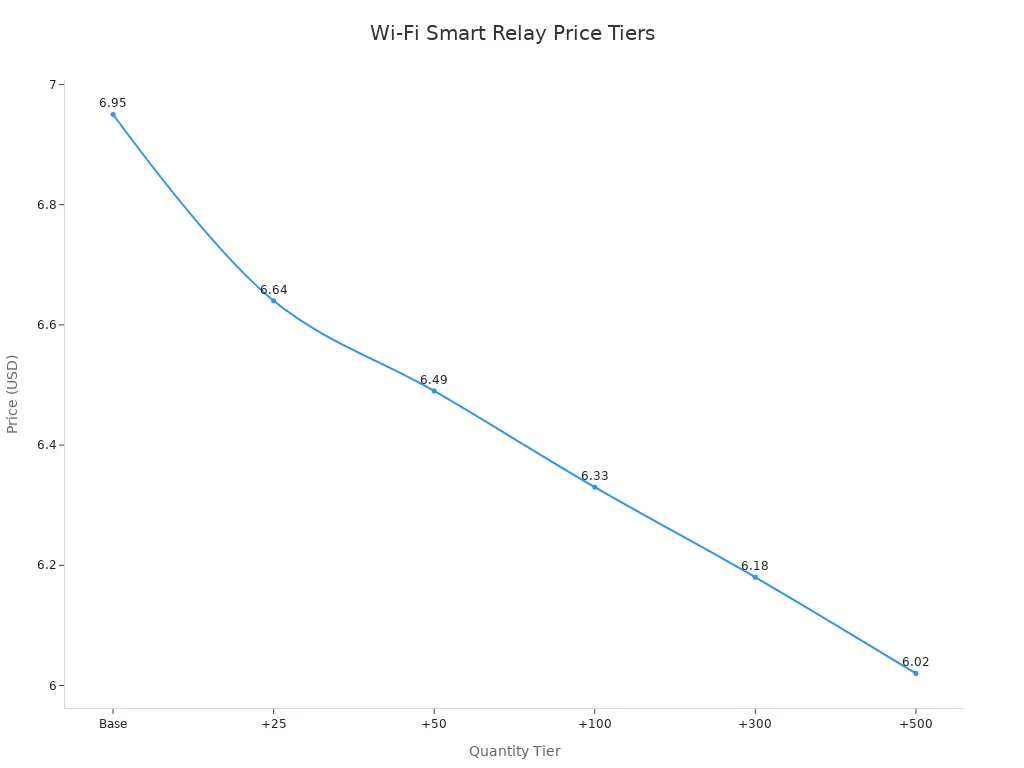
Then plan for the hidden costs. A smart relay usually needs 20-30 mm of box depth, while a full smart switch wants 32-45 mm, per smartswitchmfg.com. Most relays need a neutral at the install point, so a canopy mount often fixes a wall box without one. Think about service access too: a failed relay hidden in a fixture means a ladder and an open canopy. Z-wave relays and other protocol options add a hub purchase on top. Match the relay to your loads and your box before you spend.
Here are the top picks by category:
-
Best overall: Shelly Plus 1, with dry or live contact and 16 A.
-
Best budget: SONOFF MINIR4, a low-cost relay for ceiling lights.
-
Best for dry-contact jobs: Aeotec Pico Switch, UL listed for openers and gates.
-
Best Matter option: SONOFF MINIR4M, ETL listed and cross-platform.
-
Best for tinkerers: an ESP32 board running ESPHome.
Match your module to mounting location, load rating, and local-control needs before you buy. These best wi-fi smart relay modules only work when the box has room and the load stays in range. A smart relay is a long-term install, so check the fit twice.
Confirm UL/ETL and FCC certification, then check that the relay fits your existing box or panel.

Written by Jack Elliott from AIChipLink.
AIChipLink, one of the fastest-growing global independent electronic components distributors in the world, offers millions of products from thousands of manufacturers, and many of our in-stock parts is available to ship same day.
We mainly source and distribute integrated circuit (IC) products of brands such as Broadcom, Microchip, Texas Instruments, Infineon, NXP, Analog Devices, Qualcomm, Intel, etc., which are widely used in communication & network, telecom, industrial control, new energy and automotive electronics.
Empowered by AI, Linked to the Future. Get started on AIChipLink and submit your RFQ online today!
Frequently Asked Questions
Do I need a neutral wire for a smart relay?
Not always. Many modules, including the Shelly Plus 1 and the SONOFF MINIR4, run without a neutral at the switch. The MINIR4 uses a capacitive leakage circuit, so check your fixture first. Very low-wattage LEDs may not trigger it.
Can a relay module control my garage door?
Yes, if it has a dry contact. A dry-contact relay mimics a button press on the opener terminals. The Shelly Plus 1 and the Aeotec Pico Switch both qualify. Live-output relays cannot do this job safely.
What happens to my relays when the internet goes down?
Your wall switch still works. Matter modules keep running local automations through your hub, and Sonoff offers a LAN mode. You just lose remote access until your wi-fi comes back.
How much load can a smart relay handle?
Check the rating against your load type, not just the amp number. A 10 A resistive rating may cover far less for motors and LED drivers. Keep heavy fans and large LED arrays on a 16 A relay.
Do I need UL or ETL certification?
For permanent wiring, yes. Look for a UL or ETL mark on the module itself, plus FCC for the radio. Intertek says its ETL Mark equals the UL Mark for U.S. safety compliance. Inspectors accept both.