October 2026 Aichiplink Market Analysis shows a brutal session for chip stocks while memory prices climb
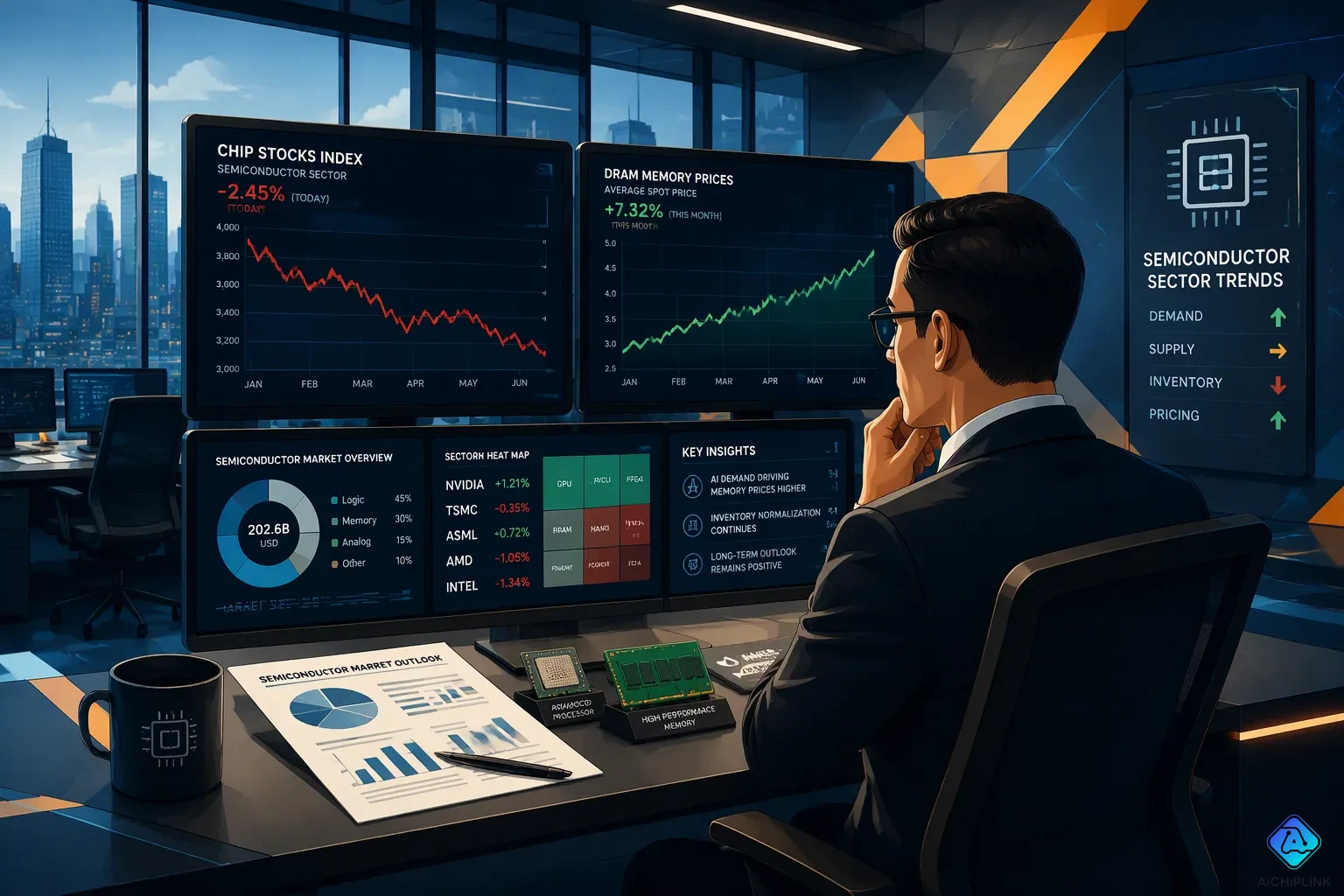
October 2026 brought a brutal, multi-day selloff in chip stocks. Memory prices went up at the same time. That split is the month's defining feature.
South Korea's Kospi closed down 8.1%, and circuit breakers went off. SK Hynix plunged nearly 11%. Samsung Electronics fell 9.5%. Kioxia slumped 11%. The chart below shows the damage across markets.
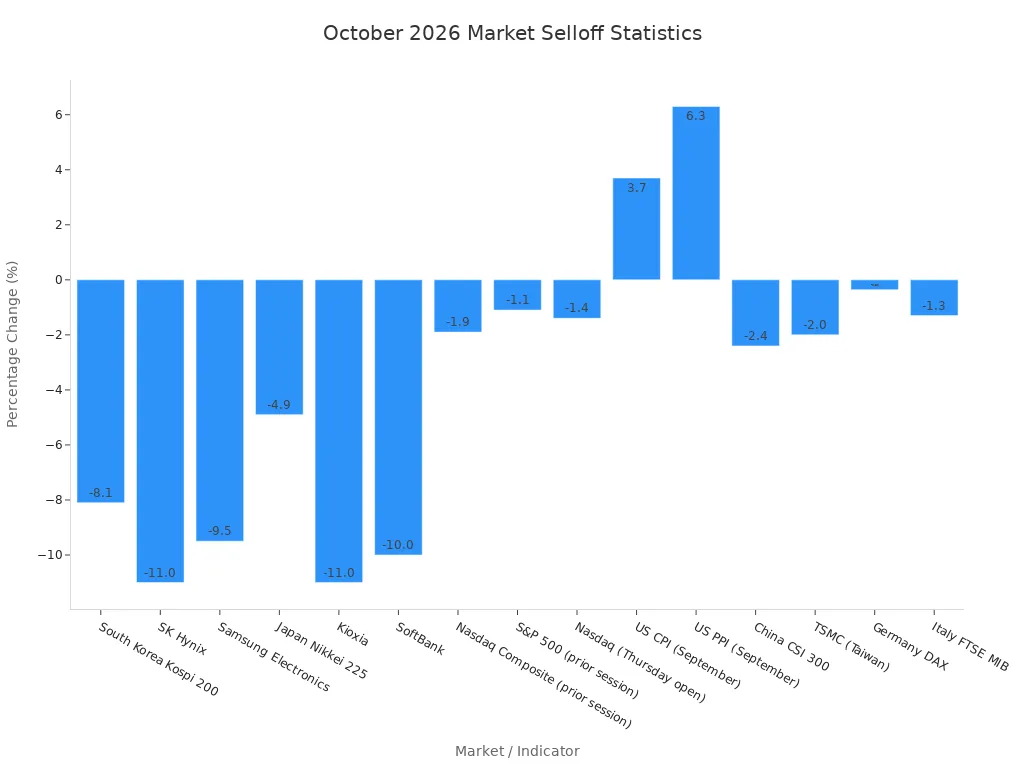
The puzzle is sharp. Industry sales sit at record highs, and prices keep rising. Yet valuations corrected hard. This aichiplink market analysis explains what drove the decline, why memory prices are rising, and how to read the divergence for ai infrastructure, ai chips, ai hardware, and ram decisions. The ai supply chain never stopped growing.
Key Takeaways
-
Chip stocks dropped a lot in October 2026 because people worried about the return on AI investments, but memory prices kept going up thanks to strong AI demand.
-
Memory prices are going up because AI workloads need more server DRAM and enterprise SSDs, and wait times now stretch to 50 weeks.
-
Buying teams should lock in Q4 prices now. This will help them avoid price hikes coming from Renesas and TSMC in January 2027.
-
Buyers must check every spot quote for brand, lot number, grade, and traceability to avoid counterfeit parts.
-
Investors should pay attention to capital expenditure guidance and manufacturer price hikes, not stock market mood, to judge AI demand.
October 2026 Aichiplink Market Analysis at a Glance
Record Sales Meet a Valuation Reset
The industry side of this aichiplink market analysis starts with records. Global semiconductor sales hit $159.7 billion in August 2026, up from $147.9 billion in July. For the first time ever, total sales from January through August passed $1 trillion.
| Metric | Value |
|---|---|
| Global sales, August 2026 | $159.7 billion |
| Global sales, July 2026 | $147.9 billion |
| Cumulative January–August 2026 | Above $1 trillion |
Memory made up most of that gain, and ram demand from ai infrastructure did the heavy lifting.
The Divergence in One Picture
Capital markets told the opposite story. The PHLX Semiconductor Index erased about $2 trillion in market value, and the sector shed more than $1.6 trillion over six sessions through Thursday. The SOXX ETF logged its fifth consecutive day of losses, its longest streak since May 2025. 22 of 30 PHLX components sat more than 20% below record highs set in May and June.
Commentators framed the split as a valuation reset in a sector that had gained more than 70% year to date, set against a possible structural inflection in ai capital spending.
Those key market trends & insights suggest the growth thesis held while sentiment swung. Buyers of ai chips, ai hardware, and gpus still face tight supply, and ai workloads keep climbing. The next sections explain the selloff, the pricing, and the sourcing response.
Why Chip Stocks Sold Off
The October drop was about valuation and mood, not about the basics of the business. It focused on the return on investment for AI-related capital spending. The industry's basics held steady all month. Prices kept going up, shortages stayed, and long-term agreement coverage stayed in place across memory and passive components. Nothing in the order book changed. What changed was how investors priced the future.
The AI ROI Debate
Two industry leaders put the argument in plain terms.
| Speaker | Role | Argument made in the AI ROI debate |
|---|---|---|
| Hock Tan | Broadcom CEO | Capital — not chip or power supply — is now the biggest limit on AI expansion. |
| Lip-Bu Tan | Intel CEO | Investors increasingly want to see return on investment rather than just more capital spending. |
A report that Meta was thinking about a business to resell extra AI compute capacity brought back doubts about whether hyperscalers' spending produces the promised returns. The reasoning is simple. If a company as big as Meta looks to make money from spare capacity instead of using it internally, that signals weak utilization across the wider AI infrastructure build. The ROI case behind chip demand weakens with it.
Funding structure added a second layer of pressure. Much of the AI data center buildout, from GPU clusters to new fabs, runs on debt rather than free cash flow. Higher borrowing costs for longer make projected AI returns less favorable. Investors began pricing that risk in real time instead of waiting for it to show up in quarterly earnings.
Strategist Neil Wilson of Saxo attributed the selloff to a mix of "worries about the AI buildout, bubbly valuations, lower-than-expected earnings growth at leading US frontier labs, Chinese competition, inflation and rates" — stressing that no single factor explains the move, which is why it hit so many names at once.
That multi-factor reading explains the breadth. A single disappointment at one company would have hit one stock. October hit the whole complex, and it hit names with little direct exposure to the debate.
Sentiment Versus Fundamentals
Positioning had grown crowded well before the drop. Bulls had chased a sector up more than 70% year to date. Bears had waited for a crack. Both sides acted on sentiment, and both amplified the move.
Fundamentals stayed firm underneath. Memory contract prices kept climbing through the month. More than 75% of 2027 output sat locked in long-term agreements. Buyers of ai chips, ai hardware, and gpus still faced allocation, and ai workloads kept growing.
The distinction matters for anyone holding AI exposure. A sentiment reset reprices the same cash flows. A fundamental break changes them. October delivered the first, not the second. Capital expenditure guidance and manufacturer price-hike notices carry the real information from here.
Memory Prices Climb on AI Infrastructure Demand
Supply, Demand, and AI Workloads
Supply is promised far ahead of time. Samsung 32GB RDIMMs sit frozen in standard channels at $2,000–$2,200 per module, and DDR5 lead times stretched from 6 weeks to 50 weeks.
Samsung has locked 75–80% of its 2027 memory output (including HBM) through long-term agreements. The remaining ~20% is now being fought over.
The demand works through ai workloads. Long-context models, agents, and persistent sessions force systems to hold more information during ai inference. Each added session and each longer context grows the KV cache footprint. That pressure pushes capacity into larger storage tiers. Enterprise NVMe SSDs now serve as a context tier beyond GPU HBM and system DRAM.
| Metric | Value / Forecast |
|---|---|
| Enterprise SSD share of global NAND bit shipments, Q2 2026 | 48% |
| Enterprise SSD share of global NAND bit shipments, Q2 2025 | ~26% |
| Counterpoint forecast: server eSSD share of NAND bits by end of 2026 | potentially more than half |
Manufacturers answer by steering capacity toward HBM and server ram. That choice serves ai training and ai inferencing in ai data centers, and it starves everything else.
New Products Rise, Old Products Fall
The split is clear. Older, lower-capacity parts are falling while new high-bandwidth parts climb. "Memory prices are rising" is only half the story.
Allocation now runs in two tiers. Hyperscale and AI buyers draw priority quotas. Industrial, automotive, consumer, and embedded buyers lean on authorized channels and vetted independent spot channels. CXMT's 4F² DRAM progress stands as a medium-term structural variable for the whole ram market.
Passive Components Follow the Same Pattern
MLCC Lead Times Stretch
The high end of the passive market shows the same story as memory. Murata raised prices 15–35% on high-capacitance, automotive, and RF products made for ai servers. Taiyo Yuden raised low-capacitance consumer and automotive-grade parts 6–13%. Forecasts for the second half of 2026 put high-capacitance MLCCs up 15–35%, high-capacity parts up 20–30%, and mid- and low-end parts up 10–20%.
Lead times tell the same story. Murata is shifting capacity toward ai server parts and ending some series. Buyers of ai hardware should treat those end-of-life notices as deadlines, not footnotes. Every ai platform adds more capacitors per board, and demand keeps climbing.
Where Supply Still Looks Comfortable
The picture flips at the commodity end. General-purpose consumer MLCCs, resistors, and commodity logic stay stable and well supplied. Domestic alternatives across MCUs, power ICs, MLCCs, and logic devices work where they fit, and they give buyers a real second source for many designs. That option suits consumer builds well.
History offers a warning. Shortages spread from active to passive components, and the pattern is repeating. Teams planning ai infrastructure should review MLCC exposure now. Ai workloads keep rising, gpus and ram allocations stay tight, and ai training and ai inference both pull on the same passive supply. Ai systems built for ai data centers carry the heaviest exposure.
Sourcing & Recycling Landscape for AI Hardware
The sourcing & recycling landscape for ai hardware depends on fit, not on one best grade. Original factory stock, long-term-contract stock, new-but-loose stock, reclaimed or desoldered parts, and domestic-compatible parts each fill a different need. Buyers should match grade to how critical the application is. Critical ai infrastructure slots deserve factory-original traceable parts. Non-critical builds can take looser grades. The same logic covers used and scrap modules, bulk lots of non-working ram, and end-of-life gpus pulled from retired servers. Those streams feed electronics recycling, where gold and precious metal recovery recovers value from gold-plated edge connectors and other plated contacts. Gold recovery potential varies by contact type, so assay before committing volume. These product sourcing insights & recommendations apply across every grade.
Planning Around End-of-Life
End-of-life planning protects long-lifecycle designs. Teams should verify EOL status on legacy part numbers and qualify one or two alternates for every shortage-prone component. A component database can flag unexpected EOL notices across the BOM.
| Aspect | Practice |
|---|---|
| LTB definition | A final purchase with a set quantity limit and order deadline |
| Demand estimation | Project long-term demand and budget for maintenance needs |
| Collaboration | Engineering, procurement, and planning teams work together |
| Post-deadline options | Emulation and aftermarket providers carry risk |
A Last Time Buy locks supply for years, yet it ties up cash and adds storage costs. Authorized continuing manufacturers offer traceable replicas built on original tooling. That path beats gray-market brokers, whose savings rarely survive a single failure.
Reading the Divergence for Investors and AI Hardware Buyers
What It Means for Portfolios
Investors should see October as a price correction while the business basics stayed strong. The selloff followed market mood, not actual orders. Expect more ups and downs either way.
Capital expenditure guidance holds the real signal. That pace pushes near-term free cash flows negative, and the market priced that gap. Rising capex still pays for ai chips, gpus, and ram demand. Manufacturer price-hike notices are the second sign to watch.
What It Means for Procurement
Procurement teams should keep stock-market mood out of inventory choices. The late-October to early-November window is the last clean chance to lock Q4 pricing. Renesas raises prices on January 1, 2027, and TSMC lifts mature-node prices 3–10% from January 2027. Orders placed now avoid both.
Spot prices need care in late November. Order momentum weakens then, and chasing peaks invites losses. Buyers of ai hardware should also match grade to how critical the part is, as earlier sections showed.
The framing stays balanced. Demand from ai infrastructure is structural, not a passing cycle. Consumer-electronics supply remains ample. Each segment has its own right answer, and ai infrastructure decisions should follow segment logic rather than headlines.
October 2026 left two big facts in this aichiplink market analysis. Chip stocks sold off. Memory prices went up.
The selloff was a valuation reset over AI ROI worries. The climb came from capacity pulled toward AI infrastructure. The basics never changed.
Will the gap last? Watch three AI scenarios. Hyperscaler AI capex may grow while AI adoption speeds up. Memory earnings may prove less steady than contracts suggest. Positioning resets may continue, favoring quality AI names. The 2027 cost-escalation window, when Renesas and TSMC raise prices, is the next AI test.
Investors should keep stock market mood apart from procurement reality. AI hardware buyers should plan ram and AI infrastructure orders on ram supply data, not AI headlines.

Written by Jack Elliott from AIChipLink.
AIChipLink, one of the fastest-growing global independent electronic components distributors in the world, offers millions of products from thousands of manufacturers, and many of our in-stock parts is available to ship same day.
We mainly source and distribute integrated circuit (IC) products of brands such as Broadcom, Microchip, Texas Instruments, Infineon, NXP, Analog Devices, Qualcomm, Intel, etc., which are widely used in communication & network, telecom, industrial control, new energy and automotive electronics.
Empowered by AI, Linked to the Future. Get started on AIChipLink and submit your RFQ online today!
Frequently Asked Questions
Did the October 2026 selloff change the outlook for AI demand?
No. The drop was about how investors valued AI and how they felt about AI returns. The industry's numbers stayed strong. AI infrastructure orders stayed on the books, AI chip prices kept going up, and AI capacity stayed tied up in long-term deals. AI buyers still face tight AI supply for AI hardware and AI servers.
Why do memory prices keep climbing while AI stocks fall?
Memory prices follow AI capacity, not the stock market. AI workloads push demand for server DRAM and enterprise SSDs higher. AI makers send more output to HBM and server RAM. AI buyers compete for the AI supply that is left.
How long are RAM lead times right now?
DDR5 lead times grew from 6 weeks to 50 weeks. More than 75% of 2027 RAM output is locked in long-term deals. Samsung 32GB RDIMMs stay at $2,000–$2,200 per module in standard channels. AI infrastructure planners should lock in RAM quotas early.
Should procurement teams wait for prices to fall?
Waiting is risky. Renesas raises prices on January 1, 2027, and TSMC lifts mature-node prices 3–10% starting January 2027. The late-October to early-November window is the last clean chance to lock Q4 pricing. AI hardware buyers should act on RAM supply data.
What should buyers verify on every spot quote?
Buyers should check brand, lot number, grade, and original-manufacturer traceability. High-value AI chips need wafer-code checks and a Certificate of Conformance. Quotes should expire in 24 or 48 hours because spot availability keeps shrinking.
How does hybrid cloud infrastructure fit the picture?
Hybrid cloud infrastructure lets companies run AI training and AI inference on both owned and rented capacity. That mix lowers exposure to any single AI supply chain. Hybrid cloud infrastructure still relies on the same AI chips, GPUs, and RAM, so AI procurement discipline matters either way.