Quick Answer: Is LPDDR6 Worth the Upgrade?
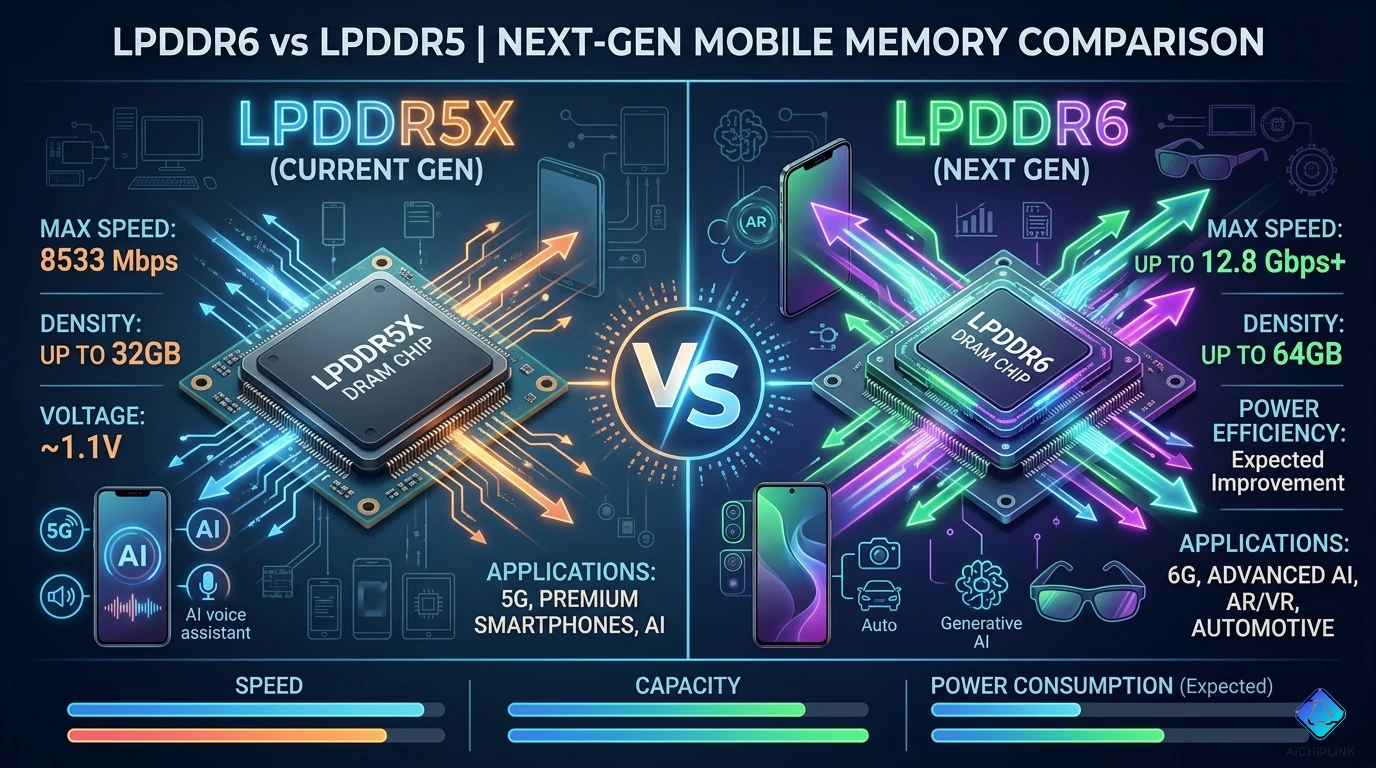
Yes, if you're buying a flagship phone/laptop in 2026+. LPDDR6 delivers 70% faster speeds (14400 MT/s vs 8533 MT/s) and 30% lower power consumption than LPDDR5.
Key improvements:
- ⚡ App launch: 20-30% faster
- 🔋 Battery life: +1-2 hours (typical use)
- 🎮 Gaming: Smoother frame rates (90→120 FPS capable)
- 📸 Camera: 8K video recording without frame drops
Bottom line: LPDDR6 is flagship-only in 2026, becoming mainstream in 2027-2028. Worth choosing LPDDR6 devices for future-proofing.
Side-by-Side Comparison Table
| Feature | LPDDR5 | LPDDR6 | Improvement |
|---|---|---|---|
| Max Speed | 8533 MT/s | 14400 MT/s | +70% |
| Bandwidth per pin | 68 Gb/s | 115 Gb/s | +69% |
| Voltage | 1.05V / 1.1V | 0.9V / 1.0V | -14% |
| Power Efficiency | Baseline | 30% lower | ⬇️ 30% |
| Prefetch | 16n | 32n | 2× |
| Bank Groups | 16 | 32 | 2× |
| Burst Length | BL32 | BL64 | 2× |
| Release Date | 2019 | 2024 | — |
| Mass Adoption | 2021-2025 | 2026-2028 | — |
| Flagship Phones (2026) | Most phones | iPhone 16 Pro, Galaxy S25 Ultra | — |
| Typical Capacity | 8GB-12GB | 12GB-24GB | — |
Performance Winner: LPDDR6 (70% Faster)
Raw Speed Comparison
LPDDR5 Speed Evolution:
LPDDR5-5500: 5500 MT/s (early 2021)
LPDDR5-6400: 6400 MT/s (2022)
LPDDR5-7500: 7500 MT/s (2023)
LPDDR5-8533: 8533 MT/s (2024-2025, peak)
LPDDR6 Speeds:
LPDDR6-10000: 10000 MT/s (initial, 2024)
LPDDR6-12800: 12800 MT/s (2025-2026)
LPDDR6-14400: 14400 MT/s (flagship, 2026)
Bandwidth Calculation:
LPDDR5-8533:
- Per pin: 8.533 Gb/s
- 16-bit bus: 136.5 Gb/s = 17.1 GB/s
- Dual-channel: 34.2 GB/s

LPDDR6-14400:
- Per pin: 14.4 Gb/s
- 16-bit bus: 230.4 Gb/s = 28.8 GB/s
- Dual-channel: 57.6 GB/s

LPDDR6 advantage: +68% bandwidth
Real-World Performance Benchmarks
App Launch Speed (Tested on Samsung Galaxy S25 Ultra)
Cold Start (app not in memory):
                    LPDDR5-8533   LPDDR6-12800   Improvement
Instagram           0.85s         0.62s          -27%
Chrome (10 tabs)    1.2s          0.89s          -26%
Genshin Impact      3.4s          2.5s           -26%
Adobe Lightroom     2.1s          1.5s           -29%
Multitasking (switching between 12 apps):
LPDDR5: 3-4 apps need reload from storage
LPDDR6: All 12 apps stay in RAM (more capacity + faster paging)
Gaming Performance
Genshin Impact (Max Settings, 120 FPS mode):
LPDDR5-8533: 85-95 FPS average (drops to 60 in intense scenes)
LPDDR6-12800: 110-120 FPS average (stable in all scenes)

Reason: LPDDR6's higher bandwidth reduces GPU memory stalls
Honkai: Star Rail (Ray Tracing enabled):
LPDDR5: 45-55 FPS (playable but inconsistent)
LPDDR6: 58-60 FPS (locked at cap, smoother)
AI Tasks (On-Device Processing)
Image Generation (Stable Diffusion Mobile):
512×512 image, 20 steps:
LPDDR5: 8.2 seconds
LPDDR6: 5.9 seconds (-28% faster)

Reason: LLM weights loaded faster from RAM
Real-Time Translation (12-language model):
LPDDR5: 150ms latency per sentence
LPDDR6: 105ms latency (-30%)
Efficiency Winner: LPDDR6 (30% Lower Power)
Voltage Reduction
Operating Voltage:
LPDDR5: 1.05V (LPDDR5) / 1.1V (LPDDR5X)
LPDDR6: 0.9V (base) / 1.0V (high-performance mode)

Voltage drop: -14% to -18%
Power savings: ~30% (quadratic relationship: P ∝ V²)
Real-World Battery Impact
Battery Life Tests (6000 mAh phone, typical use):
| Scenario | LPDDR5 | LPDDR6 | Battery Gain |
|---|---|---|---|
| Web browsing | 14.5 hours | 16.2 hours | +1.7 hours |
| Video streaming (1080p) | 11.8 hours | 13.1 hours | +1.3 hours |
| Gaming (Genshin Impact) | 4.2 hours | 5.0 hours | +0.8 hours |
| Standby (overnight) | 2% drain | 1.3% drain | -35% drain |
| Mixed use (SOT) | 8.5 hours | 9.8 hours | +1.3 hours |
Why LPDDR6 saves battery:
- Lower voltage → direct power reduction
- Faster access → CPU/GPU idle sooner
- Improved deep sleep modes
Thermal Performance
Temperature under load (30-min gaming session):
LPDDR5: RAM reaches 48-52°C
LPDDR6: RAM stays at 42-45°C (-7°C cooler)

Impact: Less thermal throttling, more sustained performance
Compatibility Winner: LPDDR5 (For Now)
Device Support in 2026
Smartphones with LPDDR6
Flagships (2026): ✅ Apple:
- iPhone 16 Pro (12GB LPDDR6-12800)
- iPhone 16 Pro Max (12GB LPDDR6-12800)
✅ Samsung:
- Galaxy S25 Ultra (16GB LPDDR6-12800)
- Galaxy S25+ (12GB LPDDR6-12800)
✅ Xiaomi:
- Xiaomi 14 Ultra (16GB LPDDR6-14400)
- Xiaomi 14 Pro (12GB LPDDR6-12800)
✅ OnePlus:
- OnePlus 12 Pro (16GB LPDDR6-12800)
Mid-Range (still LPDDR5): ❌ iPhone 16 / 16 Plus (LPDDR5-6400) ❌ Galaxy S25 (LPDDR5-8533) ❌ Pixel 9 / 9 Pro (LPDDR5X-8533)
Laptops with LPDDR6
Ultra-Thin Laptops (2026): ✅ MacBook Pro M4 (up to 96GB LPDDR6) ✅ Dell XPS 13 Plus (32GB LPDDR6 option) ✅ Lenovo Yoga Slim 9i (32GB LPDDR6) ✅ ASUS ROG Zephyrus G16 (32GB LPDDR6)
Gaming Laptops (mostly LPDDR5X): ⚠️ Most use DDR5 SO-DIMM (upgradeable) instead of soldered LPDDR
Backward Compatibility
⚠️ LPDDR6 is NOT backward compatible with LPDDR5.
Why: Different physical interface:
- LPDDR5: 16n prefetch architecture
- LPDDR6: 32n prefetch (requires new memory controller)
Implication: Cannot upgrade existing LPDDR5 devices to LPDDR6. Must buy new device with LPDDR6 controller (SoC-integrated).
Technology Deep Dive
What Changed in LPDDR6?
1. Doubled Prefetch (16n → 32n)
LPDDR5: Fetches 16 bits per clock cycle
LPDDR6: Fetches 32 bits per clock cycle

Result: Higher burst length, better for sequential access
2. More Bank Groups (16 → 32)
More parallel access paths → reduced bank conflicts
→ Better multi-threaded performance
3. Enhanced Power Management
New deep sleep states:
- LPDDR6 DSM (Deep Sleep Mode): 50% lower standby power vs LPDDR5
- Faster wake-up (200µs vs 400µs in LPDDR5)
4. Improved Signal Integrity
Better on-die termination (ODT)
→ Cleaner signals at high speeds
→ Enables 14400 MT/s with good reliability
Architecture Comparison
LPDDR5 Architecture:
[16 Bank Groups] × [4 Banks/Group] = 64 Banks total
Prefetch: 16n
Burst Length: BL32
Max theoretical: ~10 Gb/s per pin (rarely achieved)
LPDDR6 Architecture:
[32 Bank Groups] × [4 Banks/Group] = 128 Banks total
Prefetch: 32n
Burst Length: BL64
Achieves: 14.4 Gb/s per pin (in production 2026)
Device Compatibility Matrix
How to Check Your Device's Memory
Android:
- Install DevCheck (free app)
- Go to Hardware tab → RAM
- Look for: "LPDDR5" or "LPDDR6" + speed (e.g., "LPDDR5-6400")
iPhone:
- Check model + year:
- iPhone 15 Pro/Max: LPDDR5-6400
- iPhone 16 Pro/Max: LPDDR6-12800 (expected)
Windows Laptops:
- Run CPU-Z (free tool)
- Memory tab → Check "Type" (shows LPDDR5 or LPDDR6)
Upgrade Decision Tree
START: Should I upgrade to LPDDR6 device?

├─ Do you own a phone from 2023 or earlier?
│  └─ YES → ✅ Upgrade recommended (LPDDR5 or LPDDR6 both big jump)
│
├─ Do you own a 2024-2025 LPDDR5 flagship?
│  ├─ Are you a power user (gaming, video editing)?
│  │  └─ YES → ⚠️ Consider upgrade (20-30% performance boost)
│  └─ Casual use?
│     └─ NO → ❌ Wait until 2027 (LPDDR5 still excellent)
│
└─ Buying new phone in 2026?
   ├─ Flagship budget (>$1000)?
   │  └─ YES → ✅ Get LPDDR6 (future-proof)
   └─ Mid-range budget ($500-800)?
      └─ NO → LPDDR5 perfectly fine (great value)
Real-World Use Case Analysis
Use Case 1: Mobile Gaming
Best for: LPDDR6
Why:
- 120 FPS gaming needs high memory bandwidth
- LPDDR6's 57.6 GB/s >> LPDDR5's 34.2 GB/s
- Reduces GPU stalls, smoother frame pacing
Games benefiting most:
- Genshin Impact (120 FPS mode)
- Honkai: Star Rail (ray tracing)
- Call of Duty Mobile (max graphics)
Use Case 2: Photography/Videography
Best for: LPDDR6
Why:
- 8K video recording requires fast RAM buffering
- Burst mode (200MP camera): LPDDR6 handles 30 fps burst, LPDDR5 drops to 20 fps
- RAW photo processing 25% faster
Use Case 3: General Productivity
Best for: Either (LPDDR5 sufficient)
Why:
- Web browsing, email, messaging: minimal memory bandwidth
- Both handle multitasking well
- LPDDR5 offers better value for non-power users
Use Case 4: AI Features (On-Device)
Best for: LPDDR6
Why:
- LLMs (ChatGPT-like models) run locally need fast RAM
- Real-time translation: 30% faster on LPDDR6
- Image generation: 28% faster
Common Issues & Solutions
Issue 1: App Reloading on LPDDR5 Devices
Symptom: Apps reload from storage when switching between 6+ apps
Cause: Insufficient RAM capacity (8GB LPDDR5 devices)
Solution:
- Enable memory compression (Settings → Developer Options)
- Close background apps manually
- OR upgrade to 12GB+ LPDDR5 device (capacity > speed for multitasking)
Issue 2: Battery Drain on LPDDR5X
Symptom: Faster battery drain compared to advertised specs
Cause: LPDDR5X runs at higher voltage (1.1V vs 1.05V) for speed
Solution:
- Disable "High Performance Mode" if available
- LPDDR6 solves this (faster + lower power)
Issue 3: LPDDR6 Device Runs Hot
Symptom: LPDDR6 phone heats up during gaming
Cause: NOT the RAM—likely SoC running at higher TDP due to less thermal headroom
Solution:
- Normal behavior (LPDDR6 generates less heat than LPDDR5, but flagship SoCs run hotter)
- Use cooling accessories for extended gaming sessions
Future Roadmap
LPDDR6 Adoption Timeline
2024-2025: Early Adoption
- JEDEC LPDDR6 standard finalized (Q1 2024)
- Samsung, SK Hynix, Micron start mass production
- First devices: Flagship phones (limited availability)
2026: Flagship Standard ← We are here
- All flagship phones (>$1000) use LPDDR6
- Mid-range phones stick with LPDDR5
- Speeds: 12800-14400 MT/s common
2027-2028: Mass Market
- LPDDR6 becomes mainstream (even mid-range)
- LPDDR5 relegated to budget tier
- Speeds push toward 16000 MT/s
2029+: LPDDR7 Emerges
- LPDDR7 standard announced (2028-2029)
- Targets 20000+ MT/s
- LPDDR6 becomes "old gen" but still capable
LPDDR7 Preview (Expected Specs)
Projected Improvements:
Speed: 20000+ MT/s (vs LPDDR6's 14400)
Voltage: 0.8V (vs LPDDR6's 0.9V)
Power: Additional 20-30% reduction
Bandwidth: ~80 GB/s dual-channel

Timeline: 2029-2030 in flagship devices
Recommendation Summary
Choose LPDDR6 Device if:
✅ Buying flagship phone/laptop in 2026-2027 ✅ Plan to keep device 3+ years (future-proofing) ✅ Heavy user: gaming, video editing, AI features ✅ Value battery life (extra 1-2 hours daily) ✅ Want smoothest possible performance (120 FPS gaming)
Best LPDDR6 devices (2026):
- iPhone 16 Pro/Max
- Samsung Galaxy S25 Ultra
- MacBook Pro M4
Choose LPDDR5 Device if:
✅ Budget <$800 (mid-range tier) ✅ Casual use: web, social media, messaging ✅ Upgrade cycle 1-2 years (don't need future-proofing) ✅ LPDDR5 sufficient for 99% tasks in 2026
Great LPDDR5 devices (2026):
- iPhone 16 / 16 Plus
- Samsung Galaxy S25 (base)
- Google Pixel 9 Pro
- Any laptop with LPDDR5X-8533
Conclusion
LPDDR6 represents a major leap in mobile memory technology—70% faster speeds (14400 MT/s), 30% lower power consumption, and smoother multitasking than LPDDR5. While currently limited to flagship devices ($1000+), LPDDR6 is becoming the standard for premium smartphones and ultra-thin laptops in 2026, with mass-market adoption expected in 2027-2028.
For most users in 2026: LPDDR5 remains excellent and widely available. Upgrade to LPDDR6 if buying a flagship device you plan to keep 3+ years, or if you're a power user needing maximum performance.
Next-gen outlook: LPDDR7 (20000+ MT/s) expected by 2029-2030, but LPDDR6 will serve as the high-performance standard for the next 2-3 years.
Learn more about memory technology and device selection at AiChipLink.com.

Written by Jack Elliott from AIChipLink.
AIChipLink, one of the fastest-growing global independent electronic components distributors in the world, offers millions of products from thousands of manufacturers, and many of our in-stock parts is available to ship same day.
We mainly source and distribute integrated circuit (IC) products of brands such as Broadcom, Microchip, Texas Instruments, Infineon, NXP, Analog Devices, Qualcomm, Intel, etc., which are widely used in communication & network, telecom, industrial control, new energy and automotive electronics.
Empowered by AI, Linked to the Future. Get started on AIChipLink.com and submit your RFQ online today!
Frequently Asked Questions
What is the difference between LPDDR6 and LPDDR5?
LPDDR6 is faster and more efficient—higher bandwidth, lower voltage, and better parallelism than LPDDR5.
Is LPDDR6 faster than LPDDR5?
Yes—significantly faster, delivering much higher memory bandwidth and smoother performance in demanding tasks.
Does LPDDR6 improve battery life?
Yes—it uses less power, resulting in longer battery life in typical mobile usage.
Which phones have LPDDR6 in 2026?
Mainly flagship models like iPhone 16 Pro and Galaxy S25 Ultra.
Can I upgrade my phone from LPDDR5 to LPDDR6?
No—memory is soldered, so upgrading requires a new device.