How AI Data Centers Work
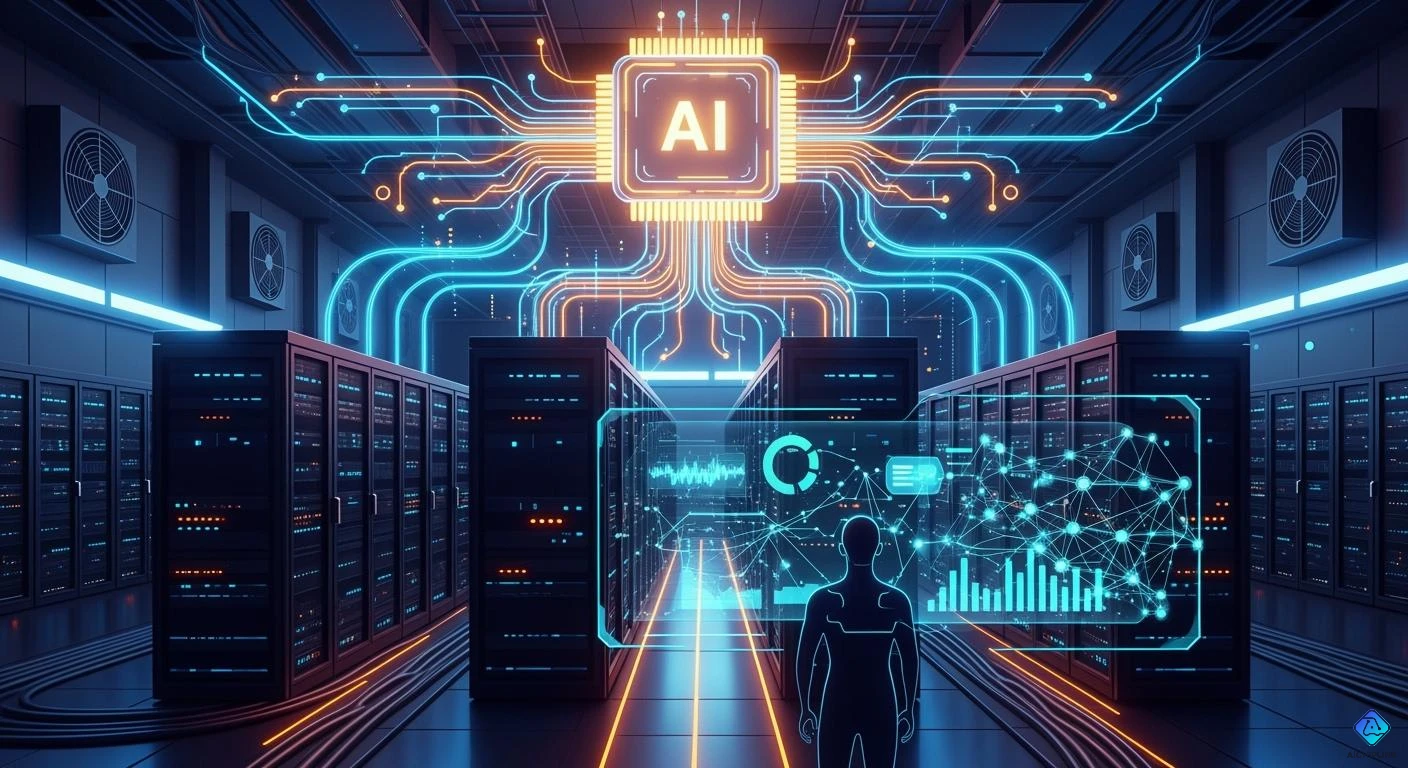
You use ai data centers for fast and strong ai services. These centers have GPU-dense racks and accelerators. They help process a lot of data very fast. Traditional data centers use CPU-based servers for steady work. Ai data centers handle sudden, heavy work and use more power.
Ai data centers have high-bandwidth, low-latency networks. These networks let processors talk to each other quickly. This setup helps ai solve hard problems and answer right away.
| Aspect | AI Data Centers | Traditional Data Centers |
|---|---|---|
| Workload Patterns | Handle sudden, heavy work | Manage steady, regular work |
| Hardware Emphasis | Use GPU-dense racks and accelerators | Mostly use CPU-based servers |
| Heat and Power Density | Use 2-3 times more power | Use less power |
| Networking Requirements | Need high-bandwidth, low-latency networks | Moderate bandwidth is enough |
Key Takeaways
-
AI data centers use strong GPUs and TPUs. These help them do hard jobs fast. This makes them great for AI work.
-
AI data centers have networks that move data very fast. These networks also let processors talk to each other quickly.
-
Good cooling is very important in AI data centers. Liquid cooling helps keep things cool. This is needed because high-density racks get hot.
-
AI data centers need more power than normal centers. They can use three times more electricity. So, it is important to plan how to save energy.
-
Edge AI data centers handle data near the users. This lowers latency and makes real-time apps work better.
AI Data Centers Overview
Definition & Purpose
AI data centers are special places for hard jobs. They use smart designs and advanced tools. These centers help artificial intelligence work faster. Inside, you find high-performance GPUs and TPUs. These help process data very quickly. Software-defined networking moves data fast. It sends data where it needs to go right away.
AI data centers use parallel processing for smooth work. This lets you train and use machine learning models fast and well.
People use ai data centers for many reasons. Here are some main uses:
-
Handle hard jobs that regular data centers cannot do.
-
Make sure important ai tasks always work.
-
Give fast results by making things run better.
-
Help with fast data growth from ai and cloud services.
Core Operations
AI data centers work in a different way than regular ones. They use high-performance computing to solve big problems. You see advanced storage like SSDs and high-bandwidth memory. These help you get and use data fast.
AI data centers have strong and safe networks. High-bandwidth and low-latency networks move data quickly. New ideas like copackaged optics help save energy and boost bandwidth.
AI data centers need strong power and cooling. They use liquid cooling and hot/cold aisles. These keep things cool and save energy.
Here are some main things ai data centers do:
-
Use high-performance computing for fast ai jobs.
-
Use advanced storage for quick data access.
-
Have strong and safe networks for fast data movement.
-
Use good power and cooling for stable work.
AI workloads need special care. Training models uses big datasets and batch processing. You need parallel compute and lots of GPU use. Checkpointing model states keeps your work safe and helps you track progress.
| Requirement | Traditional data center | AI data center |
|---|---|---|
| Compute | CPU-centric | GPU/accelerator-centric |
| Networking | Standard Ethernet | High-speed fabric (InfiniBand / high-speed Ethernet) |
| Storage | Balanced capacity and latency | High throughput for training data |
AI data centers help cloud services and future ai projects. They help you manage data, work faster, and keep things safe and reliable.
AI Data Centers vs. Traditional Data Centers
Key Differences
There are big differences between ai data centers and traditional data centers. Ai data centers use thousands of GPUs and TPUs for artificial intelligence jobs. These jobs need many processors working together and fast access to lots of data. Traditional data centers focus on steady IT work and mostly use CPUs.
Here is a table that shows how hardware and design are different:
| Feature | Traditional Data Center | AI Data Center |
|---|---|---|
| Primary Functions | General-purpose IT services | AI/ML model training and inference |
| Workload Pattern | Stable, predictable workloads | Dynamic, bursty, data-intensive workloads |
| Compute Hardware | CPU-centric | GPU/TPU-dense clusters |
| Rack Power Density | 7 kW - 10 kW/rack | 30 kW - over 100 kW/rack |
| Storage | Balanced performance and capacity | Very high-throughput SSD/NVMe storage |
| Networking | Standard Ethernet | Ultra-high-bandwidth, low-latency interconnects |
| Cooling | Primarily air cooling | Liquid cooling or hybrid cooling |
| Facility Design | Optimized for mixed workloads | Optimized for high-density AI workloads |
Ai data centers need strong computing clusters. You see multi-core CPUs with racks full of GPUs and TPUs. These clusters do big jobs and use much more power than regular data centers. Ai jobs also need storage that can hold huge amounts of data. You get fast data movement and many processors reading at once, which is not like normal storage.
Unique Requirements
Ai data centers have special needs. You must handle high power because ai racks use 30 kW to over 100 kW. Power use can change fast, so it is hard to keep things balanced. Power electronics in ai data centers work differently from normal ones, and this can affect the power grid. Sometimes, many ai data centers are built close together. This can put stress on the local power system and may need upgrades.
-
High power racks need better cooling, like liquid cooling.
-
Fast changes in power use make planning tough.
-
Power electronics can cause problems for the power grid.
-
Many ai data centers in one place can strain local systems.
You need very fast networks, like InfiniBand or RDMA, to move data quickly between processors. Ai jobs need storage that is fast and can grow bigger. These needs make ai data centers different and help them get ready for the future of artificial intelligence.
AI Data Centers: Components & Tech
Specialized Processors (GPUs, AI Chips)
The main part of ai data centers is their special processors. These include GPUs, TPUs, FPGAs, and ASICs. Each processor helps artificial intelligence work faster and better. GPUs from Nvidia and AMD can do many jobs at once. This lets you train big neural networks and look at lots of data fast. TPUs are good at tensor math, which is needed for deep learning. NPUs act like the human brain, so ai can work in real time.
Using these processors gives you strong performance and quick results. You can do trillions of tasks every second. This helps you solve hard problems and make better ai models.
Most ai clusters have thousands of GPUs linked by fast networks. These clusters help you do bigger jobs and grow your work. You use these processors when you use cloud services or train new ai models.
| Evidence | Description |
|---|---|
| GPU Data Center Market Share | In 2024, the GPU Data Center part had over 55% of the AI Data Center Market. |
| Processing Power | GPUs are key for running hard AI models. They give more power, move data faster, and help you grow your work. |
-
GPUs and AI chips help you:
-
Do many jobs at the same time.
-
Move data quickly.
-
Grow your projects without slowing down.
-
Software-Defined Networking
Ai data centers need fast and flexible networks. Software-defined networking (SDN) gives you this control. SDN lets you use software to manage how data moves. You can change paths, set rules, and control traffic easily.
With SDN, data goes where it needs to go on time. You stop slowdowns and keep ai jobs working well. SDN also keeps your network safe. You can find and fix problems fast.
SDN gets your data center ready for the future. You can add new tools, link to the cloud, and support new ai jobs without changing hardware.
Hyperconverged Infrastructure
Many new ai data centers use hyperconverged infrastructure (HCI). HCI puts computing, storage, networking, and software in one system. You do not have to manage each part alone. Everything works together, so your job is easier.
-
HCI helps you:
-
Manage hard systems with easy tools.
-
Make virtual jobs run faster.
-
Save money and use resources better.
-
Keep data safe and follow the rules.
-
HCI works with hybrid cloud setups. You can move work between your own center and the public cloud. This helps you handle changes and keep ai working well.
HCI makes your data center software-defined. You get better speed, more trust, and can grow as you need.
You can count on HCI for the trust, uptime, and space you need for ai and cloud jobs. It gets your data center ready for the future of artificial intelligence.
Operations & Sustainability
Cooling & Power
AI data centers need strong cooling and power. High-density racks get very hot. Liquid cooling works better than air cooling for these hot spots. It uses less fans and keeps equipment fast. Some centers use immersion cooling to keep parts cool and working well. Closed-loop systems save water and try to make no waste. Hybrid cooling mixes air and liquid to use less energy. AI-driven cooling uses machine learning to change temperatures right away. This helps save energy.
Using these cooling methods keeps your data center safe and efficient.
| Aspect | AI Data Centers | Traditional Data Centers |
|---|---|---|
| Electricity Consumption | 26% in Virginia | N/A |
| Power Consumption by Servers | 60% on average | N/A |
| Cooling System Efficiency | 7% to 30% | N/A |
| Water Consumption | 17 billion gallons | N/A |
AI data centers use more energy than old centers. Powerful chips for ai jobs need two to four times more energy than regular servers. Cooling can use up to 30% of all energy. You must plan for high power and water use for the future.
Energy Efficiency
You can make your data center greener with new ideas. Use green energy like solar or wind to cool things down. Recover waste heat and recycle water to help the planet. Advanced liquid cooling saves energy and helps you get a low Power Usage Effectiveness (PUE), sometimes as low as 1.2. This means you use less energy for things besides computing. Water Usage Effectiveness (WUE) is also important. It shows how well you use water for cooling.
Experts say you should find new ways to measure efficiency as AI data centers grow. Splitting up jobs can help you track work and save energy.
Security & Edge Computing
You must keep your data and AI models safe from many risks. Sensitive data for ai jobs needs strong privacy rules. Using GPUs and cloud systems makes more places for attacks. You need to stop model theft, tampering, and supply chain threats. Security must grow as your data center gets bigger. You also need to follow data protection rules.
| Security Challenge | Description |
|---|---|
| Data privacy and protection | Sensitive data used for AI training increases the risk of breaches or unauthorized access. |
| Increased attack surface | The use of GPUs and distributed systems necessitates stronger security measures. |
| Model theft and tampering | AI models are at risk of intellectual theft and manipulation during their lifecycle. |
| Scalability of security | Security solutions must scale with the dynamic nature of AI workloads without sacrificing performance. |
| Supply chain vulnerabilities | Dependencies in hardware and software can expose the infrastructure to security risks. |
| Compliance challenges | Ensuring compliance with data protection regulations is complex due to the scale of AI workloads. |
Edge computing lets you process data close to where it is made. This cuts delay and helps real-time jobs like healthcare and smart cities. By using edge and cloud together, you get a fast and flexible system. You can meet user needs quickly and get ready for the future of AI.
Applications & Future Trends
Real-World Use Cases
Ai data centers help many industries work better. They let you make new designs for games, AR, and VR. Generative ai helps you create art and content fast. Automation and robotics improve customer service with chatbots. Factories become more flexible with these tools. Ai helps doctors find better treatments by looking at lots of data. Cybersecurity uses ai to spot threats and stop cybercrime.
-
Digital Realty builds new ai racks quickly with modular designs.
-
DartPoints gives companies like Virtuous AI strong colocation for ai jobs.
Ai data centers help healthcare, finance, and cars. Powerful GPUs run complex models for medicine, smart money choices, and real-time car data. You get faster ideas and better results.
Edge AI Data Centers
Edge ai data centers bring computing close to you. These centers process data near users and devices. This cuts delay and makes things faster. You get real-time analytics for smart cities, self-driving cars, and IoT devices. Edge centers use modular designs and smaller power than big centers.
| Characteristic | Centralized AI Data Centers | Edge AI Data Centers |
|---|---|---|
| Typical Power Capacity | 50-500+ MW | 1-10 MW |
| Primary Workload | AI Training | AI Inference, Analytics |
| Latency Requirements | Seconds to Minutes | Milliseconds |
| Geographic Strategy | Power-rich Regions | Near Users/Data Sources |
| Deployment Model | Custom-built Facilities | Modular/Prefabricated |
You reach an edge server in less than 10 milliseconds. Edge centers lower delay, save bandwidth, and make scaling easier. But you also face problems like security risks, hard management, and more energy use.
-
Less delay and bandwidth use
-
Faster answers
-
More reliability
-
Easier to grow
-
Security worries
-
Hard to manage systems
-
More energy needed
-
Hardware issues
Edge ai data centers help you follow rules and process lots of data nearby. This makes them good for agentic ai jobs.
Challenges & Outlook
Ai data centers have many challenges. Getting enough power is tough because they use three times more electricity than regular centers. Operators must connect to the grid and use green energy for business needs. Cooling and density needs are much higher, so you need advanced solutions.
| Challenge | Description |
|---|---|
| Securing Adequate Power Capacity | Grid limits delay new facility connections. |
| Integrating Renewable Energy Sources | Switching to renewables is needed for business. |
| Addressing Grid Interconnection | Handling grid links is key for fast deployment. |
| Power and Cooling Infrastructure | Centers need much more power density. |
| Density Requirements | Cooling needs are 15 times higher than normal. |
| Data Privacy and Protection | Sensitive data raises breach risks. |
| Increased Attack Surface | New tech needs strong security. |
| Compliance Challenges | Changing rules make compliance hard. |
| Increased Electricity Demand | Ai centers use three times more electricity than regular ones. |
| Grid Impact | Fast growth brings problems for power grids. |
The future of ai data centers depends on balancing computing needs, profits, and less carbon. You see bigger GPU clusters, more data, and designs that save energy. Operators use renewable energy, better cooling, and sometimes nuclear power. Immersion cooling will become common as ai jobs grow. You will use integrated ai platforms for all ai work.
You help shape the future of ai data centers by using new tech and sustainable ways.
You can see AI data centers helping new technology grow. These centers have special processors and smart cooling systems. They can handle lots of data at once. This helps connect more devices and makes AI grow faster. Cloud computing also gets bigger because of this.
-
Immersion cooling cools more equipment in less space. It also costs less money.
-
AI data centers use three times more electricity than normal centers.
-
More than half of companies think they will have more data for AI models soon.
-
As data gets bigger, new storage and security tools will matter more.
AI data centers help you fix big problems and build the future.

Written by Jack Elliott from AIChipLink.
AIChipLink, one of the fastest-growing global independent electronic components distributors in the world, offers millions of products from thousands of manufacturers, and many of our in-stock parts is available to ship same day.
We mainly source and distribute integrated circuit (IC) products of brands such as Broadcom, Microchip, Texas Instruments, Infineon, NXP, Analog Devices, Qualcomm, Intel, etc., which are widely used in communication & network, telecom, industrial control, new energy and automotive electronics.
Empowered by AI, Linked to the Future. Get started on AIChipLink and submit your RFQ online today!
Frequently Asked Questions
What makes an AI data center different from a regular data center?
AI data centers use special processors like GPUs and TPUs. They use more power and need advanced cooling. These centers move data faster. They handle bigger jobs than regular data centers.
Why do AI data centers need so much cooling?
AI chips make a lot of heat. Strong cooling keeps equipment safe and working well. Liquid cooling and smart systems save energy. They stop things from getting too hot.
Can you use renewable energy in AI data centers?
Yes! Many AI data centers use solar or wind power. Using green energy helps the planet. It lowers your carbon footprint. It supports sustainability goals.
How do AI data centers keep your data safe?
You use strong security tools and follow privacy rules. AI data centers protect your data with firewalls and encryption. They check for threats and fix problems quickly.