In the era of Generative AI and Large Language Models (LLMs), the limiting factor for compute clusters is often no longer the GPU—it's the network. When training a model like GPT-4 across thousands of GPUs, the "All-Reduce" synchronization step requires massive bandwidth and ultralow latency. If the network stalls, the GPUs stall.
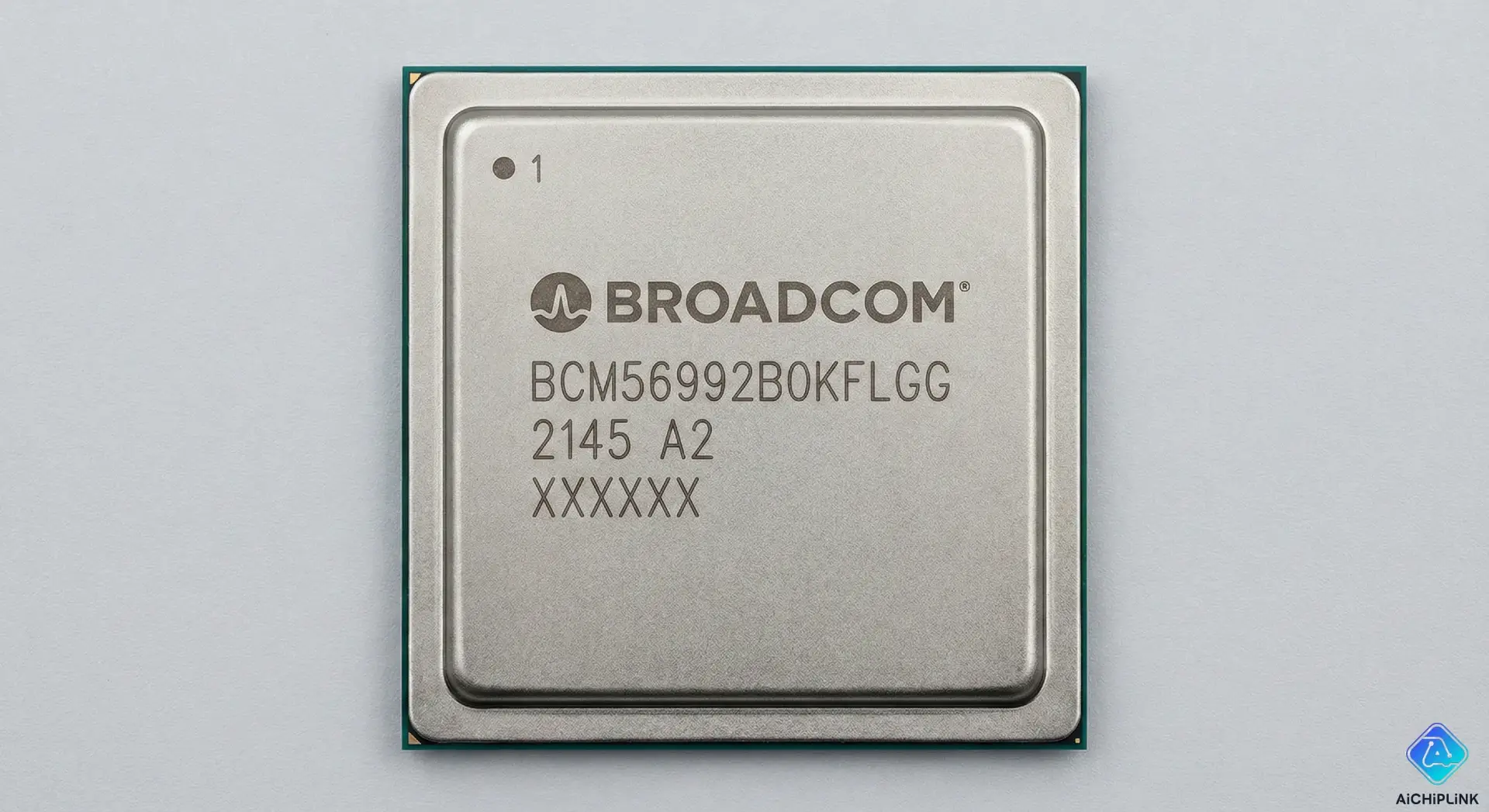
This is where the Broadcom BCM56992B0KFLGG comes into play.
As a core member of the StrataXGS® Tomahawk 4 family, this chip represents a quantum leap in switching silicon. Built on a 7nm process, it delivers 12.8 Terabits per second (Tbps) of switching capacity in a single monolithic die. While its bigger brother (the BCM56990) hits 25.6T, the BCM56992 is the strategic choice for high-density Top-of-Rack (ToR) and Leaf switches, democratizing 400GbE connectivity for the enterprise and hyperscale cloud.
This guide provides an exhaustive technical analysis of the BCM56992B0KFLGG, covering its PAM4 PHY architecture, its role in SONiC-based open networking, and the thermal engineering required to tame this beast.
Table of Contents
- 1. Decoding the Silicon: BCM56992B0KFLGG Specs
- 2. The Physics of Speed: 50G PAM4 SerDes
- 3. Architecture: High Radix & AI Clusters
- 4. Software Ecosystem: SONiC & SAI
- 5. Thermal & Hardware Design Challenges
- 6. Conclusion & Sourcing
1. Decoding the Silicon: BCM56992B0KFLGG Specs
The BCM56992B0KFLGG is not just "another switch chip"; it is a System-on-Chip (SoC) designed to replace multiple chassis-based line cards from the previous decade.
Part Number Breakdown
Understanding the Broadcom nomenclature reveals critical details about the component:
- BCM56: Standard prefix for Broadcom Ethernet Switch products.
- 992: Designates the 12.8 Tbps capacity variant of the Tomahawk 4 architecture. (The '990' is the 25.6T variant).
- B0: The Silicon Revision (Stepping). "B0" indicates a mature stepping that likely fixes hardware errata present in "A0", making it the preferred choice for mass production stability.
- KFLGG: Indicates the package type (RoHS compliant Flip-Chip BGA) and commercial temperature range.
Key Specifications Matrix
| Feature | Specification | Impact |
|---|---|---|
| Switching Capacity | 12.8 Tbps (Full Duplex) | Supports non-blocking traffic for thousands of servers. |
| Packet Processing | > 8 Billion Packets Per Second (Bpps) | Critical for handling small packets in high-frequency trading or DNS. |
| SerDes Architecture | 256 x 50G PAM4 | The physical foundation of 400GbE ports. |
| Port Configurations | 32x 400GbE / 64x 200GbE / 128x 100GbE | Flexible breakout cables allow mixing speeds. |
| Process Node | TSMC 7nm | Enables 40% lower power per bit compared to 16nm predecessors. |
| Packet Buffer | Unified Shared Buffer | Dynamically allocated memory to absorb micro-bursts without dropping packets. |
Price Analysis & Stock Availability
Due to the global demand for AI infrastructure, chips like the BCM56992 are often allocation-constrained.
Procurement Tip: Do not rely on spot markets for critical infrastructure. [Check Stock for BCM56992B0KFLGG at Aichiplink] to view real-time inventory from verified distributors.
2. The Physics of Speed: 50G PAM4 SerDes
The defining innovation of the Tomahawk 4 family is the shift in signal modulation. To achieve 12.8 Tbps, Broadcom had to move beyond traditional binary signaling.
Why NRZ Failed at 400G
Previous generations (Tomahawk 2) used NRZ (Non-Return-to-Zero) signaling, where high voltage equals '1' and low voltage equals '0'.
- The Limit: To reach 400G using NRZ lanes (e.g., 25G lanes), you would need 16 parallel lanes. This creates unmanageable cabling density and PCB routing complexity.
- The Frequency Wall: Simply speeding up NRZ to 50G Nyquist frequency causes massive signal loss (attenuation) over copper traces, requiring expensive PCB materials.
PAM4: 2 Bits Per Symbol
The BCM56992 utilizes PAM4 (Pulse Amplitude Modulation 4-level) SerDes.
- How it Works: Instead of two voltage levels, PAM4 uses four distinct voltage levels (00, 01, 10, 11). This transmits two bits per clock cycle.
- The Result: A 26.56 Gbaud signal can carry 53 Gbps of data. By bonding just 8 lanes of 50G PAM4, the BCM56992 achieves a native 400GbE port (8 x 50G = 400G).
- The Challenge: PAM4 has a significantly reduced Signal-to-Noise Ratio (SNR) compared to NRZ. This necessitates powerful Forward Error Correction (FEC) engines embedded directly into the BCM56992 silicon to correct bit errors on the fly.
For a deeper dive into signal modulation physics, the Wikipedia article on PAM4 offers excellent background.
3. Architecture: High Radix & AI Clusters
In data center design, "Radix" refers to the number of ports a switch can support. The BCM56992 is a High Radix chip, and this changes network topology fundamentally.
Flattening the Network Topology
Traditionally, networks used a 3-tier architecture (Access, Aggregation, Core) to connect thousands of servers. This added latency (hops) and cost. With the BCM56992, you can split its 400G ports into 100G breakouts.
- Example: A single chip can provide 128 ports of 100GbE.
- Impact: This allows builders to construct a 2-Tier Leaf-Spine (Clos) network connecting huge numbers of GPUs with only one "hop" between them. This significantly reduces the "tail latency," ensuring consistent performance for distributed applications.
Optimizing for AI/ML Training Workloads
AI training involves an "All-Reduce" operation where every GPU exchanges data with every other GPU.
- Load Balancing: The BCM56992 features Dynamic Load Balancing (DLB). It monitors the congestion on all links in real-time and can re-route packets mid-flow to avoid "elephant flows" (large data streams) blocking "mice flows" (control signals).
- Elephant Flow Detection: The hardware automatically identifies these massive streams and treats them differently to prevent buffer exhaustion.
4. Software Ecosystem: SONiC & SAI
Hardware is useless without software. Broadcom has embraced the Open Networking revolution with the Tomahawk 4.
Open Networking Freedom
The BCM56992 is fully compatible with SONiC (Software for Open Networking in the Cloud), the open-source network operating system pioneered by Microsoft and now managed by the Open Compute Project (OCP).
- SAI (Switch Abstraction Interface): Broadcom provides a standardized SAI binary driver. This allows network operators to write a single software stack that works on BCM56992, and theoretically, chips from other vendors, preventing vendor lock-in.
- SDKLT: For OEMs building proprietary OSs, Broadcom offers the Logical Table SDK (SDKLT). Unlike the old register-based SDK, SDKLT treats the switch hardware as a database, making automation and API integration significantly easier.
Advanced Telemetry (BroadView Gen 4)
When a packet drops in a network carrying a billion packets per second, finding the cause is like finding a needle in a haystack. The BCM56992 includes In-Band Telemetry (INT) hardware. It can stamp metadata onto live packets (such as queue depth, latency, and switch ID) without affecting performance. This allows AI operators to visualize exactly where and why latency spikes are occurring.
5. Thermal & Hardware Design Challenges
Packing 12.8 Tbps into a single package creates immense physical challenges.
Cooling 300W+ in 1U
While the 7nm process is efficient, the BCM56992 can still draw substantial power (TDP) under full load, often exceeding 300W-350W.
- Heat Density: The die size is relatively small, creating a massive heat flux density.
- Solution: Reference designs typically use Vapor Chamber heatsinks and high-CFM (Cubic Feet per Minute) counter-rotating fans. The chassis airflow impedance must be carefully modeled.
PCB Layout & Signal Integrity
Routing 256 lanes of 50G PAM4 signals requires an advanced PCB.
- Materials: Standard FR4 is too "lossy." Designers must use ultra-low-loss materials like Megtron 7 or Tachyon 100G.
- Trace Length: The trace length from the BCM56992 BGA balls to the QSFP-DD cage is critically limited. Retimers are often needed if the trace exceeds ~8-10 inches, adding cost and power. For engineers dealing with these layout constraints, EEPower’s High-Speed PCB Guidelines is a vital resource.
6. Conclusion & Sourcing
The Broadcom BCM56992B0KFLGG (Tomahawk 4) is more than a component; it is an enabler of the AI revolution. By offering 12.8 Tbps bandwidth, native 400GbE support, and robust telemetry, it allows data centers to scale to unprecedented levels of performance.
However, designing with or sourcing this chip requires navigating a complex landscape of signal integrity physics, thermal management, and supply chain constraints.
Securing Your Supply Chain In the high-stakes world of AI infrastructure, component availability is the bottleneck. Do not let silicon shortages halt your deployment. Aichiplink specializes in sourcing high-performance networking silicon, including hard-to-find Broadcom Tomahawk series chips.

Written by Jack Elliott from AIChipLink.
AIChipLink, one of the fastest-growing global independent electronic components distributors in the world, offers millions of products from thousands of manufacturers, and many of our in-stock parts is available to ship same day.
We mainly source and distribute integrated circuit (IC) products of brands such as Broadcom, Microchip, Texas Instruments, Infineon, NXP, Analog Devices, Qualcomm, Intel, etc., which are widely used in communication & network, telecom, industrial control, new energy and automotive electronics.
Empowered by AI, Linked to the Future. Get started on AIChipLink.com and submit your RFQ online today!
Frequently Asked Questions
What is the BCM56992B0KFLGG used for?
The BCM56992B0KFLGG is a 12.8 Tbps data center switch SoC designed for next-generation AI clusters, cloud networks, hyperscale data centers, and high-performance leaf-spine architectures. It enables 400GbE/200GbE/100GbE connectivity with advanced telemetry and congestion control.
How many 400G or 100G ports does the BCM56992B0KFLGG support?
This chip supports 32×400GbE, 64×200GbE, or 128×100GbE ports through 50G PAM4 SerDes lanes. Flexible breakout allows mixing port speeds depending on network design.
What technology makes the BCM56992B0KFLGG achieve 12.8 Tbps?
The chip uses 256 × 50G PAM4 SerDes, delivering 2 bits per symbol with advanced FEC. This architecture enables ultra-high bandwidth while keeping PCB trace density manageable.
Is the BCM56992B0KFLGG compatible with SONiC and open networking?
Yes. The BCM56992 fully supports SONiC, SAI, and Broadcom’s SDKLT, allowing cloud providers and OEMs to build open, automated, and vendor-neutral network operating systems.
What is the typical power consumption of the BCM56992B0KFLGG?
Depending on port utilization and configuration, the BCM56992 can reach 300W–350W. Designs typically require vapor-chamber heatsinks and high-airflow cooling for stable operation in 1U or 2U switching platforms.
.png&w=256&q=75)