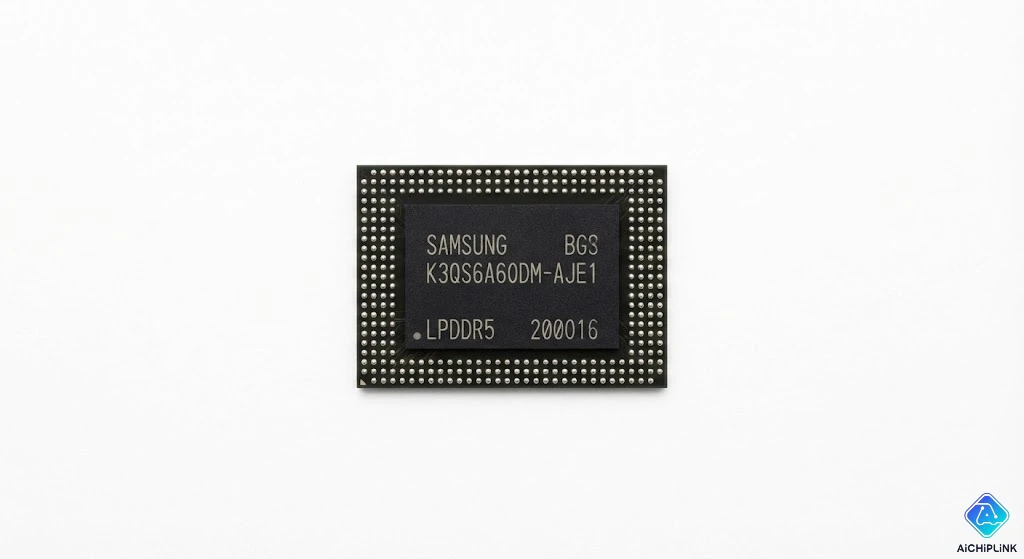
Open your smartphone, your tablet, or the dashboard of a modern electric car, and you won't find the stick of RAM you see in a desktop PC. Instead, you will find a small, square black chip soldered directly to the board—or arguably even stacked right on top of the processor.
This is LPDDR (Low Power Double Data Rate) memory.
While standard DDR serves the "Performance at all costs" world of servers and desktops, LPDDR is designed for the "Efficiency is everything" world. It is the lifeblood of the mobile revolution.
But LPDDR isn't just "slower RAM." In fact, modern LPDDR5X is often faster than desktop DDR5. This guide breaks down the architecture, the evolution, and the clever tricks LPDDR uses to sip battery power while delivering massive bandwidth.
Table of Contents
- 1. LPDDR vs. DDR: What’s the Difference?
- 2. The Evolution: From LPDDR3 to LPDDR5X
- 3. The Secret Sauce: How LPDDR Saves Power
- 4. Hardware Design: BGA, PoP, and Channels
- 5. Applications Beyond Mobile
- 6. Conclusion
1. LPDDR vs. DDR: What’s the Difference?
The "LP" stands for Low Power, but the differences go deeper than just voltage.
| Feature | Standard DDR (DDR4/5) | Mobile LPDDR (LPDDR4X/5) |
|---|---|---|
| Primary Goal | Max Capacity & Stability | Max Efficiency & Density |
| Bus Width | 64-bit wide (per DIMM) | Flexible (x16, x32, x64) |
| Voltage ($V_{DDQ}$) | 1.2V / 1.1V | 0.6V / 0.5V |
| Form Factor | Slot-in Modules (DIMM/SODIMM) | Soldered BGA or PoP |
| Standby Power | Moderate | Ultra-Low (Deep Sleep) |
Key Takeaway: LPDDR uses narrower channels (16-bit) but runs them in parallel to achieve speed while keeping the physical footprint tiny.
2. The Evolution: From LPDDR3 to LPDDR5X
Understanding the generations helps you select the right chip for your embedded design.
LPDDR3 (The Legacy)
- Status: End of Life / Legacy.
- Architecture: Single channel.
- Use Case: Older wearables, very low-cost IoT.
LPDDR4 / LPDDR4X (The Mainstream)
- The Shift: Introduced a complete architecture change—Two 16-bit channels per die. This reduced the distance data had to travel, lowering latency.
- LPDDR4: 1.1V I/O voltage.
- LPDDR4X: The "X" stands for efficiency. It lowered the I/O voltage to 0.6V, saving ~20% power. This is currently the most common memory in mid-range electronics.
LPDDR5 / LPDDR5X (The Speed Demons)
- Speed: Up to 6400 Mbps (LPDDR5) and 8533 Mbps (LPDDR5X).
- Architecture: Introduced Data Copy and Write X features to reduce system overhead.
- Use Case: Flagship phones, AI Accelerators, Automotive ADAS.
3. The Secret Sauce: How LPDDR Saves Power
How does LPDDR deliver such high speeds without draining the battery?
1. DVFS (Dynamic Voltage and Frequency Scaling)
Like a car transmission, LPDDR doesn't run at max speed all the time. It can pause clock signals and drop voltage when you are just reading text, and ramp up instantly when you launch a game.
2. PASR (Partial Array Self Refresh)
DRAM needs to be "refreshed" (electrically charged) constantly or it loses data.
- Standard RAM: Refreshes the whole chip.
- LPDDR: If your app only fills 20% of the RAM, PASR tells the chip to only refresh that 20% and let the rest sit idle.
3. Deep Sleep Mode (DSM)
In this mode, the memory turns off all internal voltage generators and input buffers. It essentially goes into a coma, drawing negligible leakage current, waiting for a wake-up command.
4. Hardware Design: BGA, PoP, and Channels
For the hardware engineer, LPDDR presents unique routing challenges.
Soldered Down (No Upgrade Path)
To maintain signal integrity at high speeds with low voltage, the traces must be incredibly short. Connectors (like DIMM slots) introduce too much capacitance. Therefore, LPDDR is always soldered via BGA (Ball Grid Array).
Package-on-Package (PoP)
In smartphones, space is so tight that the LPDDR chip is often soldered directly on top of the CPU (SoC).
- Pros: Zero footprint on PCB. Shortest possible trace length (highest speed).
- Cons: Thermal management is harder (heat from CPU cooks the RAM).
5. Applications Beyond Mobile
LPDDR isn't just for phones anymore.
1. Automotive (Digital Cockpits) Modern cars have 4K dashboards. They need the bandwidth of DDR but are enclosed in a hot dashboard with limited cooling. LPDDR4X/5 is the standard here.
2. Edge AI & Robotics Running a Large Language Model (LLM) or vision algorithm requires massive memory bandwidth. LPDDR5X provides the throughput needed for local AI inference without the power penalty of server RAM.
6. Conclusion
LPDDR memory is a marvel of efficiency. By aggressively managing power states and optimizing the physical interface for short traces, it enables the "Always-On" computing world we live in.
For embedded designers, the choice is usually between LPDDR4X (for cost-effective, balanced performance) and LPDDR5X (for AI and high-end graphics).
Sourcing LPDDR Memory? Finding reliable stock of BGA memory chips from Micron, Samsung, or SK Hynix can be challenging for low-volume production. Visit Aichiplink.com to search for available LPDDR stock.

Written by Jack Elliott from AIChipLink.
AIChipLink, one of the fastest-growing global independent electronic components distributors in the world, offers millions of products from thousands of manufacturers, and many of our in-stock parts is available to ship same day.
We mainly source and distribute integrated circuit (IC) products of brands such as Broadcom, Microchip, Texas Instruments, Infineon, NXP, Analog Devices, Qualcomm, Intel, etc., which are widely used in communication & network, telecom, industrial control, new energy and automotive electronics.
Empowered by AI, Linked to the Future. Get started on AIChipLink.com and submit your RFQ online today!
Frequently Asked Questions
1. What does LPDDR stand for?
LPDDR stands for Low Power Double Data Rate, a type of DRAM optimized for low energy consumption.
2. How is LPDDR different from standard DDR memory?
LPDDR uses lower voltage, smaller channels, and deep sleep modes, making it more power-efficient than desktop DDR.
3. Is LPDDR5X faster than DDR5?
Yes. LPDDR5X can reach up to 8533 Mbps, which is comparable to or faster than many DDR5 implementations.
4. Why is LPDDR memory soldered instead of socketed?
LPDDR requires very short signal traces for stability at low voltage, so it is soldered using BGA or PoP packaging.
5. Where is LPDDR memory commonly used?
LPDDR is widely used in smartphones, tablets, automotive systems, and edge AI devices.